Medical Fiber Optics Market Size, Share, and Growth Forecast, 2025 - 2032

Medical Fiber Optics Market By Fiber Type (Pure Silica Fiber, Polycrystalline Fiber, Polymer Optical Fiber, Others), End-user (Hospitals, Ambulatory Surgical Centers (ASCs), Others), Application (Image Transmission, Others), and Regional Analysis for 2025 - 2032

ID: PMRREP2997
Calendar

October 2025

220 Pages

Author : Abhijeet Surwase

Key Industry Highlights

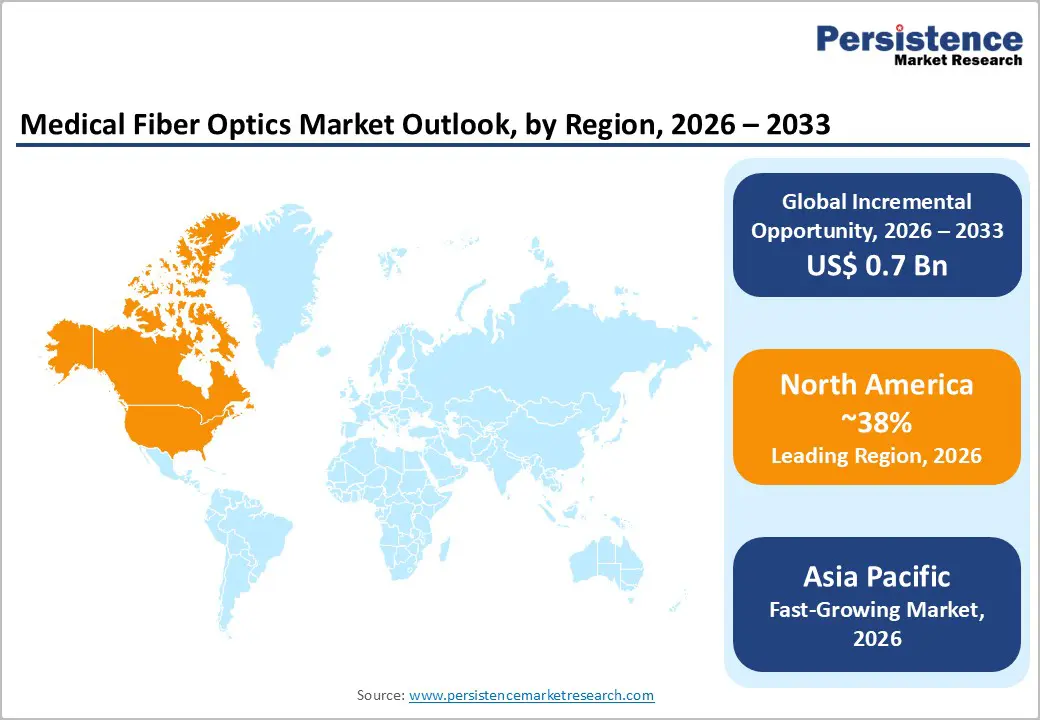
  • Dominant Region & Fastest-growing Regional Market: North America is slated to maintain regional leadership with 41.0% of the market share in 2025, whereas Asia Pacific emerges as the fastest-growing regional market at 7.4% CAGR through 2032.
  • Leading & Fastest-growing Fiber Type: Multimode optical fibers are likely to hold the leading share at 55.0% in 2025, while single-mode fibers are the fastest-growing with a 7.2% CAGR through 2032.
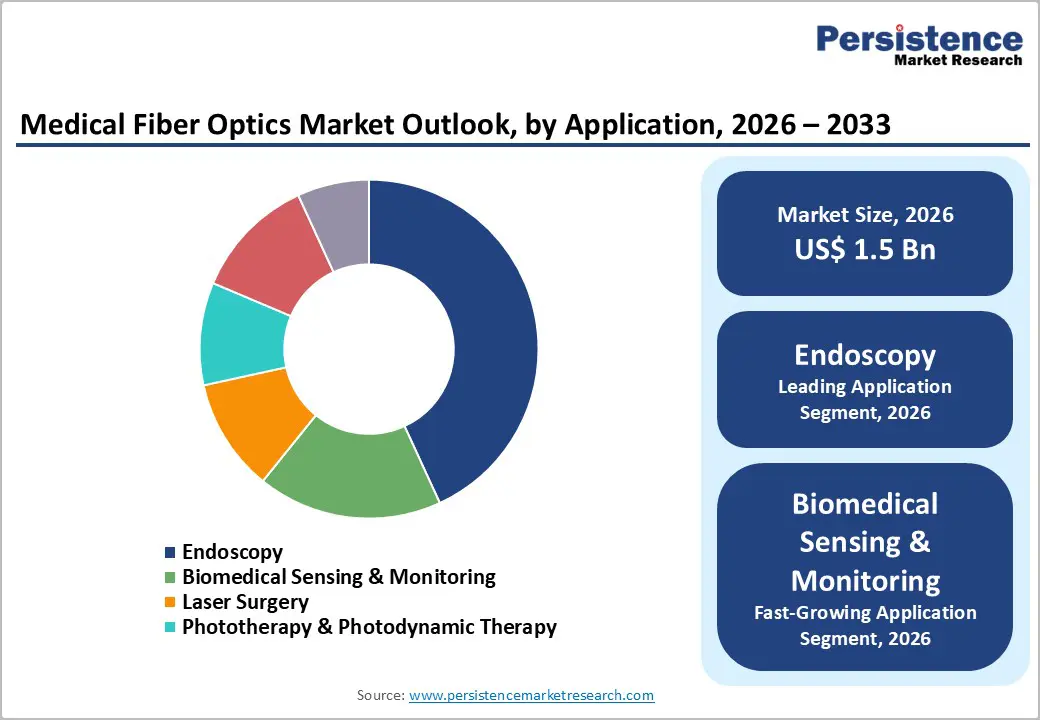
  • Leading & Fastest-growing Applications: Illumination is expected to command a dominant 32.0% market share in 2025, and endoscopic imaging is forecasted to expand at the highest rate of 7.0% CAGR over the 2025 - 2032 period.
  • Leading & Fastest-growing End-users: Hospitals are anticipated to hold around 59.0% share in 2025, with specialty clinics growing fastest at 7.3% CAGR from 2025 to 2032.
  • July 2025: In a study funded by the French National Research Agency, researchers developed a pocket-sized, noninvasive scanner that combines line-field confocal optical coherence tomography (LC-OCT) with confocal Raman microspectroscopy and AI algorithms to detect nonmelanoma skin cancers with over 90% accuracy.
Key Insights Details
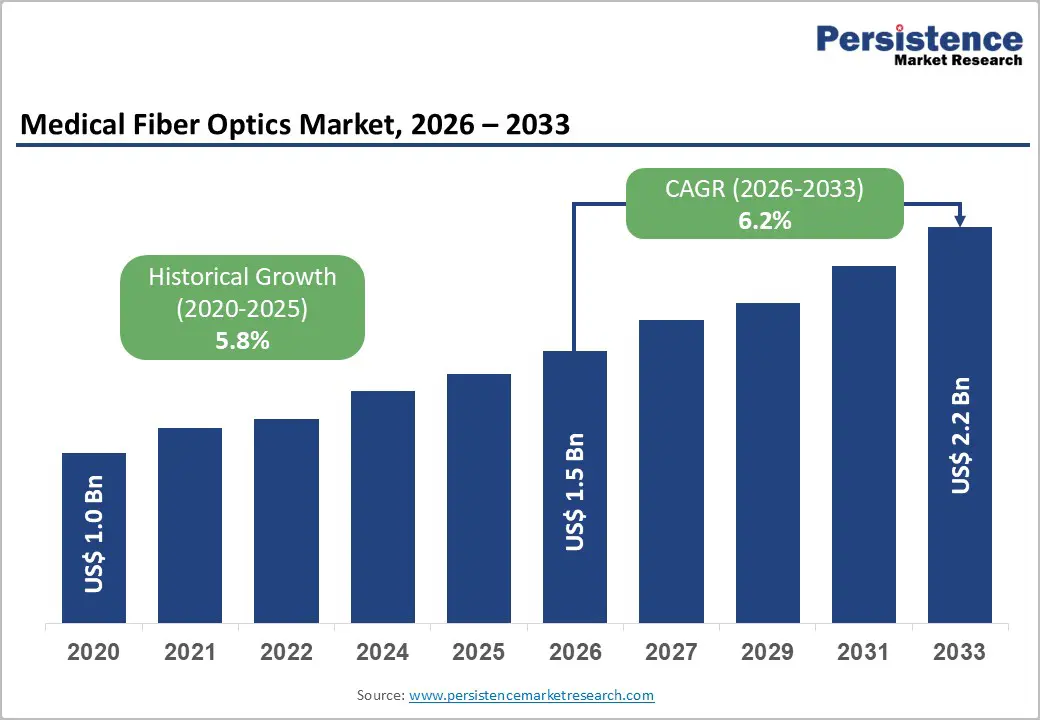
Medical Fiber Optics Market Size (2025E) US$1.5 Bn
Market Value Forecast (2032F) US$2.3 Bn
Projected Growth (CAGR 2025 to 2032) 6.4%
Historical Market Growth (CAGR 2019 to 2024) 2.8%

global-medical-fiber-optics-market-size-2025-2032

Market Factors - Growth, Barriers, and Opportunity Analysis

Advancements in Minimally Invasive Surgical Technologies

The medical fiber optics market is experiencing robust growth driven by advancements in minimally invasive surgical technologies. Fiber optics enables precise light transmission and high-resolution imaging in procedures such as endoscopy and laparoscopy, reducing recovery times and hospital stays.

Regulatory support is also accelerating innovation, with the FDA approving over 150 fiber-optic-integrated devices in 2024 alone. These advancements are fostering growth in photodynamic therapy, where targeted laser delivery minimizes damage to healthy tissue.

Emerging economies, projected by the IMF to see 5.8% annual healthcare spending growth through 2030, are increasingly investing in fiber-based tools integrated with robotic systems to boost efficiency and reduce costs. Additionally, the rising global burden of chronic diseases, expected to affect over 60% of the population by 2030 according to the CDC, is intensifying demand for advanced diagnostics.

Fiber optics offers real-time, high-fidelity imaging far superior to traditional methods. Demographic shifts are further fueling the adoption of fiber-optic sensors in biomedical applications, with SPIE reporting over 95% accuracy in monitoring vital signs, enhancing patient care and outcomes.

High Capital Requirements and Maintenance Challenges

Manufacturers and healthcare providers face significant barriers to adopting medical fiber optics due to high initial costs, often exceeding US$1,500 per unit, according to the U.S. Department of Health and Human Services (HHS).

Regulatory hurdles, such as extended validation processes by the European Medicines Agency (EMA), can delay market entry by 6-12 months, increasing development costs. Supply chain challenges, including shortages of specialty glass preforms reported by the International Trade Centre (ITC), have led to production losses of up to 15% during global disruptions such as the COVID-19 pandemic.

Regulatory delays also persist, with FDA review times for Class II fiber-optic devices averaging 18 months. Furthermore, the International Labour Organization (ILO) highlights a 20% shortage of skilled endoscopic technologists in developing regions, contributing to the underutilization of advanced fiber systems. To address these issues, companies are encouraged to diversify suppliers and invest in workforce training, especially for high-volume segments, including disposable endoscopes, to ensure long-term viability.

Unmet Biosensing Needs in Burgeoning Markets

Emerging economies, particularly in Asia Pacific, are creating significant opportunities for medical fiber optics as governments increase healthcare infrastructure spending by billions annually. These investments are accelerating the adoption of fiber-based biosensors for real-time monitoring of chronic conditions, with notable accuracy gains.

Integration with AI and support from WHO-backed digital health initiatives are propelling the biosensing sub-market, projected to reach US$500 Million by 2032. Investors can capitalize on this growth by forming partnerships with local manufacturers to develop customized single-use fibers. This strategy could capture up to 25% of the US$300 Million gastrointestinal market, where early detection remains a critical unmet clinical need.

Category-wise Analysis

Fiber Type Insights

Multimode optical fibers are expected to retain their lead in the market, holding around 55.0% of the share in 2025. Their dominance is driven by high light-carrying capacity, ideal for high-intensity applications such as endoscopy and surgical illumination, especially as 4K imaging systems become standard.

Multimode fibers offer cost-effective short-distance transmission, making them suitable for budget-conscious hospitals while ensuring consistent performance in procedures requiring broad light distribution. Additionally, their ease of manufacturing and alignment reduces installation costs by up to 20.0% in surgical environments.

Meanwhile, single-mode optical fibers are the fastest-growing segment, projected to expand at a CAGR of 7.2% from 2025 to 2032. Known for their precision in long-distance transmission and low attenuation, they are transforming laser signal delivery in minimally invasive therapies. Growth is supported by FDA approvals for advanced cancer treatments and innovations in doping materials that improve signal integrity by 25.0%.

Single-mode fibers are gaining traction in niche areas like ophthalmic diagnostics, reducing procedural errors and advancing personalized medicine, especially in aging populations. Their integration with advanced sensors is also meeting unmet needs in biomedical monitoring, enhancing market potential in wearable medical devices.

Application Insights

Illumination applications are projected to lead the medical fiber optics market in 2025, accounting for approximately 32.0% of total revenue. Fiber optics plays a vital role in delivering consistent, high-brightness light for surgical and diagnostic procedures, enhancing visibility and reducing operative time-particularly in complex fields like neurosurgery.

This dominance is supported by integration with LED and laser systems, offering energy-efficient, low-heat solutions aligned with WHO sustainability targets. The segment is further expanding due to growing adoption in phototherapy and light-based dermatological treatments, where fiber optics ensures uniform light distribution. Investments in reusable fiber bundles are rising as healthcare providers seek cost-effective solutions for high-frequency procedures.

Endoscopic imaging is emerging as the fastest-growing segment, forecasted to grow at a CAGR of 7.0% between 2025 and 2032. Increasing demand for high-resolution gastrointestinal diagnostics is fueling growth, with fiber optics enabling real-time 3D visualization and driving down diagnostic costs through reusable designs.

Innovations in flexible endoscopes tailored to telemedicine are creating new business opportunities. Additionally, advances in confocal scanning technology are significantly improving image clarity during minimally invasive procedures, enhancing early disease detection. Integrated AI analytics are further optimizing workflow efficiency in ambulatory care, positioning endoscopic imaging as a key frontier in the evolution of precision diagnostics.

End-user Insights

Hospitals are anticipated to retain their market dominance, set to capture about 59.0% of the market share in 2025, as these facilities commonly leverage optic technologies for a wide array of inpatient procedures that require robust, scalable systems to handle high patient volumes and integrate with electronic health records for seamless data flow.

This segment's strength lies in its ability to adopt comprehensive fiber solutions that enhance operational efficiency amid increasing regulatory pressures for quality care. In addition, hospitals are benefiting from bulk procurement strategies that lower per-unit costs, facilitating the deployment of advanced illumination and sensing technologies in critical care units, which supports better resource allocation and patient throughput in large-scale facilities.

Specialty clinics are advancing as the fastest-growing end-user segment at a CAGR of 7.3% from 2025 to 2032, fueled by specialized applications in outpatient settings such as dermatology and ophthalmology, where portable fiber devices are addressing unmet needs for quick, accurate diagnostics and enabling cost reductions through targeted investments in ambulatory care models.

The growth is also supported by the trend toward decentralized healthcare, where specialty clinics are adopting disposable fibers to minimize infection risks, offering businesses opportunities to develop customized solutions that improve procedural speed by a sizeable margin and attract partnerships with insurance providers focused on value-based reimbursement structures.

global-medical-fiber-optics-market-outlook-by-application-2025-2032

Regional Insights

North America Medical Fiber Optics Market Trends

North America is expected to secure a leading market share of approximately 41.0% in 2025, benefiting from the robust U.S. market for cutting-edge medical technologies. Primary growth drivers include technological advancements in laser therapies, supported by FDA initiatives that have approved over 200 fiber-integrated devices since 2024, and demographic shifts toward an aging population projected by the U.S. Census Bureau to rise 20.0% by 2030, amplifying the demand for diagnostic imaging.

The regulatory environment, characterized by stringent yet innovation-friendly frameworks from HHS, is facilitating faster market entry while balancing safety, with competitive landscape features consolidated by major players such as Coherent Inc. through R&D investments exceeding US$500 Million annually.

Investment trends are leaning toward venture capital in biosensing startups, with opportunities in expanding telemedicine networks that could yield 18.0% ROI in underserved rural areas, advising businesses to prioritize FDA-compliant partnerships for sustained dominance.

Additionally, Canada's contributions through healthcare digitization efforts are enhancing regional synergies, where cross-border collaborations are reducing supply chain dependencies and fostering innovation in high-precision fibers for oncology applications.

Europe Medical Fiber Optics Market Trends

Europe is anticipated to achieve a 28.0% market share in 2025 at a CAGR of 6.8% through 2032, powered by a strong demand for advanced healthcare solutions across Germany and the U.K., where a rise in endoscopic volumes driven by NHS efficiencies is predicted.

Key drivers encompass regulatory harmonization under the EMA, which is streamlining approvals and reducing timelines, alongside technological convergence in France and Spain, where R&D spending from the European Commission totals EUR 300 million for photonics.

The competitive landscape remains fragmented, with players such as Schott AG leading through localized manufacturing, while investment trends favor green tech integrations, offering opportunities in policy-aligned expansions that could boost margins in oncology niches.

Firms can engage in cross-border collaborations to navigate Brexit-related trade dynamics, ensuring resilient growth. Furthermore, Eastern European countries such as Poland are emerging as cost-effective manufacturing hubs, contributing to supply chain diversification and supporting the region's push toward sustainable medical technologies.

Asia Pacific Medical Fiber Optics Market Trends

Asia Pacific is poised to be the second-largest regional market for medical fiber optics with a 31.0% share in 2025, surging at the highest CAGR of approximately 7.4% during 2025 - 2032, with China and Japan leading through healthcare exports. Manufacturing advantages in India and ASEAN, where low-cost production cuts fiber prices by 20.0%, and policy changes steered by infrastructure through the Asian Development Bank (ADB) are contributing immensely to the market growth here.

Regulatory impacts from bodies such as China's National Medical Products Administration (NMPA) are accelerating approvals, fostering a competitive environment with local innovators, while investments in 5G-enabled diagnostics present opportunities for growth in biosensing.

In addition, South Korea's focus on medical tourism and Thailand's healthcare reforms are amplifying demand for affordable fiber solutions, enabling market entrants to capture share through localized R&D centers that address region-specific needs such as portable diagnostics for rural populations.

global-medical-fiber-optics-market-outlook-by-region-2025-2032

Competitive Landscape

The global medical fiber optics market is moderately consolidated, with the top five players-led by Coherent Inc., Schott AG, and Leoni, holding about 45% market share. An HHI of ~1,200 reflects this structure, where large firms leverage economies of scale in fiber drawing and coating.

Key players differentiate through vertical integration, such as securing silica supply chains to lower costs and compete in emerging markets. Strategic acquisitions of mid-tier specialists are enhancing product portfolios, particularly in biosensing and laser delivery systems. These tactics strengthen competitive positioning and broaden market reach in high-value and specialized medical applications.

Key Industry Developments

  • In October 2025, Nortech Systems Inc. achieved ≤0.35dB insertion loss using US Conec’s MT Elite ferrules, boosting performance in medical imaging and mission-critical applications. This advancement supports faster data speeds and greater reliability. With investments in training and integrated manufacturing, Nortech positions itself as a key provider of next-gen high-performance fiber optic solutions.
  • In August 2025, PAVmed Inc. signed a non-binding letter of intent to license an advanced endoscopic imaging technology from Duke University. The multi-modality probe, combining a/LCI and OCT, enables real-time detection and immediate treatment of esophageal precancerous conditions in a single procedure. This innovation could improve outcomes and efficiency over traditional biopsies, aiming to address key gaps in esophageal cancer prevention.
  • In July 2025, Coherent Corporation launched the ACE-FL photodiode, a high-speed component optimized for ultra-fast data communication and sensing. Offering enhanced sensitivity and bandwidth, it enables faster transmission and precise detection in demanding environments. This launch strengthens Coherent’s position in high-performance optical and photonic markets, supporting advanced infrastructure and industrial applications.

Companies Covered in Medical Fiber Optics Market

  • Coherent Inc.
  • Schott AG
  • Leoni A
  • Integra LifeSciences Corporation
  • Molex Incorporated
  • Fiberoptics Technology Incorporated
  • Timbercon Inc.
  • Gulf Fiberoptics
  • Newport Corporation
  • AFL
  • Boston Scientific Corporation
  • Carl Zeiss Meditec AG
  • Biolitec AG
  • Trumpf GmbH + Co. KG
  • Leica Microsystems GmbH
Frequently Asked Questions

The medical fiber optics market is projected to reach US$1.5 Billion in 2025.

Rising chronic disease prevalence worldwide and ongoing advancements in minimally invasive surgical technologies, where fiber optics are enabling precise light transmission and high-resolution imaging in procedures such as endoscopy and laparoscopy, are driving the market.

The medical fiber optics market is poised to witness a CAGR of 6.4% from 2025 to 2032.

Higher budgetary allocations to modern healthcare technologies in developing economies and the integration of fiber-based biosensors with artificial intelligence platforms are key market opportunities.

Coherent Inc., Schott AG, and Leoni AG are some of the key players in the medical fiber optics market.

Medical Fiber Optics Market Report Scope
Report Attribute Details
Historical Data/Actuals 2019 - 2024
Forecast Period 2025 - 2032
Market Analysis Value: US$ Bn
Geographical Coverage
  • North America
  • Europe
  • East Asia
  • South Asia & Oceania
  • Latin America
  • Middle East & Africa
Segmental Coverage
  • Fiber Type
  • End-user
  • Application
Competitive Analysis
  • Coherent Inc.
  • Schott AG
  • Leoni A
  • Integra LifeSciences Corporation
  • Molex Incorporated
  • Fiberoptics Technology Incorporated
  • Timbercon Inc.
  • Gulf Fiberoptics
  • Newport Corporation
  • AFL
  • Boston Scientific Corporation
  • Carl Zeiss Meditec AG
  • Biolitec AG
  • Trumpf GmbH + Co. KG
  • Leica Microsystems GmbH
Report Highlights
  • Market Forecast and Trends
  • Competitive Intelligence and Share Analysis
  • Growth Factors and Challenges
  • Strategic Growth Initiatives
  • Pricing Analysis
  • Future Opportunities and Revenue Pockets
  • Market Analysis Tools
Market Segmentation

By Fiber Type

  • Pure Silica Fiber
  • Polycrystalline Fiber
  • Polymer Optical Fiber
  • Single-Mode Optical Fiber
  • Multimode Optical Fiber
  • Thulium Doped Fiber Lasers (TDFLs)
  • Others

By End-user

  • Hospitals
  • Ambulatory Surgical Centers (ASCs)
  • Specialty Clinics
  • Contract Research Organizations (CROs)
  • Diagnostic Laboratories
  • Others

By Application

  • Image Transmission
  • Laser Signal Delivery
  • Illumination
  • Fiber Optic Confocal Scanning
  • Endoscopic Imaging
  • Biomedical Sensing
  • Others

By Region

  • North America
  • Europe
  • East Asia
  • South Asia & Oceania
  • Latin America
  • Middle East & Africa

Related Reports

  1. Executive Summary
    1. Global Medical Fiber Optics Market Snapshot, 2025 and 2032
    2. Market Opportunity Assessment, 2025 - 2032, US$ Bn
    3. Key Market Trends
    4. Future Market Projections
    5. Premium Market Insights
    6. Industry Developments and Key Market Events
    7. PMR Analysis and Recommendations
  2. Market Overview
    1. Market Scope and Definition
    2. Market Dynamics
      1. Drivers
      2. Restraints
      3. Opportunity
      4. Key Trends
    3. Macro-economic Factors
      1. Global Sectoral Outlook
      2. Global GDP Growth Outlook
    4. COVID-19 Impact Analysis
    5. Forecast Factors - Relevance and Impact
  3. Value Added Insights
    1. Tool Adoption Analysis
    2. Regulatory Landscape
    3. Value Chain Analysis
    4. PESTLE Analysis
    5. Porter’s Five Force Analysis
  4. Price Analysis, 2024A
    1. Key Highlights
    2. Key Factors Impacting Deployment Costs
    3. Pricing Analysis, By Application
  5. Global Medical Fiber Optics Market Outlook
    1. Key Highlights
      1. Market Volume (Units) Projections
      2. Market Size (US$ Bn) and Y-o-Y Growth
      3. Absolute $ Opportunity
    2. Market Size (US$ Bn) and Volume (Units) Analysis and Forecast
      1. Historical Market Size (US$ Bn) Analysis, 2019-2024
      2. Current Market Size (US$ Bn) Analysis and Forecast, 2025 - 2032
    3. Global Medical Fiber Optics Market Outlook: Fiber Type
      1. Introduction / Key Findings
      2. Historical Market Size (US$ Bn) and Volume (Units) Analysis, By Fiber Type, 2019 - 2024
      3. Current Market Size (US$ Bn) and Volume (Units) Analysis and Forecast, By Fiber Type, 2025 - 2032
        1. Pure Silica Fiber
        2. Polycrystalline Fiber
        3. Polymer Optical Fiber
        4. Single-Mode Optical Fiber
        5. Multimode Optical Fiber
        6. Thulium Doped Fiber Lasers (TDFLs)
        7. Others
      4. Market Attractiveness Analysis: Fiber Type
    4. Global Medical Fiber Optics Market Outlook: End-user
      1. Introduction / Key Findings
      2. Historical Market Size (US$ Bn) Analysis, By End-user, 2019 - 2024
      3. Current Market Size (US$ Bn) Analysis and Forecast, By End-user, 2025 - 2032
        1. Hospitals
        2. Ambulatory Surgical Centers (ASCs)
        3. Specialty Clinics
        4. Contract Research Organizations (CROs)
        5. Diagnostic Laboratories
        6. Others
      4. Market Attractiveness Analysis: End-user
    5. Global Medical Fiber Optics Market Outlook: Application
      1. Introduction / Key Findings
      2. Historical Market Size (US$ Bn) Analysis, By Application, 2019 - 2024
      3. Current Market Size (US$ Bn) Analysis and Forecast, By Application, 2025 - 2032
        1. Image Transmission
        2. Laser Signal Delivery
        3. Illumination
        4. Fiber Optic Confocal Scanning
        5. Endoscopic Imaging
        6. Biomedical Sensing
        7. Others
      4. Market Attractiveness Analysis: Application
  6. Global Medical Fiber Optics Market Outlook: Region
    1. Key Highlights
    2. Historical Market Size (US$ Bn) and Volume (Units) Analysis, By Region, 2019 - 2024
    3. Current Market Size (US$ Bn) and Volume (Units) Analysis and Forecast, By Region, 2025 - 2032
      1. North America
      2. Europe
      3. East Asia
      4. South Asia and Oceania
      5. Latin America
      6. Middle East & Africa
    4. Market Attractiveness Analysis: Region
  7. North America Medical Fiber Optics Market Outlook
    1. Key Highlights
    2. Historical Market Size (US$ Bn) Analysis, By Market, 2019 - 2024
      1. By Country
      2. By Fiber Type
      3. By End-user
      4. By Application
    3. Current Market Size (US$ Bn) Analysis and Forecast, By Country, 2025 - 2032
      1. U.S.
      2. Canada
    4. Current Market Size (US$ Bn) and Volume (Units) Analysis and Forecast, By Fiber Type, 2025 - 2032
      1. Pure Silica Fiber
      2. Polycrystalline Fiber
      3. Polymer Optical Fiber
      4. Single-Mode Optical Fiber
      5. Multimode Optical Fiber
      6. Thulium Doped Fiber Lasers (TDFLs)
      7. Others
    5. Current Market Size (US$ Bn) Analysis and Forecast, By End-user, 2025 - 2032
      1. Hospitals
      2. Ambulatory Surgical Centers (ASCs)
      3. Specialty Clinics
      4. Contract Research Organizations (CROs)
      5. Diagnostic Laboratories
      6. Others
    6. Current Market Size (US$ Bn) Analysis and Forecast, By Application, 2025-2032
      1. Image Transmission
      2. Laser Signal Delivery
      3. Illumination
      4. Fiber Optic Confocal Scanning
      5. Endoscopic Imaging
      6. Biomedical Sensing
      7. Others
    7. Market Attractiveness Analysis
  8. Europe Medical Fiber Optics Market Outlook
    1. Key Highlights
    2. Historical Market Size (US$ Bn) Analysis, By Market, 2019 - 2024
      1. By Country
      2. By Fiber Type
      3. By End-user
      4. Application
    3. Current Market Size (US$ Bn) Analysis and Forecast, By Country, 2025 - 2032
      1. Germany
      2. France
      3. U.K.
      4. Italy
      5. Spain
      6. Russia
      7. Türkiye
      8. Rest of Europe
    4. Current Market Size (US$ Bn) and Volume (Units) Analysis and Forecast, By Fiber Type, 2025 - 2032
      1. Pure Silica Fiber
      2. Polycrystalline Fiber
      3. Polymer Optical Fiber
      4. Single-Mode Optical Fiber
      5. Multimode Optical Fiber
      6. Thulium Doped Fiber Lasers (TDFLs)
      7. Others
    5. Current Market Size (US$ Bn) Analysis and Forecast, By End-user, 2025 - 2032
      1. Hospitals
      2. Ambulatory Surgical Centers (ASCs)
      3. Specialty Clinics
      4. Contract Research Organizations (CROs)
      5. Diagnostic Laboratories
      6. Others
    6. Current Market Size (US$ Bn) Analysis and Forecast, By Application, 2025-2032
      1. Image Transmission
      2. Laser Signal Delivery
      3. Illumination
      4. Fiber Optic Confocal Scanning
      5. Endoscopic Imaging
      6. Biomedical Sensing
      7. Others
    7. Market Attractiveness Analysis
  9. East Asia Medical Fiber Optics Market Outlook
    1. Key Highlights
    2. Historical Market Size (US$ Bn) Analysis, By Market, 2019 - 2024
      1. By Country
      2. By Fiber Type
      3. By End-user
      4. By Application
    3. Current Market Size (US$ Bn) Analysis and Forecast, By Country, 2025 - 2032
      1. China
      2. Japan
      3. South Korea
    4. Current Market Size (US$ Bn) and Volume (Units) Analysis and Forecast, By Fiber Type, 2025 - 2032
      1. Pure Silica Fiber
      2. Polycrystalline Fiber
      3. Polymer Optical Fiber
      4. Single-Mode Optical Fiber
      5. Multimode Optical Fiber
      6. Thulium Doped Fiber Lasers (TDFLs)
      7. Others
    5. Current Market Size (US$ Bn) Analysis and Forecast, By End-user, 2025 - 2032
      1. Hospitals
      2. Ambulatory Surgical Centers (ASCs)
      3. Specialty Clinics
      4. Contract Research Organizations (CROs)
      5. Diagnostic Laboratories
      6. Others
    6. Current Market Size (US$ Bn) Analysis and Forecast, By Application, 2025-2032
      1. Image Transmission
      2. Laser Signal Delivery
      3. Illumination
      4. Fiber Optic Confocal Scanning
      5. Endoscopic Imaging
      6. Biomedical Sensing
      7. Others
    7. Market Attractiveness Analysis
  10. South Asia & Oceania Medical Fiber Optics Market Outlook
    1. Key Highlights
    2. Historical Market Size (US$ Bn) Analysis, By Market, 2019 - 2024
      1. By Country
      2. By Fiber Type
      3. By End-user
      4. By Application
    3. Current Market Size (US$ Bn) Analysis and Forecast, By Country, 2025 - 2032
      1. India
      2. Southeast Asia
      3. ANZ
      4. Rest of South Asia & Oceania
    4. Current Market Size (US$ Bn) and Volume (Units) Analysis and Forecast, By Fiber Type, 2025 - 2032
      1. Pure Silica Fiber
      2. Polycrystalline Fiber
      3. Polymer Optical Fiber
      4. Single-Mode Optical Fiber
      5. Multimode Optical Fiber
      6. Thulium Doped Fiber Lasers (TDFLs)
      7. Others
    5. Current Market Size (US$ Bn) Analysis and Forecast, By End-user, 2025 - 2032
      1. Hospitals
      2. Ambulatory Surgical Centers (ASCs)
      3. Specialty Clinics
      4. Contract Research Organizations (CROs)
      5. Diagnostic Laboratories
      6. Others
    6. Current Market Size (US$ Bn) Analysis and Forecast, By Application, 2025-2032
      1. Image Transmission
      2. Laser Signal Delivery
      3. Illumination
      4. Fiber Optic Confocal Scanning
      5. Endoscopic Imaging
      6. Biomedical Sensing
      7. Others
    7. Market Attractiveness Analysis
  11. Latin America Medical Fiber Optics Market Outlook
    1. Key Highlights
    2. Historical Market Size (US$ Bn) Analysis, By Market, 2019 - 2024
      1. By Country
      2. By Fiber Type
      3. By End-user
      4. By Application
    3. Current Market Size (US$ Bn) Analysis and Forecast, By Country, 2025 - 2032
      1. Brazil
      2. Mexico
      3. Rest of Latin America
    4. Current Market Size (US$ Bn) and Volume (Units) Analysis and Forecast, By Fiber Type, 2025 - 2032
      1. Pure Silica Fiber
      2. Polycrystalline Fiber
      3. Polymer Optical Fiber
      4. Single-Mode Optical Fiber
      5. Multimode Optical Fiber
      6. Thulium Doped Fiber Lasers (TDFLs)
      7. Others
    5. Current Market Size (US$ Bn) Analysis and Forecast, By End-user, 2025 - 2032
      1. Hospitals
      2. Ambulatory Surgical Centers (ASCs)
      3. Specialty Clinics
      4. Contract Research Organizations (CROs)
      5. Diagnostic Laboratories
      6. Others
    6. Current Market Size (US$ Bn) Analysis and Forecast, By Application, 2025-2032
      1. Image Transmission
      2. Laser Signal Delivery
      3. Illumination
      4. Fiber Optic Confocal Scanning
      5. Endoscopic Imaging
      6. Biomedical Sensing
      7. Others
    7. Market Attractiveness Analysis
  12. Middle East & Africa Medical Fiber Optics Market Outlook
    1. Key Highlights
    2. Historical Market Size (US$ Bn) Analysis, By Market, 2019 - 2024
      1. By Country
      2. By Fiber Type
      3. By End-user
      4. By Application
    3. Current Market Size (US$ Bn) Analysis and Forecast, By Country, 2025 - 2032
      1. GCC Countries
      2. Egypt
      3. South Africa
      4. Northern Africa
      5. Rest of Middle East & Africa
    4. Current Market Size (US$ Bn) and Volume (Units) Analysis and Forecast, By Fiber Type, 2025 - 2032
      1. Pure Silica Fiber
      2. Polycrystalline Fiber
      3. Polymer Optical Fiber
      4. Single-Mode Optical Fiber
      5. Multimode Optical Fiber
      6. Thulium Doped Fiber Lasers (TDFLs)
      7. Others
    5. Current Market Size (US$ Bn) Analysis and Forecast, By End-user, 2025 - 2032
      1. Hospitals
      2. Ambulatory Surgical Centers (ASCs)
      3. Specialty Clinics
      4. Contract Research Organizations (CROs)
      5. Diagnostic Laboratories
      6. Others
    6. Current Market Size (US$ Bn) Analysis and Forecast, By Application, 2025-2032
      1. Image Transmission
      2. Laser Signal Delivery
      3. Illumination
      4. Fiber Optic Confocal Scanning
      5. Endoscopic Imaging
      6. Biomedical Sensing
      7. Others
    7. Market Attractiveness Analysis
  13. Competition Landscape
    1. Market Share Analysis, 2024
    2. Market Structure
      1. Competition Intensity Mapping By Market
      2. Competition Dashboard
    3. Company Profiles (Details - Overview, Financials, Strategy, Recent Developments)
      1. Coherent Inc.
        1. Overview
        2. Segments and Deployments
        3. Key Financials
        4. Market Developments
        5. Market Strategy
      2. Schott AG
      3. Leoni AG
      4. Integra LifeSciences Corporation
      5. Molex Incorporated
      6. Fiberoptics Technology Incorporated
      7. Timbercon Inc.
      8. Gulf Fiberoptics
      9. Newport Corporation
      10. AFL
      11. Boston Scientific Corporation
      12. Carl Zeiss Meditec AG
      13. Biolitec AG
      14. Trumpf GmbH + Co. KG
      15. Leica Microsystems GmbH
  14. Appendix
    1. Research Methodology
    2. Research Assumptions
    3. Acronyms and Abbreviations

Research Methodology Framework for Market Research Excellence

At Persistence Market Research, we implement a comprehensive, validated, and multi-dimensional approachto market analysis that delivers actionable insights across complex market landscapes. Our methodology combines the analytical rigor of leading consulting firms with innovative research techniques, ensuring robust market assessments that guide strategic decision-making with confidence.

Core Research Philosophy

Our methodology is built on four foundational pillars:

Research Philosophy Image

At Persistence Market Research, our methodology is designed to transcend conventional market studies by combining analytical rigor, multi-source validation, and future-focused insights.

We integrate advanced research frameworks, robust data collection strategies, cutting-edge analytics, and innovative technologies to deliver a 360-degree view of complex markets.

We integrate advanced research frameworks, robust data collection strategies, cutting-edge analytics, and innovative technologies to deliver a 360-degree view of complex markets.

Each stage spanning from strategic scoping and hypothesis-building to competitive intelligence, quality validation, and actionable recommendations is engineered to provide clients with unmatched clarity, precision, and confidence in decision-making.

By embedding innovation and technology at the core, our approach ensures that insights are not only comprehensive but also predictive, empowering businesses to seize opportunities, mitigate risks, and achieve sustainable growth

Research Philosophy Image

Capturing Key Information and Events

During this phase, key research objectives focus on essential information and data points for assessing the market, including:

Research Philosophy Image

TAM-SAM-SOM Framework Implementation

We employ both top-down and bottom-up approaches to ensure accurate market sizing.

Top-Down Market SizingBottom-Up Market Sizing
Universe Definition: Total global/regional market identificationUnit Economics: Average transaction values, purchase frequencies, customer lifecycle
Segmentation Filters: Geographic, demographic, and behavioral constraintsCustomer Segmentation: Detailed buyer persona development and sizing
Market Share Analysis: Competitive landscape assessment and share allocationPenetration Analysis: Market penetration rates by segment and geography
Growth Rate Application: Historical trends and forward-looking growth assumptionsScaling Methodology: Extrapolation techniques with confidence intervals

Validation & Cross-Verification

  • Triangulation: Comparing top-down and bottom-up results for consistency
  • Sensitivity Analysis: Testing key assumptions and parameter variations
  • Peer Benchmarking: Comparison with analogous markets and industry benchmarks
  • Expert Review: External validation through industry specialist consultation

Research Philosophy Image

Forecasting & Projection Modeling

Our proprietary forecasting models incorporate multiple variables and scenarios.

Forecasting Components

  • Historical Trend Analysis: 10-year historical growth patterns and cyclical variations
  • Driver-Based Modeling: Economic indicators, demographic shifts, technology adoption
  • Scenario Planning: Base case, optimistic, and conservative projections
  • Monte Carlo Simulations: Probability-weighted outcomes and risk assessments

Model Validation

  • Back-Testing: Historical accuracy assessment over 3–5-year periods
  • Cross-Validation: Multiple modeling approaches for result comparison
  • External Benchmarking: Comparison with established market forecasts
  • Continuous Calibration: Quarterly model updates based on new data

Comprehensive Data Collection Strategy

Our secondary research phase establishes a robust knowledge base utilizing diverse, credible sources.

Secondary Data Sourcess

  • Industry Publications & Reports
  • Government & Regulatory Data
  • Financial Intelligence (filings & reports)
  • Academic Research & Digital Intelligence

Quality Assurance Protocol

  • Source credibility assessment and publication date validation
  • Data consistency checks across multiple sources
  • Bias identification and neutralization techniques
  • Information gap tracking for primary research prioritization

Research Philosophy Image

Primary Research Excellence

Our primary research methodology employs best-in-class techniques to capture unique market insights.

Quantitative Research Methods

  • Large-Scale Surveys: Statistically representative samples with 95% confidence intervals
  • Survey Methodology: Multi-channel deployment (online, telephone, in-person)
  • Question Architecture and Response Optimization

Qualitative Research Methods

  • Executive Interviews
  • Focus Groups
  • Expert Consultations

Quality Assurance & Validation Framework

Multi-Stage Validation Process

  • Source Verification and Consistency Testing
  • Outlier Detection and Bias Assessment
  • Peer Review Process and External Validation
  • Sensitivity Analysis and Confidence Intervals

Research Philosophy Image

Methodology Validation & Credibility

Our research methodology has been extensively validated through:

  • Academic Partnerships: Collaborations with top-tier business schools and research institutions
  • Client Success Stories: Documented case studies demonstrating research impact and ROI
  • Continuous Benchmarking: Performance comparison with leading global research firms

This comprehensive methodology framework positions Persistence Market Research at the forefront of market intelligence, combining the analytical sophistication of top-tier consulting firms with innovative research techniques. Our approach ensures that every market assessment delivers precise, actionable, and strategically valuable insights that drive business success in competitive market environments.

Ready to unlock your market potential? Contact our research experts to discuss how our validated methodology can transform your strategic decision-making with data-driven market intelligence.

Copyright © 2026 Persistence Market Research. All Rights Reserved

Connect With Us -
Medical Fiber Optics Market Size & Growth Trends, 2032