Industrial Dispenser Market Size, Share, and Growth Forecast for 2025 - 2032

Industrial Dispenser Market By Operation (Manual Dispenser, Semi-Automatic Dispenser, Automatic Dispenser), Product Type (Liquid Dispenser, Solid Dispenser, Others), End-user (Chemicals, Pharmaceuticals, Others), during the forecast period from 2025 - 2032

ID: PMRREP29140
Calendar

November 2025

196 Pages

Author : Jitendra Deviputra

Industrial Dispenser Market Size and Share Analysis

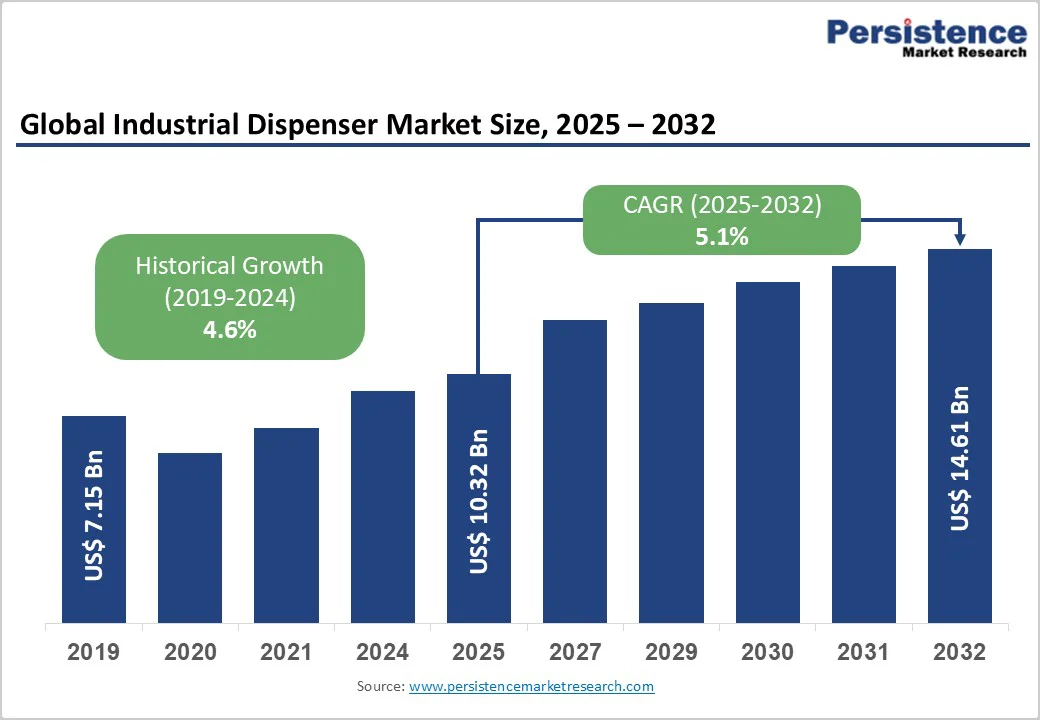
The global industrial dispenser market size was valued at US$10.32 Billion in 2025 and is projected to reach US$14.61 Billion by 2032, growing at a CAGR of 5.1% between 2025 and 2032, driven by accelerating industrial automation, rising demand for precision dispensing in pharmaceuticals and electronics, and investments in smart manufacturing infrastructure. The adoption of automatic dispensing systems, coupled with Industry 4.0 initiatives, strengthens operational efficiency and reduces material waste.

Key Industry Highlights

  • Product Segmentation Leadership: Automatic dispensers dominate the global market with an estimated 58% share, driven by their superior precision, reduced human errors, and compatibility with high-speed automated production lines.
  • Application Type Performance: Liquid dispensers hold a commanding 80% market share, propelled by their extensive uses in adhesives, coatings, lubricants, and chemical handling processes. Solid dispensers are expected to grow at the highest CAGR, supported by increasing use in pharmaceutical tablet coating, food ingredient dosing, and precision powder dispensing applications.
  • End-user Market Dynamics: The pharmaceutical sector leads with a 28.4% market share, driven by stringent quality control standards, demand for contamination-free dispensing, and the adoption of automated filling and dosing systems.
  • Regional Growth Patterns: North America leads the market with an estimated 30% share, driven by established manufacturing infrastructure, technological innovation, and early adoption of smart dispensing solutions. Asia Pacific is the fastest-growing region, fueled by rapid industrialization, growth in electronics and pharmaceutical production, and government initiatives promoting automation and smart manufacturing.
  • Strategic Market Developments: Leading companies are focusing on product innovation and strategic expansion. Notable developments include Nordson’s VersaBlue II precision dispensing system launch, Graco’s strategic acquisition expanding its industrial fluid management portfolio, and Dymax’s introduction of the RotoSpense 360, offering advanced 360-degree automated dispensing capability (2024–2025).
  • Technology Evolution: The market is evolving toward intelligent and connected dispensing systems, integrating IoT, AI, and real-time monitoring for enhanced precision and process optimization. Advancements in energy-efficient, low-waste, and modular dispensing technologies are transforming conventional systems into adaptive solutions that support Industry 4.0 manufacturing ecosystems.
Key Insights Details

Industrial Dispenser Market Size (2025E)

US$10.32 Bn

Projected Industrial Dispenser Market Value (2032F)

US$14.61 Bn

Value CAGR (2025-2032)

5.1%

Historical Market Growth Rate (CAGR 2019 to 2024)

4.6%

global-industrial-dispenser-market-size-2025-2032

Market Factors - Growth, Barriers, and Opportunity Analysis

Growth Analysis - Accelerating Industrial Automation and Industry 4.0 Adoption

Global manufacturing is transitioning to smart factories integrated with IoT, AI, and robotics, making automated dispensers essential for process control and precision. According to industry studies, approximately 72% of manufacturing facilities in North America and Europe will have adopted automation technologies by 2024, facilitating demand for fully automated dispensing systems. Industry 4.0 frameworks enable real-time monitoring, predictive maintenance, and digital twin simulations, which improve throughput and reduce downtime. Governments worldwide, including China's "Made in China 2025" initiative and Germany's Industry 4.0 strategy, provide tax incentives and funding for smart manufacturing deployment, directly boosting industrial dispenser adoption.

Rising Demand from Pharmaceutical and Healthcare Sectors

Pharmaceutical manufacturing requires accurate, sterile, and repeatable fluid dispensing for drug formulation, vaccine production, and medical device assembly. The healthcare dispensing systems market reached US$4.36 Billion in 2024, with automatic dispensers capturing a dominant market share. Regulatory agencies such as the FDA and EMA mandate precision dosing and contamination control, making advanced dispensing systems mandatory for compliance. Expansion in biosimilars, personalized medicine, and point-of-care testing further accelerates pharmaceutical dispenser demand.

Food & Beverage and Chemical Industries Expansion

Food processing and beverage manufacturing depend on automated dispensing for precise ingredient metering, packaging, and sanitation. The food & beverage sector accounts for 18-22% of global industrial dispenser installations, driven by hygiene standards and consumer demand for consistency. Chemical industries also utilize dispensers for the accurate handling of corrosive, viscous, and hazardous materials. Dispensing technologies reduce waste, ensure operator safety, and maintain quality compliance, translating to sustained market growth in these critical end-use segments.

Barrier Analysis - High Initial Investment and Operational Costs

Advanced automatic dispensing systems, particularly those integrated with IoT and robotics, require substantial capital investment. Small and medium-sized enterprises (SMEs) face financial barriers, with systems costing between US$50,000 and US$500,000 depending on complexity. Maintenance and skilled labor requirements further elevate the total cost of ownership, slowing adoption in price-sensitive emerging markets and restricting penetration in industries with tight margins.

Technical Complexity and Integration Challenges

Integrating dispensing systems into legacy production lines poses technical and operational challenges. Retrofitting existing equipment requires specialized expertise, downtime for installation, and compatibility testing. Additionally, varying viscosities, abrasive materials (such as thermal interface materials), and multi-component formulations complicate dispenser design, increasing maintenance frequency and operational complexity.

Opportunity Analysis - Expansion in Emerging Markets and Regional Manufacturing Hubs

Asia Pacific, accounting for 36-39% of global production capacity, presents significant opportunities for dispenser manufacturers. China, India, and ASEAN economies are investing in greenfield manufacturing plants, industrial clusters, and smart city projects, which require advanced dispensing solutions. Government incentives, including China's New Infrastructure Plan and India's Production-Linked Incentive (PLI) scheme, accelerate adoption, with market projections indicating a high CAGR in the region through 2033.

Semi-Automatic Dispensers for Cost-Sensitive Applications

Semi-automatic dispensers, offering a balance between precision and affordability, represent the fastest-growing segment. These systems appeal to SMEs, contract manufacturers, and industries transitioning from manual to automated processes. Product innovation in modular, user-friendly designs expands addressable markets, particularly in construction, pulp & paper, and regional manufacturing operations.

IoT-Enabled and Smart Dispensing Systems

Integration of sensors, connectivity, and data analytics into dispensers enables predictive maintenance, real-time process optimization, and remote monitoring. Smart dispensing systems reduce unplanned downtime by 30-40% and enhance traceability for regulatory compliance. These capabilities are particularly valuable in the pharmaceutical, electronics, and automotive sectors, where quality control and operational transparency are paramount.

Category-wise Analysis

Operation Type Insights

Automatic dispensers dominate the market, holding a 58% share in 2025. Their precision, consistency, and integration capability make them indispensable in high-volume, regulated industries such as pharmaceuticals, electronics, and automotive. Automated systems reduce human error, improve production efficiency, and enable seamless integration with Industry 4.0 ecosystems.

Semi-automatic dispensers are the fastest-growing segment, driven by their cost-effectiveness and versatility. Offering operator-assisted control with programmable dispensing modes, they bridge the gap between manual and fully automatic systems. This segment serves industries requiring moderate throughput, customization flexibility, and lower capital expenditure, making it ideal for SMEs and specialized applications.

Product Type Insights

Liquid dispensers command an 80% market share, reflecting their extensive use across automotive, food & beverage, chemical, and pharmaceutical sectors. Applications include adhesive bonding, coating, lubricating, and ingredient metering. Technological advances in pump design, valve accuracy, and material compatibility sustain robust demand in this segment.

Solid dispensers, handling powders, granules, and tablets, are gaining traction in the pharmaceutical and food industries. The solid industrial dispensers market, valued at US$2.5 billion in 2025, is projected to reach US$4.2 Billion by 2033. Growth is fueled by precision dosing requirements, automated packaging lines, and quality control mandates in regulated industries.

End-use Application Insights

Pharmaceuticals represent the dominant end-user segment with a 28.4% market share in 2025. Demand is propelled by sterile manufacturing requirements, high-precision drug formulation, and biosimilar production. Automatic dispensing systems ensure contamination-free, repeatable dosing, critical for regulatory compliance and patient safety.

Food & beverage is the fastest-growing end-user segment, benefiting from rising demand for processed foods, hygiene standards, and automation in packaging. Dispensers enable precise ingredient metering, reduce waste, and ensure consistency, key factors for brand reputation and profitability. Growth accelerates as food manufacturers adopt digital traceability and IoT-based quality control.
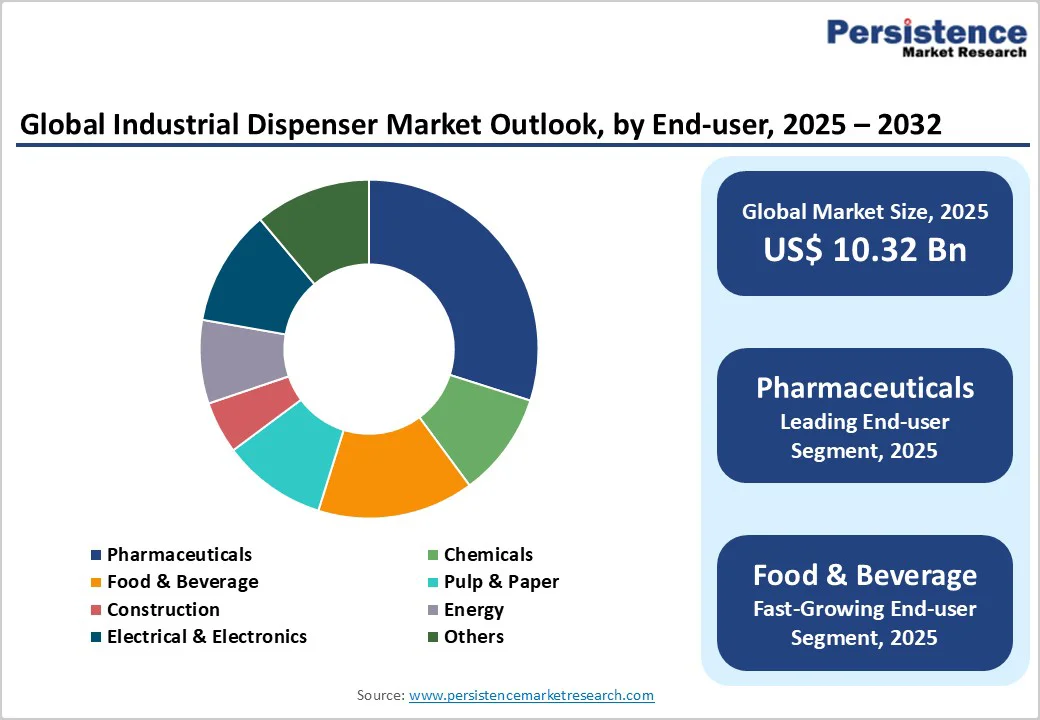
global-industrial-dispenser-market-outlook-by-end-user-2025-2032

Regional Insights

North America Industrial Dispenser Market Trends

North America holds a leading position, accounting for approximately 30% of the global market share in 2025, with the U.S. representing over 75% of regional revenue. The market benefits from advanced manufacturing infrastructure, stringent regulatory frameworks (FDA, OSHA), and the early adoption of Industry 4.0 technologies. Pharmaceutical and healthcare sectors drive demand, supported by investments in biologics, personalized medicine, and medical device manufacturing.

The presence of key market players, Nordson, Graco, Honeywell, and a strong innovation ecosystem ensures continuous product development and competitive advantage. Investments in smart factories, sustainability initiatives, and automation retrofits position North America as a mature yet growth-sustaining market.

Europe Industrial Dispenser Market Trends

Europe commands a 23-25% of the global market share, led by Germany, the U.K., France, and Spain. The region's emphasis on precision engineering, automotive manufacturing, and pharmaceutical production fuels dispenser adoption. Germany's Industry 4.0 leadership and France's pharmaceutical sector provide substantial demand, while EU-wide regulatory harmonization (REACH, CE marking) facilitates market entry and standardization.

European manufacturers prioritize sustainability, energy efficiency, and advanced sensor integration, driving innovation in smart dispensing systems. Investment in electric vehicle (EV) production and renewable energy infrastructure further expands opportunities for specialized dispensing solutions in adhesive bonding, thermal management, and battery assembly.

Asia Pacific Industrial Dispenser Market Trends

Asia Pacific is the fastest-growing region, holding 25% of global installations through 2033. China, India, Japan, and ASEAN nations lead expansion, driven by manufacturing capacity growth, government incentives, and urbanization. China's "Made in China 2025" and India's PLI schemes accelerate automation and smart manufacturing deployment.

The region benefits from cost-competitive production, expanding pharmaceutical and electronics industries, and increasing FDI in manufacturing sectors. Regional players focus on affordability and modular designs, while global leaders establish local partnerships and production facilities to capture market share. Investments in infrastructure, industrial clusters, and technology transfer programs ensure sustained growth momentum.
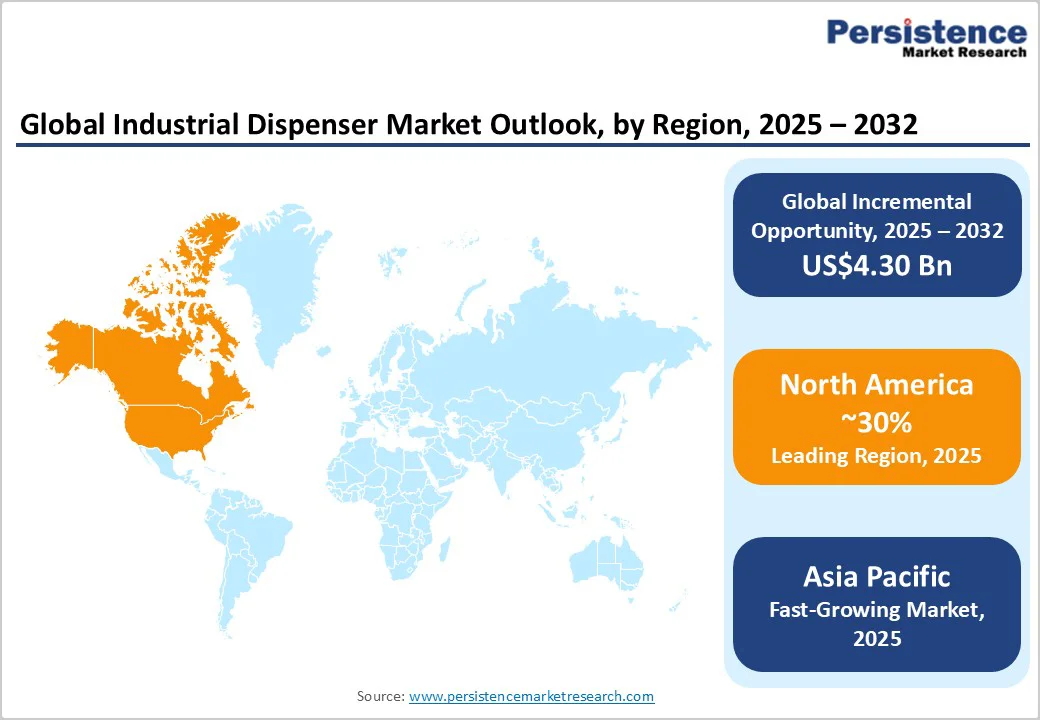
global-industrial-dispenser-market-outlook-by-region-2025-2032

Competitive Landscape

The global industrial dispenser market is fragmented in nature, with the presence of a large number of players in the unorganized space, such as regional or local players.

Manufacturers with expertise in creating custom-built dispensing systems, such as GS Manufacturing and DOPAG, have provided a few devices up to this point. These players collaborate closely with their clients to create products that are specifically designed to meet their needs. Collaborations with clients to create customized dispensing systems are anticipated to be a dominant trend in the market as dispensing system manufacturers seek to strengthen current client relationships and increase their clientele.

Key Industry Developments

  • In May 2024, Graco Inc., a major manufacturer of fluid handling equipment, launched the Pulse® Asset. An extension of Graco’s proven Pulse Pro Fluid Management system, it is the platform-based system that features programmable ID tags for tracking the machines getting files, the amount of fluid used, and who and when the dispensing occurred.
  • In September 2024, Kimberly-Clark Professional launched the WypAl® Midi-Roll, the latest surface wiping solution, while expanding its range of WypAll cleaning and wiping products. The product is specially designed to meet the requirements across all segments of industry and manufacturing.

Companies Covered in Industrial Dispenser Market

  • Nordson Corporation
  • Eisenmann intec GmbH & Co. KG
  • Henkel AG & Co KGaA
  • Atlas Copco AB
  • Graco Inc.
  • Hitachi High-Technologies Corporation
  • Delo
  • Dosiertechnik und Pneumatik AG
  • Dymax Corporation
  • Hernon Manufacturing Inc.
  • GPD Global
  • Fisnar Inc.
Frequently Asked Questions

The industrial dispenser market size is estimated to be valued at US$10.32 Billion in 2025.

The key demand driver for the industrial dispenser market is the growing adoption of automated dispensing solutions to enhance manufacturing precision, productivity, and material efficiency across various industries.

In 2025, the North America region will dominate the market with an exceeding 30% revenue share in the industrial dispenser market.

Automatic dispenser holds the highest preference, capturing beyond 58% of the market revenue share in 2025, surpassing other operation segments.

The key players in the industrial dispenser market are Nordson Corporation, Henkel AG & Co KGaA, Atlas Copco AB, and Graco Inc.
Industrial Dispenser Market Report Scope
Report Attribute Details

Historical Data/Actuals

2019 - 2024

Forecast Period

2025 - 2032

Market Analysis

Value: US$ Bn

Geographical Coverage

  • North America
  • Europe
  • Asia Pacific
  • Latin America
  • Middle East & Africa

Segmental Coverage

  • By Product Type
  • By Operation
  • By End-user
  • Region

Competitive Analysis

  • Nordson Corporation
  • Eisenmann intec GmbH & Co. KG
  • Henkel AG & Co KGaA
  • Atlas Copco AB
  • Graco Inc.
  • Hitachi High-Technologies Corporation
  • Delo
  • Dosiertechnik und Pneumatik AG
  • Dymax Corporation
  • Hernon Manufacturing Inc.
  • GPD Global
  • Fisnar Inc.

Report Highlights

  • Market Forecast and Trends
  • Competitive Intelligence & Share Analysis
  • Growth Factors and Challenges
  • Strategic Growth Initiatives
  • Pricing Analysis & Technology Roadmap
  • Future Opportunities and Revenue Pockets
  • Market Analysis Tools
Market Segmentation

By Operation

  • Manual Dispenser
  • Semi-Automatic Dispenser
  • Automatic Dispenser

By Product type

  • Liquid Dispenser
  • Solid Dispenser
  • Others

By End-user

  • Chemicals
  • Pharmaceuticals
  • Food & Beverage
  • Pulp & Paper
  • Construction
  • Energy
  • Electrical & Electronics
  • Others

By Region

  • North America
  • Europe
  • Asia Pacific
  • Latin America
  • Middle East & Africa

Related Reports

  1. Executive Summary
    1. Global Industrial Dispenser Market Snapshot 2025 and 2032
    2. Market Opportunity Assessment, 2025-2032, US$ Bn
    3. Key Market Trends
    4. Industry Developments and Key Market Events
    5. Demand Side and Supply-Side Analysis
    6. PMR Analysis and Recommendations
  2. Market Overview
    1. Market Scope and Definitions
    2. Value Chain Analysis
    3. Macro-Economic Factors
      1. Global GDP Outlook
      2. Global Construction Industry Overview
      3. Global Chemical Industry Overview
    4. Forecast Factors – Relevance and Impact
    5. COVID-19 Impact Assessment
    6. PESTLE Analysis
    7. Porter's Five Forces Analysis
    8. Geopolitical Tensions: Market Impact
    9. Regulatory and Technology Landscape
  3. Market Dynamics
    1. Drivers
    2. Restraints
    3. Opportunities
    4. Trends
  4. Price Trend Analysis, 2019 – 2032
    1. Region-wise Price Analysis
    2. Price by Segments
    3. Price Impact Factors
  5. Global Industrial Dispenser Market Outlook: Historical (2019 – 2024) and Forecast (2025 – 2032)
    1. Key Highlights
    2. Global Industrial Dispenser Market Outlook: Operation
      1. Introduction/Key Findings
      2. Historical Market Size (US$ Bn) and Volume (Units) Analysis by Operation, 2019-2024
      3. Current Market Size (US$ Bn) and Volume (Units) Forecast, by Operation, 2025-2032
        1. Manual Dispenser
        2. Semi-Automatic Dispenser
        3. Automatic Dispenser
      4. Market Attractiveness Analysis: Operation
    3. Global Industrial Dispenser Market Outlook: Product Type 
      1. Introduction/Key Findings
      2. Historical Market Size (US$ Bn) and Volume (Units) Analysis by Product Type , 2019-2024
      3. Current Market Size (US$ Bn) and Volume (Units) Forecast, by Product Type , 2025-2032
        1. Liquid Dispenser
        2. Solid Dispenser
        3. Others
      4. Market Attractiveness Analysis: Product Type 
    4. Global Industrial Dispenser Market Outlook: End- user
      1. Introduction/Key Findings
      2. Historical Market Size (US$ Bn) and Volume (Units) Analysis by End- user, 2019-2024
      3. Current Market Size (US$ Bn) and Volume (Units) Forecast, by End- user, 2025-2032
        1. Chemicals
        2. Pharmaceuticals
        3. Food & Beverage
        4. Pulp & Paper
        5. Construction
        6. Energy
        7. Electrical & Electronics
        8. Others
      4. Market Attractiveness Analysis: End- user
  6. Global Industrial Dispenser Market Outlook: Region
    1. Key Highlights
    2. Historical Market Size (US$ Bn) and Volume (Units) Analysis by Region, 2019-2024
    3. Current Market Size (US$ Bn) and Volume (Units) Forecast, by Region, 2025-2032
      1. North America
      2. Europe
      3. East Asia
      4. South Asia & Oceania
      5. Latin America
      6. Middle East & Africa
    4. Market Attractiveness Analysis: Region
  7. North America Industrial Dispenser Market Outlook: Historical (2019 – 2024) and Forecast (2025 – 2032)
    1. Key Highlights
    2. Pricing Analysis
    3. North America Market Size (US$ Bn) and Volume (Units) Forecast, by Country, 2025-2032
      1. U.S.
      2. Canada
    4. North America Market Size (US$ Bn) and Volume (Units) Forecast, by Operation, 2025-2032
      1. Manual Dispenser
      2. Semi-Automatic Dispenser
      3. Automatic Dispenser
    5. North America Market Size (US$ Bn) and Volume (Units) Forecast, by Product Type , 2025-2032
      1. Liquid Dispenser
      2. Solid Dispenser
      3. Others
    6. North America Market Size (US$ Bn) and Volume (Units) Forecast, by End- user, 2025-2032
      1. Chemicals
      2. Pharmaceuticals
      3. Food & Beverage
      4. Pulp & Paper
      5. Construction
      6. Energy
      7. Electrical & Electronics
      8. Others
  8. Europe Industrial Dispenser Market Outlook: Historical (2019 – 2024) and Forecast (2025 – 2032)
    1. Key Highlights
    2. Pricing Analysis
    3. Europe Market Size (US$ Bn) and Volume (Units) Forecast, by Country, 2025-2032
      1. Germany
      2. Italy
      3. France
      4. U.K.
      5. Spain
      6. Russia
      7. Rest of Europe
    4. Europe Market Size (US$ Bn) and Volume (Units) Forecast, by Operation, 2025-2032
      1. Manual Dispenser
      2. Semi-Automatic Dispenser
      3. Automatic Dispenser
    5. Europe Market Size (US$ Bn) and Volume (Units) Forecast, by Product Type , 2025-2032
      1. Liquid Dispenser
      2. Solid Dispenser
      3. Others
    6. Europe Market Size (US$ Bn) and Volume (Units) Forecast, by End- user, 2025-2032
      1. Chemicals
      2. Pharmaceuticals
      3. Food & Beverage
      4. Pulp & Paper
      5. Construction
      6. Energy
      7. Electrical & Electronics
      8. Others
  9. East Asia Industrial Dispenser Market Outlook: Historical (2019 – 2024) and Forecast (2025 – 2032)
    1. Key Highlights
    2. Pricing Analysis
    3. East Asia Market Size (US$ Bn) and Volume (Units) Forecast, by Country, 2025-2032
      1. China
      2. Japan
      3. South Korea
    4. East Asia Market Size (US$ Bn) and Volume (Units) Forecast, by Operation, 2025-2032
      1. Manual Dispenser
      2. Semi-Automatic Dispenser
      3. Automatic Dispenser
    5. East Asia Market Size (US$ Bn) and Volume (Units) Forecast, by Product Type , 2025-2032
      1. Liquid Dispenser
      2. Solid Dispenser
      3. Others
    6. East Asia Market Size (US$ Bn) and Volume (Units) Forecast, by End- user, 2025-2032
      1. Chemicals
      2. Pharmaceuticals
      3. Food & Beverage
      4. Pulp & Paper
      5. Construction
      6. Energy
      7. Electrical & Electronics
      8. Others
  10. South Asia & Oceania Industrial Dispenser Market Outlook: Historical (2019 – 2024) and Forecast (2025 – 2032)
    1. Key Highlights
    2. Pricing Analysis
    3. South Asia & Oceania Market Size (US$ Bn) and Volume (Units) Forecast, by Country, 2025-2032
      1. India
      2. Southeast Asia
      3. ANZ
      4. Rest of SAO
    4. South Asia & Oceania Market Size (US$ Bn) and Volume (Units) Forecast, by Operation, 2025-2032
      1. Manual Dispenser
      2. Semi-Automatic Dispenser
      3. Automatic Dispenser
    5. South Asia & Oceania Market Size (US$ Bn) and Volume (Units) Forecast, by Product Type , 2025-2032
      1. Liquid Dispenser
      2. Solid Dispenser
      3. Others
    6. South Asia & Oceania Market Size (US$ Bn) and Volume (Units) Forecast, by End- user, 2025-2032
      1. Chemicals
      2. Pharmaceuticals
      3. Food & Beverage
      4. Pulp & Paper
      5. Construction
      6. Energy
      7. Electrical & Electronics
      8. Others
  11. Latin America Industrial Dispenser Market Outlook: Historical (2019 – 2024) and Forecast (2025 – 2032)
    1. Key Highlights
    2. Pricing Analysis
    3. Latin America Market Size (US$ Bn) and Volume (Units) Forecast, by Country, 2025-2032
      1. Brazil
      2. Mexico
      3. Rest of LATAM
    4. Latin America Market Size (US$ Bn) and Volume (Units) Forecast, by Operation, 2025-2032
      1. Manual Dispenser
      2. Semi-Automatic Dispenser
      3. Automatic Dispenser
    5. Latin America Market Size (US$ Bn) and Volume (Units) Forecast, by Product Type , 2025-2032
      1. Liquid Dispenser
      2. Solid Dispenser
      3. Others
    6. Latin America Market Size (US$ Bn) and Volume (Units) Forecast, by End- user, 2025-2032
      1. Chemicals
      2. Pharmaceuticals
      3. Food & Beverage
      4. Pulp & Paper
      5. Construction
      6. Energy
      7. Electrical & Electronics
      8. Others
  12. Middle East & Africa Industrial Dispenser Market Outlook: Historical (2019 – 2024) and Forecast (2025 – 2032)
    1. Key Highlights
    2. Pricing Analysis
    3. Middle East & Africa Market Size (US$ Bn) and Volume (Units) Forecast, by Country, 2025-2032
      1. GCC Countries
      2. South Africa
      3. Northern Africa
      4. Rest of MEA
    4. Middle East & Africa Market Size (US$ Bn) and Volume (Units) Forecast, by Operation, 2025-2032
      1. Manual Dispenser
      2. Semi-Automatic Dispenser
      3. Automatic Dispenser
    5. Middle East & Africa Market Size (US$ Bn) and Volume (Units) Forecast, by Product Type , 2025-2032
      1. Liquid Dispenser
      2. Solid Dispenser
      3. Others
    6. Middle East & Africa Market Size (US$ Bn) and Volume (Units) Forecast, by End- user, 2025-2032
      1. Chemicals
      2. Pharmaceuticals
      3. Food & Beverage
      4. Pulp & Paper
      5. Construction
      6. Energy
      7. Electrical & Electronics
      8. Others
  13. Competition Landscape
    1. Market Share Analysis, 2024
    2. Market Structure
      1. Competition Intensity Mapping
      2. Competition Dashboard
    3. Company Profiles
      1. Nordson Corporation
        1. Company Overview
        2. Product Portfolio/Offerings
        3. Key Financials
        4. SWOT Analysis
        5. Company Strategy and Key Developments
      2. Eisenmann intec GmbH & Co. KG
      3. Henkel AG & Co KGaA
      4. Atlas Copco AB
      5. Graco Inc.
      6. Hitachi High-Technologies Corporation
      7. Delo
      8. Dosiertechnik und Pneumatik AG
      9. Dymax Corporation
      10. Hernon Manufacturing Inc.
      11. GPD Global
      12. Fisnar Inc.
  14. Appendix
    1. Research Methodology
    2. Research Assumptions
    3. Acronyms and Abbreviations

Research Methodology Framework for Market Research Excellence

At Persistence Market Research, we implement a comprehensive, validated, and multi-dimensional approachto market analysis that delivers actionable insights across complex market landscapes. Our methodology combines the analytical rigor of leading consulting firms with innovative research techniques, ensuring robust market assessments that guide strategic decision-making with confidence.

Core Research Philosophy

Our methodology is built on four foundational pillars:

Research Philosophy Image

At Persistence Market Research, our methodology is designed to transcend conventional market studies by combining analytical rigor, multi-source validation, and future-focused insights.

We integrate advanced research frameworks, robust data collection strategies, cutting-edge analytics, and innovative technologies to deliver a 360-degree view of complex markets.

We integrate advanced research frameworks, robust data collection strategies, cutting-edge analytics, and innovative technologies to deliver a 360-degree view of complex markets.

Each stage spanning from strategic scoping and hypothesis-building to competitive intelligence, quality validation, and actionable recommendations is engineered to provide clients with unmatched clarity, precision, and confidence in decision-making.

By embedding innovation and technology at the core, our approach ensures that insights are not only comprehensive but also predictive, empowering businesses to seize opportunities, mitigate risks, and achieve sustainable growth

Research Philosophy Image

Capturing Key Information and Events

During this phase, key research objectives focus on essential information and data points for assessing the market, including:

Research Philosophy Image

TAM-SAM-SOM Framework Implementation

We employ both top-down and bottom-up approaches to ensure accurate market sizing.

Top-Down Market SizingBottom-Up Market Sizing
Universe Definition: Total global/regional market identificationUnit Economics: Average transaction values, purchase frequencies, customer lifecycle
Segmentation Filters: Geographic, demographic, and behavioral constraintsCustomer Segmentation: Detailed buyer persona development and sizing
Market Share Analysis: Competitive landscape assessment and share allocationPenetration Analysis: Market penetration rates by segment and geography
Growth Rate Application: Historical trends and forward-looking growth assumptionsScaling Methodology: Extrapolation techniques with confidence intervals

Validation & Cross-Verification

  • Triangulation: Comparing top-down and bottom-up results for consistency
  • Sensitivity Analysis: Testing key assumptions and parameter variations
  • Peer Benchmarking: Comparison with analogous markets and industry benchmarks
  • Expert Review: External validation through industry specialist consultation

Research Philosophy Image

Forecasting & Projection Modeling

Our proprietary forecasting models incorporate multiple variables and scenarios.

Forecasting Components

  • Historical Trend Analysis: 10-year historical growth patterns and cyclical variations
  • Driver-Based Modeling: Economic indicators, demographic shifts, technology adoption
  • Scenario Planning: Base case, optimistic, and conservative projections
  • Monte Carlo Simulations: Probability-weighted outcomes and risk assessments

Model Validation

  • Back-Testing: Historical accuracy assessment over 3–5-year periods
  • Cross-Validation: Multiple modeling approaches for result comparison
  • External Benchmarking: Comparison with established market forecasts
  • Continuous Calibration: Quarterly model updates based on new data

Comprehensive Data Collection Strategy

Our secondary research phase establishes a robust knowledge base utilizing diverse, credible sources.

Secondary Data Sourcess

  • Industry Publications & Reports
  • Government & Regulatory Data
  • Financial Intelligence (filings & reports)
  • Academic Research & Digital Intelligence

Quality Assurance Protocol

  • Source credibility assessment and publication date validation
  • Data consistency checks across multiple sources
  • Bias identification and neutralization techniques
  • Information gap tracking for primary research prioritization

Research Philosophy Image

Primary Research Excellence

Our primary research methodology employs best-in-class techniques to capture unique market insights.

Quantitative Research Methods

  • Large-Scale Surveys: Statistically representative samples with 95% confidence intervals
  • Survey Methodology: Multi-channel deployment (online, telephone, in-person)
  • Question Architecture and Response Optimization

Qualitative Research Methods

  • Executive Interviews
  • Focus Groups
  • Expert Consultations

Quality Assurance & Validation Framework

Multi-Stage Validation Process

  • Source Verification and Consistency Testing
  • Outlier Detection and Bias Assessment
  • Peer Review Process and External Validation
  • Sensitivity Analysis and Confidence Intervals

Research Philosophy Image

Methodology Validation & Credibility

Our research methodology has been extensively validated through:

  • Academic Partnerships: Collaborations with top-tier business schools and research institutions
  • Client Success Stories: Documented case studies demonstrating research impact and ROI
  • Continuous Benchmarking: Performance comparison with leading global research firms

This comprehensive methodology framework positions Persistence Market Research at the forefront of market intelligence, combining the analytical sophistication of top-tier consulting firms with innovative research techniques. Our approach ensures that every market assessment delivers precise, actionable, and strategically valuable insights that drive business success in competitive market environments.

Ready to unlock your market potential? Contact our research experts to discuss how our validated methodology can transform your strategic decision-making with data-driven market intelligence.

Copyright © 2026 Persistence Market Research. All Rights Reserved

Connect With Us -