Humanized Liver Mice Model Market Size, Share, and Growth Forecast 2026 - 2033

Humanized Liver Mice Model Market by Model Type (Genetic, Cell Based), by Application (Oncology, Immunology, Neuroscience), by End User (Research Institutes, Biotech Companies, Hospitals), by Regional Analysis, 2026-2033

ID: PMRREP25417
Calendar

January 2026

198 Pages

Author : Pravin Rewale

Humanized Liver Mice Model Market Size and Trend Analysis

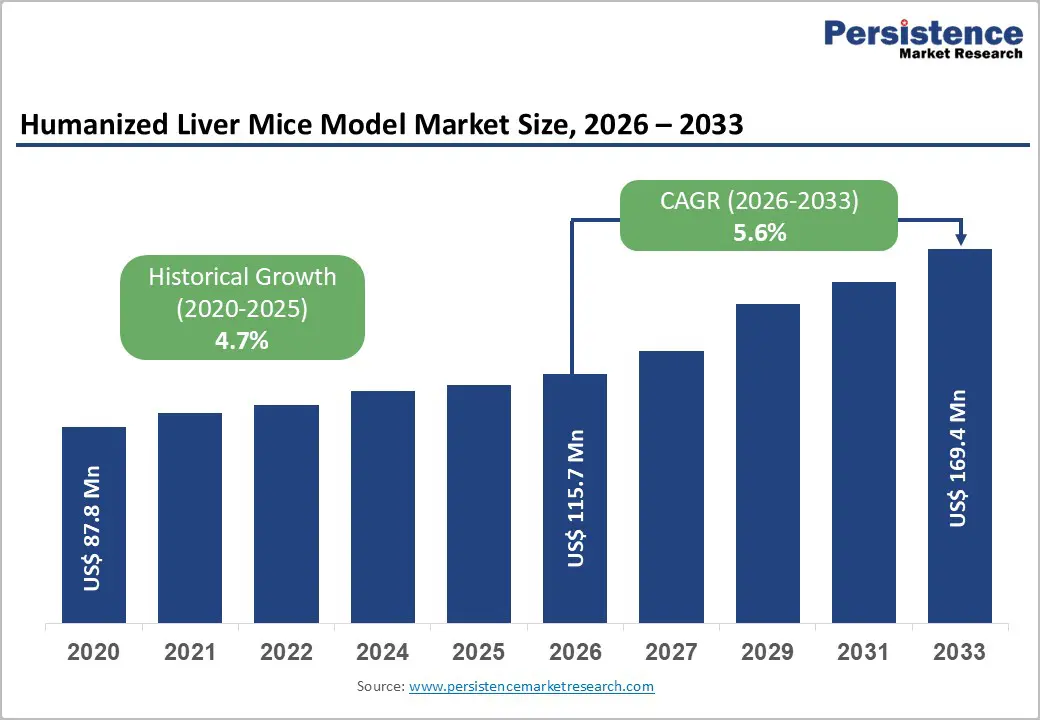
The global Humanized Liver Mice Model Market size is expected to be valued at US$ 115.7 million in 2026 and projected to reach US$ 169.4 million by 2033, growing at a CAGR of 5.6% between 2026 and 2033.

The humanized liver mice model market is gaining momentum due to the surging demand for human-relevant preclinical testing. These models help bridge interspecies gaps in drug metabolism and toxicity studies, offering high translational accuracy. With 70–90% human hepatocyte chimerism, they closely replicate human liver structure and function, enabling more reliable evaluation of pharmacokinetics and safety profiles during early-stage drug development.

Additionally, the rising global burden of liver diseases such as hepatitis, liver cirrhosis, and hepatocellular carcinoma is accelerating research activity. Increasing FDA approvals for liver-related therapies further stimulate pharmaceutical R&D investments, strengthening the adoption of humanized liver mice models across preclinical research pipelines.

Key Market highlights

  • North America remains the largest market, supported by strong biomedical research funding, advanced infrastructure, and high adoption in drug development studies.
  • Asia Pacific is projected to be the fastest-growing region, driven by rising liver disease burden, expanding research facilities, and increasing pharmaceutical investments.
  • Genetic humanized liver mice models hold the largest share due to superior physiological relevance, consistency, and widespread use in preclinical drug testing.
  • CRISPR-based humanized models represent the fastest-growing segment, fuelled by demand for precision modelling, faster development timelines, and improved translational outcomes.
Key Insights Details
Humanized Liver Mice Model Market Size (2026E) US$ 115.7 Mn
Market Value Forecast (2033F) US$ 169.4 Mn
Projected Growth (CAGR 2026 to 2033) 5.6%
Historical Market Growth (CAGR 2020 to 2025) 4.7%

humanized-liver-mice-model-market-size-2026–2033

Market Dynamics

Driver: Advancements in Research Technologies and Rising Liver Disease Burden

Technological advancements are a major driver of growth in the humanized liver mice model market, enabling the development of highly sophisticated and reliable preclinical models. Modern models such as PPARα- and AFC8-based mice more closely replicate human liver physiology, offering improved stability, functional consistency, and predictive accuracy. The transition from basic immunodeficient mice implanted with human hepatocytes to advanced chimeric models that naturally replace murine liver tissue with human cells has significantly enhanced translational research outcomes. These innovations allow researchers to conduct more precise studies on drug metabolism, toxicity, and liver-specific disease mechanisms, increasing confidence in preclinical data and accelerating drug development pipelines.

In parallel, the rising global prevalence of liver diseases is intensifying demand for humanized liver mice models. Conditions such as hepatitis B, hepatitis C, liver cirrhosis, and hepatocellular carcinoma continue to pose major public health challenges, particularly in Asia and Africa. Humanized liver mice models play a critical role in understanding disease progression and evaluating novel therapeutics in a biologically relevant environment. As pharmaceutical companies and research institutions increase investments in liver disease research and antiviral drug development, the need for robust preclinical models is expected to drive sustained market growth.

Restraint: High Model Costs and Stringent Regulatory Requirements

The high cost associated with humanized liver mice models remains a significant restraint on market growth. These models require complex genetic engineering, human cell engraftment, and specialized animal care, resulting in substantially higher costs compared to conventional laboratory mice. While standard immunodeficient mice may cost between USD 140 and USD 500, advanced chimeric humanized liver mice models can range from USD 2,500 to USD 3,500 per animal. Additional expenses related to specialized housing, skilled personnel, and temperature-controlled shipping further increase the financial burden, limiting adoption among smaller research organizations and academic institutions with constrained budgets.

Stringent regulatory and ethical requirements further restrict market expansion. The use of animal models is governed by strict regulatory frameworks emphasizing humane treatment and ethical justification, such as the 3Rs principle replacement, reduction, and refinement. Compliance with these regulations requires extensive documentation, ethical approvals, and ongoing monitoring, which can delay study initiation and raise operational costs. Lengthy approval timelines and regulatory complexity can discourage researchers and slow innovation. Together, high costs and regulatory hurdles reduce accessibility and scalability, acting as key constraints on the broader adoption of humanized liver mice models.

Opportunity: Genetic Editing Innovations and Expansion into Emerging Markets

The integration of advanced genetic editing technologies, particularly CRISPR-Cas9, presents a significant opportunity for the humanized liver mice model market. CRISPR-based tools enable precise genome editing, allowing researchers to create models with specific human gene expressions and liver functions that closely mimic human physiology. This precision improves model reliability and relevance for studying complex liver diseases and drug responses. Additionally, CRISPR technology reduces development timelines and costs associated with generating customized humanized models, making them more accessible to a wider research community. As genetic engineering tools continue to evolve, they are expected to enhance model performance and expand application areas in toxicology, virology, and personalized medicine.

Another major opportunity lies in expansion across emerging markets, particularly in Asia Pacific and Latin America. These regions are witnessing increased investments in healthcare infrastructure, biomedical research, and pharmaceutical manufacturing. High prevalence of hepatitis B and C further amplifies the need for advanced preclinical liver models. By establishing regional facilities, forming partnerships with local research institutions, and supporting government-led research initiatives, companies can tap into new revenue streams and strengthen their global footprint. This geographic expansion is expected to unlock long-term growth opportunities for the humanized liver mice model market.

Category-wise Insights

Model Type Analysis

Genetic humanized mouse models dominate the model type segmentation due to their critical role in accelerating drug discovery and preclinical research. These models are engineered to express human genes or develop functional human liver tissue, enabling accurate evaluation of human-specific drug metabolism, toxicity, and disease pathways. Pharmaceutical and biotechnology companies extensively rely on genetic humanized models to generate reliable translational data before advancing candidates into clinical trials. Their ability to reduce late-stage drug failures and regulatory confidence has positioned them as the leading revenue-generating segment. Additionally, academic and contract research institutions increasingly adopt these models for experimental analysis, reinforcing their widespread use. Continuous improvements in genetic engineering techniques further enhance model stability and reproducibility, strengthening the dominance of genetic humanized mouse models in the market.

Application Analysis

Oncology represents the leading application segment in the humanized mice model market, driven by the growing global burden of cancer and the demand for advanced preclinical research tools. Humanized mouse models are extensively used to study tumor biology, cancer progression, and tumor–host interactions in a human-relevant environment. These models enable precise evaluation of anticancer drugs, immunotherapies, and targeted treatments, improving the predictive accuracy of preclinical studies. By closely replicating the complexity of human tumors, they help researchers assess treatment efficacy and safety more effectively. As cancer remains a major global health challenge, continued investment in oncology research sustains strong demand for humanized mouse models, reinforcing the segment’s leadership and long-term growth potential.
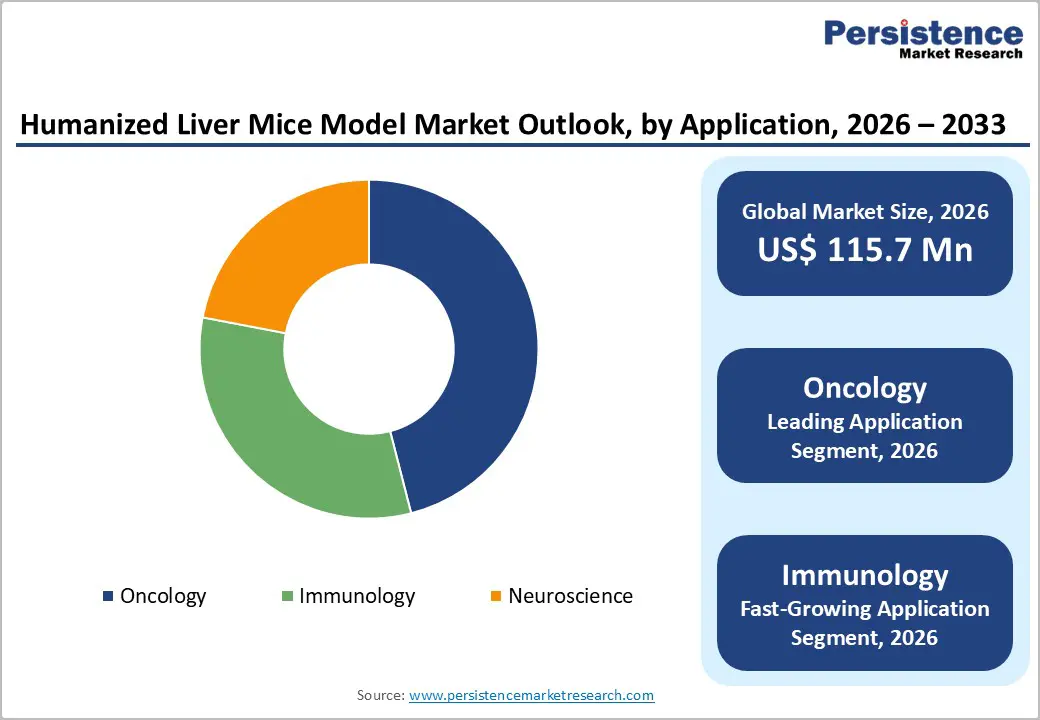
humanized-liver-mice-model-market-outlook-by-application-2026-2033

Regional Insights

North America Humanized Liver Mice Model Market Trends and Insights

The humanized liver mice model market in North America is projected to witness substantial growth, supported by the increasing demand for personalized and precision medicine. Pharmaceutical and biotechnology companies in the region are actively adopting humanized mouse models for preclinical studies to better predict human-specific drug metabolism, toxicity, and therapeutic response. Continuous advancements in genetic engineering and genome-editing technologies, such as CRISPR-based tools, have improved the accuracy, stability, and relevance of these models. Academic research institutes and contract research organizations increasingly rely on humanized liver mice to study complex liver diseases and evaluate novel drug candidates. Moreover, North America benefits from a robust healthcare ecosystem, strong regulatory frameworks, and significant investments in biomedical research and development. Government funding, private sector investments, and collaborations between industry and academia further strengthen the research environment. These factors collectively support sustained market growth and position North America as a key revenue-generating region for humanized liver mice models.

Asia Pacific Humanized Liver Mice Model Market Trends and Insights

Asia Pacific is emerging as a high-growth region in the humanized liver mice model market, driven by expanding pharmaceutical research, rising prevalence of liver diseases, and increasing focus on translational medicine. Countries such as China, Japan, South Korea, and India are investing heavily in biotechnology infrastructure and preclinical research capabilities. The high burden of hepatitis B and C across the region is accelerating demand for advanced liver disease models to support drug discovery and validation. Governments and private organizations are promoting research collaborations and funding initiatives to strengthen life sciences research. Additionally, the growing presence of contract research organizations and academic institutes is improving access to advanced animal models. Cost-effective research environments and increasing adoption of genetic engineering technologies further support market expansion. As regulatory frameworks mature and research standards align with global practices, Asia Pacific is expected to witness strong adoption of humanized liver mice models over the forecast period.
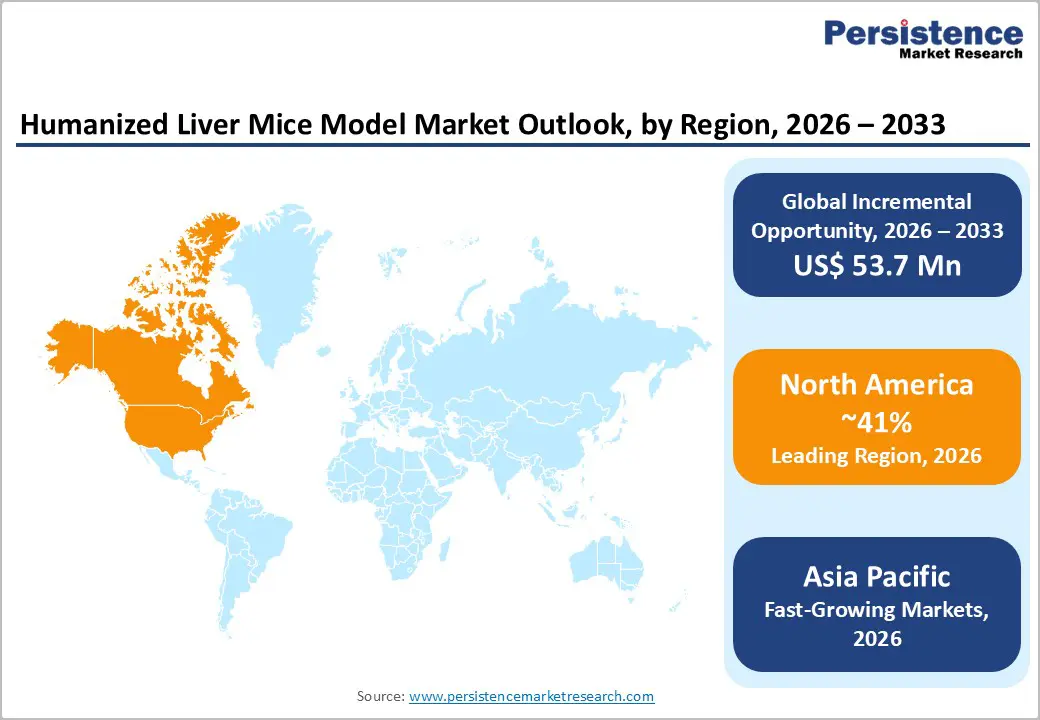
humanized-liver-mice-model-market-outlook-by-region-2026–2033

Competitive Landscape

Market Structure Analysis

The competitive landscape of the humanized liver mice model market is shaped by the presence of several prominent players emphasizing innovation and continuous expansion of their product offerings. Leading companies are making substantial investments in research and development to deliver highly reliable and functionally efficient humanized models.

Strategic collaborations, mergers, and acquisitions are commonly pursued to strengthen technological capabilities and broaden market reach. Competition is further intensified by rapid advancements in genetic engineering tools, particularly CRISPR-Cas9, which enable the development of more advanced and physiologically relevant models. Moreover, the growing demand for preclinical drug testing and the increasing global burden of liver diseases continue to fuel competitive dynamics across the market.?

Key Market Developments

  • January 2022: Taconic Biosciences, Inc. (US) launched the huNOG-EXL EA (early access) humanized immune system (HIS) mouse model.
  • October 2021: The Jackson Laboratory (US) acquired the Research Models & Services (RMS) business of Charles River Laboratories Japan, Inc., making it a wholly owned subsidiary.

Companies Covered in Humanized Liver Mice Model Market

  • Ingenious Targeting Laboratory
  • Axenis S.A.S
  • Trans Genic Inc.
  • Horizon Discovery Group PLC
  • HuMurine Technologies
  • Champions Oncology Inc.
  • Genoway S.A.
  • Crown Bioscience Inc.
  • Taconic Biosciences Inc.
  • The Jackson Laboratory
  • Vitalstar Biotechnology Co. Ltd.
  • Others
Frequently Asked Questions

The global humanized liver mice model market is expected to reach US$ 115.7 million in 2026.​

Rising drug development activity, increasing liver disease prevalence, need for predictive preclinical models, and advancements in genetic engineering technologies.​

North America leads with 41% share in 2025.​

Growing adoption in personalized medicine, gene therapy research, and toxicity testing creates strong opportunities for specialized humanized liver mouse models.

Leaders include Ingenious Targeting Laboratory, Axenis S.A.S, Trans Genic Inc., Horizon Discovery Group PLC, and HuMurine Technologies​.

Global Humanized Liver Mice Model Market Report Scope
Report Attribute Details

Historical Data/Actuals

2020 - 2025

Forecast Period

2026 - 2033

Market Analysis

Value: US$ Bn

Volume (Units) If Applicable

Geographical Coverage

  • North America
  • Europe
  • East Asia
  • South Asia and Oceania
  • Middle East and Africa
  • Latin America

Segmental Coverage

  • Model Type
  • Application
  • End User
  • Region

Competitive Analysis 

  • Ingenious Targeting Laboratory
  • Axenis S.A.S
  • Trans Genic Inc.
  • Horizon Discovery Group PLC
  • HuMurine Technologies
  • Champions Oncology Inc.
  • Genoway S.A.
  • Crown Bioscience Inc.
  • Taconic Biosciences Inc.
  • The Jackson Laboratory
  • Vitalstar Biotechnology Co. Ltd.
  • Others

Report Highlights 

  • Market Forecast and Trends
  • Competitive Intelligence & Share Analysis
  • Growth Factors and Challenges
  • Strategic Growth Initiatives
  • Future Opportunities and Revenue Pockets
  • Market Analysis Tools
Market Segmentation

Model Type

  • Genetic
  • Cell Based

Application

  • Oncology
  • Immunology
  • Neuroscience

End User

  • Research Institutes
  • Biotech Companies
  • Hospitals

Regions

  • North America
  • Europe
  • East Asia
  • South Asia & Oceania
  • Latin America
  • Middle East & Africa

Related Reports

  1. Executive Summary
    1. Global Humanized Liver Mice Model Market Snapshot 2026 and 2033
    2. Market Opportunity Assessment, 2026-2033, US$ Mn
    3. Key Market Trends
    4. Industry Developments and Key Market Events
    5. Demand Side and Supply-Side Analysis
    6. PMR Analysis and Recommendations
  2. Market Overview
    1. Market Scope and Definitions
    2. Market Dynamics
      1. Driver
      2. Restraint
      3. Opportunities
      4. Trends
    3. Macro-Economic Factors
      1. Global GDP Outlook
      2. Global Prison Growth Outlook
      3. Global Prison Population by Country
      4. Global Private Prison Market Growth Outlook
    4. Forecast Factors – Relevance and Impact
    5. COVID-19 Impact Assessment
  3. Value Added Insights
    1. Value Chain analysis
    2. Key Market Players
    3. Product Adoption Analysis
    4. Key Promotional Strategies by key players
    5. PESTLE Analysis
    6. Porter's Five Forces Analysis
    7. Regulatory and Technology Landscape
  4. Global Humanized Liver Mice Model Market Outlook: Historical (2020 – 2025) and Forecast (2026 – 2033)
    1. Key Highlights
    2. Global Humanized Liver Mice Model Market Outlook: Model Type
      1. Introduction/Key Findings
      2. Historical Market Size (US$ Mn) Analysis by Model Type, 2020-2025
      3. Current Market Size (US$ Mn) Forecast, by Model Type, 2026-2033
        1. Genetic
        2. Cell Based
      4. Market Attractiveness Analysis: Model Type
    3. Global Humanized Liver Mice Model Market Outlook: Application
      1. Introduction/Key Findings
      2. Historical Market Size (US$ Mn) Analysis by Application, 2020-2025
      3. Current Market Size (US$ Mn) Forecast, by Application, 2026-2033
        1. Oncology
        2. Immunology
        3. Neuroscience
      4. Market Attractiveness Analysis: Application
    4. Global Humanized Liver Mice Model Market Outlook: End User
      1. Introduction/Key Findings
      2. Historical Market Size (US$ Mn) Analysis by End User, 2020-2025
      3. Current Market Size (US$ Mn) Forecast, by End User, 2026-2033
        1. Research Institutes
        2. Biotech Companies
        3. Hospitals
      4. Market Attractiveness Analysis: End User
  5. Global Humanized Liver Mice Model Market Outlook: Region
    1. Key Highlights
    2. Historical Market Size (US$ Mn) Analysis by Region, 2020-2025
    3. Current Market Size (US$ Mn) Forecast by Region, 2026-2033
      1. North America
      2. Europe
      3. East Asia
      4. South Asia & Oceania
      5. Latin America
      6. Middle East & Africa
    4. Market Attractiveness Analysis: Region
  6. North America Humanized Liver Mice Model Market Outlook: Historical (2020 – 2025) and Forecast (2026 – 2033)
    1. Key Highlights
    2. North America Market Size (US$ Mn) Forecast, by Country, 2026-2033
      1. U.S.
      2. Canada
    3. North America Market Size (US$ Mn) Forecast, by Model Type, 2026-2033
      1. Genetic
      2. Cell Based
    4. North America Market Size (US$ Mn) Forecast, by Application, 2026-2033
      1. Oncology
      2. Immunology
      3. Neuroscience
    5. North America Market Size (US$ Mn) Forecast, by End User, 2026-2033
      1. Research Institutes
      2. Biotech Companies
      3. Hospitals
  7. Europe Humanized Liver Mice Model Market Outlook: Historical (2020 – 2025) and Forecast (2026 – 2033)
    1. Key Highlights
    2. Europe Market Size (US$ Mn) Forecast, by Country, 2026-2033
      1. Germany
      2. Italy
      3. France
      4. U.K.
      5. Spain
      6. Russia
      7. Rest of Europe
    3. Europe Market Size (US$ Mn) Forecast, by Model Type, 2026-2033
      1. Genetic
      2. Cell Based
    4. Europe Market Size (US$ Mn) Forecast, by Application, 2026-2033
      1. Oncology
      2. Immunology
      3. Neuroscience
    5. Europe Market Size (US$ Mn) Forecast, by End User, 2026-2033
      1. Research Institutes
      2. Biotech Companies
      3. Hospitals
  8. East Asia Humanized Liver Mice Model Market Outlook: Historical (2020 – 2025) and Forecast (2026 – 2033)
    1. Key Highlights
    2. East Asia Market Size (US$ Mn) Forecast, by Country, 2026-2033
      1. China
      2. Japan
      3. South Korea
    3. East Asia Market Size (US$ Mn) Forecast, by Model Type, 2026-2033
      1. Genetic
      2. Cell Based
    4. East Asia Market Size (US$ Mn) Forecast, by Application, 2026-2033
      1. Oncology
      2. Immunology
      3. Neuroscience
    5. East Asia Market Size (US$ Mn) Forecast, by End User, 2026-2033
      1. Research Institutes
      2. Biotech Companies
      3. Hospitals
  9. South Asia & Oceania Humanized Liver Mice Model Market Outlook: Historical (2020 – 2025) and Forecast (2026 – 2033)
    1. Key Highlights
    2. South Asia & Oceania Market Size (US$ Mn) Forecast, by Country, 2026-2033
      1. India
      2. Southeast Asia
      3. ANZ
      4. Rest of SAO
    3. South Asia & Oceania Market Size (US$ Mn) Forecast, by Model Type, 2026-2033
      1. Genetic
      2. Cell Based
    4. South Asia & Oceania Market Size (US$ Mn) Forecast, by Application, 2026-2033
      1. Oncology
      2. Immunology
      3. Neuroscience
    5. South Asia & Oceania Market Size (US$ Mn) Forecast, by End User, 2026-2033
      1. Research Institutes
      2. Biotech Companies
      3. Hospitals
  10. Latin America Humanized Liver Mice Model Market Outlook: Historical (2020 – 2025) and Forecast (2026 – 2033)
    1. Key Highlights
    2. Latin America Market Size (US$ Mn) Forecast, by Country, 2026-2033
      1. Brazil
      2. Mexico
      3. Rest of LATAM
    3. Latin America Market Size (US$ Mn) Forecast, by Model Type, 2026-2033
      1. Genetic
      2. Cell Based
    4. Latin America Market Size (US$ Mn) Forecast, by Application, 2026-2033
      1. Oncology
      2. Immunology
      3. Neuroscience
    5. Latin America Market Size (US$ Mn) Forecast, by End User, 2026-2033
      1. Research Institutes
      2. Biotech Companies
      3. Hospitals
  11. Middle East & Africa Humanized Liver Mice Model Market Outlook: Historical (2020 – 2025) and Forecast (2026 – 2033)
    1. Key Highlights
    2. Middle East & Africa Market Size (US$ Mn) Forecast, by Country, 2026-2033
      1. GCC Countries
      2. South Africa
      3. Northern Africa
      4. Rest of MEA
    3. Middle East & Africa Market Size (US$ Mn) Forecast, by Model Type, 2026-2033
      1. Genetic
      2. Cell Based
    4. Middle East & Africa Market Size (US$ Mn) Forecast, by Application, 2026-2033
      1. Oncology
      2. Immunology
      3. Neuroscience
    5. Middle East & Africa Market Size (US$ Mn) Forecast, by End User, 2026-2033
      1. Research Institutes
      2. Biotech Companies
      3. Hospitals
  12. Competition Landscape
    1. Market Share Analysis, 2025
    2. Market Structure
      1. Competition Intensity Mapping
      2. Competition Dashboard
    3. Company Profiles
      1. Ingenious Targeting Laboratory
        1. Company Overview
        2. Product Portfolio/Offerings
        3. Key Financials
        4. SWOT Analysis
        5. Company Strategy and Key Developments
      2. Axenis S.A.S
      3. Trans Genic Inc.
      4. Horizon Discovery Group PLC
      5. HuMurine Technologies
      6. Champions Oncology Inc.
      7. Genoway S.A.
      8. Crown Bioscience Inc.
      9. Taconic Biosciences Inc.
      10. The Jackson Laboratory
      11. Vitalstar Biotechnology Co. Ltd.
      12. Others
  13. Appendix
    1. Research Methodology
    2. Research Assumptions
    3. Acronyms and Abbreviations

Research Methodology Framework for Market Research Excellence

At Persistence Market Research, we implement a comprehensive, validated, and multi-dimensional approachto market analysis that delivers actionable insights across complex market landscapes. Our methodology combines the analytical rigor of leading consulting firms with innovative research techniques, ensuring robust market assessments that guide strategic decision-making with confidence.

Core Research Philosophy

Our methodology is built on four foundational pillars:

Research Philosophy Image

At Persistence Market Research, our methodology is designed to transcend conventional market studies by combining analytical rigor, multi-source validation, and future-focused insights.

We integrate advanced research frameworks, robust data collection strategies, cutting-edge analytics, and innovative technologies to deliver a 360-degree view of complex markets.

We integrate advanced research frameworks, robust data collection strategies, cutting-edge analytics, and innovative technologies to deliver a 360-degree view of complex markets.

Each stage spanning from strategic scoping and hypothesis-building to competitive intelligence, quality validation, and actionable recommendations is engineered to provide clients with unmatched clarity, precision, and confidence in decision-making.

By embedding innovation and technology at the core, our approach ensures that insights are not only comprehensive but also predictive, empowering businesses to seize opportunities, mitigate risks, and achieve sustainable growth

Research Philosophy Image

Capturing Key Information and Events

During this phase, key research objectives focus on essential information and data points for assessing the market, including:

Research Philosophy Image

TAM-SAM-SOM Framework Implementation

We employ both top-down and bottom-up approaches to ensure accurate market sizing.

Top-Down Market SizingBottom-Up Market Sizing
Universe Definition: Total global/regional market identificationUnit Economics: Average transaction values, purchase frequencies, customer lifecycle
Segmentation Filters: Geographic, demographic, and behavioral constraintsCustomer Segmentation: Detailed buyer persona development and sizing
Market Share Analysis: Competitive landscape assessment and share allocationPenetration Analysis: Market penetration rates by segment and geography
Growth Rate Application: Historical trends and forward-looking growth assumptionsScaling Methodology: Extrapolation techniques with confidence intervals

Validation & Cross-Verification

  • Triangulation: Comparing top-down and bottom-up results for consistency
  • Sensitivity Analysis: Testing key assumptions and parameter variations
  • Peer Benchmarking: Comparison with analogous markets and industry benchmarks
  • Expert Review: External validation through industry specialist consultation

Research Philosophy Image

Forecasting & Projection Modeling

Our proprietary forecasting models incorporate multiple variables and scenarios.

Forecasting Components

  • Historical Trend Analysis: 10-year historical growth patterns and cyclical variations
  • Driver-Based Modeling: Economic indicators, demographic shifts, technology adoption
  • Scenario Planning: Base case, optimistic, and conservative projections
  • Monte Carlo Simulations: Probability-weighted outcomes and risk assessments

Model Validation

  • Back-Testing: Historical accuracy assessment over 3–5-year periods
  • Cross-Validation: Multiple modeling approaches for result comparison
  • External Benchmarking: Comparison with established market forecasts
  • Continuous Calibration: Quarterly model updates based on new data

Comprehensive Data Collection Strategy

Our secondary research phase establishes a robust knowledge base utilizing diverse, credible sources.

Secondary Data Sourcess

  • Industry Publications & Reports
  • Government & Regulatory Data
  • Financial Intelligence (filings & reports)
  • Academic Research & Digital Intelligence

Quality Assurance Protocol

  • Source credibility assessment and publication date validation
  • Data consistency checks across multiple sources
  • Bias identification and neutralization techniques
  • Information gap tracking for primary research prioritization

Research Philosophy Image

Primary Research Excellence

Our primary research methodology employs best-in-class techniques to capture unique market insights.

Quantitative Research Methods

  • Large-Scale Surveys: Statistically representative samples with 95% confidence intervals
  • Survey Methodology: Multi-channel deployment (online, telephone, in-person)
  • Question Architecture and Response Optimization

Qualitative Research Methods

  • Executive Interviews
  • Focus Groups
  • Expert Consultations

Quality Assurance & Validation Framework

Multi-Stage Validation Process

  • Source Verification and Consistency Testing
  • Outlier Detection and Bias Assessment
  • Peer Review Process and External Validation
  • Sensitivity Analysis and Confidence Intervals

Research Philosophy Image

Methodology Validation & Credibility

Our research methodology has been extensively validated through:

  • Academic Partnerships: Collaborations with top-tier business schools and research institutions
  • Client Success Stories: Documented case studies demonstrating research impact and ROI
  • Continuous Benchmarking: Performance comparison with leading global research firms

This comprehensive methodology framework positions Persistence Market Research at the forefront of market intelligence, combining the analytical sophistication of top-tier consulting firms with innovative research techniques. Our approach ensures that every market assessment delivers precise, actionable, and strategically valuable insights that drive business success in competitive market environments.

Ready to unlock your market potential? Contact our research experts to discuss how our validated methodology can transform your strategic decision-making with data-driven market intelligence.

Copyright © 2026 Persistence Market Research. All Rights Reserved

Connect With Us -
Humanized Liver Mice Model Market Size & Forecast, 2033