Natural and Organic Flavors Market Size, Share, Growth, and Regional Forecast, 2025 - 2032

Natural and Organic Flavors Market by Form (Liquid and Powder), Source (Fruit & Fruit Juices, Plants & Botanical, Dairy, Vegetable & Vegetable Juices, and Meat & Seafood), End-user, and Regional Analysis from 2025 - 2032

ID: PMRREP11836
Calendar

October 2025

190 Pages

Author : Amol Patil

Key Industry Highlights:

  • Leading Country: North America dominates the global natural and organic flavors market, driven by high consumer awareness, strong demand for clean-label products, and well-established food and beverage industries.
  • Fastest-Growing Region: Asia Pacific is the fastest-growing region, fueled by rising urbanization, increasing disposable incomes, and growing adoption of processed and packaged foods with natural ingredients.
  • Fastest-Growing Technology: Liquid flavors are growing rapidly, driven by demand in beverages, sauces, and liquid-based food products offering superior solubility and fresh taste.
  • Market Drivers: Increasing consumer demand for clean-label, natural, and health-focused products, coupled with growing awareness of artificial additive avoidance, drives market growth.
  • Investments: Companies are investing in advanced extraction technologies, sustainable sourcing, and product innovation to meet evolving consumer preferences and expand regional reach.
Key Insights Details

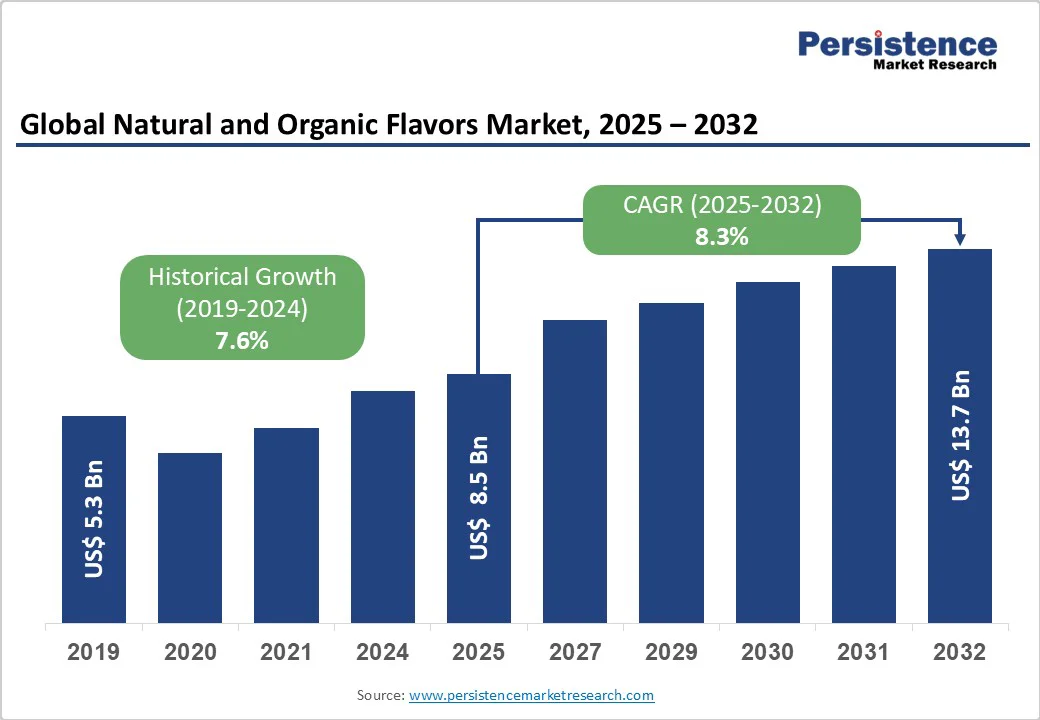
Natural and Organic Flavors Market Size (2025E) 

US$ 8.5 Bn 

Market Value Forecast (2032F) 

US$ 13.7 Bn

Projected Growth (CAGR 2025 to 2032) 

8.3% 

Historical Market Growth (CAGR 2019 to 2024) 

7.6% 

global-natural-and-organic-flavors-market-2025-2032

Market Dynamics

Driver - Increasing Consumer Demand for Clean-Label Products

The global natural and organic flavors market is driven significantly by the rising consumer preference for clean-label and health-focused products. Increasing awareness of diet-related health issues, coupled with growing concerns over artificial additives and preservatives, has led consumers to actively seek products made from natural and organic ingredients. Millennials and Gen Z, who are shaping modern purchasing trends, show a strong inclination toward products that are transparent, minimally processed, and perceived as healthier.

Retailers and manufacturers have responded by highlighting ingredient transparency in packaging and offering natural alternatives, which has further boosted consumer confidence. Additionally, the growth of online grocery platforms has made natural and organic products more accessible, encouraging higher adoption rates. Social trends, including healthy eating and plant-based diets, have normalized the use of natural flavors across beverages, snacks, and packaged foods. This shift toward clean-label consumption not only drives volume growth but also motivates innovation, with companies developing new flavor formulations that meet the dual demand for taste and health, thereby sustaining the market’s robust expansion.

Restraints - High Costs Restrict Global Natural and Organic Flavors Market Growth

The natural and organic flavors market faces a significant restraint in the form of high production costs. Sourcing raw materials from fruits, vegetables, plants, dairy, and seafood involves labor-intensive harvesting, seasonal dependency, and often limited availability, which elevates input costs. Processing natural ingredients into stable, high-quality flavors requires sophisticated techniques such as steam distillation, cold pressing, and enzymatic extraction, which are more expensive than conventional synthetic methods. These expenses are often reflected in retail pricing, making natural and organic flavor products less accessible to price-sensitive consumers, particularly in emerging markets.

Smaller food and beverage manufacturers may struggle to absorb these costs, limiting their ability to compete with larger, established brands. In addition, maintaining product consistency and quality across batches adds additional operational complexity. Collectively, these factors restrict market penetration and adoption, posing a challenge to the widespread expansion of natural and organic flavor offerings globally.

Opportunity - Technological Advancements in Flavor Extraction

Technological advancements in flavor extraction present a substantial growth opportunity for the natural and organic flavors market. Modern extraction techniques, including supercritical CO2 extraction, vacuum distillation, enzymatic methods, and membrane filtration, allow manufacturers to produce high-purity natural flavors more efficiently while retaining the nutritional and aromatic qualities of raw ingredients. These innovations reduce production time, improve yield, and minimize waste, significantly lowering overall costs and making natural flavors more commercially viable.

Enhanced extraction methods enable the development of novel flavors, including rare botanical and plant-based compounds, broadening the product portfolio and catering to evolving consumer tastes. With the growing demand for clean-label, plant-based, and functional food products, companies can leverage these technologies to offer differentiated, high-quality flavor solutions. By investing in research and advanced processing infrastructure, manufacturers can expand market reach, penetrate new regions, and respond swiftly to changing consumer preferences, thereby driving sustained growth and competitiveness in the market.

Category-wise Analysis

By Form, Powder Forms Dominate the Natural and Organic Flavors Market

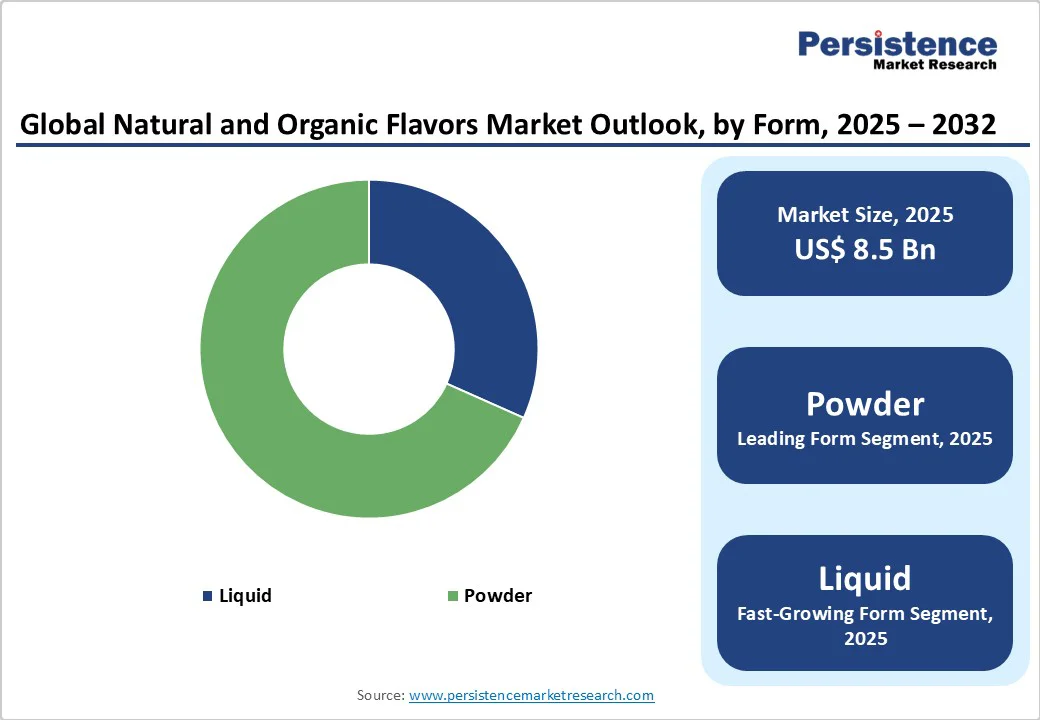
By form, powder forms are the dominant product type, capturing over 67% of the market share in 2025. Powdered flavors are preferred for their excellent stability, long shelf life, and ease of storage, making them ideal for incorporation into dry food applications such as bakery mixes, seasoning blends, and snack powders. Their uniform dispersion ensures consistent flavor delivery, which is particularly important in large-scale food production. Manufacturers also favor powdered formats for logistical efficiency, as they reduce transportation costs and simplify handling compared with liquid forms.

On the other hand, liquid flavors are the fastest-growing segment, driven by increasing consumer demand in beverages, sauces, and liquid-based food products. Liquid formats provide superior solubility, immediate flavor release, and a fresh taste profile, making them particularly suitable for ready-to-drink beverages, syrups, and dairy-based products. This rising adoption positions liquid flavors as a rapidly expanding opportunity within the natural and organic flavors market.

By Source, Fruit & Fruit Juices Segment Leads

In the natural and organic flavors market, the fruit and fruit juices segment holds approximately 35% share. This segment is highly favored due to its ability to deliver vibrant, natural sweetness and authentic fruit notes that enhance the taste of beverages, yogurts, confectionery, and desserts. Fruit-derived flavors are versatile and widely accepted by consumers, making them a preferred choice for manufacturers aiming to create appealing and health-conscious products. The consistent availability of fruits and the development of advanced extraction methods further support the dominance of this segment.

The fastest-growing source is plants and botanical extracts. Driven by the rising interest in herbal, functional, and plant-based products, this segment is expanding rapidly. Botanical flavors offer unique, nuanced taste profiles and health benefits, making them increasingly popular in beverages, supplements, and ready-to-eat meals, positioning them as a key growth opportunity.
global-natural-and-organic-flavors-market-outlook-by-form-2025-2032

Region-wise Insights

North America Natural and Organic Flavors Market Trends

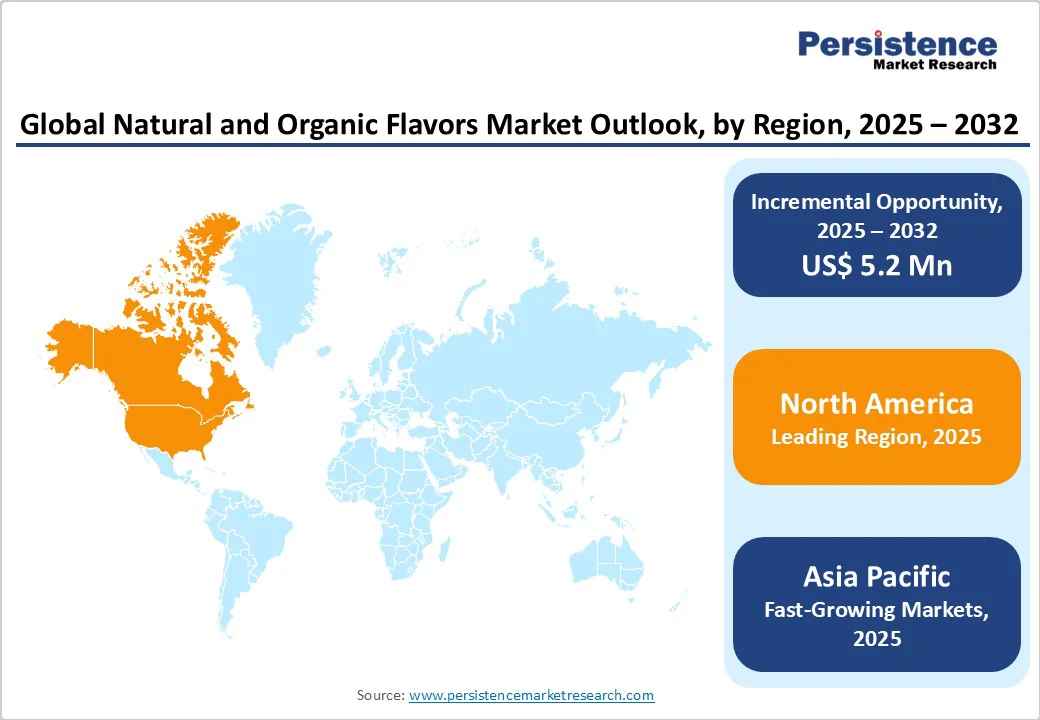
North America leads the global natural and organic flavors market, driven by increasing consumer demand for clean-label and health-conscious products. The U.S. and Canada are at the forefront, with a growing preference for natural ingredients in food and beverages. Regulatory support, such as the USMCA, facilitates the trade of organic products within the region. Companies are focusing on innovation and sustainability to meet consumer expectations. The market is characterized by a shift towards plant-based and functional flavors, catering to the rising trend of health and wellness. Despite challenges like tariff uncertainties, the region's robust infrastructure and consumer base continue to drive market growth. The natural and organic flavors market in North America is projected to expand steadily, reflecting the region's dominance in the global market.

Europe Natural and Organic Flavors Market Trends

The European natural and organic flavors market is witnessing steady growth, driven by increasing consumer preference for healthier and clean-label products. Germany dominates the region due to its mature food and beverage industry, strong regulatory framework, and widespread adoption of natural ingredients. France and the UK are key contributors, focusing on innovation and sustainable sourcing of flavors. Spain and Italy are emerging as the fastest-growing markets, fueled by rising demand for plant-based and functional flavors in bakery, confectionery, and beverages.

Manufacturers are increasingly introducing liquid and powder natural flavors to cater to diverse applications and convenience in food processing. The growth is further supported by consumer awareness campaigns, organic certification programs, and collaborations between flavor companies and local producers. Overall, Europe remains a stable yet evolving market with opportunities for innovation and expansion in natural and organic flavors.

Asia and Pacific Natural and Organic Flavors Market Trends

Asia Pacific is experiencing rapid growth in the natural and organic flavors market, emerging as the fastest-growing segment globally. Countries such as China, India, and Japan are witnessing increased consumer awareness about health and wellness, leading to a surge in demand for clean-label and natural products. The rise of the middle-income groups and urbanization are contributing to this shift. Advancements in extraction technologies and the proliferation of organic farming in Southeast Asia are enhancing the availability of natural raw materials.

The beverage sector, particularly ready-to-drink formats, is a significant driver, with flavors like jasmine, oolong, and lychee gaining popularity. The market is characterized by a diverse consumer base and a growing inclination towards plant-based and functional flavors. This dynamic landscape positions Asia Pacific as a key player in the global natural and organic flavors market.
global-natural-and-organic-flavors-market-outlook-by-region-2025-2032

Competitive Landscape

The global natural and organic flavors market is moderately consolidated, with major players focusing on innovation, sustainability, and strategic partnerships. Key companies include Givaudan, Firmenich, Symrise, IFF, Kerry Group, and Sensient Flavors. These players are expanding portfolios with natural and organic flavor compounds, investing in biotransformation, fermentation, and clean-label technologies. Mergers, acquisitions, and collaborations with food and beverage manufacturers are common strategies to enhance market reach. Regional players compete by offering cost-effective, locally sourced flavors. Continuous R&D, regulatory compliance, and consumer-driven innovation remain critical to maintain competitiveness and capture emerging market opportunities.

Key Industry Developments:

  • In July 2025, Sensient Flavors & Extracts introduced BioSymphony, a new range of natural flavors created using biotransformation technology.
  • In March 2024, BASF Aroma Ingredients expanded its Isobionics portfolio by introducing a new natural flavor.

Companies Covered in Natural and Organic Flavors Market

  • Kerry Group Plc.
  • Firmenich
  • Sensus
  • Givaudan S.A.
  • IFF (International Flavors Fragrances)
  • Archer Daniels Midland Company
  • Olam International
  • McCormick Company
  • Robertet SA
  • Naturex
  • Sensient Technologies Corporation
  • Symrise AG
  • Other
Frequently Asked Questions

The global market is projected to be valued at US$ 8.5 Bn in 2025.

Rising consumer preference for clean-label, health-conscious products, increasing demand for organic ingredients, and sustainability trends drive market growth globally.

The global market is poised to witness a CAGR of 8.3% between 2025 and 2032.

Innovation in flavor profiles, expansion in emerging markets, strategic collaborations, and adoption in beverages, nutraceuticals, and personal care segments.

Kerry Group Plc., Firmenich, Sensus, Givaudan S.A., IFF (International Flavors Fragrances), and others.

Global Natural and Organic Flavors Market Report Scope
Report Attribute Details

Historical Data/Actuals

2019 – 2024

Forecast Period

2025 – 2032

Market Analysis

Value: US$ Bn and Volume (if Available)

Geographical Coverage

  • North America
  • Europe
  • East Asia
  • South Asia and Oceania
  • Middle East and Africa
  • Latin America

Segmental Coverage

  • By Form
  • By Source
  • By Application
  • By Region

Competitive Analysis 

  • Kerry Group Plc.
  • Firmenich
  • Sensus
  • Givaudan S.A.
  • IFF (International Flavors Fragrances)
  • Archer Daniels Midland Company
  • Olam International
  • McCormick Company
  • Robertet SA
  • Naturex
  • Sensient Technologies Corporation
  • Symrise AG
  • Other

Report Highlights 

  • Market Forecast and Trends 
  • ompetitive Intelligence & Share Analysis  
  • Growth Factors and Challenges 
  • Strategic Growth Initiatives 
  • Future Opportunities and Revenue Pockets 
  • Industry Market Analysis Tools 
Market Segmentation

By Form

  • Liquid
  • Powder 

By Source

  • Fruit & Fruit Juices
  • Plants & Botanical
  • Dairy
  • Vegetable & Vegetable Juices
  • Meat & Seafood

By Application

  • Food
  • Beverages

By Region

  • North America
  • Europe
  • East Asia
  • South Asia and Oceania
  • Latin America
  • Middle East and Africa

Related Reports

  1. Executive Summary
    1. Global Natural and Organic Flavors Market Snapshot, 2025 and 2032
    2. Market Opportunity Assessment, 2025 - 2032, US$ Bn
    3. Key Market Trends
    4. Future Market Projections
    5. Premium Market Insights
    6. Industry Developments and Key Market Events
    7. PMR Analysis and Recommendations
  2. Market Overview
    1. Market Scope and Definition
    2. Market Dynamics
      1. Drivers
      2. Restraints
      3. Opportunity
      4. Challenges
      5. Key Trends
    3. COVID-19 Impact Analysis
    4. Forecast Factors - Relevance and Impact
  3. Value Added Insights
    1. Value Chain Analysis
    2. Product Adoption / Usage Analysis
    3. Key Market Players
    4. Key Promotional Strategies, By Key Players
    5. Regulatory Landscape
    6. PESTLE Analysis
    7. Porter’s Five Force Analysis
  4. Global Natural and Organic Flavors Market Outlook
    1. Key Highlights
      1. Market Size (US$ Bn) and Y-o-Y Growth
      2. Absolute $ Opportunity
    2. Market Size (US$ Bn) Analysis and Forecast
      1. Historical Market Size (US$ Bn) Analysis, 2019-2024
      2. Market Size (US$ Bn) Analysis and Forecast, 2025-2032
    3. Global Natural and Organic Flavors Market Outlook: Form
      1. Historical Market Size (US$ Bn) Analysis, By Form, 2019-2024
      2. Market Size (US$ Bn) and Forecast Analysis, By Form, 2025-2032
        1. Liquid
        2. Powder 
      3. Market Attractiveness Analysis: Form
    4. Global Natural and Organic Flavors Market Outlook: Source
      1. Historical Market Size (US$ Bn) Analysis, By Source, 2019-2024
      2. Market Size (US$ Bn) and Forecast Analysis, By Source, 2025-2032
        1. Fruit & Fruit Juices
        2. Plants & Botanical
        3. Dairy
        4. Vegetable & Vegetable Juices
        5. Meat & Seafood
      3. Market Attractiveness Analysis: Source
    5. Global Natural and Organic Flavors Market Outlook: Application
      1. Historical Market Size (US$ Bn) Analysis, By Application, 2019-2024
      2. Market Size (US$ Bn) and Forecast Analysis, By Application, 2025-2032
        1. Food
        2. Beverages
      3. Market Attractiveness Analysis: Application
  5. Global Natural and Organic Flavors Market Outlook: Region
    1. Historical Market Size (US$ Bn) Analysis, By Region, 2019-2024
    2. Market Size (US$ Bn) and Forecast Analysis, By Region, 2025-2032
      1. North America
      2. Latin America
      3. Europe
      4. East Asia
      5. South Asia and Oceania
      6. Middle East & Africa
    3. Market Attractiveness Analysis: Region
  6. North America Natural and Organic Flavors Market Outlook
    1. Historical Market Size (US$ Bn) Analysis, By Market, 2019-2024
      1. By Country
      2. By Form
      3. By Source
      4. By Application
    2. Market Size (US$ Bn) Analysis and Forecast by Country, 2025-2032
      1. U.S.
      2. Canada
    3. Market Size (US$ Bn) and Forecast Analysis, By Form, 2025-2032
      1. Liquid
      2. Powder 
    4. Market Size (US$ Bn) Analysis and Forecast, By Source, 2025-2032
      1. Fruit & Fruit Juices
      2. Plants & Botanical
      3. Dairy
      4. Vegetable & Vegetable Juices
      5. Meat & Seafood 
    5. Market Size (US$ Bn) Analysis and Forecast, By Application, 2025-2032
      1. Food
      2. Beverages 
    6. Market Attractiveness Analysis
  7. Europe Natural and Organic Flavors Market Outlook
    1. Historical Market Size (US$ Bn) Analysis, By Market, 2019-2024
      1. By Country
      2. By Form
      3. By Source
      4. By Application
    2. Market Size (US$ Bn) Analysis and Forecast by Country, 2025-2032
      1. Germany
      2. France
      3. U.K.
      4. Italy
      5. Spain
      6. Russia
      7. Rest of Europe
    3. Market Size (US$ Bn) and Forecast Analysis, By Form, 2025-2032
      1. Liquid
      2. Powder 
    4. Market Size (US$ Bn) Analysis and Forecast, By Source, 2025-2032
      1. Fruit & Fruit Juices
      2. Plants & Botanical
      3. Dairy
      4. Vegetable & Vegetable Juices
      5. Meat & Seafood 
    5. Market Size (US$ Bn) Analysis and Forecast, By Application, 2025-2032
      1. Food
      2. Beverages 
    6. Market Attractiveness Analysis
  8. East Asia Natural and Organic Flavors Market Outlook
    1. Historical Market Size (US$ Bn) Analysis, By Market, 2019-2024
      1. By Country
      2. By Form
      3. By Source
      4. By Application
    2. Market Size (US$ Bn) Analysis and Forecast by Country, 2025-2032
      1. China
      2. Japan
      3. South Korea
    3. Market Size (US$ Bn) and Forecast Analysis, By Form, 2025-2032
      1. Liquid
      2. Powder 
    4. Market Size (US$ Bn) Analysis and Forecast, By Source, 2025-2032
      1. Fruit & Fruit Juices
      2. Plants & Botanical
      3. Dairy
      4. Vegetable & Vegetable Juices
      5. Meat & Seafood 
    5. Market Size (US$ Bn) Analysis and Forecast, By Application, 2025-2032
      1. Food
      2. Beverages 
    6. Market Attractiveness Analysis
  9. South Asia & Oceania Natural and Organic Flavors Market Outlook
    1. Historical Market Size (US$ Bn) Analysis, By Market, 2019-2024
      1. By Country
      2. By Form
      3. By Source
      4. By Application
    2. Market Size (US$ Bn) Analysis and Forecast by Country, 2025-2032
      1. India
      2. Indonesia
      3. Thailand
      4. Singapore
      5. ANZ
      6. Rest of South Asia & Oceania
    3. Market Size (US$ Bn) and Forecast Analysis, By Form, 2025-2032
      1. Liquid
      2. Powder 
    4. Market Size (US$ Bn) Analysis and Forecast, By Source, 2025-2032
      1. Fruit & Fruit Juices
      2. Plants & Botanical
      3. Dairy
      4. Vegetable & Vegetable Juices
      5. Meat & Seafood 
    5. Market Size (US$ Bn) Analysis and Forecast, By Application, 2025-2032
      1. Food
      2. Beverages 
    6. Market Attractiveness Analysis
  10. Latin America Natural and Organic Flavors Market Outlook
    1. Historical Market Size (US$ Bn) Analysis, By Market, 2019-2024
      1. By Country
      2. By Form
      3. By Source
      4. By Application
    2. Market Size (US$ Bn) Analysis and Forecast by Country, 2025-2032
      1. Brazil
      2. Mexico
      3. Rest of Latin America
    3. Market Size (US$ Bn) and Forecast Analysis, By Form, 2025-2032
      1. Liquid
      2. Powder 
    4. Market Size (US$ Bn) Analysis and Forecast, By Source, 2025-2032
      1. Fruit & Fruit Juices
      2. Plants & Botanical
      3. Dairy
      4. Vegetable & Vegetable Juices
      5. Meat & Seafood 
    5. Market Size (US$ Bn) Analysis and Forecast, By Application, 2025-2032
      1. Food
      2. Beverages 
    6. Market Attractiveness Analysis
  11. Middle East & Africa Natural and Organic Flavors Market Outlook
    1. Historical Market Size (US$ Bn) Analysis, By Market, 2019-2024
      1. By Country
      2. By Form
      3. By Source
      4. By Application
    2. Market Size (US$ Bn) Analysis and Forecast by Country, 2025-2032
      1. GCC Countries
      2. Egypt
      3. South Africa
      4. Northern Africa
      5. Rest of Middle East & Africa
    3. Market Size (US$ Bn) and Forecast Analysis, By Form, 2025-2032
      1. Liquid
      2. Powder 
    4. Market Size (US$ Bn) Analysis and Forecast, By Source, 2025-2032
      1. Fruit & Fruit Juices
      2. Plants & Botanical
      3. Dairy
      4. Vegetable & Vegetable Juices
      5. Meat & Seafood 
    5. Market Size (US$ Bn) Analysis and Forecast, By Application, 2025-2032
      1. Food
      2. Beverages 
    6. Market Attractiveness Analysis
  12. Competition Landscape
    1. Market Share Analysis, 2024
    2. Market Structure
      1. Competition Intensity Mapping by Market
      2. Competition Dashboard
    3. Company Profiles (Details - Overview, Financials, Strategy, Recent Developments)
      1. Kerry Group Plc.
        1. Overview
        2. Segments and Applications
        3. Key Financials
        4. Market Developments
        5. Market Strategy
      2. Firmenich
      3. Sensus
      4. Givaudan S.A.
      5. IFF (International Flavors Fragrances)
      6. Archer Daniels Midland Company
      7. Olam International
      8. McCormick Company
      9. Robertet SA
      10. Naturex
      11. Sensient Technologies Corporation
      12. Symrise AG
      13. Other
  13. Appendix
    1. Research Methodology
    2. Research Assumptions
    3. Acronyms and Abbreviations

Research Methodology Framework for Market Research Excellence

At Persistence Market Research, we implement a comprehensive, validated, and multi-dimensional approachto market analysis that delivers actionable insights across complex market landscapes. Our methodology combines the analytical rigor of leading consulting firms with innovative research techniques, ensuring robust market assessments that guide strategic decision-making with confidence.

Core Research Philosophy

Our methodology is built on four foundational pillars:

Research Philosophy Image

At Persistence Market Research, our methodology is designed to transcend conventional market studies by combining analytical rigor, multi-source validation, and future-focused insights.

We integrate advanced research frameworks, robust data collection strategies, cutting-edge analytics, and innovative technologies to deliver a 360-degree view of complex markets.

We integrate advanced research frameworks, robust data collection strategies, cutting-edge analytics, and innovative technologies to deliver a 360-degree view of complex markets.

Each stage spanning from strategic scoping and hypothesis-building to competitive intelligence, quality validation, and actionable recommendations is engineered to provide clients with unmatched clarity, precision, and confidence in decision-making.

By embedding innovation and technology at the core, our approach ensures that insights are not only comprehensive but also predictive, empowering businesses to seize opportunities, mitigate risks, and achieve sustainable growth

Research Philosophy Image

Capturing Key Information and Events

During this phase, key research objectives focus on essential information and data points for assessing the market, including:

Research Philosophy Image

TAM-SAM-SOM Framework Implementation

We employ both top-down and bottom-up approaches to ensure accurate market sizing.

Top-Down Market SizingBottom-Up Market Sizing
Universe Definition: Total global/regional market identificationUnit Economics: Average transaction values, purchase frequencies, customer lifecycle
Segmentation Filters: Geographic, demographic, and behavioral constraintsCustomer Segmentation: Detailed buyer persona development and sizing
Market Share Analysis: Competitive landscape assessment and share allocationPenetration Analysis: Market penetration rates by segment and geography
Growth Rate Application: Historical trends and forward-looking growth assumptionsScaling Methodology: Extrapolation techniques with confidence intervals

Validation & Cross-Verification

  • Triangulation: Comparing top-down and bottom-up results for consistency
  • Sensitivity Analysis: Testing key assumptions and parameter variations
  • Peer Benchmarking: Comparison with analogous markets and industry benchmarks
  • Expert Review: External validation through industry specialist consultation

Research Philosophy Image

Forecasting & Projection Modeling

Our proprietary forecasting models incorporate multiple variables and scenarios.

Forecasting Components

  • Historical Trend Analysis: 10-year historical growth patterns and cyclical variations
  • Driver-Based Modeling: Economic indicators, demographic shifts, technology adoption
  • Scenario Planning: Base case, optimistic, and conservative projections
  • Monte Carlo Simulations: Probability-weighted outcomes and risk assessments

Model Validation

  • Back-Testing: Historical accuracy assessment over 3–5-year periods
  • Cross-Validation: Multiple modeling approaches for result comparison
  • External Benchmarking: Comparison with established market forecasts
  • Continuous Calibration: Quarterly model updates based on new data

Comprehensive Data Collection Strategy

Our secondary research phase establishes a robust knowledge base utilizing diverse, credible sources.

Secondary Data Sourcess

  • Industry Publications & Reports
  • Government & Regulatory Data
  • Financial Intelligence (filings & reports)
  • Academic Research & Digital Intelligence

Quality Assurance Protocol

  • Source credibility assessment and publication date validation
  • Data consistency checks across multiple sources
  • Bias identification and neutralization techniques
  • Information gap tracking for primary research prioritization

Research Philosophy Image

Primary Research Excellence

Our primary research methodology employs best-in-class techniques to capture unique market insights.

Quantitative Research Methods

  • Large-Scale Surveys: Statistically representative samples with 95% confidence intervals
  • Survey Methodology: Multi-channel deployment (online, telephone, in-person)
  • Question Architecture and Response Optimization

Qualitative Research Methods

  • Executive Interviews
  • Focus Groups
  • Expert Consultations

Quality Assurance & Validation Framework

Multi-Stage Validation Process

  • Source Verification and Consistency Testing
  • Outlier Detection and Bias Assessment
  • Peer Review Process and External Validation
  • Sensitivity Analysis and Confidence Intervals

Research Philosophy Image

Methodology Validation & Credibility

Our research methodology has been extensively validated through:

  • Academic Partnerships: Collaborations with top-tier business schools and research institutions
  • Client Success Stories: Documented case studies demonstrating research impact and ROI
  • Continuous Benchmarking: Performance comparison with leading global research firms

This comprehensive methodology framework positions Persistence Market Research at the forefront of market intelligence, combining the analytical sophistication of top-tier consulting firms with innovative research techniques. Our approach ensures that every market assessment delivers precise, actionable, and strategically valuable insights that drive business success in competitive market environments.

Ready to unlock your market potential? Contact our research experts to discuss how our validated methodology can transform your strategic decision-making with data-driven market intelligence.

Copyright © 2026 Persistence Market Research. All Rights Reserved

Connect With Us -