• Home
  • Home
  • Retail
  • Home
  • Feminine Hygiene Product Market

Feminine Hygiene Product Market Size, Share, Trends, Growth, and Forecasts for 2025 - 2032

Feminine Hygiene Product Market by Product (Sanitary Napkins/Pads, Tampons, Panty Liners, Menstrual Cup, Feminine Hygiene Wash), Distribution Channel (Supermarket, Convenience Stores, Department Stores, Others), and Regional Analysis for 2025 - 2032

ID: PMRREP3226
Calendar

July 2025

182 Pages

Author : Likhit Meshram

Market Dynamics

Driver - Increasing awareness about feminine hygiene to boost product adoption

One of the primary drivers for the feminine hygiene product market growth is the rising awareness and education surrounding menstrual hygiene, propelled by global campaigns, government initiatives, and the efforts of local, national, and international NGOs. Private sector-led social programs, such as Procter & Gamble’s ‘Always Keeping Girls in School’ and educational outreach in schools, have helped normalize conversations about menstruation. These initiatives are proving vital in boosting product adoption and improving access to sanitary products, especially in underserved and rural communities. This surge in awareness has led to greater acceptance and usage of feminine hygiene products, thereby fueling the market in the process.

Restraint - Cultural taboos to stifle market growth

A significant restraint in the adoption of sanitary products is the rigid persistence of cultural taboos and social stigma surrounding menstruation, especially in Asian, African, and Latin American countries. In several communities, even today, menstruation is often misunderstood and seen as a taboo subject, leading to misinformation that prevents open discussions about menstrual health. Worsening this situation is the lack of education and social acceptance, which also restricts market penetration and can adversely impact women’s health outcomes globally.

Opportunity - Environmental concerns to fuel demand for sustainable products

A prominent opportunity in the feminine hygiene product market lies in the growing demand for sustainable and reusable alternatives, such as biodegradable pads. With increasing concerns about environmental damage, both consumers and manufacturers are markedly shifting toward eco-friendly solutions. Companies are innovating with organic materials and recyclable packaging, and the adoption of these products is expected to accelerate with the increasing awareness of their benefits. Regulatory support for sustainability will also strengthen market growth.

Category-wise Analysis

Product Insights

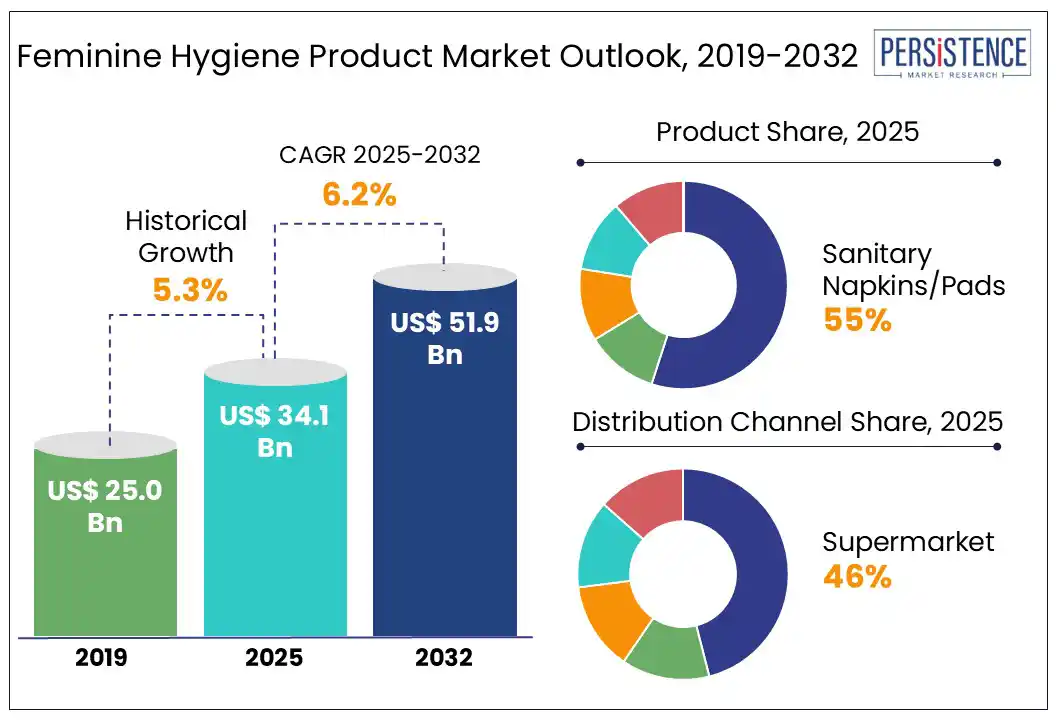
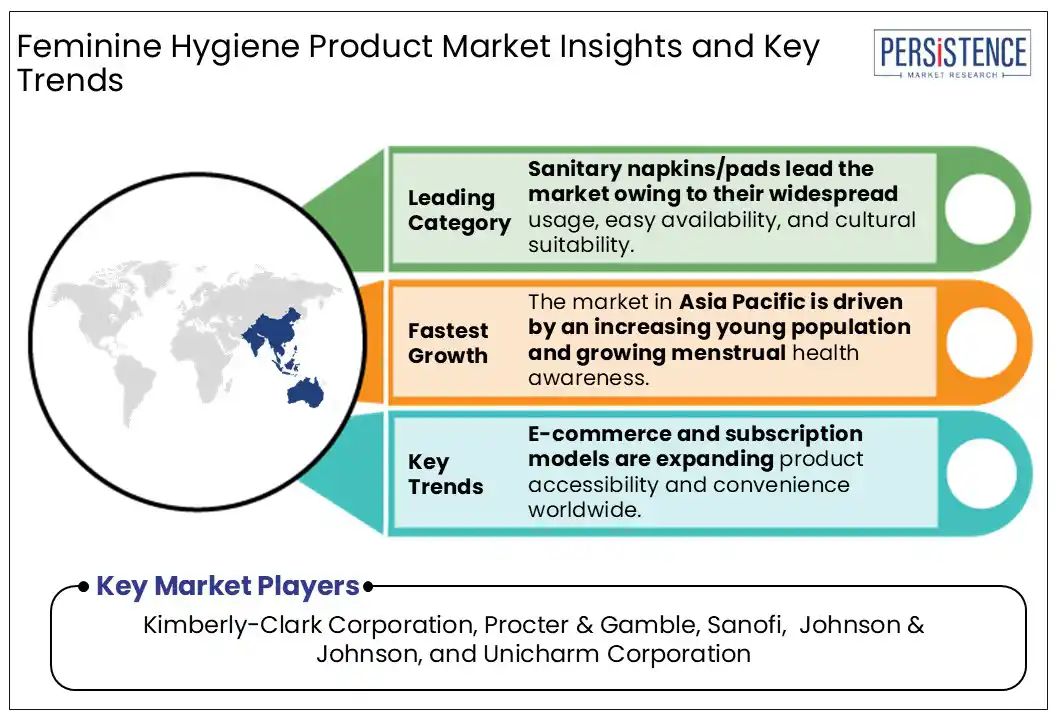
Based on product, this feminine hygiene product market has been segmented into sanitary napkins/pads, tampons, panty liners, menstrual cups, and feminine hygiene wash. Out of these, the sanitary napkins/pads segment is expected to dominate accounting for a market share of 55% in 2025, owing to their widespread usage, easy availability, and suitability for diverse cultural and economic contexts.

Sanitary pads are a staple feminine hygiene product globally, particularly in regions such as Asia Pacific, where they form the primary choice for menstrual hygiene due to their affordability and accessibility. They are available across urban and rural areas and cater to a wide range of income groups. Several governments and organizations distribute them at subsidized rates or for free in low-income regions, boosting their adoption.

Leading manufacturers are investing in product innovations, such as ultra-thin pads with high absorption, biodegradable options, and designs tailored for specific age groups or lifestyles. These developments have reinforced the popularity of sanitary pads.

Distribution Channel Insights

Based on distribution channel, the market is divided into supermarket, convenience stores, department stores, retail pharmacies, and online purchases. Out of these, the supermarket segment is anticipated to dominate, accounting for 46% of the market share due to its convenience and accessibility.

Supermarkets offer a one-stop shopping experience, allowing consumers to purchase a wide range of feminine hygiene products alongside other household necessities. It provides an extensive selection of brands and product types, catering to diverse consumer preferences and budgets.

Supermarkets often feature discounts and promotional offers, making products more affordable and appealing to a broad customer base. The extensive network of supermarkets ensures product availability across various regions, including urban and suburban areas.

Supermarkets dominate the distribution of feminine hygiene products due to their convenience, variety, and accessibility. The rising prominence of online retail channels indicates a dynamic market poised for further evolution.
feminine-hygiene-product-market-insights-and-key-trends

Regional Insights

Asia Pacific Feminine Hygiene Product Market Trends

Asia Pacific is anticipated to lead the feminine hygiene product market share, accounting for approximately 34% of the market share over the forecast period. The growth is driven by a young population, rising disposable incomes, and growing menstrual health awareness. Government initiatives, such as India’s promotion programs targeting adolescent girls in rural areas, are playing a crucial role in reducing stigma and expanding access to hygiene products. Expanding availability of sanitary napkins and pads in both urban and rural regions, often supported by subsidies, is also promoting the growth of this market in the region.

Europe Feminine Hygiene Product Market Trends

The feminine hygiene product market in Europe is developing steadily, fueled by increased awareness about various sanitary products, high disposable incomes, and improved accessibility. Although sanitary pads remain a staple, innovations focus on ultra-thin and biodegradable options for environmentally conscious consumers. The market in Europe also benefits from widespread urbanization and supportive government initiatives. Another key driver is that the region is a global leader in sustainability and technological advancements. In Europe, regulations pertaining to product labeling, ingredient disclosure, and environmental impact are becoming more stringent.

Competitive Landscape

The global feminine hygiene product market is highly competitive, marked by the presence of major players such as Procter & Gamble, Kimberly-Clark, and Johnson & Johnson. These players are strengthening their market presence by building extensive product portfolios, fostering brand recognition, and employing robust marketing strategies. These companies continually invest in product innovation to cater to evolving consumer preferences and address sustainability concerns. On the other hand, emerging brands such as Luna Daily and WUKA are gaining traction by introducing eco-friendly and reusable alternatives, including menstrual cups and period underwear. Meanwhile, regional players in Asia Pacific and Africa are addressing local needs through affordable products and strategic distribution partnerships.

Key Industry Developments

  • In May 2025, GreenCore Solutions Corp. launched FemCare UltraThin, its first tree-free feminine care product line, now available to private label retailers throughout Europe. This innovation features SGS-tested, tree-free materials and universal packaging, reflecting the company’s aim to introduce sustainable hygiene solutions in Europe.
  • In March 2025, Procter & Gamble launched “Always Pocket Flexfoam”, a compact, portable feminine hygiene product offering leak-proof, comfortable protection. The launch included a partnership with Coachella 2025 as the festival’s first official period care sponsor, featuring an on-site “House of Flow” activation to provide product samples to attendees.

Companies Covered in Feminine Hygiene Product Market

  • Kimberly-Clark Corporation
  • Procter and Gamble
  • Unicharm Corporation
  • Svenska Cellulosa Aktiebolaget SCA
  • Johnson and Johnson
  • Sanofi
  • Ontex
  • Edgewell Personal Care
  • Lil-lets UK Limited
  • Diva International Inc.
Frequently Asked Questions

The feminine hygiene product market is projected to reach US$ 34.1 Bn in 2025.

Rising awareness and education surrounding menstrual hygiene are the key market drivers.

The feminine hygiene product market is poised to witness a CAGR of 6.2% from 2025 to 2032.

The growing demand for sustainable and reusable alternatives, such as biodegradable pads, is a key market opportunity.

Major players in the Global Feminine Hygiene Product Market include Kimberly-Clark Corporation, Procter & Gamble, Sanofi and others.

Global Feminine Hygiene Product Market Report Scope

Report Attribute

Details

Historical Data/Actuals

2019 - 2024

Forecast Period

2025 - 2032

Market Analysis Units

Value: US$ Bn

Geographical Coverage

  • North America
  • Latin America
  • Europe
  • South Asia and Oceania
  • East Asia
  • Middle East and Africa

Segmental Coverage

  • Product
  • Distribution Channel
  • Region

Competitive Analysis

  • Kimberly-Clark Corporation
  • Procter and Gamble
  • Unicharm Corporation
  • Svenska Cellulosa Aktiebolaget SCA
  • Johnson and Johnson
  • Sanofi
  • Ontex
  • Edgewell Personal Care
  • Lil-lets UK Limited
  • Diva International Inc.

Report Highlights

  • Market Forecast and Trends
  • Competitive Intelligence and Share Analysis
  • Growth Factors and Challenges
  • Strategic Growth Initiatives
  • Pricing Analysis
  • Future Opportunities and Revenue Pockets
  • Market Analysis Tools

Customization and Pricing

Available upon request

Market Segmentation

By Product

  • Sanitary Napkins/Pads
  • Tampons
  • Panty Liners
  • Menstrual Cups
    • Feminine Hygiene Wash

By Distribution Channel

  • Supermarket
  • Convenience Stores
  • Department Stores
  • Retail Pharmacies
  • Online Purchase

By Region

  • North America
  • Latin America
  • Europe
  • Middle East and Africa
  • South Asia and Oceania
  • East Asia

Related Reports

  1. Executive Summary
    1. Feminine Hygiene Product Market Snapshot, 2025 and 2032
    2. Market Opportunity Assessment, 2025 - 2032, US$ Bn
    3. Key Market Trends
    4. Future Market Projections
    5. Premium Market Insights
    6. Industry Developments and Key Market Events
    7. PMR Analysis and Recommendations
  2. Market Overview
    1. Market Scope and Definition
    2. Market Dynamics
      1. Drivers
      2. Restraints
      3. Opportunity
      4. Challenges
      5. Key Trends
    3. Macro-Economic Factors
      1. Global Sectorial Outlook
      2. Global GDP Growth Outlook
    4. COVID-19 Impact Analysis
    5. Forecast Factors - Relevance and Impact
  3. Value Added Insights
    1. Regulatory Landscape
    2. Pipeline Analysis
    3. Product Adoption Analysis
    4. Value Chain Analysis
    5. Key Promotional Strategies by Manufacturers
    6. PESTLE Analysis
    7. Porter’s Five Force Analysis
  4. Feminine Hygiene Product Market Outlook:
    1. Key Highlights
      1. Market Size (US$ Bn) and Y-o-Y Growth
      2. Absolute $ Opportunity
    2. Market Size (US$ Bn) Analysis and Forecast
      1. Historical Market Size (US$ Bn) Analysis, 2019-2024
      2. Market Size (US$ Bn) Analysis and Forecast, 2025-2032
    3. Global Feminine Hygiene Product Market Outlook: Product
      1. Introduction / Key Findings
      2. Historical Market Size (US$ Bn) Analysis, By Product, 2019 - 2024
      3. Market Size (US$ Bn) Analysis and Forecast, By Product, 2025 - 2032
        1. Sanitary Napkins/Pads
        2. Tampons
        3. Panty Liners
        4. Menstrual Cups
        5. Feminine Hygiene Wash
      4. Market Attractiveness Analysis: Product
    4. Global Feminine Hygiene Product Market Outlook: Distribution Channel
      1. Introduction / Key Findings
      2. Historical Market Size (US$ Bn) Analysis, By Distribution Channel, 2019 - 2024
      3. Market Size (US$ Bn) Analysis and Forecast, By Distribution Channel, 2025 - 2032
        1. Supermarket
        2. Convenience Stores
        3. Department Stores
        4. Retail Pharmacies
        5. Online Purchase
      4. Market Attractiveness Analysis: Distribution Channel
  5. Global Feminine Hygiene Product Market Outlook: Region
    1. Key Highlights
    2. Historical Market Size (US$ Bn) Analysis, By Region, 2019 - 2024
    3. Market Size (US$ Bn) Analysis and Forecast, By Region, 2025 - 2032
      1. North America
      2. Europe
      3. Asia Pacific
      4. South Asia and Oceania
      5. Latin America
      6. Middle East & Africa
    4. Market Attractiveness Analysis: Region
  6. North America Feminine Hygiene Product Market Outlook:
    1. Key Highlights
    2. Historical Market Size (US$ Bn) Analysis, By Market, 2019 - 2024
      1. By Product
      2. By Distribution Channel
    3. Market Size (US$ Bn) Analysis and Forecast, By Country, 2025 - 2032
      1. U.S.
      2. Canada
    4. Market Size (US$ Bn) Analysis and Forecast, By Product, 2025 - 2032
      1. Sanitary Napkins/Pads
      2. Tampons
      3. Panty Liners
      4. Menstrual Cups
      5. Feminine Hygiene Wash
    5. Market Size (US$ Bn) Analysis and Forecast, By Distribution Channel, 2025 - 2032
      1. Supermarket
      2. Convenience Stores
      3. Department Stores
      4. Retail Pharmacies
      5. Online Purchase
    6. Market Attractiveness Analysis
  7. Europe Feminine Hygiene Product Market Outlook:
    1. Key Highlights
    2. Historical Market Size (US$ Bn) Analysis, By Market, 2019 - 2024
      1. By Country
      2. By Product
      3. By Distribution Channel
    3. Market Size (US$ Bn) Analysis and Forecast, By Country, 2025 - 2032
      1. Germany
      2. France
      3. U.K.
      4. Italy
      5. Spain
      6. Russia
      7. Türkiye
      8. Rest of Europe
    4. Market Size (US$ Bn) Analysis and Forecast, By Product, 2025 - 2032
      1. Sanitary Napkins/Pads
      2. Tampons
      3. Panty Liners
      4. Menstrual Cups
      5. Feminine Hygiene Wash
    5. Market Size (US$ Bn) Analysis and Forecast, By Distribution Channel, 2025 - 2032
      1. Supermarket
      2. Convenience Stores
      3. Department Stores
      4. Retail Pharmacies
      5. Online Purchase
    6. Market Attractiveness Analysis
  8. East Asia Feminine Hygiene Product Market Outlook:
    1. Key Highlights
    2. Historical Market Size (US$ Bn) Analysis, By Market, 2019 - 2024
      1. By Country
      2. By Product
      3. By Distribution Channel
    3. Market Size (US$ Bn) Analysis and Forecast, By Country, 2025 - 2032
      1. China
      2. Japan
      3. South Korea
    4. Market Size (US$ Bn) Analysis and Forecast, By Product, 2025 - 2032
      1. Sanitary Napkins/Pads
      2. Tampons
      3. Panty Liners
      4. Menstrual Cups
      5. Feminine Hygiene Wash
    5. Market Size (US$ Bn) Analysis and Forecast, By Distribution Channel, 2025 - 2032
      1. Supermarket
      2. Convenience Stores
      3. Department Stores
      4. Retail Pharmacies
      5. Online Purchase
    6. Market Attractiveness Analysis
  9. South Asia & Oceania Feminine Hygiene Product Market Outlook:
    1. Key Highlights
    2. Historical Market Size (US$ Bn) Analysis, By Market, 2019 - 2024
      1. By Country
      2. By Product
      3. By Distribution Channel
    3. Market Size (US$ Bn) Analysis and Forecast, By Country, 2025 - 2032
      1. India
      2. Southeast Asia
      3. ANZ
      4. Rest of South Asia & Oceania
    4. Market Size (US$ Bn) Analysis and Forecast, By Product, 2025 - 2032
      1. Sanitary Napkins/Pads
      2. Tampons
      3. Panty Liners
      4. Menstrual Cups
      5. Feminine Hygiene Wash
    5. Market Size (US$ Bn) Analysis and Forecast, By Distribution Channel, 2025 - 2032
      1. Supermarket
      2. Convenience Stores
      3. Department Stores
      4. Retail Pharmacies
      5. Online Purchase
    6. Market Attractiveness Analysis
  10. Latin America Feminine Hygiene Product Market Outlook:
    1. Key Highlights
    2. Historical Market Size (US$ Bn) Analysis, By Market, 2019 - 2024
      1. By Country
      2. By Product
      3. By Distribution Channel
    3. Market Size (US$ Bn) Analysis and Forecast, By Country, 2025 - 2032
      1. Brazil
      2. Mexico
      3. Rest of Latin America
    4. Market Size (US$ Bn) Analysis and Forecast, By Product, 2025 - 2032
      1. Sanitary Napkins/Pads
      2. Tampons
      3. Panty Liners
      4. Menstrual Cups
      5. Feminine Hygiene Wash
    5. Market Size (US$ Bn) Analysis and Forecast, By Distribution Channel, 2025 - 2032
      1. Supermarket
      2. Convenience Stores
      3. Department Stores
      4. Retail Pharmacies
      5. Online Purchase
    6. Market Attractiveness Analysis
  11. Middle East & Africa Feminine Hygiene Product Market Outlook:
    1. Key Highlights
    2. Historical Market Size (US$ Bn) Analysis, By Market, 2019 - 2024
      1. By Country
      2. By Product
      3. By Distribution Channel
    3. Market Size (US$ Bn) Analysis and Forecast, By Country, 2025 - 2032
      1. GCC Countries
      2. Egypt
      3. South Africa
      4. Northern Africa
      5. Rest of Middle East & Africa
    4. Market Size (US$ Bn) Analysis and Forecast, By Product, 2025 - 2032
      1. Sanitary Napkins/Pads
      2. Tampons
      3. Panty Liners
      4. Menstrual Cups
      5. Feminine Hygiene Wash
    5. Market Size (US$ Bn) Analysis and Forecast, By Distribution Channel, 2025 - 2032
      1. Supermarket
      2. Convenience Stores
      3. Department Stores
      4. Retail Pharmacies
      5. Online Purchase
      6. Others
    6. Market Attractiveness Analysis
  12. Competition Landscape
    1. Market Share Analysis, 2025
    2. Market Structure
      1. Competition Intensity Mapping By Market
      2. Competition Dashboard
    3. Company Profiles (Details - Overview, Financials, Strategy, Recent Developments)
      1. Sanofi
        1. Overview
        2. Segments and Products
        3. Key Financials
        4. Market Developments
        5. Market Strategy
      2. Kimberly-Clark Corporation
      3. Procter and Gamble
      4. Unicharm Corporation
      5. Svenska Cellulosa Aktiebolaget SCA
      6. Johnson and Johnson
      7. Ontex
      8. Edgewell Personal Care
      9. Lil-lets UK Limited
      10. Diva International Inc
  13. Appendix
    1. Research Methodology
    2. Research Assumptions
    3. Acronyms and Abbreviations

Research Methodology Framework for Market Research Excellence

At Persistence Market Research, we implement a comprehensive, validated, and multi-dimensional approachto market analysis that delivers actionable insights across complex market landscapes. Our methodology combines the analytical rigor of leading consulting firms with innovative research techniques, ensuring robust market assessments that guide strategic decision-making with confidence.

Core Research Philosophy

Our methodology is built on four foundational pillars:

Research Philosophy Image

At Persistence Market Research, our methodology is designed to transcend conventional market studies by combining analytical rigor, multi-source validation, and future-focused insights.

We integrate advanced research frameworks, robust data collection strategies, cutting-edge analytics, and innovative technologies to deliver a 360-degree view of complex markets.

We integrate advanced research frameworks, robust data collection strategies, cutting-edge analytics, and innovative technologies to deliver a 360-degree view of complex markets.

Each stage spanning from strategic scoping and hypothesis-building to competitive intelligence, quality validation, and actionable recommendations is engineered to provide clients with unmatched clarity, precision, and confidence in decision-making.

By embedding innovation and technology at the core, our approach ensures that insights are not only comprehensive but also predictive, empowering businesses to seize opportunities, mitigate risks, and achieve sustainable growth

Research Philosophy Image

Capturing Key Information and Events

During this phase, key research objectives focus on essential information and data points for assessing the market, including:

Research Philosophy Image

TAM-SAM-SOM Framework Implementation

We employ both top-down and bottom-up approaches to ensure accurate market sizing.

Top-Down Market SizingBottom-Up Market Sizing
Universe Definition: Total global/regional market identificationUnit Economics: Average transaction values, purchase frequencies, customer lifecycle
Segmentation Filters: Geographic, demographic, and behavioral constraintsCustomer Segmentation: Detailed buyer persona development and sizing
Market Share Analysis: Competitive landscape assessment and share allocationPenetration Analysis: Market penetration rates by segment and geography
Growth Rate Application: Historical trends and forward-looking growth assumptionsScaling Methodology: Extrapolation techniques with confidence intervals

Validation & Cross-Verification

  • Triangulation: Comparing top-down and bottom-up results for consistency
  • Sensitivity Analysis: Testing key assumptions and parameter variations
  • Peer Benchmarking: Comparison with analogous markets and industry benchmarks
  • Expert Review: External validation through industry specialist consultation

Research Philosophy Image

Forecasting & Projection Modeling

Our proprietary forecasting models incorporate multiple variables and scenarios.

Forecasting Components

  • Historical Trend Analysis: 10-year historical growth patterns and cyclical variations
  • Driver-Based Modeling: Economic indicators, demographic shifts, technology adoption
  • Scenario Planning: Base case, optimistic, and conservative projections
  • Monte Carlo Simulations: Probability-weighted outcomes and risk assessments

Model Validation

  • Back-Testing: Historical accuracy assessment over 3–5-year periods
  • Cross-Validation: Multiple modeling approaches for result comparison
  • External Benchmarking: Comparison with established market forecasts
  • Continuous Calibration: Quarterly model updates based on new data

Comprehensive Data Collection Strategy

Our secondary research phase establishes a robust knowledge base utilizing diverse, credible sources.

Secondary Data Sourcess

  • Industry Publications & Reports
  • Government & Regulatory Data
  • Financial Intelligence (filings & reports)
  • Academic Research & Digital Intelligence

Quality Assurance Protocol

  • Source credibility assessment and publication date validation
  • Data consistency checks across multiple sources
  • Bias identification and neutralization techniques
  • Information gap tracking for primary research prioritization

Research Philosophy Image

Primary Research Excellence

Our primary research methodology employs best-in-class techniques to capture unique market insights.

Quantitative Research Methods

  • Large-Scale Surveys: Statistically representative samples with 95% confidence intervals
  • Survey Methodology: Multi-channel deployment (online, telephone, in-person)
  • Question Architecture and Response Optimization

Qualitative Research Methods

  • Executive Interviews
  • Focus Groups
  • Expert Consultations

Quality Assurance & Validation Framework

Multi-Stage Validation Process

  • Source Verification and Consistency Testing
  • Outlier Detection and Bias Assessment
  • Peer Review Process and External Validation
  • Sensitivity Analysis and Confidence Intervals

Research Philosophy Image

Methodology Validation & Credibility

Our research methodology has been extensively validated through:

  • Academic Partnerships: Collaborations with top-tier business schools and research institutions
  • Client Success Stories: Documented case studies demonstrating research impact and ROI
  • Continuous Benchmarking: Performance comparison with leading global research firms

This comprehensive methodology framework positions Persistence Market Research at the forefront of market intelligence, combining the analytical sophistication of top-tier consulting firms with innovative research techniques. Our approach ensures that every market assessment delivers precise, actionable, and strategically valuable insights that drive business success in competitive market environments.

Ready to unlock your market potential? Contact our research experts to discuss how our validated methodology can transform your strategic decision-making with data-driven market intelligence.

Copyright © 2026 Persistence Market Research. All Rights Reserved

Connect With Us -