




- Energy Storage Solutions
- Energy Harvesting Market
Energy Harvesting Market Size, Share, and Growth Forecast, 2026 - 2033
Energy Harvesting Market by Technology (Piezoelectric, Thermoelectric, Photovoltaic, Radio Frequency (RF), Misc.), Component Type (Transducers, Power Management Units, Storage Devices, Energy Conversion Modules, Misc.), Application (Consumer Electronics & Wearables, Industrial & Manufacturing, Automotive & Transportation, Healthcare, Building & Home Automation, Security & Defense Systems, Misc.) and Regional Analysis for 2026 - 2033

Energy Harvesting Market Size and Trends Analysis
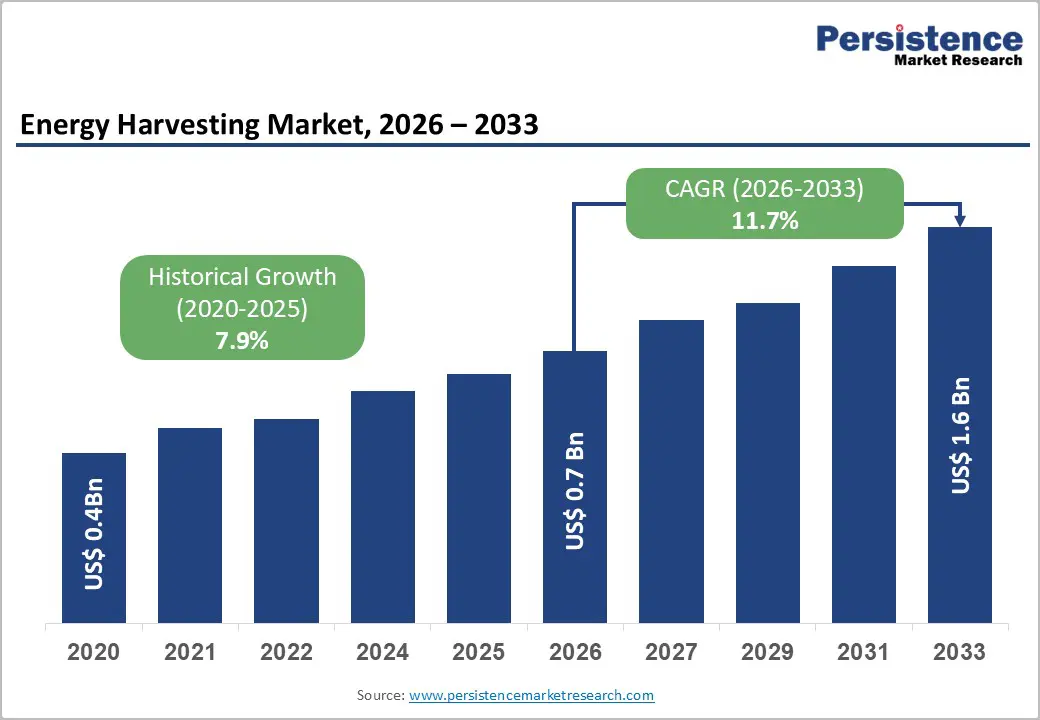
The global energy harvesting market size was valued at US$ 0.7 Bn in 2026 and is projected to reach US$ 1.6 Bn by 2033, growing at a CAGR of 11.7% between 2026 and 2033. This steady expansion is driven by the proliferation of battery-free IoT sensor deployments in industrial automation and smart building applications, technological advancements in ultra-low-power management circuits that enable efficient ambient energy conversion, and regulatory pressures promoting sustainable electronics amid EU battery regulations.
The market's momentum reflects a fundamental shift from battery-dependent devices to self-powered systems that harvest ambient energy from piezoelectric vibrations, electromagnetic waves, radio-frequency signals, and solar radiation. With industrial facilities implementing wireless sensor networks, smart buildings adopting battery-free environmental monitoring, and consumer electronics integrating energy-autonomous wearables, energy harvesting technologies have become essential for enabling maintenance-free IoT deployments, reducing electronic waste, and supporting sustainable digital transformation initiatives across global enterprises.
Key Industry Highlights:
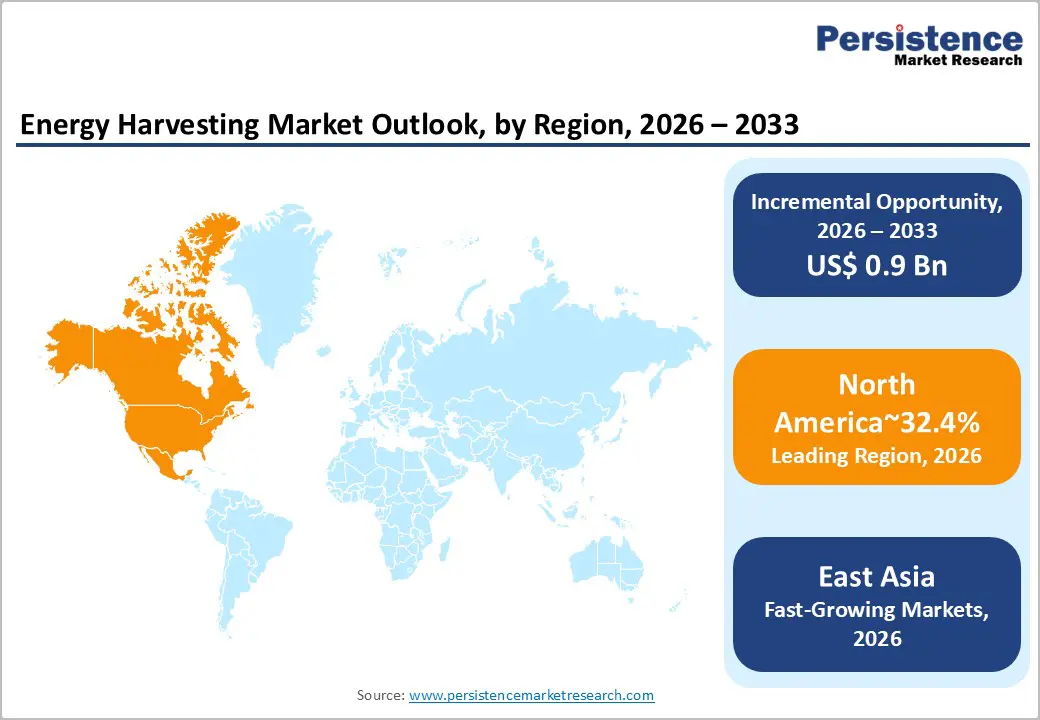
- Regional Leadership: North America leads the globalenergy harvesting market with a 32.4% share, driven by advanced IoT infrastructure, adoption of industrial automation, and strong smart building deployment.
- Fastest-Growing Regional Cluster: East Asia is the fastest-growing region, with a 28% share, driven by large-scale electronics manufacturing, semiconductor production, and government-backed smart city initiatives.
- Strong European Presence: Europe holds 18% market share, supported by strict environmental regulations, sustainability mandates, and leadership in energy-efficient smart building technologies.
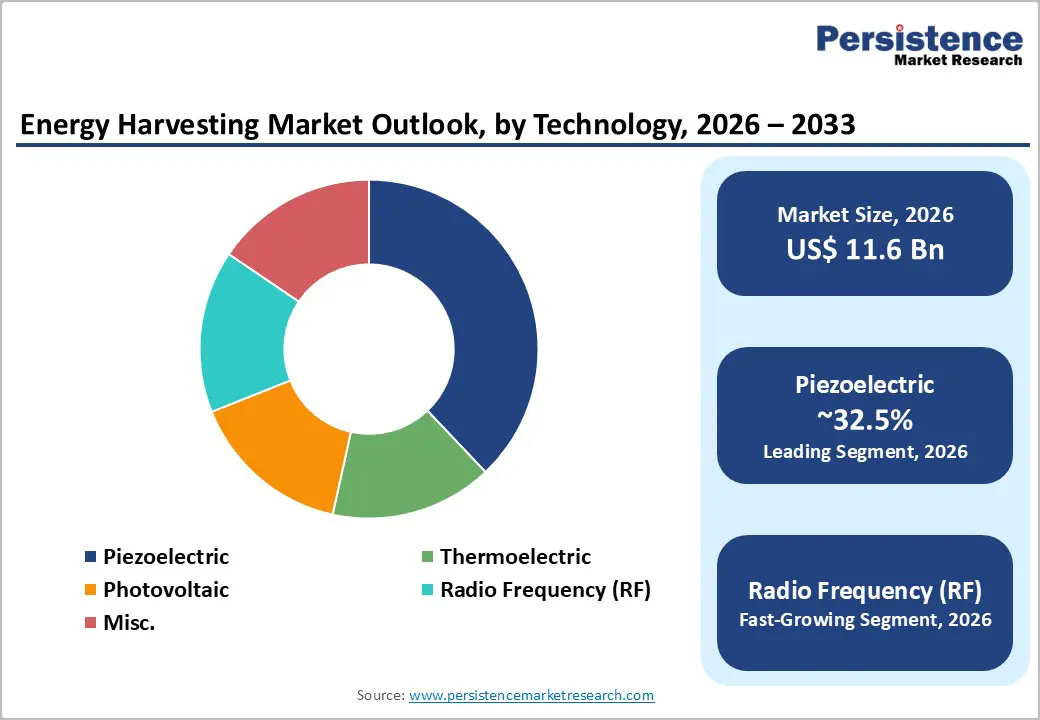
- Leading Technology Segment: Piezoelectric technology dominates with a 32.5% share, leveraging mechanical vibrations from industrial machinery, automotive systems, and human motion to generate reliable energy.
- Fastest-Growing Technology Segment: Radio Frequency (RF) energy harvesting is the fastest-growing segment, driven by 5G proliferation, ambient electromagnetic radiation, and IoT device deployment.
- Leading Component Segment: Transducers lead with a 38.5% market share, serving as the core interface that converts ambient energy into usable electricity across industrial, consumer, and IoT applications.
| Global Market Attributes | Key Insights |
|---|---|
| Energy Harvesting Market Size (2026E) | US$ 0.7 Bn |
| Market Value Forecast (2033F) | US$ 1.6 Bn |
| Projected Growth (CAGR 2026 to 2033) | 11.7% |
| Historical Market Growth (CAGR 2020 to 2025) | 7.9% |
Market Dynamics
Growth Drivers
Electronics Manufacturing Expansion and IoT Device Proliferation
The substantial global expansion of electronics manufacturing and the proliferation of Internet of Things (IoT) devices create strong demand for the energy harvesting market, as manufacturers seek battery-free solutions that enable autonomous sensor operations across industrial, consumer, and commercial applications. India's electronics industry demonstrated remarkable growth, with domestic production expanding from US$29 billion in FY15 to US$101 billion in FY23, contributing 3.4 percent to the country's GDP.
The electronics manufacturing sector is expected to grow from US$75 billion in FY21 to US$300 billion by FY26, with mobile phones, IT hardware, consumer electronics, industrial electronics, and automotive electronics leading the expansion. India emerged as the second-largest mobile phone manufacturer after China, with a 21-fold increase in mobile phone production, reaching US$49.3 billion over the past decade. India's electronics exports, including mobile phones, IT hardware, and consumer electronics, reached US$29.12 billion in FY24, up 23.6% from the previous year.
SMK Electronics Corporation announced at CES 2026 the launch of its HarvestLoop™ energy-harvesting solutions, including a solar-powered coin battery and Slim Sense SCPS LoRaWAN® tracker, highlighting its expansion into sensor-based, batteryless energy solutions for IoT and wearable devices. This massive growth in electronics production, combined with IoT sensor deployment requirements for industrial monitoring, environmental sensing, and asset tracking, necessitates energy-harvesting technologies that enable autonomous device operation without battery replacement, substantially benefiting the energy harvesting market.
Building Automation and Smart Infrastructure Development
The comprehensive development of smart buildings and intelligent infrastructure across global markets creates substantial opportunities for the energy harvesting market by enabling the deployment of battery-free sensors, wireless switches, and environmental monitoring devices, thereby enabling automated building management without maintenance-intensive battery replacements. India's building and construction sector offers robust investment opportunities, with government capital expenditure rising 11.1 percent to $133 billion in FY 2024-25, equivalent to 3.4 percent of GDP, fueling nationwide infrastructure growth.
The real estate market is projected to reach $5.8 trillion by 2047, accounting for 15.5 percent of total GDP, while initiatives such as PMAY-U have sanctioned 1.18 crore houses, with 86.6 lakh already completed. The U.S. construction sector contributed $2.2 trillion in annual spending in 2024, representing 4.5 percent of GDP, with 1.6 million new homes built in 2024, underscoring residential demand.
In 2025, e-peas showcased advanced energy-harvesting technologies at CES 2025 for smart buildings and smart homes, highlighting battery-free, eco-friendly solutions powered by ambient energy, including presence detectors, CO sensors, and Edge IoT devices, leveraging its AEM13920 dual-source and other AEM ICs. On March 12, 2024, the Connectivity Standards Alliance announced the release of Green Power 1.1.2, enhancing Zigbee-based energy-harvesting technology for battery-free or low-battery IoT devices, simplifying testing and strengthening adoption of energy-harvested control devices such as lighting switches and sensors.
This substantial building construction activity, combined with smart building technology adoption requirements, necessitates energy-harvesting solutions that enable wireless sensor networks, automated lighting controls, and HVAC optimisation without requiring battery maintenance, driving sustained demand in the energy-harvesting market.
Regulatory Frameworks and Environmental Sustainability Mandates
The implementation of stringent battery disposal regulations and environmental sustainability mandates across global markets compels manufacturers to adopt energy harvesting technologies in the energy harvesting market, helping address electronic waste concerns, reduce the environmental impact of the battery lifecycle, and ensure compliance with emerging regulations restricting disposable battery use. Asahi Kasei Microdevices launched its AP4413 ultra-low current PMIC series designed for energy harvesting battery charging applications in IoT sensors, remote controls and Bluetooth® trackers, consuming just 52 nA and supporting rechargeable battery adoption amid EU regulatory shifts, accelerating the market's transition from disposable batteries to sustainable energy-harvesting electronics.
Europe's electronics industry ecosystem contributed approximately €51 billion to the global semiconductor industry in 2022, accounting for 9.3 percent of the global market. The EU27 region showed strong performance, with double-digit growth of 12.3 percent. The European Monitor of Industrial Ecosystems (EMI) report emphasises environmental impact tracking and the transition toward sustainable electronics across European markets.
The Middle East construction sector grew 2.8% in 2024 and is projected to grow 4.2% in 2025, according to IMF data, driven by infrastructure projects that require sustainable building technologies. These regulatory pressures, combined with corporate sustainability commitments and consumer preferences for environmentally responsible products, necessitate energy harvesting solutions that eliminate disposable batteries, reduce electronic waste, and enable circular economy principles within electronics manufacturing, substantially driving the energy harvesting market.
Market Restraining Factors
Power Output Limitations and Energy Conversion Efficiency Constraints
Energy harvesting technologies face fundamental physical limitations on power output and energy conversion efficiency, constraining applicability to ultra-low-power devices and limiting adoption for applications requiring higher power consumption or consistent energy availability. Ambient energy sources, including vibrations, temperature differences, electromagnetic noise, and radio-frequency signals, provide intermittent, low-intensity power that is insufficient for many electronic applications.
Piezoelectric generators produce microwatts to milliwatts depending on vibration frequency and amplitude, thermoelectric devices require substantial temperature gradients for meaningful power generation, and RF harvesting depends on proximity to transmitters with variable signal strength. These power limitations limit the deployment of energy harvesting to specialised applications, including wireless sensors, RFID tags, and ultra-low-power microcontrollers, excluding higher-power devices that require continuous operation or rapid response times, thereby constraining overall market addressability.
Key Market Opportunities
Industrial Automation and Predictive Maintenance Sensor Deployment
The comprehensive deployment of industrial automation systems and predictive maintenance programs across manufacturing facilities presents transformative opportunities for the energy harvesting market through battery-free wireless sensor networks, enabling continuous equipment monitoring without maintenance-intensive battery replacements in harsh industrial environments. In 2023, Sony Semiconductor Solutions Corporation developed an energy-harvesting module that efficiently generates power from electromagnetic-wave noise, converting ambient electromagnetic energy from devices in factories, offices, and homes into electricity, enabling stable power for low-power IoT sensors and communications equipment and contributing to a sustainable, battery-free IoT ecosystem.
India's logistics and warehousing infrastructure is undergoing substantial expansion, with the warehousing market expected to reach 159 million sq. ft. by 2047 at a 4 percent CAGR, driven by e-commerce and manufacturing growth, and by the need for extensive sensor deployments for inventory management and environmental monitoring. Europe's construction output in December 2024 showed stability in the euro area and 0.4 percent growth in the EU, with strong monthly gains from Poland (+5.7 percent), the Czech Republic (+4.6 percent), and Portugal (+3.6 percent), indicating ongoing investment in industrial infrastructure.
Industrial facilities require continuous monitoring of vibration, temperature, pressure, and equipment status across distributed machinery, conveyor systems, motors, and production lines, traditionally constrained by battery replacement logistics in hazardous locations, elevated installations, and sealed equipment housings. Energy harvesting enables self-powered sensors to capture kinetic energy from machinery vibrations, thermal energy from equipment heat dissipation, and electromagnetic energy from industrial environments, eliminating battery maintenance while enabling real-time condition monitoring that supports predictive maintenance strategies, reducing unplanned downtime, and optimising equipment lifecycle management within the energy harvesting market.
Healthcare Remote Monitoring and Medical IoT Applications
The substantial expansion of remote patient monitoring, wearable medical devices, and hospital IoT systems creates significant opportunities for the energy harvesting market through battery-free sensors, enabling continuous health monitoring without patient intervention for battery replacement or device charging. India's healthcare industry is poised for strong growth, emerging as one of the country's largest sectors with over 7.5 million people employed and millions of new jobs expected by 2030, driven by increasing adoption of digital health, telemedicine, and health-tech solutions transforming service delivery and accessibility.
Brazil is the largest healthcare market in Latin America, accounting for 9.7 percent of its GDP, or roughly US$135 billion, and supporting a vast network of over 575,000 physicians, 402,000 dentists, and more than 93,000 drugstores, creating substantial medical device deployment opportunities. Europe's healthcare industry faces an estimated shortfall of 1.2 million doctors, nurses, and midwives, according to the 2024 Health at a Glance: Europe report. An ageing population is driving higher demand for long-term and chronic care that requires remote monitoring solutions.
MIT developed a battery-free, self-powered sensor that harvests energy from ambient magnetic fields, enabling operation in remote or hard-to-reach locations without wiring or battery replacement. It provides long-term monitoring of temperature and operational data while advancing practical applications of energy harvesting in industrial IoT systems. Healthcare applications, including continuous glucose monitors, cardiac rhythm sensors, temperature monitors, and activity trackers, require unobtrusive, maintenance-free operation enabling patient comfort and clinical effectiveness.
Energy harvesting technologies that capture body heat, motion energy, and ambient electromagnetic fields enable medical wearables to operate indefinitely without battery replacements, reducing patient burden, ensuring continuous monitoring reliability, and enabling implantable sensors for chronic disease management within the energy harvesting market.
Category-wise Analysis
Technology Insights
Piezoelectric technology dominates the global energy harvesting market with 32.5% market share in 2026, reflecting the widespread availability of mechanical vibrations, structural movements, and kinetic energy sources across industrial, automotive, and consumer applications. Piezoelectric materials generate electrical charge when subjected to mechanical stress, enabling energy capture from machinery vibrations, vehicle movements, human motion, and structural oscillations, providing reliable power generation from predictable mechanical energy sources.
WePower Technologies, in collaboration with Southco, unveiled a battery-free smart lock at CES 2026, powered by its Gemns™ Energy Harvesting Generator (EHG), which captures kinetic energy from button presses and motion to power locking and wireless communication, demonstrating piezoelectric energy-harvesting applications in access control. Industrial facilities generate continuous vibrations from motors, pumps, compressors, and production machinery, providing a consistent energy source for wireless sensor networks that monitor equipment condition, temperature, and operational parameters. Automotive applications leverage road-induced vibrations, suspension movements, and tire pressure fluctuations for tire pressure monitoring systems and structural health sensors.
Radio Frequency (RF) energy harvesting is the fastest-growing technology in the global energy harvesting market, driven by ubiquitous wireless communications infrastructure, proliferation of 5G networks, and ambient electromagnetic radiation from cellular towers, Wi-Fi routers, and broadcast transmitters, enabling distributed power generation for IoT devices. RF harvesting captures electromagnetic energy from intentional transmitters or ambient wireless signals, converting radio waves into usable electrical power for ultra-low power electronics.
Technology Type Insights
Transducers command the largest component share of the global energy harvesting market at 38.5% in 2026, reflecting their role as core energy conversion elements that transform ambient energy into usable electrical signals. This category includes piezoelectric crystals that convert mechanical stress into charge, thermoelectric modules that generate voltage from temperature differences, photovoltaic cells that convert light into electricity, and electromagnetic coils that produce current from magnetic field variations, collectively serving as the primary interface between environmental energy and electronic systems. SMK Electronics Corporation showcased its HarvestLoop™ energy harvesting solutions at CES 2026, including a solar-powered coin battery demonstrating how photovoltaic transducers can be integrated into compact form factors for low-power applications.
The segment’s dominance is also driven by the need for highly engineered, application-specific designs optimized for energy source type, operating frequency, power output, form factor, and environment. Industrial vibration monitoring relies on rugged piezoelectric transducers that withstand mechanical stress and temperature extremes, while consumer wearables favor lightweight, flexible transducers that conform to body movement.
Power Management Units (PMUs) are the fastest-growing component of the global energy harvesting market, driven by technological advances in ultra-low-power integrated circuits, sophisticated energy storage management algorithms, and the critical need for efficient power conversion from intermittent, low-voltage ambient sources into stable supply voltages for electronic loads. PMUs encompass voltage regulators, maximum power point tracking circuits, energy storage controllers, and power-on reset circuits, enabling optimal energy utilisation from variable ambient sources.
Regional Insights and Trends
North America Market Trend
North America dominates the Global Energy Harvesting Market with 32.4% share, driven by advanced IoT infrastructure, substantial R&D investments in energy-autonomous electronics, early adoption of Industry 4.0 technologies across manufacturing sectors, and concentrated presence of leading energy harvesting semiconductor companies and system integrators. The region benefits from established smart-building markets, mature industrial-automation deployments, and proactive sustainability initiatives that support the adoption of battery-free electronics.
The U.S. construction sector represents a multi-trillion-dollar economic pillar, accounting for a significant share of national GDP and employing millions, with steady residential development driving demand for building automation and intelligent energy management systems. SMK Electronics Corporation’s introduction of HarvestLoop™ energy harvesting solutions, including solar-powered coin batteries and LoRaWAN® tracking devices, reflects growing U.S. industrial participation in batteryless sensing technologies for IoT and wearables. Research institutions such as MIT have also demonstrated self-powered sensing systems that harvest ambient magnetic energy, reducing the need for wiring and battery maintenance in remote or inaccessible environments and reinforcing North America’s role in foundational energy-harvesting innovation.
Energous Corporation has introduced active RF energy harvesting technologies enabling wireless “one-to-many” charging of IoT nodes for smart buildings and industrial settings, while the Connectivity Standards Alliance has advanced the Green Power protocol to enable battery-free or low-power Zigbee-based devices. North America’s competitive strengths include robust venture funding for deep-tech startups, collaboration between semiconductor firms and IoT platforms, technologically mature end-markets in manufacturing and commercial real estate, and regulatory emphasis on sustainable electronics. These factors collectively position the region for continued leadership in energy harvesting, with rapid commercialization, ecosystem expansion, and cross-sector deployments over the coming decade.
East Asia Market Trend
East Asia represents 28.0% of the Global Energy Harvesting Market, characterized by massive electronics manufacturing capacity, rapid IoT adoption across industrial and consumer sectors, substantial government investments in smart city initiatives, and concentrated semiconductor production capabilities supporting energy harvesting component manufacturing.
The region’s strong position reflects its strategic focus on electronics leadership, sustainable manufacturing, and extensive deployment of IoT infrastructure across factories, buildings, and public systems.
Sony Semiconductor Solutions has developed electromagnetic energy-harvesting modules that convert ambient electromagnetic noise into usable power for low-energy IoT sensors and communication devices, illustrating ongoing Japanese innovation in energy-harvesting materials and system design. Asahi Kasei Microdevices has introduced ultra-low-current PMIC solutions optimized for energy-harvesting battery charging in IoT sensors, demonstrating advanced semiconductor capabilities in ultra-low-power power management critical for harvesting applications. East Asia benefits from established semiconductor ecosystems, mature consumer electronics markets, and government-backed smart manufacturing programs, positioning the region for sustained growth driven by high-volume production, technological specialisation, and expanding domestic IoT demand through 2033.
Europe Market Trend
Europe accounts for 18% of the Global Energy Harvesting Market, supported by stringent environmental regulations that promote battery-free electronics, comprehensive sustainability mandates that drive circular-economy principles, advanced building-automation markets that emphasise energy efficiency, and collaborative research initiatives that advance energy-harvesting technologies. The region's market characteristics reflect strong regulatory enforcement, technology sovereignty priorities, and established partnerships between component manufacturers, system integrators, and end-user industries.
Europe is emerging as a strong hub for the Energy Harvesting Market, driven by leadership in sustainable IoT devices, smart building automation, and ultra-low-power electronics. Companies such as e-peas (Belgium) are advancing battery-free sensor solutions for presence detection, CO-monitoring, and edge IoT devices in smart buildings and homes, leveraging dual-source and high-efficiency power management ICs that optimize ambient energy utilization. EnOcean GmbH (Germany) has expanded efforts to scale energy-harvesting IoT deployments, reinforcing its role as a leading developer of self-powered wireless building automation technologies.
Competitive Landscape
The global energy harvesting market is moderately consolidated, led by a mix of major semiconductor companies and specialised innovators. Large players such as Analog Devices, Inc., STMicroelectronics, Texas Instruments, Inc., ABB, and Schneider Electric dominate the market with strong R&D, IP portfolios, and integrated power management solutions that support industrial and IoT adoption. Meanwhile, niche innovators such as EnOcean GmbH and Powercast Corp. contribute specialised harvesting technologies, adding fragmentation at the application level.
This combination creates a competitive environment where core technology layers are consolidated, but device applications remain diverse. As adoption accelerates in smart buildings, industrial automation, and wireless sensors, collaboration and ecosystem partnerships are becoming increasingly important in shaping future market structure.
Key Industry Developments
- January 5, 2026, SMK Electronics Corporation, USA, announced at CES 2026 the launch of its new HarvestLoop™ energy harvesting solutions, including a solar-powered coin battery and Slim Sense SCPS LoRaWAN® tracker, highlighting the company’s expansion into sensor-based, batteryless energy solutions and innovative applications in IoT and wearable devices.
- January 5, 2026, WePower Technologies, in collaboration with Southco, unveiled a battery-free smart lock at CES 2026, powered by their Gemns™ Energy Harvesting Generator (EHG). The solution captures kinetic energy from button presses and motion to power locking and wireless communication, eliminating the need for batteries or wiring and enabling maintenance-free, scalable access control for smart home, industrial, and enterprise applications.
Companies Covered in Energy Harvesting Market
- ABB
- Analog Devices, Inc.
- Bionic Power, Inc.
- Cymbet
- EnOcean GmbH
- Mahle GmbH
- Powercast Corp.
- Schneider Electric
- STMicroelectronics
- Texas Instruments, Inc.
Frequently Asked Questions
The Global Energy Harvesting Market is projected to be valued at US$ 0.7 Bn in 2026.
The Single-Temperature segment is expected to account for approximately 32.5% of the Global Energy Harvesting Market by Temperature Class in 2026.
The market is expected to witness a CAGR of 11.7% from 2026 to 2033.
The Energy Harvesting Market is primarily driven by rapid electronics manufacturing and IoT device proliferation, expanding smart building and infrastructure adoption, and regulatory sustainability mandates pushing industries toward battery-free, low-maintenance autonomous devices.
Key market opportunities in the Energy Harvesting Market lie in industrial automation and predictive maintenance through self-powered sensors for real-time equipment monitoring, and in healthcare via battery-free medical IoT devices enabling continuous, maintenance-free patient monitoring.
Key players in the Energy Harvesting Market include Analog Devices, Inc., STMicroelectronics, Texas Instruments, Inc., ABB, and Schneider Electric.


