




- Specialty & Fine Chemicals
- Wetting Additives Market
Wetting Additives Market Size, Share, and Growth Forecast, 2026 - 2033
Wetting Additives Market by Product Type (For Solvent-Based Media, For Water-Based Media), Application (Paints & Coatings, Printing Inks, Adhesives & Sealants, Textiles, Plastics & Films), and Regional Analysis for 2026 - 2033

Wetting Additives Market Size and Trends Analysis
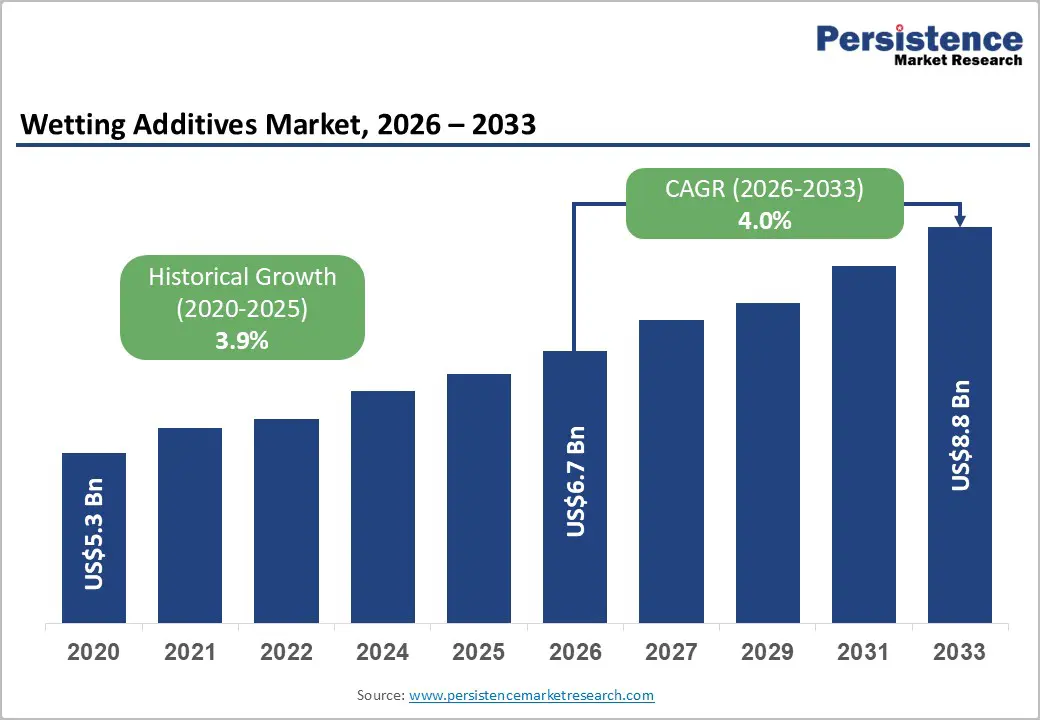
The global wetting additives market size is likely to be valued at US$6.7 billion in 2026 and is expected to reach US$8.8 billion by 2033, growing at a CAGR of 4.0% during the forecast period from 2026 to 2033, driven by its essential role in enhancing surface wetting, substrate penetration, and dispersion efficiency across a wide range of liquid formulations. These additives are critical in optimizing performance characteristics such as uniform coating, improved adhesion, and defect reduction, particularly in applications such as paints & coatings, printing inks, and adhesives & sealants.
Market expansion is strongly influenced by the ongoing transition toward water-based and environmentally compliant formulations, as regulatory frameworks worldwide continue to restrict volatile organic compound (VOC) emissions and encourage sustainable chemistry. Increasing demand from key end-user industries, including construction, automotive, packaging, and industrial manufacturing, is reinforcing consistent consumption patterns, as these sectors rely heavily on high-performance coatings and surface treatment solutions.
Key Industry Highlights:
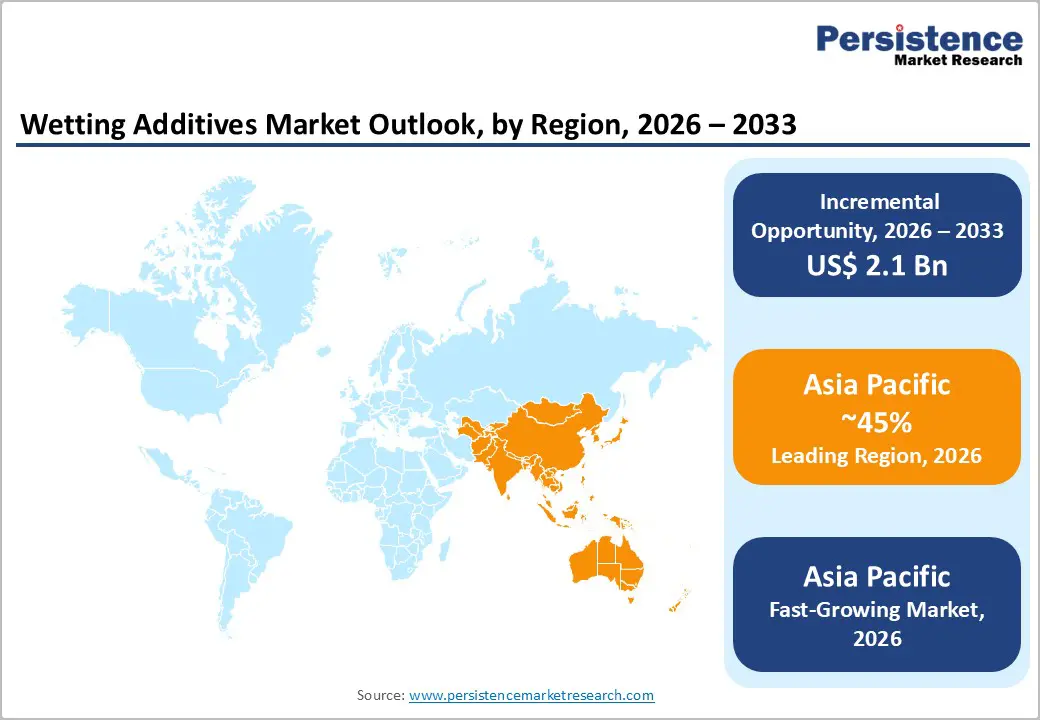
- Leading Region: Asia Pacific is anticipated to be the leading region, accounting for a market share of 45% in 2026, driven by strong demand from paints & coatings, rapid industrialization, expanding construction activities, and growing automotive and packaging industries.
- Fastest-growing Region: Asia Pacific is likely to be the fastest-growing region, supported by rapid industrialization, infrastructure development, and increasing adoption of water-based formulations across key end-use industries.
- Leading Product Type: The for solvent-based media segment is projected to represent the leading product type in 2026, accounting for 40% of the revenue share, driven by superior compatibility with high-performance coatings, faster evaporation rates, and strong substrate wetting in industrial applications.
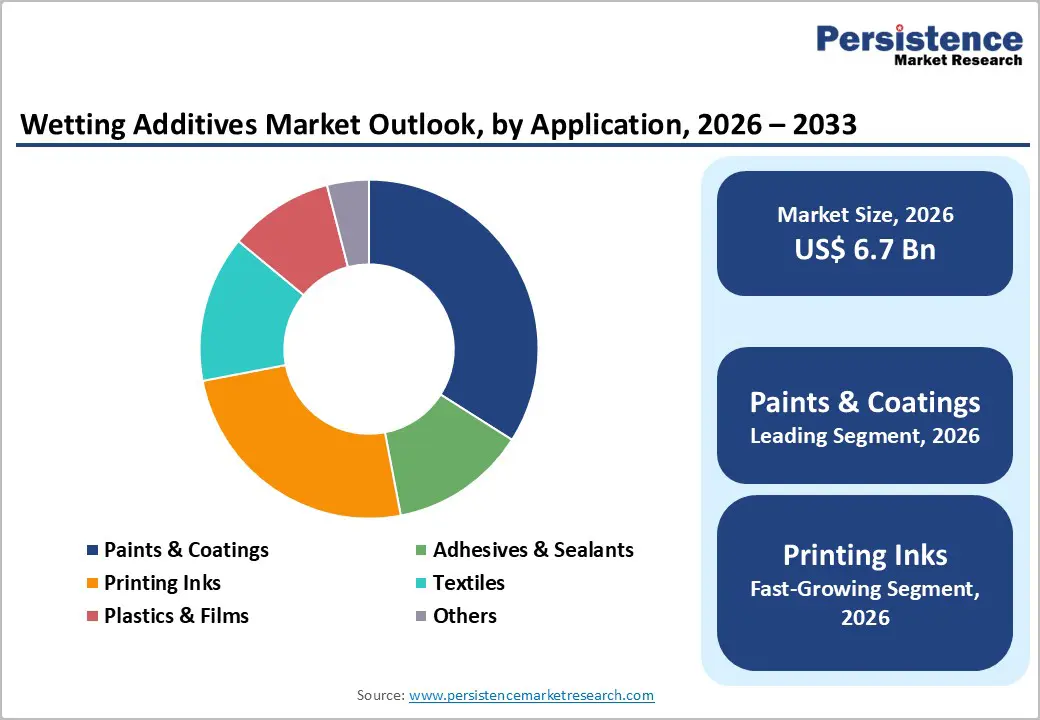
- Leading Application: Paints & coatings are anticipated to be the leading application, accounting for over 50% of the revenue share in 2026, supported by high demand from construction, automotive, and industrial sectors, along with the need for improved surface coverage, adhesion, and finish quality.
| Key Insights | Details |
|---|---|
|
Wetting Additives Market Size (2026E) |
US$6.7 Bn |
|
Market Value Forecast (2033F) |
US$8.8 Bn |
|
Projected Growth (CAGR 2026 to 2033) |
4.0% |
|
Historical Market Growth (CAGR 2020 to 2025) |
3.9% |
Market Factors - Driver, Restraint, and Opportunity Analysis
Driver Analysis - Shift toward Water-Based Formulations and Low-VOC Regulations
The transition toward water-based formulations is accelerating due to increasingly stringent environmental regulations targeting volatile organic compound (VOC) emissions. Regulatory bodies across major economies are enforcing limits on solvent usage in coatings, inks, and adhesives, compelling manufacturers to reformulate products with environmentally compliant alternatives. Wetting additives play a crucial role in these systems by enhancing surface wetting, pigment dispersion, and substrate adhesion in the absence of organic solvents. This shift is particularly evident in architectural coatings, industrial finishes, and packaging inks, where sustainability requirements are reshaping formulation strategies and driving consistent demand for advanced wetting solutions.
Rising environmental awareness among consumers and industries is reinforcing the adoption of eco-friendly materials, supporting water-based technologies. Manufacturers are investing in research to improve the performance of waterborne systems, ensuring they match or exceed solvent-based counterparts in terms of durability, appearance, and application efficiency. Wetting additives tailored for aqueous systems are being engineered to deliver superior spreading and defect control, enabling broader application across industries. This change supports sustainability goals and also creates long-term growth opportunities as industries focus more on meeting regulations and reducing environmental impact.
Technological Advancements in Multifunctional and Bio-Based Additives
Ongoing innovation in additive chemistry is leading to the development of multifunctional wetting agents that combine wetting, dispersing, and leveling properties within a single formulation. These advanced additives improve formulation efficiency by reducing the need for multiple components, lowering overall production costs while enhancing performance. Industries such as coatings, inks, and adhesives are increasingly adopting these solutions to achieve better surface uniformity, pigment stability, and process optimization. The integration of multifunctionality is particularly valuable in high-performance applications where precision and consistency are critical, reinforcing the importance of technological advancements in driving market expansion.
The shift toward bio-based additives is gaining traction as sustainability becomes a core focus across industries. Manufacturers are exploring renewable raw materials to develop environmentally friendly wetting agents that reduce dependency on petrochemicals. These bio-based solutions are designed to meet performance standards while minimizing environmental impact, aligning with regulatory and corporate sustainability targets. Continuous improvements in formulation science are enabling these additives to deliver comparable or enhanced efficiency, encouraging wider adoption. This convergence of innovation and sustainability is shaping the future landscape, positioning advanced wetting additives as essential components in next-generation formulations.
Restraint Analysis - Formulation Complexity and Compatibility Challenges
Developing effective wetting additives requires careful consideration of formulation compatibility, as interactions between additives, resins, solvents, and pigments can significantly influence final product performance. In complex systems such as coatings and inks, achieving the desired balance between wetting, dispersion, and stability can be challenging, often requiring extensive testing and customization. Incompatibility issues lead to defects such as poor leveling, surface cratering, or phase separation, which can compromise product quality.
The transition to water-based and environmentally friendly systems introduces additional complexity, as these formulations behave differently compared to traditional solvent-based systems. Wetting additives must be specifically engineered to function effectively in aqueous environments, which can limit the availability of universally compatible solutions. Variations in raw materials and processing conditions complicate formulation consistency, especially in large-scale production.
Supply Chain Constraints for Specialty Raw Materials
The production of wetting additives depends on a range of specialty raw materials, including surfactants, silicones, and other performance-enhancing chemicals, which are often sourced from limited suppliers. Disruptions in supply chains, driven by geopolitical factors, trade restrictions, or logistical challenges, can impact the availability and cost of these critical inputs. Such constraints can lead to production delays and increased manufacturing costs, affecting the overall stability of the market.
Fluctuations in raw material prices can create uncertainty for both producers and end users, making cost management a key challenge. The reliance on petrochemical-based inputs also exposes the market to volatility in crude oil prices, influencing the overall cost structure of wetting additives. Efforts to diversify supply sources and develop alternative materials are ongoing, but these solutions require time and investment. As demand for high-performance additives continues to grow, ensuring a stable and resilient supply chain remains critical to sustaining market development and meeting industry requirements.
Opportunity Analysis - Technological Convergence with Sustainable and High-Performance Coatings
The increasing demand for sustainable yet high-performance coatings is creating opportunities for wetting additives to play a more integrated role in advanced formulation systems. As industries seek to balance environmental compliance with superior performance, there is a growing need for additives that can enhance efficiency in low-VOC, water-based, and high-solid coatings. Wetting additives are being designed to improve substrate coverage, reduce defects, and optimize application processes, making them essential components in next-generation coatings.
Advancements in coating technologies, including smart coatings and functional surfaces, are expanding the application scope for wetting additives. These systems require precise control over surface interactions, where wetting agents contribute to improved adhesion and uniformity. Industries such as automotive, construction, and electronics are increasingly adopting these advanced coatings to enhance durability and functionality. As research and development efforts continue to evolve, wetting additives are expected to play a critical role in enabling these innovations, creating long-term growth opportunities across multiple high-value applications.
Growth in Specialty Applications such as Textiles and Plastics & Films
Expanding applications in textiles and plastics & films are creating significant growth opportunities for wetting additives, as these industries increasingly demand improved surface properties and processing efficiency. In textile processing, wetting agents are used to enhance dye penetration, uniformity, and finishing quality, supporting the production of high-performance fabrics. In plastics and films, wetting additives improve surface treatment, coating adhesion, and extrusion processes, enabling better product quality and functionality.
The rise of sustainable and functional materials in these industries is increasing the need for specialized wetting solutions. In packaging, the shift toward recyclable and biodegradable materials requires additives that can maintain performance while meeting environmental standards. In textiles, innovations such as technical fabrics and smart materials are creating new requirements for surface treatment and processing. Wetting additive manufacturers are responding by developing tailored solutions that address these evolving needs, positioning themselves to capitalize on emerging opportunities in these dynamic and rapidly evolving application areas.
Category-wise Analysis
Product Type Insights
The solvent-based media segment is expected to lead the wetting additives market, accounting for approximately 40% of revenue in 2026, driven by their strong compatibility with high-performance formulations used across industrial coatings, printing inks, and adhesive systems. These additives provide superior solubility, rapid surface spreading, and enhanced penetration on low-energy substrates, making them highly effective in demanding environments where fast evaporation and uniform film formation are critical. For example, in automotive refinishing coatings, solvent-based wetting additives are extensively used to ensure smooth surface leveling and optimal gloss, demonstrating their continued relevance despite the gradual transition toward environmentally friendly alternatives in the broader coatings industry.
Water-based media are likely to represent the fastest-growing segment, supported by increasing regulatory pressure to reduce volatile organic compound emissions and the growing adoption of environmentally sustainable formulations. These wetting additives are specifically engineered to enhance performance in aqueous systems, improving pigment wetting, dispersion stability, and substrate coverage without relying on organic solvents. For example, in decorative wall paints, water-based wetting additives are widely used to achieve consistent color distribution and smooth application, reflecting their increasing acceptance and effectiveness.
Application Insights
Paints & coatings are projected to lead the market, capturing around 50% of the revenue share in 2026, supported by the high consumption of additives in architectural, industrial, and automotive coating formulations. Wetting additives play a critical role in ensuring uniform surface coverage, improving adhesion, and minimizing defects such as craters and uneven film formation. For example, in architectural coatings used for residential and commercial buildings, wetting additives are crucial for achieving smooth application and long-lasting surface protection, highlighting their importance in maintaining the dominance of this segment within the market.
Printing inks are likely to be the fastest-growing application, driven by rising demand in packaging, labeling, and advanced material industries. Wetting additives are essential in these applications for improving substrate wetting, enhancing print quality, and ensuring uniform coating on various surfaces, including flexible and non-porous materials. In plastics and films, these additives contribute to improved surface treatment, better adhesion of coatings, and enhanced processing efficiency during extrusion and lamination. For example, in flexible packaging films, wetting additives are widely used to ensure proper ink adhesion and high-quality printing on polymer surfaces, demonstrating their expanding role in modern packaging solutions.
Regional Insights
North America Wetting Additives Market Trends
North America is likely to be a significant market for wetting additives in 2026, driven by strong demand from established coatings, inks, and adhesive industries, supported by advanced manufacturing infrastructure and strict environmental regulations. The region emphasizes high-performance and sustainable formulations, particularly water-based and low-VOC systems, as regulatory bodies continue to enforce compliance standards. Innovation is a key trend, with companies focusing on improving dispersion efficiency, surface wetting, and multifunctionality of additives to meet evolving industrial requirements.
The increasing focus on bio-based and environmentally friendly wetting additives aligns with sustainability goals and regulatory frameworks. Companies are actively developing innovative solutions to reduce environmental impact while maintaining product performance. For example, BASF SE has introduced bio-based wetting agents designed to meet stringent environmental standards while delivering high efficiency in coatings and industrial applications, reflecting the shift toward green chemistry. Strategic collaborations, product innovation, and capacity expansions are common, enabling companies to strengthen their market presence.
Europe Wetting Additives Market Trends
Europe is likely to be a significant market for wetting additives in 2026, due to stringent environmental regulations and a well-established specialty chemicals industry, particularly under frameworks such as REACH that promote low-VOC, bio-based, and silicone-free formulations. The region emphasizes sustainability-driven innovation, with increasing demand for waterborne coatings across architectural, automotive, and industrial applications. Growth is supported by rising consumption of decorative and protective coatings, especially in countries such as Germany, France, and the U.K., where construction and refurbishment activities remain steady.
A key trend in Europe is the focus on high-performance and eco-friendly additive solutions supported by technological innovation and strategic product development. Companies are investing in advanced formulations that combine sustainability with enhanced functionality to meet evolving industrial requirements. For example, Evonik Industries AG has introduced innovative coating additive solutions such as advanced defoamers designed for waterborne systems, improving surface quality and compliance with environmental standards.
Asia Pacific Wetting Additives Market Trends
The Asia Pacific region is anticipated to be the leading region, accounting for a market share of 45% in 2026, driven by rapid industrialization, urbanization, and strong expansion in construction, automotive, and manufacturing sectors across countries such as China, India, and Southeast Asia. The region dominates demand for coatings and related additives, supported by large-scale infrastructure development and increasing consumption of architectural and industrial coatings. Wetting additives play a crucial role in improving dispersion, adhesion, and surface performance in these high-volume applications.
A key trend in the region is the growing focus on advanced and sustainable additive technologies, supported by both multinational and regional players expanding their footprint. Companies are investing in R&D and localized production to cater to diverse industrial needs and regulatory requirements. For example, Solvay has expanded its presence in Asia Pacific by developing high-performance specialty additives tailored for coatings and industrial applications, supporting improved wetting efficiency and environmental compliance.
Competitive Landscape
The global wetting additives market exhibits a moderately fragmented structure, driven by the presence of both large multinational chemical companies and a wide base of regional and niche manufacturers competing across diverse application segments. The market is characterized by strong participation from specialty chemical leaders with extensive product portfolios and distribution networks, alongside emerging players focusing on cost-effective and customized solutions.
With key leaders including BASF SE, Evonik Industries, BYK (ALTANA Group), Solvay S.A., Dow Inc., and Arkema, the competitive environment is shaped by technological expertise, brand strength, and application-specific innovation. These companies collectively hold a significant share of the market, supported by continuous investments in research, sustainability initiatives, and expansion into high-growth regions. These players compete through product innovation, strategic collaborations, and the development of environmentally compliant and high-performance additives tailored for evolving industry needs.
Key Industry Developments:
- In February 2026, hubergroup Chemicals launched the ELARA additive portfolio, including advanced wetting agents such as ELARA Wetora 300, designed for coatings, printing inks, and adhesives, offering improved substrate wetting, dispersion performance, and compatibility across water-based, solvent-based, and UV-curable systems.
- In April 2025, Evonik Industries AG launched TEGO® Wet 288, an advanced substrate wetting additive designed for waterborne and radiation-curable formulations, offering superior surface tension reduction, long-term stability, and improved performance in inkjet inks and coatings while maintaining reprintability and enabling use in food packaging applications.
- In March 2025, Evonik Coating Additives launched TEGO® Wet 270 eCO and TEGO® Foamex 812 eCO, introducing mass-balanced wetting and defoaming additives with reduced carbon footprint, designed for coatings and printing inks while maintaining high performance and enabling the use of renewable raw materials.
Companies Covered in Wetting Additives Market
- Jebchem
- Fine organics industries
- Sang Won Chem. Co., LTD
- Kao Chemicals
- Solvay S.A.
- Uniqchem GmbH
- BASF
- Harmony Additive Pvt. Ltd.
- Allnex GmbH
- Borchers Inc.
- Akzo Nobel N.V.
Frequently Asked Questions
The global wetting additives market is projected to reach US$6.7 billion in 2026.
Rising demand for high-performance coatings and the shift toward water-based, low-VOC formulations drive the wetting additives market.
The wetting additives market is expected to grow at a CAGR of 4.0% from 2026 to 2033.
Growing adoption of water-based and bio-based additives, along with expanding applications in coatings, inks, textiles, and plastics, creates key market opportunities.
Jebchem, Fine Organics Industries, Sang Won Chem Co., Ltd., Kao Chemicals, Solvay S.A, and Uniqchem GmbH are the leading players in the wetting additives market.


