




- Renewable Energy
- Water Electrolysis Market
Water Electrolysis Market Size, Share, and Growth Forecast, 2026 - 2033
Water Electrolysis Market By Technology (Alkaline Electrolyzer, PEM Electrolyzer, SOEC Electrolyzer, AEM Electrolyzer), Production Capacity, End Use, Deployment Type, and Regional Analysis for 2026 - 2033

Water Electrolysis Market Size and Trends Analysis
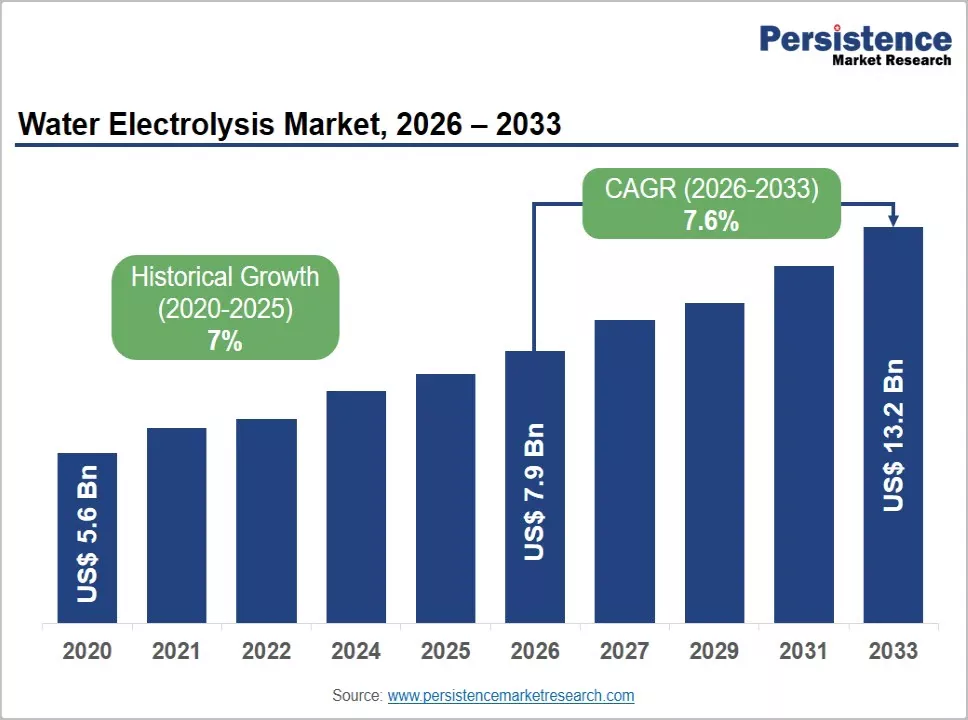
The global water electrolysis market size is likely to be valued at US$ 7.9 billion in 2026 and is expected to reach US$ 13.2 billion by 2033, growing at a CAGR of 7.6% between 2026 and 2033.
Market expansion is supported by industrial decarbonization, renewable power integration, and investment in low-emissions hydrogen production. Alkaline systems retain a leading position, while PEM technology and large-scale renewable-linked installations gain momentum as project developers prioritize flexible operations and higher production capacity.
Key Industry Highlights
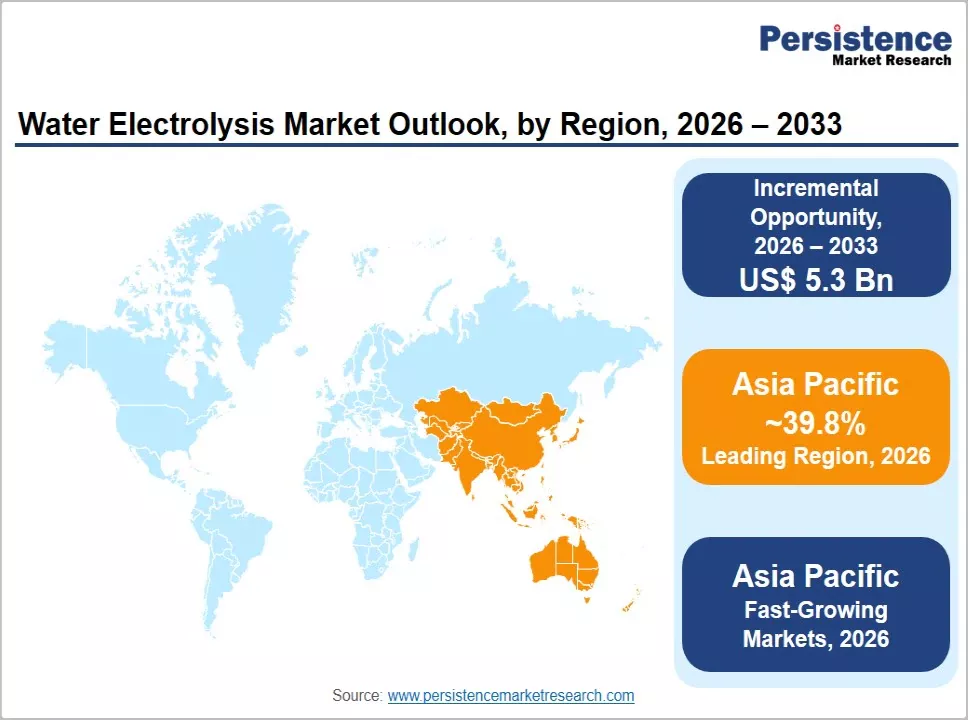
- Leading Region: Asia Pacific, accounting for approximately 39.8% of the market, supported by large-scale hydrogen deployment, manufacturing capacity, and investment in industrial decarbonization.
- Fastest-growing Region: Asia Pacific, driven by expansion of electrolyzer manufacturing, government-backed hydrogen programs, and large renewable energy and industrial projects.
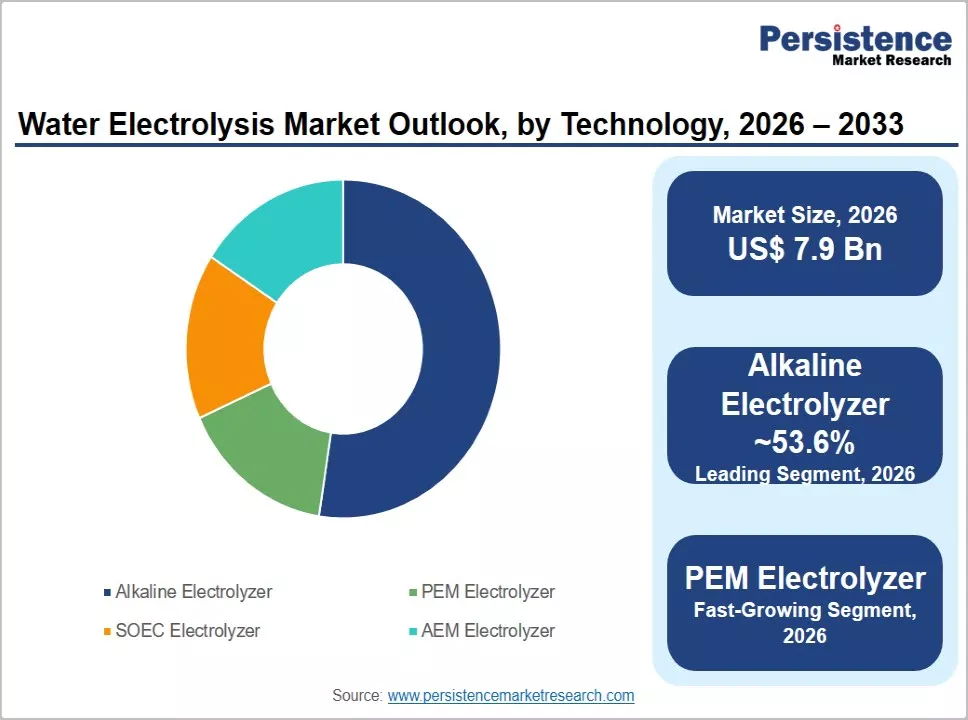
- Dominant Technology: Alkaline electrolyzers, anticipated to account for approximately 53.6% of the market in 2026, supported by mature technology, established supply chains, and suitability for large-scale hydrogen production.
- Leading End Use: Chemicals and industrial feedstock, accounting for approximately 41.6% of demand, reflecting established hydrogen consumption in ammonia, methanol, refining, and chemical production.
DRO Analysis
Drivers - Industrial Decarbonization Is Increasing Demand for Low-Emissions Hydrogen
Industrial decarbonization is a primary driver of water electrolysis adoption. Refining, ammonia, methanol, steel, and chemical production already consume substantial volumes of hydrogen, creating established industrial demand for lower-emissions supply.
The International Energy Agency reported that global hydrogen demand exceeded 100 million tons in 2025, with traditional industrial uses and refining accounting for almost all consumption. Low-emissions hydrogen production reached close to 1 million tons in the same year. Electrolyzer installations support the replacement of fossil-based hydrogen with hydrogen produced using renewable or other low-emissions electricity, linking equipment demand with industrial emissions-reduction programs.
Existing hydrogen users also offer more established offtake routes than emerging mobility and power applications. Refiners and chemical producers have operating experience with hydrogen handling, storage, and process integration. Investment in electrolyzers at existing industrial sites therefore supports incremental equipment demand, particularly for plants seeking to reduce the carbon intensity of feedstock and process heat. The IEA reported that more than 85% of 2025 investment in low-emissions hydrogen projects targeted existing industrial and refinery uses or hydrogen-based fuels, highlighting the near-term commercial importance of established demand centers.
Restraint - High Capital Costs and Uncertain Hydrogen Offtake Constrain Project Economics
High upfront investment remains a structural restraint for water electrolysis projects. Electrolyzer stacks represent only part of total installed cost, while engineering, procurement, construction, power connection, water treatment, compression, storage, and safety systems add substantial project expenditure. Electricity prices also have a direct effect on hydrogen production economics, making project viability dependent on access to competitive renewable power and suitable operating hours. The IEA reported that installed electrolyzer costs outside China were materially higher than domestic Chinese costs in 2024, while engineering and construction represented more than half of total project investment.
Uncertain offtake arrangements add further investment risk. Hydrogen producers require long-term buyers, reliable transport and storage infrastructure, and certification systems that recognize emissions intensity. The IEA reported that only around one-fifth of newly signed low-emissions hydrogen offtake volumes in 2025 were backed by firm contractual commitments. Delays in permitting, grid connections, renewable power procurement, and industrial conversion also extend project timelines and affect financing costs. These factors favor projects located near existing hydrogen consumers and established industrial infrastructure. (IEA, Global Hydrogen Review 2025 and 2026)
Opportunities - Large-Scale Industrial Hydrogen Hubs Are Creating Equipment Demand
Industrial hydrogen hubs represent a significant opportunity for electrolyzer suppliers and project developers. Refineries, chemical clusters, fertilizer plants, steel facilities, and ports offer concentrated hydrogen demand and established industrial utilities.
Co-locating electrolyzers with these users reduces reliance on long-distance hydrogen transport and supports phased capacity additions. The European Hydrogen Bank’s 2025 auction selected 15 renewable hydrogen projects for grant agreement preparation, while the European Commission reported that the selected projects were expected to install 381.25 MW of electrolyzer capacity under the second auction. These programs strengthen project pipelines and create demand for equipment, engineering, and long-term service support.
India is also expanding its industrial hydrogen ecosystem through the National Green Hydrogen Mission. As of December 2025, the Government of India reported awards for 3,000 MW per year of electrolyzer manufacturing capacity and 862,000 tons per year of green hydrogen production capacity. Refinery procurement and green ammonia supply awards provide additional demand signals for electrolyzer deployment. Industrial clusters with renewable power access, water infrastructure, and existing hydrogen consumption are positioned to attract equipment manufacturing, system integration, and operation and maintenance investment. (European Commission; Ministry of New and Renewable Energy, India).
Category-wise Analysis
Technology Insights
Alkaline electrolyzers are anticipated to account for approximately 53.6% of the market share in 2026, retaining the leading position among technology types. The technology has a long operating history, established manufacturing processes, and suitability for large-scale hydrogen production.
Alkaline systems use a liquid electrolyte and are widely deployed in industrial applications where stable operation and high hydrogen output are important. Their established supply chain and competitive equipment costs support adoption in ammonia production, refining, chemical manufacturing, and large renewable hydrogen projects. Manufacturers are also focusing on modular system design, higher current density, improved efficiency, and longer operating life to strengthen performance in large installations.
PEM electrolyzers are the fastest-growing technology segment, with a projected CAGR of 9.1% through 2031. Their compact design, high current density, and rapid response to variable power input support integration with solar and wind generation.
PEM systems are relevant to projects requiring flexible operation, a smaller installation footprint, and high-purity hydrogen. The U.S. Department of Energy’s 2026 technical targets for PEM systems include a system capital cost target of US$250/kW and a hydrogen production cost target of US$2/kg, reflecting ongoing efforts to improve performance and reduce costs. SOEC systems are gaining attention for industrial heat integration, while AEM technology remains an emerging option focused on lower-cost materials and improved durability.
Production Capacity Insights
Electrolyzer systems with production capacity above 2,000 L/hr represent the leading production-capacity category, reflecting demand from industrial users that require continuous and high-volume hydrogen supply. Large chemical plants, refineries, fertilizer facilities, and integrated hydrogen hubs favor higher-output systems because of their process requirements and established hydrogen consumption. Large-capacity installations also support centralized operation, shared utilities, and integration with hydrogen compression and storage infrastructure.
Equipment suppliers are increasingly developing modular stacks and standardized balance-of-plant systems to simplify installation and support capacity expansion across industrial sites.
Systems above 5 MW are the fastest-growing capacity category as green hydrogen projects move toward larger production blocks and utility-scale renewable integration. Project developers are combining multiple electrolyzer modules with dedicated renewable generation, grid connections, water treatment, compression, and storage systems.
The IEA reported that more than 2.5 GW of global electrolysis capacity was under construction in 2026, with projects targeting operation during the year. This reflects the shift toward larger installations, although project delivery remains linked to power availability, financing, permitting, and hydrogen offtake. Systems in the 500-2,000 L/hr and below-500 L/hr categories continue to serve smaller industrial, laboratory, distributed, and specialized applications.
End Use Insights
Chemicals and industrial feedstock represent the leading end-use category, accounting for approximately 41.6% of the market share. Hydrogen is an established input for ammonia, methanol, refining, and several chemical processes, providing a direct route for electrolyzer adoption at existing industrial sites.
Replacing conventional hydrogen with electrolytic hydrogen reduces the emissions intensity of feedstock when the electricity supply meets applicable low-emissions criteria. Industrial users also benefit from proximity between production and consumption, which reduces dependence on transport and storage infrastructure. The IEA’s 2026 review reported that traditional industrial uses and refining accounted for almost all global hydrogen demand in 2025.
Transportation is the fastest-growing end-use category, with a projected CAGR of 10.9%. Hydrogen fuel-cell vehicles, heavy-duty transport, buses, rail, and selected maritime applications are creating demand for hydrogen refueling and supply infrastructure.
Electrolyzers located near refueling stations and logistics hubs support localized hydrogen production, particularly where renewable power and fleet demand are available. Power and utilities represent another emerging application through long-duration energy storage, power-to-gas systems, and hydrogen-fired generation. Oil and gas, refining, and industrial manufacturing also remain important users as companies evaluate lower-emissions hydrogen for feedstock, process heat, and selected production operations.
Regional Insights
North America Water Electrolysis Market Trends
North America is an established market for water electrolysis, supported by industrial hydrogen demand, clean hydrogen policy frameworks, technology development, and investment in regional hydrogen infrastructure. The U.S. accounts for the largest share of regional activity, with Canada contributing through clean energy projects, industrial hydrogen demand, and renewable power availability. Regional investment is linked to the development of low-emissions hydrogen supply for refining, chemicals, fertilizer production, steel, and emerging transportation applications.
U.S. Water Electrolysis Market Trends
The U.S. is the leading North American market due to its industrial base, established energy technology ecosystem, and federal support for clean hydrogen production. The U.S. Department of Energy has established technical targets for alkaline, PEM, and high-temperature electrolysis, including targets for capital cost, efficiency, durability, and hydrogen production cost. In January 2025, the U.S. Treasury and Internal Revenue Service issued final rules for the Section 45V clean hydrogen production tax credit. The rules clarify lifecycle emissions accounting and eligibility for hydrogen produced using electricity and other feedstock, providing a framework for project qualification.
U.S. electrolyzer deployment is connected to regional hydrogen hubs, refinery demand, renewable power procurement, and industrial decarbonization. The market also has a strong base of technology developers and engineering companies working on PEM and SOEC systems. Project economics remain sensitive to electricity prices, tax-credit eligibility, permitting, and the timing of industrial offtake. The DOE’s technical targets provide a reference for equipment developers pursuing lower stack and system costs, while industrial buyers remain important counterparties for long-term hydrogen supply agreements. (U.S. Department of Energy; U.S. Treasury, 2025)
Europe Water Electrolysis Market Trends
Europe is a major water electrolysis market, supported by renewable hydrogen targets, industrial decarbonization requirements, carbon pricing, and public funding. Germany and France are important country markets, with activity spanning electrolyzer manufacturing, industrial hydrogen demand, engineering, and renewable power integration. The European Union’s Renewable Energy Directive and renewable fuels of non-biological origin rules establish criteria for renewable hydrogen, while the European Hydrogen Bank provides financial support through competitive auctions.
The European Commission’s second auction selected 15 projects for grant agreement preparation in 2025, including projects with a combined planned electrolyzer capacity of 381.25 MW.
Germany Water Electrolysis Market Trends
Germany represents a major European market because of its large chemical, steel, refining, and manufacturing base. Industrial hydrogen demand and the country’s renewable energy transition support investment in electrolyzer systems, particularly at industrial clusters and sites connected to future hydrogen infrastructure. Germany’s hydrogen core network received regulatory approval in October 2024. The approved network covers 9,040 km of pipelines, with approximately 60% converted from existing natural gas pipelines and total investment costs of €18.9 billion. The network is designed to connect industrial consumption centers, hydrogen production sites, storage facilities, and import corridors.
German electrolyzer deployment is supported by public funding, industrial partnerships, and domestic engineering capabilities. The country is also participating in European Hydrogen Bank support mechanisms, including national funding alongside EU auctions. Large industrial users are evaluating hydrogen for steelmaking, chemicals, and refining, while project developers are integrating electrolyzers with renewable power and future pipeline connections. The pace of deployment remains linked to renewable electricity costs, project approvals, and the availability of firm hydrogen offtake.
France Water Electrolysis Market Trends
France is an important European market due to its industrial hydrogen demand, nuclear and renewable electricity base, and national hydrogen strategy. Electrolyzer deployment is relevant to refining, chemicals, fertilizer production, mobility, and industrial heat. The country’s electricity mix provides a potential basis for low-carbon hydrogen production, subject to applicable renewable and emissions certification requirements. French technology developers and industrial groups are active in electrolyzer manufacturing, engineering, and hydrogen project development.
Public support and industrial partnerships are strengthening the French project pipeline. European Union funding mechanisms also support renewable hydrogen production projects and cross-border market development. France’s established chemical and refining facilities provide potential demand centers for electrolytic hydrogen, while ports and industrial zones offer opportunities for hydrogen derivatives and logistics infrastructure. Project implementation is influenced by electricity procurement arrangements, certification requirements, and the cost competitiveness of hydrogen relative to conventional industrial supply.
Asia Pacific Water Electrolysis Market Trends
Asia Pacific is the leading and fastest-growing regional market, accounting for approximately 39.8% of global water electrolysis demand. China leads regional deployment and equipment manufacturing, while India is expanding electrolyzer manufacturing and industrial hydrogen procurement. Japan contributes through large-scale technology demonstration, system integration, and industrial decarbonization. Regional growth is supported by manufacturing scale, government-backed hydrogen programs, renewable energy development, and established demand from chemicals, refining, and fertilizer production.
China Water Electrolysis Market Trends
China is the largest national market for water electrolysis, supported by extensive industrial hydrogen demand, domestic electrolyzer manufacturing, and large renewable hydrogen projects. The IEA reported that China accounted for nearly three-quarters of new global electrolysis installations in 2025 and held a substantial share of global manufacturing capacity. Domestic suppliers benefit from established component supply chains and large-scale manufacturing. The market includes alkaline technology leaders as well as companies developing PEM and other electrolysis systems.
China’s manufacturing scale supports competitive equipment pricing, while intense domestic competition and excess manufacturing capacity are influencing supplier economics. The IEA reported that China’s electrolyzer manufacturing capacity reached 35 GW per year in 2025, compared with domestic demand below 2 GW. This gap has increased price competition and encouraged manufacturers to pursue overseas sales and technology improvements. Large renewable hydrogen projects and industrial demand from chemicals and refining continue to support domestic deployment. (IEA, Global Hydrogen Review 2026).
Competitive Landscape
The global water electrolysis market includes established industrial engineering companies, specialist electrolyzer manufacturers, and emerging technology developers. Competition is based on technology performance, system efficiency, capital cost, manufacturing scale, project execution, service coverage, and integration with renewable power and industrial processes. Alkaline systems benefit from mature manufacturing and large-project experience, while PEM suppliers compete through flexibility and compact system design. SOEC and AEM developers focus on high-efficiency industrial integration and lower-cost materials.
Leading companies are focusing on technology efficiency, manufacturing scale, modular system design, and long-term service agreements. Partnerships with renewable power developers, engineering contractors, industrial users, and government-backed programs support project execution. Manufacturers are also expanding regional production and service networks, improving stack durability, and developing alkaline, PEM, SOEC, and AEM portfolios to address different operating requirements.
Key Industry Developments
- In December 2025, India’s Ministry of New and Renewable Energy reported awards for 3,000 MW per year of electrolyzer manufacturing capacity and 862,000 tons per year of green hydrogen production capacity under the National Green Hydrogen Mission.
- In January 2026, the European Commission reported that six projects from the second European Hydrogen Bank auction had signed grant agreements, receiving €270.6 million in support and planning a combined 381.25 MW of electrolyzer capacity.
Companies Covered in Water Electrolysis Market
- thyssenkrupp nucera
- Siemens Energy
- Nel ASA
- ITM Power
- Plug Power
- Bloom Energy
- Topsoe
- John Cockerill
- McPhy Energy
- LONGi Hydrogen
- PERIC Hydrogen Technologies
- Sungrow Hydrogen
- Envision Energy
- Asahi Kasei
- Elogen
Frequently Asked Questions
The global water electrolysis market is likely to be valued at US$ 7.9 billion in 2026.
The market is expected to reach US$ 13.2 billion by 2033.
The market is projected to expand at a CAGR of 7.6% between 2026 and 2033.
Alkaline electrolyzers are anticipated to lead the market, accounting for approximately 53.6% of the market in 2026.
Major companies include thyssenkrupp nucera, Siemens Energy, Nel ASA, ITM Power, Plug Power, Bloom Energy, Topsoe, John Cockerill, LONGi Hydrogen, and Asahi Kasei.


