




- Clothing, Footwear, & Accessories
- Upcycled Fashion Market
Upcycled Fashion Market Size, Share, and Growth Forecast, 2026 - 2033
Upcycled Fashion Market by Product Type (Apparel, Accessories, Footwear, Others), Consumer (Women, Men, Unisex, Kids), Material Source, Distribution Channel, and Regional Analysis for 2026 - 2033

Upcycled Fashion Market Size and Trends Analysis
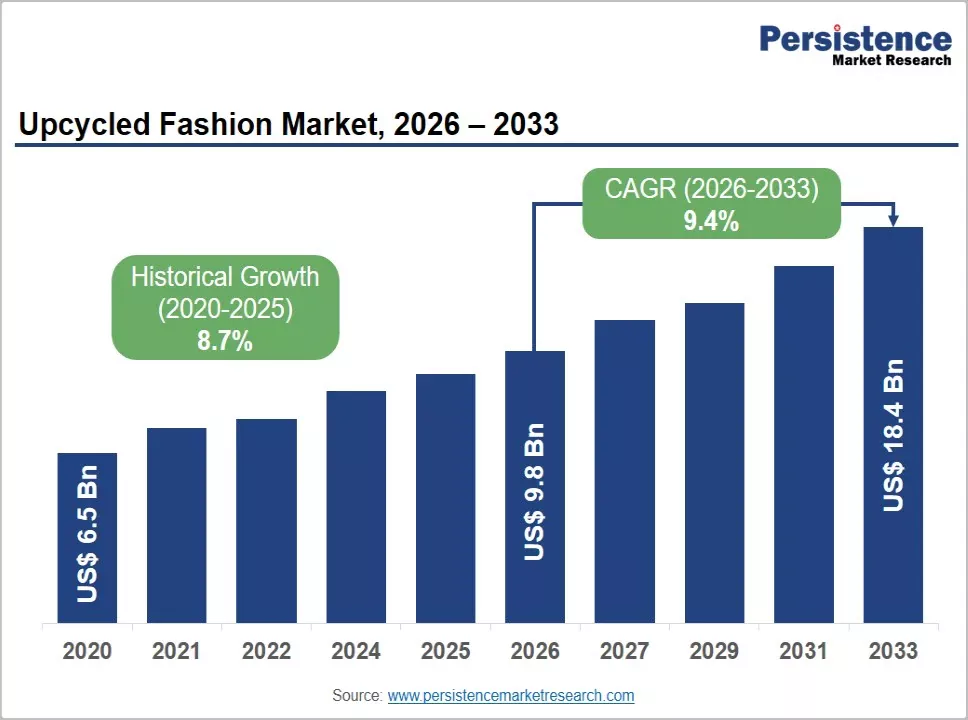
The global upcycled fashion market size is likely to be valued at US$ 9.8 billion in 2026 and is expected to reach US$ 18.4 billion by 2033, growing at a CAGR of 9.4% between 2026 and 2033, driven by rising textile waste volumes, tightening producer-responsibility regulation, and growing consumer preference for distinctive, lower-impact garments.
Brands and designers are increasingly converting post-consumer garments, factory offcuts, and deadstock fabrics into new apparel and accessories, positioning upcycling as a design-led response to linear fashion consumption.
Key Industry Highlights
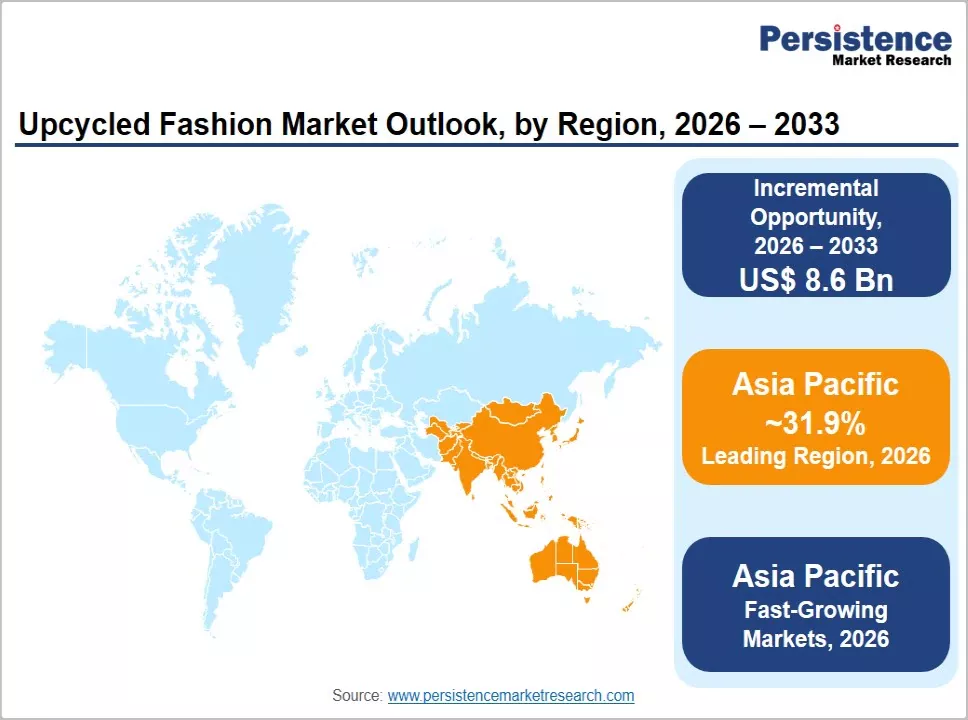
- Leading Region: Asia Pacific, anticipated to account for 31.9% of the market share, supported by large garment manufacturing bases, abundant textile waste feedstock, and a growing base of design-led labels.
- Fastest-growing Region: Asia Pacific, also projected to record the fastest growth, driven by rising fashion consumption, expanding online retail, and government-backed textile recycling initiatives.
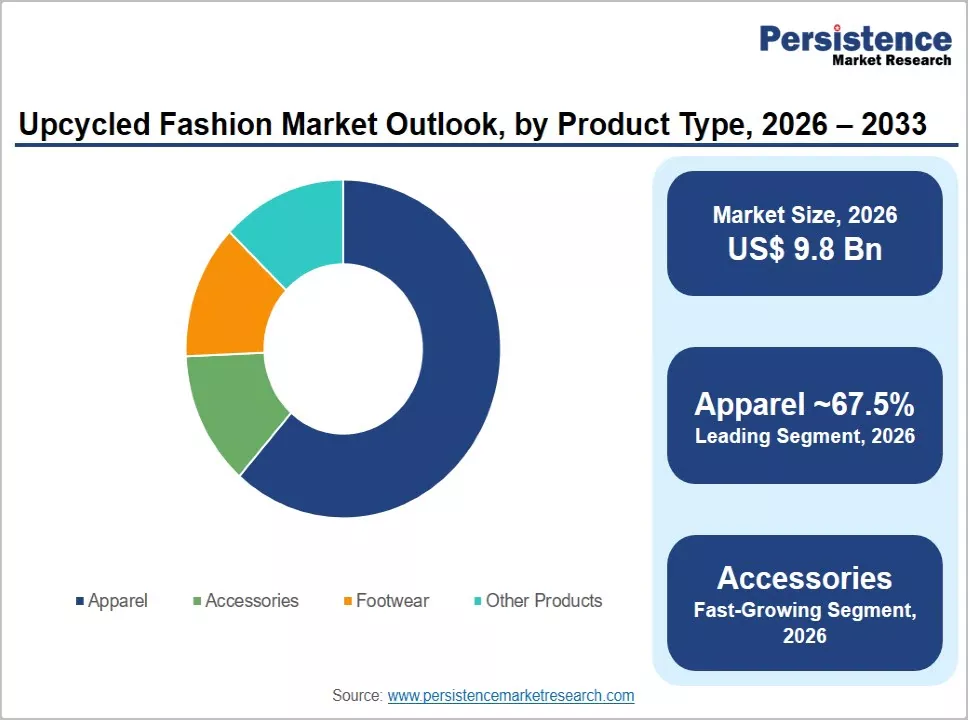
- Dominant Product Type: Apparel, anticipated to hold 67.5% of the market, driven by upcycled tops, jackets, dresses, trousers, and denim.
- Leading Consumer Segment: Women, anticipated to account for 45.3% of the market share, supported by stronger fashion engagement and demand for distinctive pieces.
DRO Analysis
Drivers - Growing Textile Waste Volumes Are Expanding the Supply of Upcycling Feedstock
Textile waste has reached a scale that is drawing attention from brands, policymakers, and designers. The U.S. Environmental Protection Agency estimated that 17 million tons of textiles were generated in the U.S. in 2018, of which 11.3 million tons were landfilled. In the European Union, about 12.6 million tonnes of textile waste are generated each year, and only around 22% of post-consumer textile waste is collected separately for reuse or recycling.
These volumes create a steady, low-cost supply of discarded garments, factory offcuts, and unsold inventory that upcycling businesses convert into higher-value products. Because each garment is reworked rather than broken down into fibers, upcycling avoids the energy-intensive processing associated with fiber-to-fiber recycling, and the resulting products often carry premium pricing as limited-edition or one-of-a-kind pieces. Feedstock availability is therefore supporting new brand launches and expanding the volume of upcycled products in retail.
Regulation and Consumer Preference for Circular Fashion Are Strengthening Market Demand
Regulatory change is moving textile end-of-life responsibility toward producers. The revised EU Waste Framework Directive entered into force on October 16, 2025, requiring Member States to establish extended producer responsibility schemes for textile and footwear products, with producers financing collection, sorting, reuse, and recycling. In the U.S., California enacted the Responsible Textile Recovery Act in 2024, establishing the first textile recycling program in the country that places end-of-life responsibility on certain apparel producers.
These rules raise the cost of generating textile waste and encourage brands to develop reuse and remanufacturing programs. Consumer interest in resale, vintage, and remade fashion is also growing, supporting demand for upcycled pieces that combine distinctive design with lower environmental impact. Brands operating take-back programs are using returned garments as feedstock for upcycled lines, linking compliance activity with new revenue streams.
Restraint - Limited Scalability, Inconsistent Feedstock, and Higher Production Costs Restrict Mass-Market Adoption
Scalability remains a significant challenge for the Upcycled Fashion Market. Used garments, factory offcuts, and deadstock vary in fabric type, size, condition, and quantity. Each batch requires sorting, cleaning, and redesign, and many pieces are produced through manual cutting, reconstruction, and finishing by skilled workers. As a result, production remains concentrated in limited-edition collections and small studios rather than high-volume programs.
Labor-intensive production raises unit costs and positions many upcycled products at premium price points, which restricts adoption among price-sensitive consumers. Mixed-fiber garments, trims, and blended fabrics also complicate reuse, while brands require consistent material supplies to plan seasonal assortments. Standard definitions for upcycled claims remain limited, which is increasing scrutiny of sustainability marketing and adding compliance considerations for brands entering the segment.
Opportunities - Brand Take-Back Programs and In-Store Studios Create Scalable Upcycled Product Lines
One of the most notable opportunities in the market is the integration of upcycling into the take-back and repair operations of established fashion companies. Uniqlo's Re.Uniqlo Studios convert returned garments into new pieces through repair and reconstruction by seamstresses working in the studios, while Poland's LPP Group has tested an upcycled range built from defective stock across its brands. These models connect collection, design, and retail within one workflow.
Template-based designs, small-batch production, and in-store studios address the consistency challenge by standardizing patterns while still using varied inputs. As EU producer-responsibility schemes take shape, large retailers are expected to extend such programs, creating a route for upcycled products to move from limited capsules toward repeatable ranges. Companies that secure steady supplies of returned garments and deadstock are likely to hold a cost and sourcing advantage.
Asia Pacific Offers Strong Expansion Potential through Manufacturing Scale and Digital Retail
Asia Pacific combines large garment manufacturing capacity, high volumes of textile waste, and expanding digital commerce, creating favorable conditions for upcycled fashion. China discards more than 26 million tons of clothing annually, while India hosts established textile recycling clusters, such as Panipat in Haryana, and a growing community of designers using factory offcuts.
Online channels, social commerce, and resale platforms allow small upcycling labels to reach consumers across borders without large retail footprints. Government textile recycling targets in China and rising interest in circular design in India are expected to support supply chains and new brand creation across the region.
Category-wise Analysis
Product Type Insights
Apparel is anticipated to account for approximately 67.5% of the market share in 2026. The segment includes upcycled tops, jackets, dresses, trousers, and denim made from used garments, factory offcuts, and deadstock fabrics. For example, Miu Miu's Upcycled 2026 collection reworks vintage white cotton shirts and khaki chinos, sourced from vintage dealers worldwide, into reconstructed tailoring, dresses, and bustiers, with each piece individually restored and finished. The wide availability of discarded garments provides direct feedstock without additional fiber processing, which supports the segment's leading position.
Accessories are anticipated to be the fastest-growing product category, as bags, scarves, belts, wallets, and jewelry use small and irregular material scraps effectively. For example, UK-based Elvis & Kresse produces bags and wallets from reclaimed materials such as decommissioned fire hose, and Miu Miu's 2026 collection includes a pouch and backpack trimmed with leather. Smaller formats reduce the volume of material required per unit, making them practical for offcuts that are too small for garments.
Consumer Insights
Women are anticipated to account for approximately 45.3% of the market share in 2026, reflecting stronger fashion engagement and higher demand for distinctive pieces. Many upcycled labels design collections around dresses, tailoring, and statement garments where one-of-a-kind construction carries visible value. For example, Delhi-based Doodlage assembles factory fabric waste into dresses and sarees, and luxury houses such as Miu Miu direct reworked vintage pieces toward women's wardrobes. Familiarity with resale and vintage shopping formats further supports adoption within the segment.
Men are anticipated to be the fastest-growing consumer category, with a projected CAGR of 9.9%, supported by rising menswear interest and social-media influence. For example, Wylie Welling, a circular brand launched by a Carhartt family member in April 2026, upcycles vintage Carhartt workwear into unisex one-off pieces, and Seasalt introduced men's styles for the first time in its capsule collection using upcycled denim from Beyond Retro. Workwear, denim, and outerwear offer abundant source garments for menswear upcycling.
Regional Insights
North America Upcycled Fashion Market Trends
North America represents a significant regional market, supported by established resale and vintage retail, a strong base of designer-led labels, and growing state-level textile regulation. Brands in the region are using upcycling to differentiate collections and engage consumers interested in circular fashion.
U.S. Upcycled Fashion Market Trends
The U.S. remains the leading market in North America due to its large apparel retail base and extensive supply of used clothing. The U.S. Environmental Protection Agency estimated textile generation at 17 million tons in 2018, with 11.3 million tons landfilled and a recycling rate of 14.7%. These volumes provide abundant feedstock for upcycling businesses, while thrift and vintage retail supply designers with source garments.
California's Responsible Textile Recovery Act of 2024 introduced a textile recycling program that places end-of-life responsibility on certain apparel producers, increasing attention to reuse and remanufacturing. In April 2026, Wylie Welling launched online with a spring collection of unisex, one-off pieces made from vintage Carhartt workwear, with a Detroit store planned for summer 2026 and mending workshops as part of its retail concept.
Canada Upcycled Fashion Market Trends
Canada represents a smaller but developing market, supported by consumer interest in thrift, vintage, and locally made fashion. Independent designers and resale retailers in major cities are the primary source of upcycled products, and cross-border e-commerce with the U.S. is expanding customer reach for small labels.
Europe Upcycled Fashion Market Trends
Europe is a mature market characterized by strong regulatory direction, an established vintage and resale culture, and the presence of luxury and high-street brands with circular fashion programs. The European Union generates 12.6 million tons of textile waste annually, including 5.2 million tons of clothing and footwear. Separate collection of textiles has been mandatory across Member States since January 2025, and the revised Waste Framework Directive requires textile producer-responsibility schemes to be established within 30 months of entry into force.
Germany Upcycled Fashion Market Trends
Germany represents a major European market because of its large fashion retail sector and high consumer participation in waste separation and used-clothing collection. This infrastructure supports the availability of source garments for designers and brands developing remade collections.
German fashion retailers are increasingly adding circular materials to their assortments. In September 2026, Zalando launched a five-piece t-shirt collection made with recycled cotton fiber from RE&UP, bringing textile-to-textile recycled content into its products for the first time. Such developments indicate the broader shift toward circular supply chains in the country, which is expected to benefit upcycled product lines.
U.K. Upcycled Fashion Market Trends
The U.K. remains an important market for upcycled fashion because of its established vintage retail sector, active design schools, and strong consumer interest in resale. Independent designers and vintage specialists, such as Beyond Retro, supply remade and upcycled ranges to both specialty and mainstream retail.
A notable industry development occurred in June 2026 when Uniqlo launched Everyday Re.Imagined, a 10-piece upcycled collection, across 15 Re.Uniqlo Studios in the UK and Europe. The pieces are created from returned items by seamstresses working in the studios, using template designs developed with graduates of the Central Saint Martins BA Fashion course. This development illustrates the growing use of scalable, template-based upcycling within high-volume retail.
Asia Pacific Upcycled Fashion Market Trends
Asia Pacific is the leading regional market, anticipated to account for 31.9% of the market share, and is also expected to be the fastest-growing region. Large garment manufacturing capacity, high volumes of textile waste, expanding online retail, and rising interest in sustainable fashion are supporting regional growth. Government textile recycling policies and the presence of design-led labels in major cities are further strengthening the regional supply chain.
India Upcycled Fashion Market Trends
India is emerging as a major growth market because it combines large-scale garment production with a long tradition of reuse and craft. Designers are increasingly collecting factory offcuts, known locally as katran, and converting them into garments and home products. Panipat in Haryana is a major hub for mechanical textile recycling, supplying recycled yarns for blankets, rugs, and other products.
Doodlage, founded in Delhi in 2012, collects fabric waste from factories discarded for minor defects and assembles it into limited-edition dresses, sarees, and menswear. Its model demonstrates how upcycled labels convert pre-consumer waste into premium products.
China Upcycled Fashion Market Trends
China is a major market because of its scale in garment manufacturing and consumption. The country discards more than 26 million tons of clothing annually. Under the 14th Five-Year Plan, China aimed to recycle 25% of waste textiles and produce 2 million tons of recycled fiber annually by 2025, and the National Development and Reform Commission has indicated plans to raise the recycling target to nearly one-third by 2030.
Sustainable fashion remains a niche market in China, with most participants being small studios and individual designers who redesign old clothes or unsold inventory, according to the United Nations Development Program. Global retailers are also building collection infrastructure; Uniqlo launched a pilot garment collection program in mainland China in partnership with the recycling platform FeimaYi, supporting future availability of source garments for remade products.
Competitive Landscape
The global upcycled fashion market is fragmented, with competition occurring among independent designers, small circular fashion labels, heritage and luxury houses, high-street retailers with take-back programs, and resale platforms. Companies compete based on design originality, material sourcing, brand credibility, access to returned garments, and retail reach. The market includes both established fashion groups operating upcycling lines and specialized labels built entirely around waste-based production.
Leading companies are focusing on limited-edition collections, take-back and repair programs, template-based small-batch production, and collaborations with design schools and vintage dealers. Competitive differentiation increasingly depends on traceable sourcing, consistent access to feedstock, and the ability to retain design value at scale. Companies are also introducing in-store studios, resale integration, and digital storytelling to communicate the origin of each piece.
Key Industry Developments
- In May 2026, Miu Miu released its Upcycled 2026 collection, reworking vintage white cotton shirts and khaki chinos into one-of-a-kind pieces, available in selected stores worldwide from May 18, 2026.
- In February 2026, LPP Group introduced the Reserved upcycled by INTU collection, made from defective stock across the group's brands, as a test of how second-cycle processes are implemented at scale within a large fashion group.
Companies Covered in Upcycled Fashion Market
- Fast Retailing Co., Ltd. (Uniqlo)
- Levi Strauss & Co.
- Prada S.p.A. (Miu Miu)
- Urban Outfitters, Inc.
- LPP S.A.
- Patagonia, Inc.
- Eileen Fisher, Inc.
- Re/Done
- Marine Serre
- Collina Strada
- Christopher Raeburn
- Beyond Retro
- Seasalt
- Doodlage
- Elvis & Kresse
Frequently Asked Questions
The global upcycled fashion market is projected to be valued at US$ 9.8 billion in 2026.
The market is expected to reach US$ 18.4 billion by 2033.
Key trends include the growing adoption of brand take-back programs, in-store upcycling studios, limited-edition capsule collections, deadstock sourcing, textile producer-responsibility regulation, and online resale and social commerce.
Apparel is anticipated to remain the leading product type segment, accounting for approximately 67.5% of the market.
The market is projected to expand at a CAGR of 9.4% between 2026 and 2033.
Major companies include Fast Retailing (Uniqlo), Levi Strauss & Co., Prada (Miu Miu), Urban Outfitters, and Patagonia.


