




- Medical Devices
- Topical Cyanoacrylates Market
Topical Cyanoacrylates Market Size, Share, and Growth Forecast 2026 - 2033
Topical Cyanoacrylates Market by Product Type (2-Octyl Cyanoacrylate, n-Butyl-Cyanoacrylate), by Application (General Surgery, Plastic Surgery, and Aesthetic Procedures), by End-user (Hospitals), and Regional Analysis, 2026 - 2033

Topical Cyanoacrylates Market Size and Trends Analysis
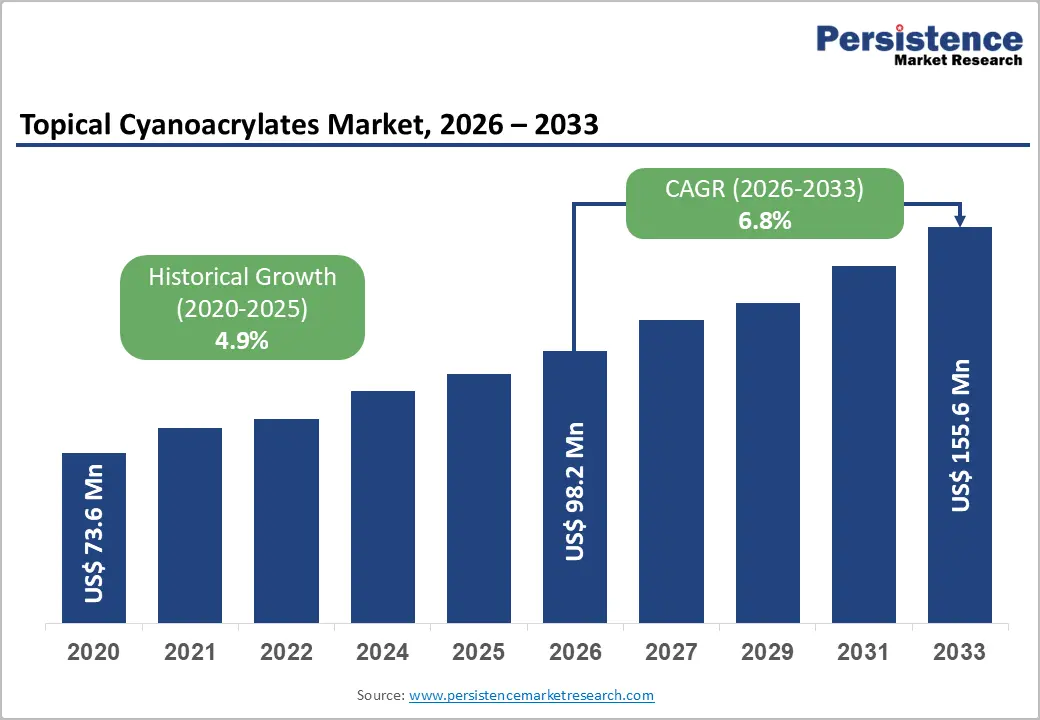
The global topical cyanoacrylates market size is likely to be valued at US$98.2 million in 2026 and is expected to reach US$155.6 million by 2033, growing at a CAGR of 6.8% during the forecast period from 2026 to 2033, driven by a rising shift toward suture-less wound closure techniques in emergency and outpatient settings. Increasing volumes of minimally invasive and cosmetic surgeries are also pushing demand for topical adhesives.
Key Industry Highlights:
- New Product: In 2025, companies such as H.B. Fuller continued strengthening their topical cyanoacrylate portfolios through products such as Histoacryl and Histoacryl Flexible. These utilize n-butyl-2-cyanoacrylate technology for surgical skin closure applications.
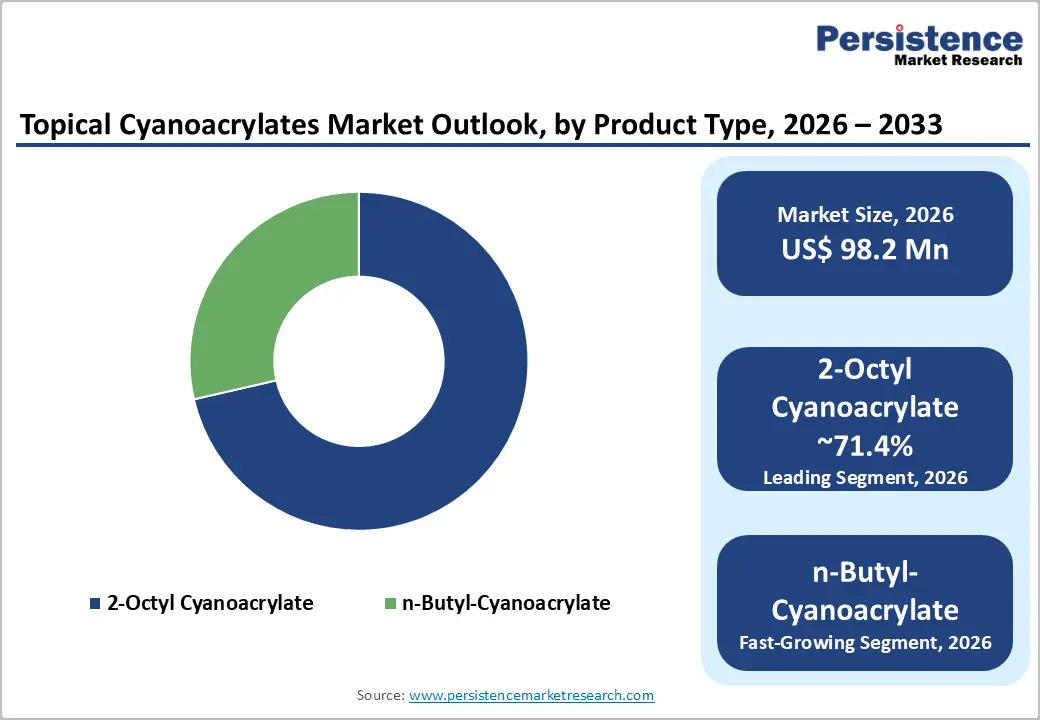
- Leading Product Type: 2-octyl cyanoacrylate, approximately 71.4% share in 2026, owing to its ability to deliver improved cosmetic outcomes with minimal scarring.
- Dominant Application: General surgery, nearly 33.7% in 2026, backed by the high volume of procedures requiring quick wound closure solutions.
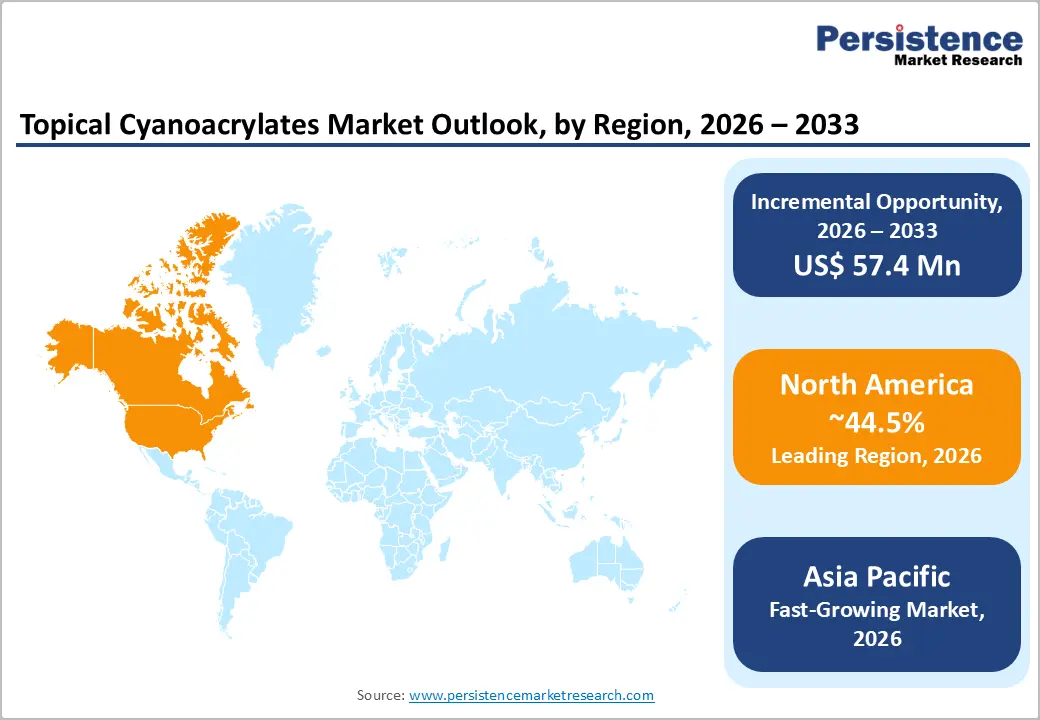
- Leading Region: North America, with about 44.5% share in 2026, spurred by the rising adoption of advanced wound care technologies.
- Fast-growing Region: Asia Pacific, augmented by rising healthcare infrastructure and increasing surgical volumes.
DRO Analysis
Driver - Rising Occurrence of Wounds, Including Minor Cuts and Lacerations
Minor acute wounds such as cuts, lacerations, abrasions, and superficial burns represent one of the most common reasons people seek emergency care. Lacerations alone account for nearly 8.2% of all ED visits in the U.S., translating to an estimated 7 to 9 million lacerations treated in U.S. emergency departments every year. This creates sustained, recurring demand for fast and effective wound closure options.
A PubMed-indexed study analyzing data from the CDC's National Hospital Ambulatory Medical Care Survey (2012 to 2015) found that across an estimated 540 million ED visits, over 26 million patients had at least one laceration. Topical Skin Adhesives (TSA) were used in about 1 in 4 wound closures and were associated with a 26-minute shorter ED stay compared to sutures or staples. This efficiency advantage is pushing clinicians to adopt topical cyanoacrylates for routine wound care across emergency and outpatient settings.
Increasing Incidence of Sports-related Injuries
Participation in sports and recreational activities is rising globally, and so are the injuries that come with it. According to the National Safety Council, sports and recreational injuries increased by 17% in 2024, following back-to-back annual increases of 2% in 2023, 12% in 2022, and 20% in 2021. Skin wounds are a notable subset of these injuries. Sports injuries account for 15 to 20% of all annual acute care visits, with soft tissue injuries to the skin, including contusions, abrasions, and lacerations, among the most commonly encountered.
Cyanoacrylate adhesives allow fast and needle-free wound closure, which means athletes can return to activity soon. The American Academy of Family Physicians has showcased the use of octylcyanoacrylate (Dermabond) in sports settings, noting it as an effective option for athletes who sustain traumatic lacerations and require rapid wound closure before returning to competition. This combination of rising injury rates and the requirement for quick sideline management supports demand for topical cyanoacrylates.
Restraint - Inferior Mechanical Strength Limits Use in High-Stress Wound Areas
A key clinical limitation of topical cyanoacrylates is their low tensile strength, mainly in the early healing phase. Studies have shown that on Day 1 post-application, wound breaking strength with cyanoacrylate adhesives is only about 10 to 15% of that achieved with 5- 0 monofilament sutures, restricting their use to areas of low tension and minimal movement. This becomes a real problem for wounds over joints such as the knee or elbow, where repeated motion can break the adhesive film and cause wound dehiscence.
A randomized, controlled animal model study published in Annals of Emergency Medicine found that wound closures made with cyanoacrylate tissue adhesive alone had significantly less tensile strength at four days compared to sutures alone or combined suture-adhesive closures. After polymerizing, the adhesive becomes brittle and is prone to fracturing when used in skin creases or along longer incisions, further narrowing the range of viable clinical applications. Hence, surgeons and emergency physicians still default to sutures for complex or high-mobility wound sites, limiting the addressable use cases for topical cyanoacrylates.
Opportunity - Next-Generation Formulations to Overcome Toxicity Challenges
Standard cyanoacrylate adhesives degrade in the body and can release byproducts, including formaldehyde, that raise biocompatibility concerns. New preclinical work is directly addressing this. A 2023 study published in Materials (MDPI) by researchers at Theramx Inc. and Kyung Hee University tested mixtures of prepolymer allyl 2-cyanoacrylate (PAC) and 2-octyl cyanoacrylate (OC) in multiple formulations.
Samples containing 70% or 40% PAC showed the highest antimicrobial activity against various microbial strains, no cytotoxicity against fibroblast cells, and formaldehyde release within medically permitted levels. This is a meaningful advance. If a single adhesive can close wounds, resist infection, and stay within safety thresholds for degradation products, it reduces the requirement for secondary antimicrobial treatment. As these formulations move from bench to clinical validation, they hold significant commercial potential in wound care applications where infection risk is high.
Expanding Role in Minimally Invasive and Oncological Surgery
Topical cyanoacrylates are displacing sutures in surgical settings where precision and recovery speed matter most. A prospective cohort study conducted at a tertiary care center in India (Cureus, January 2026), covering 114 patients, evaluated n-butyl-cyanoacrylate for closing laparoscopic trocar sites. Mean closure time was as low as 20 seconds for single-port closures, wound dehiscence occurred in only 2.63% of cases, and the adhesive cost was approximately US$3.50 per application.
Beyond laparoscopy, cyanoacrylates are gaining traction in musculoskeletal oncology. A STROBE-compliant observational study from the Chulabhorn Cancer Center in Bangkok evaluated 2-octyl cyanoacrylate (2OCA) for wound closure after musculoskeletal oncology surgeries involving soft tissue and bone tumors. It was described as a promising complementary tool to traditional sutures in this complex patient population. These emerging applications point to a broadening clinical footprint well beyond simple laceration management.
Category-wise Analysis
Product Type Insights
The 2-octyl cyanoacrylate segment is anticipated to lead with a share of nearly 71.4% in 2026. This is attributed to its superior clinical performance, safety profile, and broad acceptance in surgical and wound care applications. Compared to n-butyl cyanoacrylate, 2-octyl delivers improved flexibility, stronger wound closure, and reduced skin irritation, making it ideal for use on dynamic body areas and in sensitive patient populations, including children. A study found that Dermabond (2-octyl cyanoacrylate) demonstrates bactericidal properties against Gram-positive bacteria.
The n-butyl-cyanoacrylate segment will likely remain in the second position in 2026. It is a rapid, easy, and highly effective modality for immediate hemostasis of gastric variceal bleeding, with immediate hemostasis rates reported at 95.9%. This makes it indispensable in gastroenterology, where it is used to plug bleeding varices in patients with portal hypertension. A systematic review and meta-analysis found that endoscopic cyanoacrylate injection and endoscopic variceal ligation are equally effective for initial hemostasis of bleeding gastric varices.
Application Insights
The general surgery segment is expected to dominate with a share of approximately 33.7% in 2026. Cyanoacrylate adhesives are widely used in general surgical procedures for closing incisions and wounds quickly and effectively. Their ability to reduce surgery time, minimize scarring, and lower infection risks makes them highly favored by surgeons. The shift to minimally invasive and laparoscopic approaches has further pushed their application.
The plastic surgery and aesthetic procedures segment is projected to be the fastest-growing in 2026. Cosmesis is everything in plastic and aesthetic surgery, and cyanoacrylates deliver where it matters most. A prospective and randomized controlled study in bilateral reduction mammaplasty comparing 2-octyl cyanoacrylate with suture closure found that both patients and blinded panelists expressed a preference for the adhesive side as early as one week after surgery.
Regional Insights
North America Topical Cyanoacrylates Market Trends
North America is predicted to dominate in 2026 with a share of nearly 44.5%. Growth is spurred by developments in medical technology, increasing demand for minimally invasive procedures, and a rising emphasis on efficient wound management. The region also benefits from a steady flow of Food and Drug Administration (FDA) approvals that open new use cases and build clinician confidence. In recent years, companies such as Advanced Medical Solutions Group plc have strengthened their presence in the U.S. market through products such as LiquiBand Exceed. These are mainly adopted for replacing sutures and staples in low-tension wounds.
U.S. Topical Cyanoacrylates Market Trends
The U.S. benefits from high emergency department volumes, insured populations, and an outpatient care push. Growth is further supported by the rising number of surgical procedures, trauma cases, and sports injuries, alongside an aging population that requires more chronic wound care. The migration toward outpatient care is particularly important. Topical cyanoacrylate adhesives are becoming a preferred option in outpatient clinics and emergency care settings due to their quick application, ability to minimize scarring, and lower risk of infection. These properties are in line with the shift toward outpatient care, where efficiency and reduced procedural complexity are key priorities.
Asia Pacific Topical Cyanoacrylates Market Trends
Asia Pacific is the fastest-growing region for cyanoacrylate surgical adhesives, fueled by healthcare modernization and rising surgical volumes. Growth is also fueled by expanding healthcare infrastructure and increasing medical expenditure in emerging economies. Countries such as India and China are investing heavily in modernizing their surgical facilities, creating substantial opportunities for advanced medical adhesives. Medical tourism is another key driver. Patients from across Southeast Asia travel to India, Thailand, and South Korea for affordable surgeries, thereby increasing demand for high-quality wound closure products.
China Topical Cyanoacrylates Market Trends
China holds the dominant market share in Asia Pacific, with healthcare infrastructure expanding rapidly. The aging population is a key driver. The increasing incidence of chronic conditions such as diabetes and cardiovascular diseases among this aging population is increasing demand for wound care products. Domestic manufacturers are now producing cyanoacrylate formulations, reducing dependence on imports. Companies such as Zhejiang PerfectSeal New Material have entered the field of cyanoacrylate surgical sealants. It shows a broad localization trend that is making these products more accessible across China’s hospital tiers.
India Topical Cyanoacrylates Market Trends
India’s market is being propelled by expanding surgical infrastructure, surging medical tourism, and increasing adoption of unique surgical techniques. Homegrown innovation is a key differentiator. Meril Life Sciences, based in Gujarat, markets its MeriGlu product, an n-butyl cyanoacrylate adhesive, across general, plastic, gynecologic, orthopedic, pediatric, and oncological surgeries. It has a set time of under 50 seconds and a waterproof formulation. This domestic supply reduces cost barriers that historically slowed adoption. Rising government investment in hospital infrastructure under schemes, including Ayushman Bharat, is also extending the base of facilities that can deploy these products.
Europe Topical Cyanoacrylates Market Trends
Europe's growth is being boosted by demographic pressure and a systematic push toward evidence-based wound care. According to Eurostat, around one-fifth of the EU population was aged 65 and over as of January 2023. This aging demographic has low healing ability, and patients with chronic diseases are expected to boost healthcare infrastructure and innovation in the region. Policy frameworks are also accelerating adoption. According to NICE, wound management guidelines were updated in 2023 to mandate novel dressings for all chronic wounds with automatic inclusion in NHS formularies.
Germany Topical Cyanoacrylates Market Trends
Germany is the leading market in Europe and operates on strong institutional foundations. Growth is bolstered by comprehensive reimbursement policies, a high number of certified wound care centers, and rising adoption of advanced dressings in both hospital and home care settings. Germany's strength lies in its health-technology assessment process. Manufacturers require authentic trial data to secure formulary listings, which creates a high barrier to entry but also strong uptake once a product is listed.
U.K. Topical Cyanoacrylates Market Trends
The U.K. is one of the most dynamic wound care markets in Europe. According to NHS England, over 2.4 million patients received wound care in 2023, with diabetic foot ulcers and pressure injuries accounting for 68% of chronic cases. The NHS Supply Chain distributes millions of units of advanced dressings annually to hospitals and community providers. According to the International Society of Aesthetic Plastic Surgery, a total of 130,372 surgical procedures were performed in the U.K. in 2022, compared to 77,924 non-surgical procedures. It is a rising surgical volume that is anticipated to fuel demand for acute wound care, including tissue adhesives.
Competitive Landscape
The global topical cyanoacrylates market is moderately fragmented. Large players such as Johnson & Johnson, Advanced Medical Solutions Group, H.B. Fuller, and Medtronic dominate premium surgical-grade applications, while small firms focus on niche trauma care, outpatient surgery, and cost-effective regional offerings. Competition is heavily centered around formulation performance rather than price alone.
Companies are racing to improve flexibility, drying speed, antimicrobial protection, and reduced tissue toxicity, especially for minimally invasive surgeries and cosmetic wound closure. Companies with FDA-cleared products gain strong hospital access and surgeon trust. For instance, Advanced Medical Solutions Group received U.S. FDA approval for LiquiBandFix8 for hernia repair fixation. This made it one of the first cyanoacrylate-based fixation systems approved for that indication in the U.S. market.
Key Industry Developments
- In June 2025, Panacol launched Cyanolit 290 WR, a moisture- and water-resistant cyanoacrylate adhesive developed for medical devices and wearable healthcare applications. The adhesive demonstrated high resistance to humidity, chemicals, and aging while meeting ISO 10993-5 biocompatibility standards.
- In 2025, Chemence Medical strengthened the positioning of its Exofin Advantage in surgical and trauma care settings. The product is designed with a high-viscosity formulation to improve application control and reduce adhesive migration, supporting its growing use in ambulatory surgical centers and emergency departments.
- In 2025, Chemence Medical continued strengthening its wound closure portfolio through Exofin Advantage. It is a high-viscosity 2-octyl cyanoacrylate adhesive designed for topical skin closure in surgical and trauma-related wounds.
Companies Covered in Topical Cyanoacrylates Market
- Medline Industries, LP
- Advanced Medical Solutions Group plc
- H.B. Fuller Medical Adhesive Technologies, LLC
- Meril Life
- Ethicon (Johnson & Johnson MedTech)
- Medtronic
- Alfa Pharma GmbH
- Epiglue Pharma Pvt. Ltd.
- B. Braun SE
- Resivant Medical LLC.
- Others
Frequently Asked Questions
The global topical cyanoacrylates market is projected to be valued at US$98.2 million in 2026.
The market is expected to reach US$155.6 million by 2033.
A shift toward flexible cyanoacrylate formulations and surging adoption in emergency care are the key market trends.
2-octyl cyanoacrylate is expected to be the leading product type with a share of nearly 71.4% in 2026, due to its superior flexibility and strength.
The market is expected to grow at a CAGR of 6.8% from 2026 to 2033.
Medline Industries, LP, Advanced Medical Solutions Group plc, and H.B. Fuller Medical Adhesive Technologies, LLC are a few key market players.


