




- Automation & Robotics
- Southeast Asia Lab Automation Market
Southeast Asia Lab Automation Market Size, Share, Trends Growth, Forecast, 2025 - 2032
Southeast Asia Lab Automation Market by Product (Equipment, Software & Services), by Automation Type (Total Automation Systems, Modular Automation System), by Application, by End-user and Regional Analysis for 2025 - 2032

Southeast Asia Lab Automation Market Size, Share, and Trends Analysis
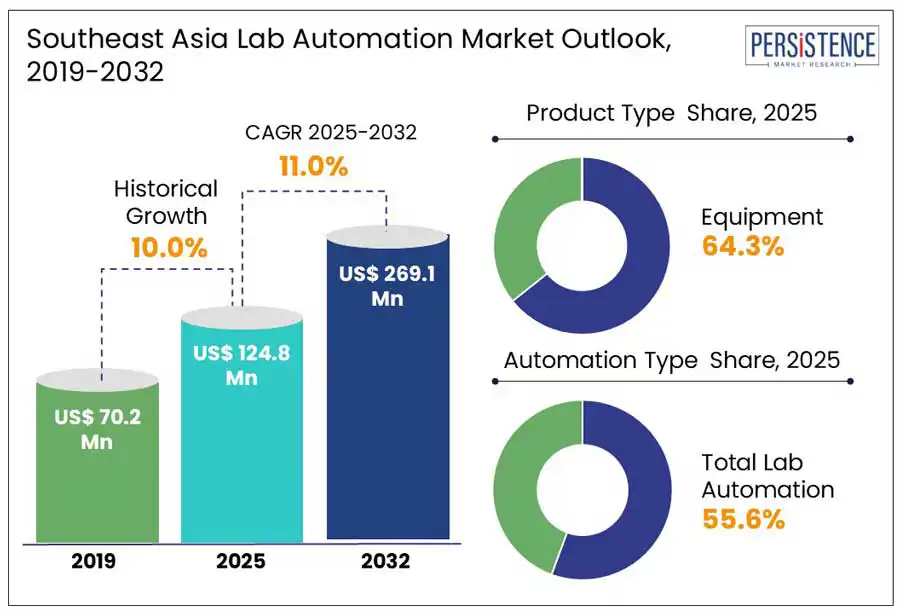
The Southeast Asia lab automation market is estimated to grow from US$ 124.8 million in 2025 to US$ 269.1 million at a CAGR of 11.6% by 2032. According to the Persistence Market Research report, the Southeast Asia lab automation market is set for steady growth, fueled by rising demand for precision diagnostics and scalable research and development (R&D) infrastructure. Key drivers include significant investments in bio-manufacturing, such as AbbVie’s USD 223 million expansion and Sanofi’s modular biopharma facility in Singapore, highlighting a regional shift toward automation-led healthcare.
In Malaysia, the United Nations Development Programme (UNDP) promotes cost-effective automation for MSMEs. Thailand, on the other hand, focuses on enhancing lab infrastructure to support its medical tourism sector. These developments reflect growing public-private collaboration across the region, creating strong demand for solutions such as laboratory information management systems (LIMS), liquid handling systems, and AI-based tools. Overall, Southeast Asia’s lab automation market is shaped by a blend of public-private investments and the increasing need for precision, speed, and data-driven laboratory operations.
Key Industry Highlights:
- Lab automation adoption is rising across Southeast Asia, driven by the need for faster, more accurate lab processes in pharma, biotech, and diagnostics.
- Vendors offer modular, AI-integrated systems tailored to diverse lab environments in the region.
- The growing genomics and microbiome research supports the high demand for liquid handling and nucleic acid extraction systems.
- Clinical and research labs are prioritizing automation to boost reproducibility, reduce errors, and handle larger test volumes.
- Technological advances in robotics, LIMS, and cloud-based tools are enhancing lab efficiency, data management, and compliance.
|
Market Attribute |
Key Insights |
|
Southeast Asia Lab Automation Market Size (2025E) |
US$ 124.8 Mn |
|
Market Value Forecast (2032F) |
US$ 269.1 Mn |
|
Projected Growth (CAGR 2025 to 2032) |
11.6% |
|
Historical Market Growth (CAGR 2019 to 2024) |
10.0% |
Market Dynamics
Driver - Strategic National Initiatives Accelerate Lab Automation Growth Across Southeast Asia
One of the key drivers of the Southeast Asia lab automation market is the region’s strategic focus on strengthening healthcare and biomanufacturing capabilities to support precision diagnostics, scalable R&D, and clinical efficiency. Southeast Asia countries prioritize innovation-led growth. For instance, Singapore has emerged as a key biotech and medtech hub supported by government initiatives under the Research, Innovation and Enterprise (RIE) 2025 plan. This push has spurred the rise of high-tech clusters such as Biopolis a biomedical R&D hub and driven investment in intelligent manufacturing and digital labs.
Similarly, Thailand is advancing its healthcare infrastructure under the “Thailand 4.0” policy, with a focus on modern lab technologies. This is anticipated to support Thailand’s positioning as a global medical and wellness hub an effort it plans to spotlight at Expo 2025 in Osaka. Meanwhile, Vietnam and Indonesia are increasingly attracting global clinical trials through their expanding Contract Research Organization (CRO) sectors, accelerating demand for automated systems such as LIMS, nucleic acid extraction units, and robotic handlers. These country-specific initiatives collectively create a robust regional momentum, making Southeast Asia an increasingly vital destination for lab automation solutions.
Restraint - Skilled Workforce Shortage Hinders Automation Rollout
One of the notable restraints affecting lab automation adoption in Southeast Asia is the shortage of trained professionals equipped to handle complex automation technologies. According to recent studies, while demand for automated systems is growing across diagnostics and research sectors, the slow pace of adoption is challenging in emerging economies.
In countries such as Vietnam and the Philippines, technical training programs tailored to lab automation remain limited. For instance, according to a recently published study, in Vietnam, the integration of open-source LIMS in public health labs has frequently depended on external consultants due to a lack of in-country specialists. This reliance not only escalates operational costs but also delays deployment timelines, highlighting the urgent need for capacity-building initiatives to support sustainable automation adoption.
Opportunity - Boosting Accessibility through Localized Supply Chains
There is significant scope in Southeast Asia to boost lab automation adoption through localized manufacturing and distribution networks. By establishing regional production hubs and forming partnerships with domestic suppliers or distributors, global and local players are likely to reduce costs, shorten lead times, and improve service responsiveness. For example, companies such as Esco Lifesciences, headquartered in Singapore, have leveraged local presence to expand their footprint efficiently across ASEAN markets.
Fostering collaborations between automation technology providers and regional contract manufacturers can make automation solutions more affordable for mid-sized labs, particularly in countries such as Vietnam, Indonesia, and the Philippines. This localized approach is expected to help navigate import duties and regulatory complexities, making lab automation more accessible across these regions.
Southeast Asia Lab Automation Market Key Trend
Remote Monitoring and Cloud Integration Redefining Lab Operations
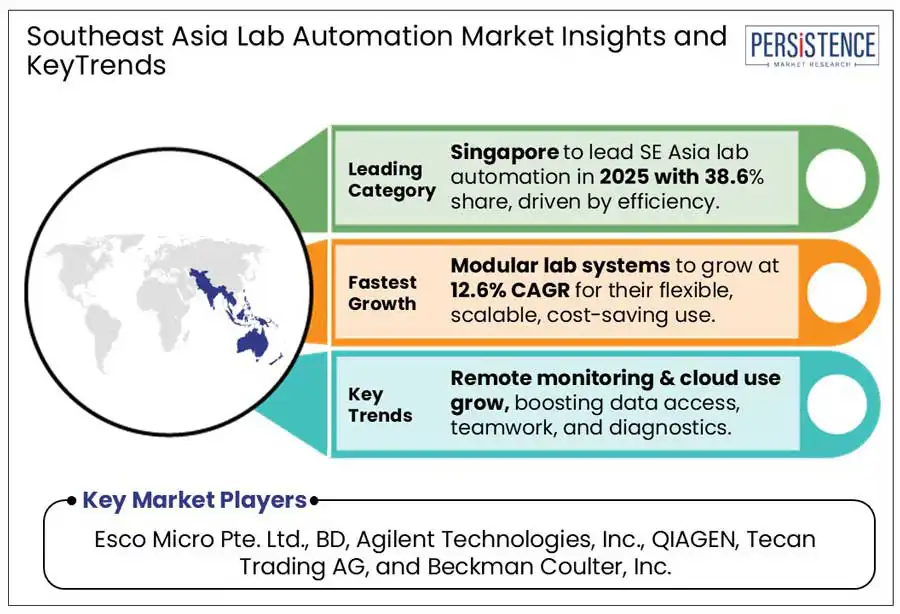
A key trend shaping the lab automation landscape in Southeast Asia is the growing demand for remote monitoring and cloud connectivity. Factors include the need for real-time oversight, streamlined data access, and operational agility across distributed lab environments. Reflecting this shift, several automation providers are embedding advanced connectivity features into their platforms. For instance, Tecan has enhanced its Fluent® automation workstation with FluentControl™ software, which supports remote access and secure cloud integration. This allows users to monitor instrument status, schedule runs, and troubleshoot systems offsite. This is particularly valuable in Southeast Asia, where multi-site research collaborations and cross-border diagnostics are becoming more common. Such cloud-enabled tools not only reduce downtime and labor costs but also improve data traceability and compliance across lab networks.
Category-wise Analysis
Product Insights
In Southeast Asia, lab automation equipment is expected to lead the market by a 64.3% share in 2025, owing to its critical role in enhancing accuracy, speed, and lab productivity. The demand for high-throughput instruments, such as automated analyzers and robotic systems is rising across diagnostics and research settings.
In Thailand, several hospitals have implemented end-to-end automation from phlebotomy to analysis. This shift aims to reduce manual errors and efficiently manage increasing patient volumes. Meanwhile, the software and services segment is also growing steadily, supporting lab operations through data integration, remote monitoring, and system maintenance solutions.
Automation Type Insights
In the Southeast Asia lab automation market, total automation systems are expected to lead with a market share of 55.6% in 2025. This dominance is driven by the growing demand for end-to-end workflow efficiency, especially in large hospitals and centralized diagnostic laboratories that require seamless, high-throughput workflows.
Total automation minimizes human intervention from sample reception to result delivery, reducing errors and enhancing consistency. On the other hand, modular automation systems are gaining popularity among mid-sized labs for their flexibility and lower upfront investment, but remain a secondary segment due to scalability limitations.
Regional Insights
Singapore Lab Automation Market Trends
Singapore is estimated to hold the dominant position within the Southeast Asia market with around 38.6% value share, due to its strong biotech ecosystem and sustained investments. Recent developments such as WuXi Biologics’ new CRDMO center, ASTAR’s* partnerships with Flagship Pioneering and Ring Therapeutics, and AbbVie’s USD 223 million manufacturing expansion highlight the country’s leadership in automation-driven biomanufacturing. These strategic moves position Singapore as a regional hub for advanced lab technologies and innovation.
Thailand Lab Automation Market Trends
?Thailand market is projected to grow at a 12.7% CAGR through 2032, driven by medical tourism and digital healthcare initiatives. Under Thailand 4.0, the government promotes the country as a medical hub, encouraging investment in advanced healthcare technologies. Chiang Mai Hospital partnered with IBM in December 2024 to automate lab orders and integrate fully automated systems. This showcases efforts to improve efficiency, reduce diagnostic times, and enhance patient outcomes, accelerating the adoption of lab automation technologies.
Competitive Landscape
The Southeast Asia lab automation market is moderately fragmented, with a mix of global leaders and regional players competing on innovation, integration, and affordability. Companies are increasingly focusing on adapting solutions to local needs, supported by regional partnerships and distribution networks.
Recent advancements include AI-powered workflow optimization, cloud-integrated laboratory information systems, and mobile robotic platforms enhancing efficiency and scalability. The push toward localized manufacturing and collaborations in genomics and diagnostics is also shaping a more dynamic and competitive environment across the region.
Key Industry Developments
- In February 2025, Allwin Medical Devices entered a strategic partnership with Esco Lifesciences Group Ltd., a Singapore-based global leader in life sciences equipment. The collaboration integrates Allwin’s IVF consumables with Esco’s advanced instruments, offering a complete workflow solution for fertility clinics and driving innovation in assisted reproductive technologies.
- In January 2025, Basepair Inc. entered into a distribution agreement with Sciencewerke to bring its user-friendly bioinformatics platform to Southeast Asia. The partnership aimed to support genomic research and precision medicine by offering scalable and efficient data analysis tools across the region.
- In March 2024, WuXi Biologics announced it had broken ground on a new 13.5-hectare CRDMO facility at Tuas Biomedical Park, Singapore. The center is set to offer integrated biologics research, development, and manufacturing services, strengthening the region’s position as a biomedical hub.
Companies Covered in Southeast Asia Lab Automation Market
- Esco Micro Pte. Ltd.
- BD
- Yokogawa Electric Corporation
- Agilent Technologies, Inc.
- Pepperl&Fuchs (India) Pvt. Ltd.
- Accuris Instruments
- Thermo Fisher Scientific Inc.
- PerkinElmer
- Beckman Coulter, Inc.
- Siemens Healthineers AG
- F. Hoffmann-La Roche Ltd
- Abbott
- Hamilton Company
- Tecan Trading AG
- Eppendorf SE
- QIAGEN
- Bio-Rad Laboratories, Inc.
- Hudson Lab Automation
- Sartorius AG
- Analytik Jena GmbH+Co. KG
- Gilson Incorporated.
- Aurora Biomed Inc.
- Biosero, Inc.
Frequently Asked Questions
Southeast Asia market is estimated to increase from US$ 124.8 Mn in 2025 to US$ 269.1 Mn in 2032.
The market is driven by increasing demand for faster, more accurate diagnostic results and government initiatives promoting investment in healthcare automation technologies.
The market is projected to record a CAGR of 11.6% during the forecast period from 2025 to 2032.
Opportunities in the Southeast Asia lab automation market include local manufacturing and distribution to reduce costs, as well as the rising demand in emerging countries driven by healthcare advancements.
Major players in lab automation market include Esco Micro Pte. Ltd., BD, Agilent Technologies, Inc., QIAGEN, Tecan Trading AG, and Beckman Coulter, Inc.


