




- Medical Devices
- Single-Use Scopes Market
Single-Use Scopes Market Size, Share, and Growth Forecast, 2026 - 2033
Single-Use Scopes Market by Product Type (Endoscopic Scopes, Colonoscopy Scopes, Bronchoscopy Scopes, Urology Scopes, Arthroscopy Scopes), Material (Plastic, Polymer Coated, Biodegradable Materials, Silicone), and Regional Analysis for 2026 - 2033

Single-Use Scopes Market Size and Trends Analysis
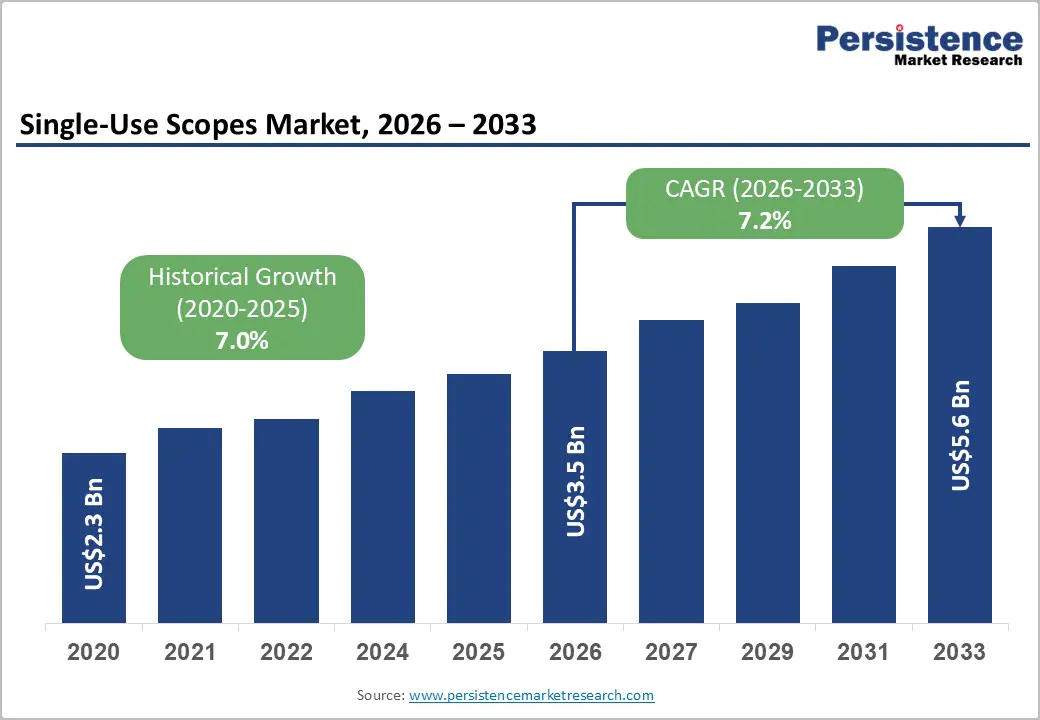
The global single-use scopes market size is likely to be valued at US$3.5 billion in 2026 and is expected to reach US$5.6 billion by 2033, growing at a CAGR of 7.2% during the forecast period from 2026 to 2033, driven by increasing infection-prevention priorities, rising procedure volumes, technological advancements, and supportive regulatory and reimbursement frameworks.
The market is anticipated to favor the growing occurrences of hospital-acquired infections (HAI) owing to the usage of contaminated endoscopes and the lower cost associated with single-use scopes.
According to the World Health Organization (2022), out of every 100 patients in acute-care hospitals, approximately 7 in high-income countries and 15 in low- and middle-income countries acquire at least one HAI during their hospital stay, many of which are preventable through effective infection prevention and control measures. This elevated HAI burden reinforces the adoption of disposable endoscopes, as single-use devices eliminate cross-contamination risks, reduce reprocessing time, and streamline hospital workflow.
Key Industry Highlights:
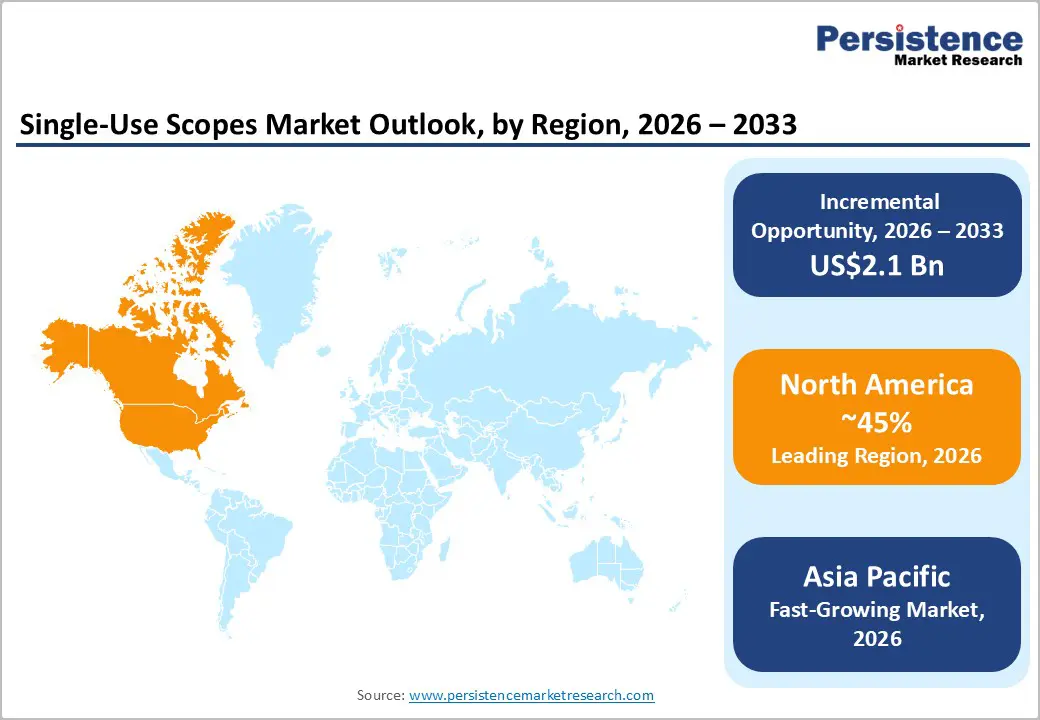
- Leading Region: North America is anticipated to be the leading region, accounting for a market share of 45% in 2026, driven by advanced healthcare infrastructure, high reimbursement, strong infection-control standards, and a consolidated competitive landscape.
- Fastest-growing Region: Asia Pacific is likely to be the fastest-growing region in the single-use scopes in 2026, supported by large patient populations, growing private healthcare investment, and expanding domestic manufacturing capabilities.
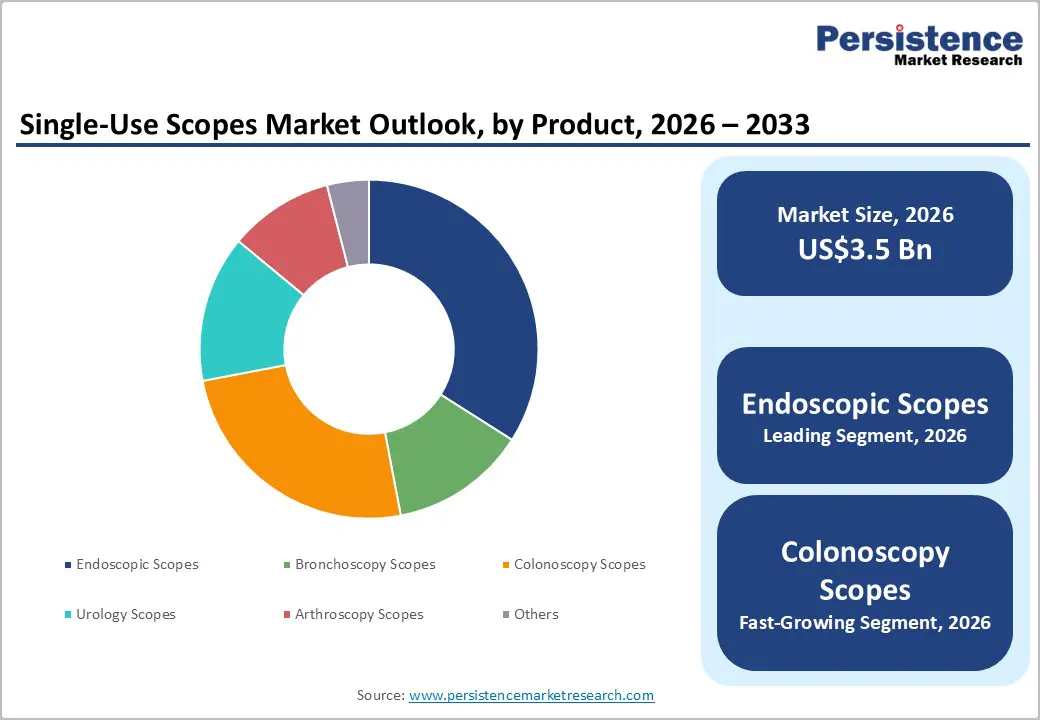
- Leading Product Type: Endoscopic scopes are projected to represent the leading product type in 2026, accounting for 40% of the revenue share, driven by high gastrointestinal procedure volumes and strong infection-control adoption across healthcare settings.
- Leading Material Type: Plastics are anticipated to be the leading material type, accounting for over 60% of the revenue share in 2026, due to cost-effective manufacturing, established medical-grade polymer supply chains, and reliable performance in single-use clinical applications.
| Key Insights | Details |
|---|---|
| Single-Use Scopes Market Size (2026E) | US$3.5 Bn |
| Market Value Forecast (2033F) | US$5.6 Bn |
| Projected Growth (CAGR 2026 to 2033) | 7.2% |
| Historical Market Growth (CAGR 2020 to 2025) | 7.0% |
Market Factors - Growth, Barriers, and Opportunity Analysis
Growth Analysis - Rising Focus on Infection Control and Hospital-Acquired Infection (HAI) Prevention
Reusable endoscopes require complex reprocessing procedures, and lapses in sterilization have been linked to cross-contamination events. Healthcare providers are increasingly adopting disposable scopes to ensure a sterile device for every patient, minimizing infection risks and liability exposure. Regulatory agencies continue to emphasize strict infection prevention protocols, encouraging hospitals to evaluate alternatives that eliminate reprocessing variability. This shift aligns with broader patient safety initiatives and quality improvement programs, positioning single-use scopes as a reliable infection-control solution across gastroenterology, pulmonology, and urology settings.
Hospitals and ambulatory surgical centers now prioritize solutions that reduce surface contact, staff handling, and sterilization workload. Single-use scopes help streamline workflows by eliminating turnaround delays and reducing dependency on central sterile departments. Infection prevention committees increasingly influence purchasing decisions, accelerating disposable device adoption. As healthcare systems aim to lower HAI rates and meet accreditation standards, demand for single-use scopes continues to expand, reinforcing their role as a preventive strategy within modern endoscopic practice and hospital risk-management frameworks.
Increasing Volume of Minimally Invasive Diagnostic and Therapeutic Procedures
The growing prevalence of gastrointestinal disorders, respiratory diseases, kidney stones, and cancers has increased the number of diagnostic and therapeutic endoscopic interventions. Aging populations and improved access to screening programs expand procedure volumes. Single-use scopes support this growth by offering immediate availability without reprocessing delays, enabling higher patient throughput. Their convenience makes them particularly attractive in outpatient and ambulatory surgical center settings, where efficiency, rapid turnover, and reduced infrastructure requirements are critical to operational performance and cost management.
Advancements in imaging resolution, maneuverability, and ergonomic design have enhanced clinician confidence in disposable devices for complex procedures. As therapeutic endoscopy expands into advanced interventions, including stone management and biopsy-guided diagnostics, single-use platforms are increasingly integrated into routine care. The shift toward day-care surgeries and minimally invasive treatment pathways aligns well with disposable scope adoption. Healthcare providers benefit from predictable performance and simplified logistics, which support scalable procedural growth.
Barrier Analysis - Limited Clinical Evidence and Physician Preference for Reusable Systems
Despite strong growth, limited long-term clinical evidence in certain specialties restrains the broader adoption of single-use scopes. Many physicians remain accustomed to reusable systems that have demonstrated durability and high-definition imaging performance over decades. In advanced therapeutic procedures, clinicians may perceive reusable scopes as offering superior tactile feedback and accessory compatibility. This preference slows transition in high-complexity settings where performance confidence is critical. Institutional purchasing committees often require robust comparative data before replacing established capital equipment, creating adoption barriers in specialty departments with entrenched workflows.
Clinical skepticism is reinforced by concerns regarding image clarity, device rigidity, and compatibility with specialized instruments. While technological improvements are narrowing performance gaps, perception challenges persist in segments such as advanced gastrointestinal interventions and complex urology cases. Hospitals with established reprocessing infrastructure may also hesitate to shift fully toward disposables. Overcoming these restraints requires continued clinical trials, peer-reviewed evidence, and practitioner education to demonstrate equivalency or superiority. Building physician trust remains essential for accelerating widespread market penetration across diverse medical specialties.
Environmental and Waste-Management Pressures
Disposable devices contribute to medical plastic waste, raising concerns among hospital administrators and policymakers focused on carbon footprint reduction. Increasing regulatory attention toward sustainable healthcare practices places pressure on manufacturers to address waste generation. Healthcare institutions implementing green procurement policies may evaluate the environmental trade-offs between disposable and reusable systems. As sustainability reporting becomes more prominent, waste-management implications influence purchasing decisions, particularly in regions with strict environmental compliance standards.
Waste disposal costs and recycling limitations complicate large-scale adoption. Single-use scopes often incorporate mixed materials and embedded electronics, making recycling challenging under conventional systems. Hospitals must balance infection prevention benefits with environmental responsibility goals. In response, manufacturers are exploring recyclable components and biodegradable alternatives, but widespread implementation remains evolving. Environmental advocacy and public scrutiny may influence regulatory frameworks in the future. Addressing these sustainability challenges through material innovation and circular economy strategies is critical to mitigating long-term restraints on market growth.
Opportunity Analysis - Technological Convergence with AI-Enabled Imaging and Data Analytics
AI-powered computer-aided detection (CADe) and computer-aided diagnosis (CADx) systems can be embedded into endoscopic platforms to enhance real-time lesion detection, polyp classification, bleeding source identification, and mucosal abnormality assessment. In gastrointestinal applications, AI algorithms improve adenoma detection rates and reduce missed lesions, directly influencing early cancer diagnosis outcomes. When integrated with disposable scopes, AI eliminates variability caused by device wear-and-tear seen in reusable systems, ensuring consistent image quality for algorithm performance. This combination strengthens clinical reliability while maintaining sterility advantages.
Beyond detection, AI integration enables procedural guidance and workflow optimization. Machine learning models can analyze live procedural feeds to provide on-screen prompts, navigation assistance, and quality indicators such as withdrawal time monitoring in colonoscopy. Disposable scopes integrated with digital processors can automatically upload procedural data to secure cloud platforms, enabling advanced analytics, benchmarking, and quality reporting. This enhances hospital compliance with accreditation standards and value-based reimbursement models.
Biodegradable Material Innovation
Hospitals worldwide are adopting sustainability initiatives aimed at reducing plastic waste and environmental impact. Development of biodegradable polymers and recyclable components aligns disposable scopes with green healthcare objectives. Manufacturers investing in eco-friendly materials can differentiate their products while addressing environmental concerns associated with traditional plastics. Such advancements support broader acceptance of disposable technologies among environmentally conscious healthcare systems.
As regulatory bodies encourage sustainable procurement policies, biodegradable scope solutions may gain a competitive advantage. Advances in material science enable improved durability, optical clarity, and biocompatibility without compromising environmental goals. Partnerships between medical device companies and material engineering firms are accelerating the commercialization of sustainable alternatives. Adoption of closed-loop recycling programs and environmentally responsible production practices enhances market attractiveness. By aligning infection prevention benefits with sustainability commitments, biodegradable material innovation strengthens long-term growth prospects for the single-use scopes industry.
Category-wise Analysis
Product Type Insights
Endoscopic scopes are expected to lead the single-use scopes market, accounting for approximately 40% of revenue in 2026, driven by the high volume of gastrointestinal procedures, including routine diagnostic gastroscopy and screening-based colon evaluations. Growing awareness of early cancer detection, expanding reimbursement coverage, and strong adoption across hospitals and ambulatory surgical centers reinforce segment leadership. Infection-control priorities also favor disposable GI scopes due to historical contamination risks associated with reusable endoscopes.
For example, the increasing clinical adoption of single-use upper GI scopes for routine diagnostic procedures in high-volume centers, where workflow efficiency and guaranteed sterility are critical decision factors.
Colonoscopy scopes are likely to represent the fastest-growing segment, supported by expanding national colorectal cancer screening programs and rising early-detection awareness. Growth is directly linked to the increasing incidence of colorectal cancer and policy-driven preventive screening initiatives. Disposable colonoscopy platforms reduce cross-contamination risks while supporting high patient throughput in outpatient settings. Rising aging populations and lifestyle-related gastrointestinal disorders contribute to the growing demand.
For example, includes the integration of single-use colonoscopy systems in screening-focused ambulatory centers, where infection prevention and rapid turnaround enhance operational scalability.
Material Type Insights
Plastic is expected to dominate the market, accounting for approximately 60% of the revenue share by 2026, driven by its cost-effectiveness, scalability, and suitability for high-volume medical manufacturing. Medical-grade polymers offer the ideal balance of flexibility, durability, and optical clarity needed for endoscopic procedures. Well-established supply chains for polymer components ensure consistent production and reliable quality control, facilitating widespread adoption. For instance, plastic-based housings and insertion tubes are commonly used in disposable bronchoscopes, particularly in intensive care units, where dependable performance and guaranteed sterility are critical.
Biodegradable materials are expected to be the fastest-growing category, driven by increasing environmental concerns and sustainability efforts within healthcare systems. Hospitals and policymakers are placing greater emphasis on reducing medical plastic waste and carbon footprints, which is prompting manufacturers to explore compostable or recyclable polymers for disposable medical devices. Advances in material science are making it possible to create biodegradable alternatives that still meet required standards for mechanical strength, optical clarity, and patient safety.
For instance, the development of biodegradable polymer components in next-generation disposable urology scopes is being tailored for environmentally conscious healthcare facilities in Europe.
Regional Insights
North America Single-Use Scopes Market Trends
North America is anticipated to be the leading region, accounting for a market share of 45% in 2026, driven by a strong emphasis on reducing healthcare-associated infections (HAIs), which has heightened interest in disposable devices that eliminate reprocessing variability and cross-contamination risks. Hospitals and ambulatory surgical centers are increasingly adopting single-use endoscopes across gastroenterology, pulmonology, and urology procedures due to clear regulatory guidance and favorable reimbursement frameworks. The U.S. Centers for Medicare & Medicaid Services (CMS) and private payers provide structured reimbursement pathways that reduce financial barriers to adoption.
Another key trend in North America is competitive innovation and strategic collaboration among major medical device companies aimed at broadening single-use scope portfolios. For example, Ambu A/S has strengthened its presence with AI-ready disposable endoscopy solutions tailored to U.S. hospital and ASC environments, helping clinicians balance sterility with high-definition visualization. Companies are also focusing on digital integration and data analytics to elevate diagnostic performance; disposable scopes embedded with smarter imaging and connectivity features support quality documentation and performance tracking.
Europe Single-Use Scopes Market Trends
Europe is likely to be a significant market for single-use scopes, due to the emphasis on infection prevention, quality of care, and procedural efficiency. Hospitals and outpatient centers are increasingly adopting disposable endoscopes to address cross-contamination risks associated with reprocessing reusable devices, particularly in gastroenterology, pulmonology, and urology departments. National health authorities across countries such as Germany, France, and the Netherlands have strengthened infection control policies, prompting larger procurement of single-use solutions that simplify workflow and reduce sterilization burden on central sterile services.
Another prominent trend in Europe is the integration of digital and ergonomic design improvements that tailor single-use scopes toward clinician needs and patient outcomes, alongside increasing environmental considerations. For example, KARL STORZ SE & Co. KG has introduced single-use endoscopic solutions optimized for visibility and handling, aligning with surgeon preferences for improved visualization and reduced infection risk. European health systems are exploring sustainable procurement criteria, encouraging manufacturers to develop recyclable components and greener materials.
Partnerships between device makers and research institutions focus on biodegradable polymers and end-of-life recycling solutions to address environmental impact without compromising performance.
Asia Pacific Single-Use Scopes Market Trends
The Asia Pacific region is likely to be the fastest-growing region in 2026, driven by the rising incidence of chronic diseases, expanding preventive care programs, and growing awareness of infection risks associated with reusable endoscopes. Large patient populations requiring gastroenterology, pulmonology, and urology procedures support volume-based demand for disposable endoscopic devices. Governments and private healthcare providers are increasing capital investments in ambulatory surgical centers and outpatient diagnostic clinics, where single-use scopes help reduce turnaround times and lower sterilization burden.
Another significant trend in the Asia Pacific region is the emergence of domestic manufacturing capabilities and competitive pricing, which are helping to accelerate market adoption. Local device makers are leveraging lower production costs and established electronics supply chains to produce high-quality single-use scopes tailored to regional needs. For example, Hunan Vathin Medical Devices Co., Ltd., a Chinese firm, has developed its own line of disposable bronchoscopes and flexible endoscopes, gaining traction in both local and export markets.
Competitive Landscape
The global single-use scopes market exhibits a moderately fragmented structure, driven by a mix of established medical device giants, specialized endoscopy innovators, and emerging regional manufacturers focusing on cost, technology, and clinical performance. Demand for disposable endoscopes across gastroenterology, pulmonology, urology, and other minimally invasive applications has lowered entry barriers for niche players, while large multinational corporations leverage broad product portfolios and distribution networks to maintain leadership.
With key leaders including Ambu A/S, Boston Scientific Corporation Inc., KARL STORZ SE & Co. KG, and HOYA Corporation, the market’s competitive environment blends legacy endoscopy expertise with next-generation disposable innovation. These players compete through product differentiation, strategic alliances, specialty-specific solutions, and expanded service support programs that enhance adoption in hospitals and ambulatory surgical centers. Smaller and regional firms often focus on pricing competitiveness, localized manufacturing efficiencies, and tailored features for emerging markets.
Key Industry Developments:
- In February 2026, Xenocor, Inc. announced that the U.S. Food and Drug Administration (FDA) granted clearance for its Saberscope®, the first single-use 5mm articulating laparoscope designed to provide high-definition visualization during minimally invasive abdominal and thoracic procedures. The device integrates a disposable articulating scope with a compact reusable video processor, enabling plug-and-play compatibility with standard HD monitors and existing operating room systems. The Saberscope features a 90-degree articulating tip to enhance anatomical visualization while reducing reliance on traditional reusable towers and reprocessing systems.
- In February 2026, Olympus Corp. of the Americas announced FDA clearance for a pediatric use indication for two single-use bronchoscopes within its respiratory portfolio. The H-SteriScope™ video flexible bronchoscopes, manufactured by Hunan Vathin® Medical Instrument Co., Ltd. and distributed exclusively by Olympus America Inc., received 510(k) clearance for expanded pediatric applications. The Zero BCV1-02 model, featuring a 2.2mm distal end, is approved for use in pediatric patients aged 6 months to 6 years, while the Slim BCV1-C2 model, with a 3.2mm distal end and 1.2mm working channel, is approved for patients aged six years and older.
Companies Covered in Single-Use Scopes Market
- OOTU Medical Inc.
- 3NT Medical Ltd
- Boston Scientific Corporation Inc.
- Coloplast A/S
- Hill Rom Holdings
- Prosurg Inc.
- Corinth MedTech Inc.
- Parburch Medical Developments Ltd. Ambu A/S
- KARL STORZ SE & Co. KG
- HOYA Corporation
- Integra LifeSciences Holdings Corporation
- Flexicare Medical Ltd
- Integrated Endoscopy
- Roper Technologies Inc.
- OBP Medical Corporation
Frequently Asked Questions
The global single-use scopes market is projected to reach US$3.5 billion in 2026.
The single-use scopes market is driven by rising infection-control priorities, increasing minimally invasive procedure volumes, and growing preference for devices that eliminate reprocessing risks and improve workflow efficiency.
The single-use scopes market is expected to grow at a CAGR of 7.2% from 2026 to 2033.
Key market opportunities include AI-enabled imaging integration, expansion into pediatric and specialty applications, and development of biodegradable and sustainable single-use scope materials.
OOTU Medical Inc., 3NT Medical Ltd, Boston Scientific Corporation Inc., Coloplast A/S, and Hill Rom Holdings are the leading players.


