




- Technology
- Secure Multiparty Computation (SMPC) Market
Secure Multiparty Computation (SMPC) Market Size, Share, and Growth Forecast, 2026 - 2033
Secure Multiparty Computation (SMPC) Market by Service Type (Software Solutions, Services), Deployment Mode (On-Premise, Cloud-Based, Hybrid), Organization Size (Large Enterprises, Small & Medium Enterprises (SMEs)) Industry (Healthcare & Life Sciences, Banking, Financial Services & Insurance (BFSI), Government & Public Sector, Defense & Law Enforcement, Telecommunications, IT & Cloud Service Providers) and Regional Analysis for 2026 - 2033

Secure Multiparty Computation (SMPC) Market Size and Share Analysis
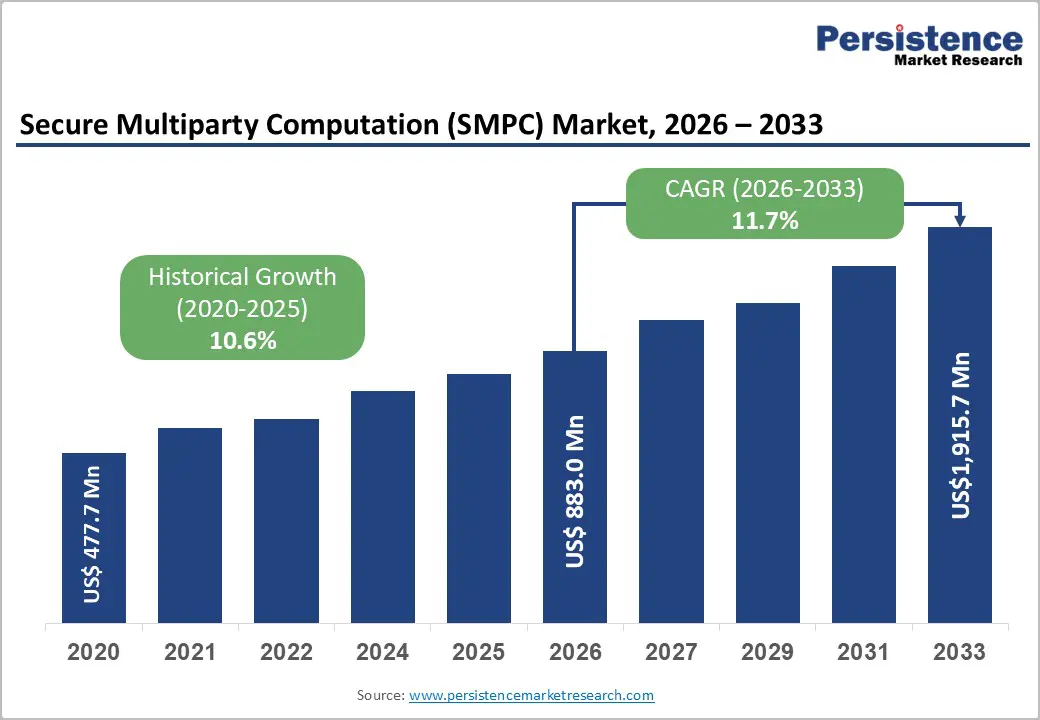
The global secure multiparty computation (SMPC) market size is likely to be valued at US$ 883.0 million in 2026 and is projected to reach US$ 1,915.7 million by 2033, growing at a CAGR of 11.7% between 2026 and 2033. This expansion reflects escalating regulatory requirements for data privacy compliance, institutional adoption of decentralized custody models for digital assets, and enterprise demand for privacy-preserving collaborative data analysis across regulated sectors.
The market's trajectory is anchored in three structural drivers: stringent data protection regulations (GDPR, HIPAA, CCPA) creating compliance imperatives for secure data collaboration; exponential growth in digital asset markets driving demand for multi-party computation-based custody infrastructure; and the convergence of artificial intelligence with privacy-preserving computation, enabling organisations to perform machine learning inference on encrypted data without exposing sensitive information.
Key Industry Highlights:
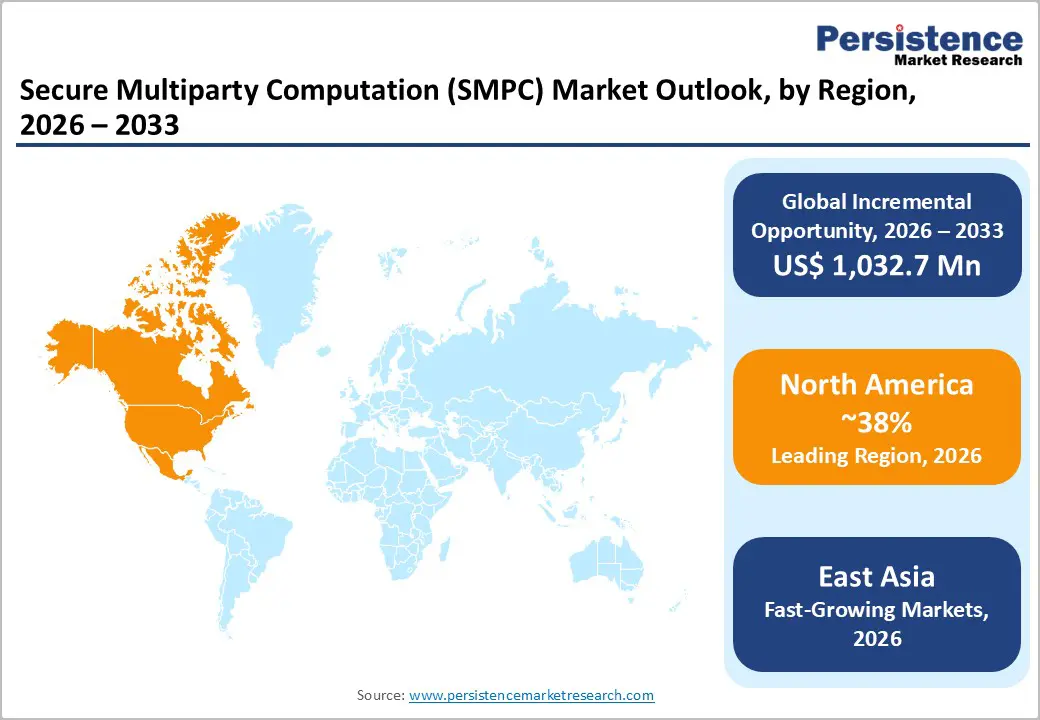
- Regional Leadership: North America dominates the global SMPC market with ~38% share, driven by advanced digital infrastructure, regulatory mandates, and strong enterprise adoption in BFSI, healthcare, and government sectors.
- Strong European Presence: Europe accounts for ~26% of market share, supported by GDPR compliance, mature cloud adoption, and systematic SMPC deployment across banking, healthcare, and public administration.
- High-Growing Region: East Asia holds ~18% share, led by China, Japan, and South Korea, fueled by rapid digitalisation, large-scale cloud infrastructure expansion, and institutional blockchain adoption.
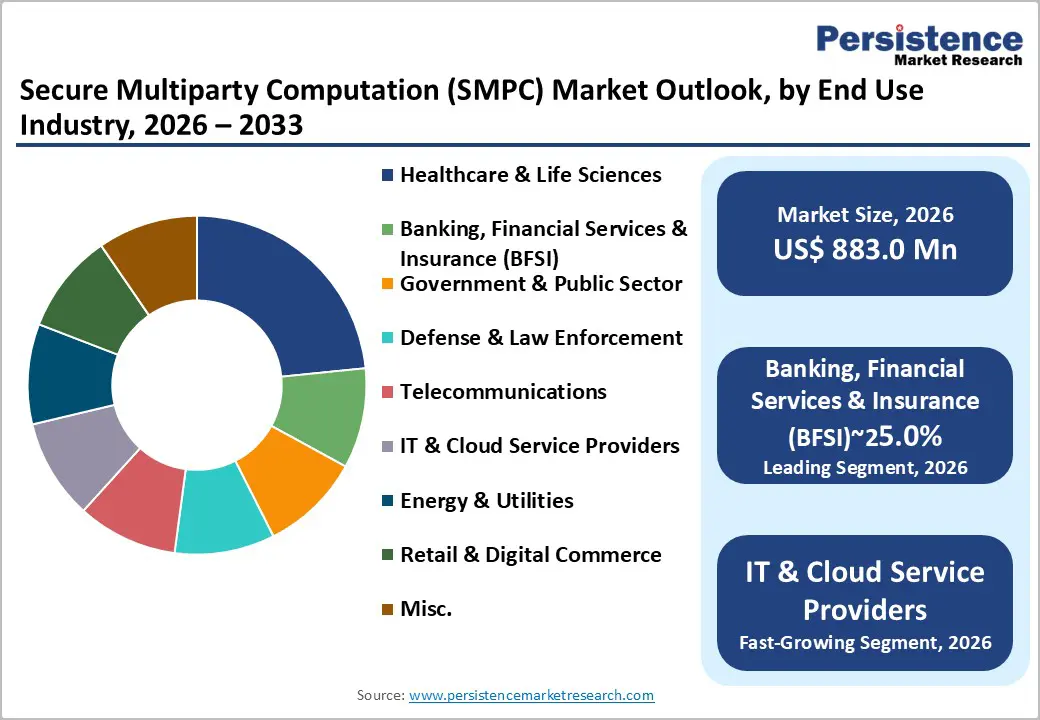
- Leading End-user: BFSI commands ~25% market share, reflecting systematic adoption of SMPC for fraud detection, risk analysis, secure transactions, and regulatory compliance.
- Fastest-Growing End-user: IT & Cloud Service Providers are expanding rapidly, integrating SMPC for privacy-preserving AI, data analytics, and multi-institutional collaboration across regulated clients.
| Key Insights | Details |
|---|---|
|
Secure Multiparty Computation (SMPC) Market Size (2026E) |
US$ 883.0 Mn |
|
Market Value Forecast (2033F) |
US$ 1,915.7Mn |
|
Projected Growth (CAGR 2026 to 2033) |
11.4% |
|
Historical Market Growth (CAGR 2020 to 2025) |
10.6% |
Market Dynamics
Drivers - Regulatory Compliance Framework and Data Protection Mandate Enforcement
Organizations across financial services, healthcare, and government sectors face increasing regulatory pressure to implement privacy-by-design computing frameworks that enable data collaboration while maintaining strict confidentiality controls. The Secure Multiparty Computation (SMPC) Market has emerged as a core infrastructure technology addressing this regulatory imperative, as SMPC enables multiple parties to jointly compute functions over their data while keeping individual inputs confidential throughout the computation process.
The European Data Protection Supervisor (EDPS), in collaboration with Goethe Frankfurt University, formally positioned SMPC as a core pillar of next-generation privacy-enhancing technologies in October 2025, emphasizing its practical relevance for real-world deployments across highly regulated sectors.
Global data protection regulations, such as GDPR in the European Union, HIPAA in healthcare, and CCPA in California, explicitly mandate privacy-by-design principles that SMPC directly addresses. Organisations failing to demonstrate adequate privacy controls face penalties reaching 4% of global revenue (GDPR), making compliance investments economically rational. India's BFSI sector, valued at US$ 1 trillion in 2025, contributing 27% to national GDP, exemplifies this regulatory acceleration: as gross NPAs declined from 5.8% in FY22 to 2.2% in FY25, regulatory focus intensified on data protection frameworks for financial transactions and customer information management. SMPC enables this sector to perform fraud detection, risk analysis, and secure transactions on encrypted data without exposing confidential information, supporting the sector's transformation while maintaining regulatory alignment.
Privacy-Preserving Machine Learning and Collaborative AI Inference Acceleration
Organisations increasingly require the ability to perform machine learning inference and model training on sensitive datasets without exposing raw data to untrusted third parties or cloud environments, driving adoption of secure multi-party computation for AI workloads. The Secure Multiparty Computation (SMPC) Market is expanding to address this requirement by enabling multiple parties to jointly train models or perform inference on encrypted data, thereby preserving privacy throughout the computation. Microsoft Research India demonstrated this capability in February 2024, leveraging their EzPC-OnnxBridge technology to perform privacy-preserving machine learning inference on sensitive rs-fMRI datasets, enabling multiple parties to collaboratively conduct advanced medical analysis while ensuring patient privacy.
Financial services firms deploy SMPC for fraud detection across shared datasets without exposing transaction details; healthcare institutions leverage the technology for rare disease research across multiple hospitals without exposing individual patient records; manufacturing organisations use SMPC for predictive maintenance algorithms trained on sensitive equipment performance data. This trend directly addresses a critical enterprise constraint: regulatory compliance frameworks (HIPAA, GDPR) restrict data movement for model training, yet competitive pressure demands sophisticated AI-driven insights. SMPC provides the cryptographic infrastructure enabling this capability.
The global IT & Cloud Service Providers sector, the fastest-growing end-use segment for SMPC, relies on privacy-preserving computation to deliver AI-powered analytics services to regulated clients (healthcare, financial services, government) while maintaining data confidentiality throughout the inference pipeline.
Restraint - Computational Complexity and Performance Overhead in SMPC Protocol Execution
Secure Multiparty Computation protocols incur substantial computational overhead compared to traditional unencrypted computation, as multiple parties must exchange encrypted data shares, perform computation on secret-shared values, and coordinate to reconstruct results securely. This overhead translates to longer execution times, higher CPU consumption, and increased network bandwidth requirements, creating barriers to SMPC adoption for latency-sensitive applications and computationally intensive workloads.
Organisations evaluating SMPC solutions frequently encounter implementation challenges: circuit-based MPC protocols require conversion of business logic into boolean or arithmetic circuits, a complex optimisation task requiring specialised expertise; multi-party coordination overhead increases with participant count, making large-scale collaborative computation economically inefficient; and cryptographic operations (especially involving homomorphic encryption or zero-knowledge proofs) introduce latency that may be unacceptable for real-time applications. These technical barriers increase deployment costs and extend implementation timelines, particularly for organisations lacking in-house cryptographic expertise.
Opportunity - Privacy-Preserving Machine Learning Infrastructure and Federated Learning Integration
Organizations require computing frameworks that enable AI model development and inference on distributed, sensitive datasets without centralizing data, creating substantial demand for secure multi-party computation integrated with federated learning platforms. This opportunity directly addresses enterprise constraints: healthcare organizations maintain patient data across multiple institutions but cannot consolidate this information for model training due to regulatory restrictions; financial services firms require collaborative fraud detection models leveraging transaction data from multiple institutions without exposing transaction details; pharmaceutical companies need to train rare disease prediction models across hospital networks without centralizing patient records. The secure multiparty computation (SMPC) market is expanding to integrate with federated learning frameworks, enabling multiple parties to jointly train machine learning models where each party maintains local data ownership and privacy.
Silence Laboratories, a Singapore-based cryptographic solutions provider, raised an additional $4.1 million in Series B funding to scale its privacy-preserving data collaboration infrastructure, specifically its Silent Compute solution, which uses multi-party computation as a core cryptographic primitive for secure, compliant AI workload processing across regulated sectors. This funding reflects investor confidence in the market opportunity for SMPC-powered federated learning platforms.
Organisations successfully deploying federated learning with SMPC integration report substantial benefits: model accuracy comparable to centralised training, reduced regulatory compliance risk, improved data governance, and elimination of data movement across organisational boundaries. The global IT & Cloud Service Providers sector, experiencing the fastest growth within the SMPC market, depends on this integration to deliver AI-powered analytics services to regulated clients while maintaining confidentiality guarantees. As artificial intelligence becomes increasingly central to competitive strategies across industries, the demand for privacy-preserving ML infrastructure will accelerate, creating substantial opportunities for SMPC platform providers and services organizations.
Cross-Institutional Healthcare Data Collaboration and Biomedical Research Enablement
Healthcare and life sciences organizations require computational frameworks enabling collaborative analysis of patient data across multiple institutions for rare disease research, clinical trial recruitment, and epidemiological analysis, while maintaining patient privacy and regulatory compliance (HIPAA, GDPR). The Secure Multiparty Computation (SMPC) Market is uniquely positioned to address this requirement, as SMPC enables multiple hospitals to jointly analyze patient records to identify health patterns without exposing individual-level personal health information.
Research demonstrates SMPC's practical viability for clinical use cases: a peer-reviewed protocol using circuit-based MPC for cross-institution patient risk stratification achieved computation completion times of approximately seven minutes over large, realistically synthesized datasets, representing a performance improvement of an order of magnitude compared to earlier-stage clinical informatics applications.
The protocol enables two healthcare institutions to identify high-utilizer patients and calculate the Charlson comorbidity indices without exposing individual patient records. This capability directly addresses a critical healthcare research barrier: rare diseases require large patient populations for statistical power, yet institutional data silos prevent effective collaboration. SMPC eliminates this barrier by enabling cross-institutional analysis without data movement. India's healthcare sector, which is integrated within the broader IT & Cloud Service Providers segment, exemplifies this opportunity: as digital healthcare infrastructure expands and patient data becomes increasingly accessible through electronic health records, demand for privacy-preserving analytical capabilities will accelerate. Organizations standardizing SMPC protocols for healthcare data collaboration will capture substantial market share as regulatory frameworks increasingly mandate privacy-by-design computing for sensitive health information.
Category-wise Analysis
Solution Type Insights
Software Solutions command 70% market share within the secure multiparty computation (SMPC) market in 2026, establishing clear leadership as organisations seek plug-and-play, deployable cryptographic platforms addressing specific use cases. This segment dominance reflects several factors: software-based SMPC solutions offer lower capital requirements compared to custom development; cloud-based deployment models enable scalable, cost-effective access to MPC capabilities without infrastructure investment; and established vendors (Fireblocks, Qredo, Silence Laboratories) have matured their software platforms through production deployments.
The segment encompasses distinct product categories: protocol libraries and SDKs enabling custom SMPC application development; managed service platforms providing custody, data collaboration, and privacy-preserving analytics; and specialised solutions addressing specific industries (healthcare, financial services, government). Organisations standardising on software solutions benefit from vendor-managed security updates, protocol optimisation, and ecosystem integration, reducing deployment complexity. The segment's dominance reflects the technology's maturation from academic research to production-ready software platforms accessible to organisations without deep cryptographic expertise.
Services represent the fastest-growing segment within Secure Multiparty Computation (SMPC) offerings. This acceleration reflects organisational demand for consulting, system integration, and managed service delivery that software solutions alone cannot address. Services encompass: advisory and governance services that help organizations define SMPC deployment strategies aligned with regulatory requirements and business objectives; and system integration services that connect SMPC platforms with existing IT infrastructure, databases, analytics systems, and compliance frameworks.
End Use Industry Insights
Banking, Financial Services & Insurance (BFSI) commands 25% market share within the Secure Multiparty Computation (SMPC) Market in 2026, establishing clear leadership as the sector's regulatory requirements, sensitivity to data breaches, and technological sophistication drive systematic SMPC adoption. Financial institutions handle vast quantities of sensitive customer data (transaction records, credit histories, personal identifiers, biometric information) and are prime targets for cyberattacks, making data privacy a strategic priority. SMPC enables financial institutions to perform critical computations, fraud detection, risk analysis, regulatory reporting, secure transactions, and blockchain-based asset settlement on encrypted data without exposing confidential information.
The global BFSI sector exemplifies this adoption momentum: India's BFSI sector, valued at US$ 1 trillion in 2025 with 27% contribution to national GDP, is systematically modernizing core infrastructure to address regulatory requirements; Europe's banking sector, holding €43.6 trillion in total assets with 5,304 credit institutions as of 2023, is undergoing structural transformation through digitalization and efficiency initiatives that SMPC supports; China's banking sector, with RMB 467.3 trillion in total assets (+7.9% YoY as of Q2 2025) and insurance assets of RMB 39.2 trillion (+9.2% YoY), demonstrates robust expansion requiring secure infrastructure for increasingly sophisticated financial services.
SMPC enables these sectors to deploy AI-driven fraud detection, perform risk analysis across encrypted datasets, and manage blockchain-based settlement infrastructure while maintaining regulatory alignment with data protection mandates. The segment's leadership reflects BFSI's structural characteristics: high-value transactions, regulatory scrutiny, mandatory privacy compliance, and technological sophistication create both incentive and capability for SMPC adoption.
IT & Cloud Service Providers represent the fastest-growing end-use industry segment for the Secure Multiparty Computation (SMPC) Market, driven by the sector's role in enabling data-driven services for regulated clients while maintaining confidentiality guarantees.
Regional Insights and Trends
North America Secure Multiparty Computation (SMPC) Market Trends
North America holds the largest share of the Global Secure Multiparty Computation (SMPC) Market, estimated at 38%. The region's dominance is anchored by a sophisticated digital economy and high commercial adoption of advanced technologies. The U.S. retail e-commerce market, a key consumer of secure transaction technologies, reached US$ 310.3 billion in Q3 2025, growing 5.1% year-on-year. This high volume of digital transactions necessitates advanced fraud protection and secure data sharing between merchants and financial issuers, a primary use case for SMPC.
The region is a hub for cryptographic innovation, hosting key market players and driving developments such as the Worldcoin Foundation’s May 2024 deployment of SMPC for biometric data protection. The mature investment landscape supports rapid scaling of privacy tech, ensuring North America remains the primary revenue generator.
East Asia Secure Multiparty Computation (SMPC) Market Trends
East Asia represents approximately 18% of the global Secure Multiparty Computation (SMPC) Market and is experiencing rapid growth driven by accelerating digital infrastructure investment, institutional adoption of blockchain technologies, and government policy initiatives prioritising cryptographic innovation. The region encompasses both mature technology markets (Japan, South Korea) and rapidly digitising economies (China, India) that collectively represent the world's largest mobile and internet user populations.
China's banking and insurance sectors demonstrated robust growth through Q2 2025, with total banking assets reaching RMB 467.3 trillion and insurance assets reaching RMB 39.2 trillion, reflecting the continued expansion of sophisticated financial services requiring advanced security infrastructure. The sector's large commercial banks, which is of 43.7% of total banking assets and include lending programs of RMB 36 trillion in micro and small enterprise loans, +12.3% YoY, demonstrate institutional scale and regulatory emphasis on financial inclusion. These organisational structures and service models require secure infrastructure for cross-institutional data collaboration, risk analysis, and regulatory reportinguse cases where SMPC provides direct value.
The region's rapid 5G adoption (accelerating expansion of 4G and 5G networks), government digital inclusion initiatives and emerging fintech ecosystems create substantial demand for secure data collaboration infrastructure.
Europe Secure Multiparty Computation (SMPC) Market Trends
Europe commands 26% of the global market, driven by a stringent regulatory environment that incentivizes privacy-enhancing technologies. The region’s financial activities sector generates €0.9 trillion in value added, providing a substantial economic base for technology investment. The presence of high-productivity enterprises in Germany, France, and Italy (accounting for over 65% of the sector’s value) creates a concentrated market for high-end SMPC solutions.
The European Data Protection Supervisor’s active role in promoting SMPC in October 2025 highlights the region's "regulation-first" approach to adoption. Furthermore, the structural transformation of the EU banking sector characterized by a 2.9% decline in physical institutions and a shift toward digitalization accelerates the need for virtual trust mechanisms that SMPC provides, replacing physical branch security with cryptographic verification.
Competitive Landscape
The global SMPC market is fragmented, with a mix of technology giants, specialised cryptography providers, and blockchain-focused firms competing for market share. Leading players such as Microsoft, IBM Corporation, and Google LLC dominate enterprise cloud and confidential computing applications, while Fireblocks, Inpher, and Qredo Services Ltd. focus on digital asset security, secure wallets, and MPC-based transaction solutions.
Companies such as Penta Security Inc. and Zengo Ltd. provide niche cryptographic solutions, enhancing privacy and secure key management for mobile and web applications. The market’s fragmented nature encourages innovation, partnerships, and gradual consolidation as adoption of MPC across finance, healthcare, and blockchain sectors grows globally.
Key Industry Developments
- In October 2025 – IBM Corporation: IBM launched IBM Digital Asset Haven, integrating Multi-Party Computation (MPC) with Hardware Security Module (HSM)-based key management. The platform supports multi-party authorization, policy-driven governance, and quantum-safe cryptography, enhancing secure digital asset operations across blockchains for financial institutions, governments, and corporations while ensuring regulatory compliance.
- In February 2024 – Silence Laboratories: Silence Laboratories raised $4.1 million to scale its privacy-preserving data collaboration infrastructure. Its Silent Shard and Silent Compute solutions leverage SMPC to enable enterprises to jointly process sensitive data and AI workloads without exposing underlying information, supporting secure, compliant collaboration across regulated sectors.
Companies Covered in Secure Multiparty Computation (SMPC) Market
- Microsoft
- IBM Corporation
- Google LLC
- Fireblocks
- Blockdaemon
- Penta Security Inc.
- Qredo Services Ltd.
- Zengo Ltd.
- Inpher
- CYBAVO Pte. Ltd.
- Binance
- Blockdaemon
Frequently Asked Questions
The global secure multiparty computation (SMPC) Market is projected to be valued at US$ 883.0 Mn in 2026.
The Healthcare & Life Sciences segment is expected to account for approximately 25.0% of the Global Secure Multiparty Computation (SMPC) Market by Use Industry in 2026.
The secure multiparty computation (SMPC) market is expected to witness a CAGR of 11.4% from 2026 to 2033.
The secure multiparty computation (SMPC) market is driven by regulatory compliance mandates, data protection requirements, and the need for privacy-preserving machine learning and collaborative AI across highly regulated sectors like BFSI, healthcare, and government.
Key market opportunities in the Secure Multiparty Computation (SMPC) Market lie in privacy-preserving machine learning and federated learning integration, cross-institutional healthcare data collaboration, and secure biomedical research enabling AI-driven analytics while maintaining regulatory compliance.
Key players in the Secure Multiparty Computation (SMPC) Market include Microsoft, IBM Corporation, Google LLC, Fireblocks, Penta Security Inc., Inpher, and Qredo Services Ltd.


