




- Healthcare IT
- Secure Messaging in Healthcare Market
Secure Messaging in Healthcare Market Size, Trends, Share, Growth, and Regional Forecast, 2026 to 2033
Secure Messaging in Healthcare Market by Component (Software, Services), by End-user (Hospitals, Clinics, Laboratories), by Regional Analysis, from 2026 to 2033

Secure Messaging in Healthcare Market Share and Trends Analysis
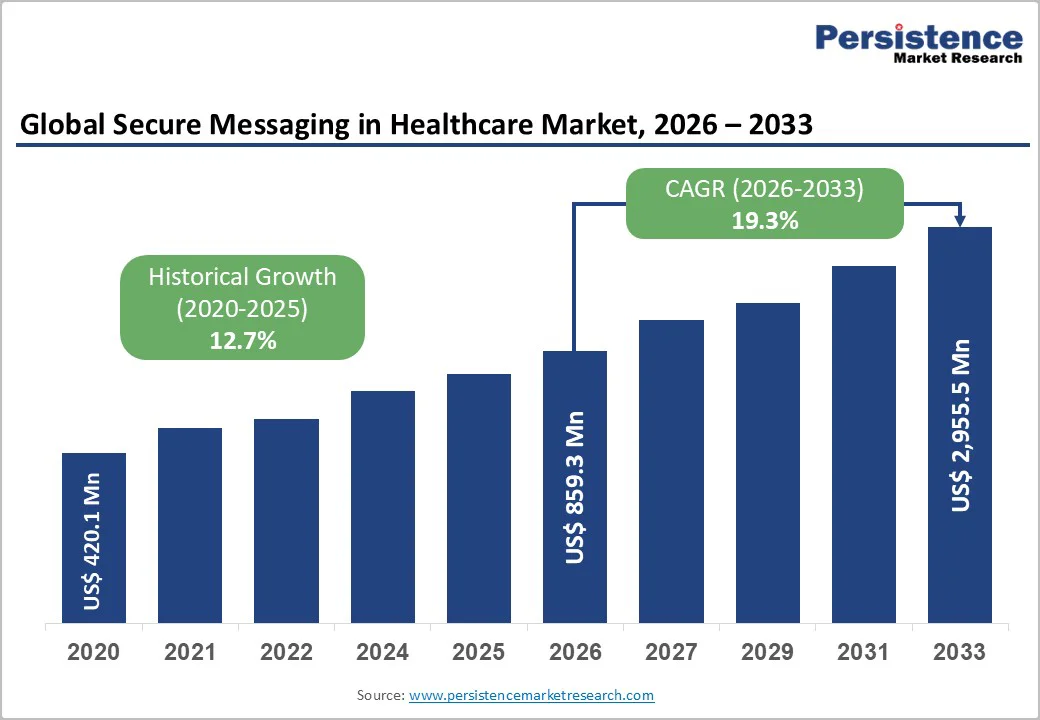
The global secure messaging in healthcare market size is likely to value at US$ 859.3 million in 2026 and projected to value US$ 2,955.5 million, growing at a CAGR of 19.3% during the forecast period from 2026 to 2033.
Secure messaging in healthcare is becoming more important because it helps patients and healthcare providers share information safely. More patients today prefer to talk to their doctors and receive care from home, and secure messaging makes this possible while protecting their personal health details. These messaging systems follow strict privacy rules, so information like medical records, prescriptions, and reports can be shared without the risk of data leaks.
For healthcare providers, secure messaging brings added safety and helps reduce fraud. Since messages are encrypted and linked to verified identities, it becomes easier to confirm who the patient is, which lowers the chance of identity theft or misuse of medical information. It also reduces unnecessary in-person visits, which can sometimes be misused for fraudulent claims.
Overall, the demand for secure messaging is growing because it offers convenience, protects sensitive data, and supports better communication between patients and doctors. As more people use digital health services, the need for safe and reliable messaging tools will continue to rise.
Key Industry Highlights
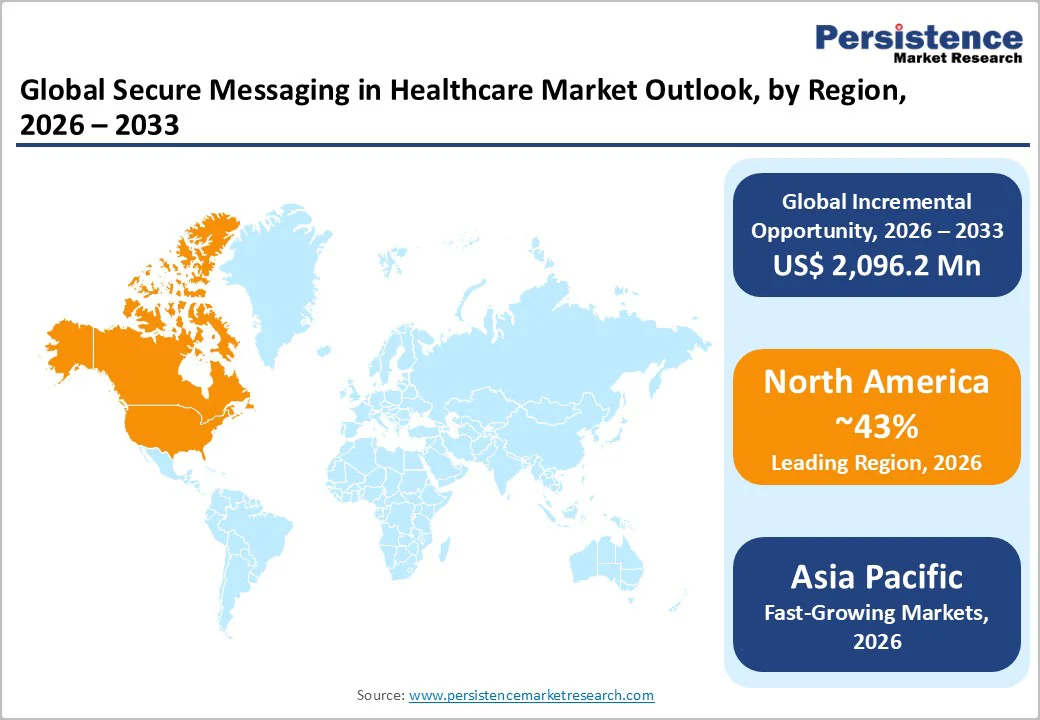
- Leading Region: North America leads the market, driven by strict HIPAA rules, strong regulatory guidance, and advanced adoption of secure clinical communication systems.
- Fastest Growing Region: Asia Pacific grows fastest as China, India, Japan, and ASEAN rapidly expand telehealth, digitize hospitals, and adopt cloud-based secure messaging solutions.
- Dominant Segment: Software remains the dominant component due to high demand for encrypted apps, cloud platforms, and integration tools supporting secure, real-time clinical communication.
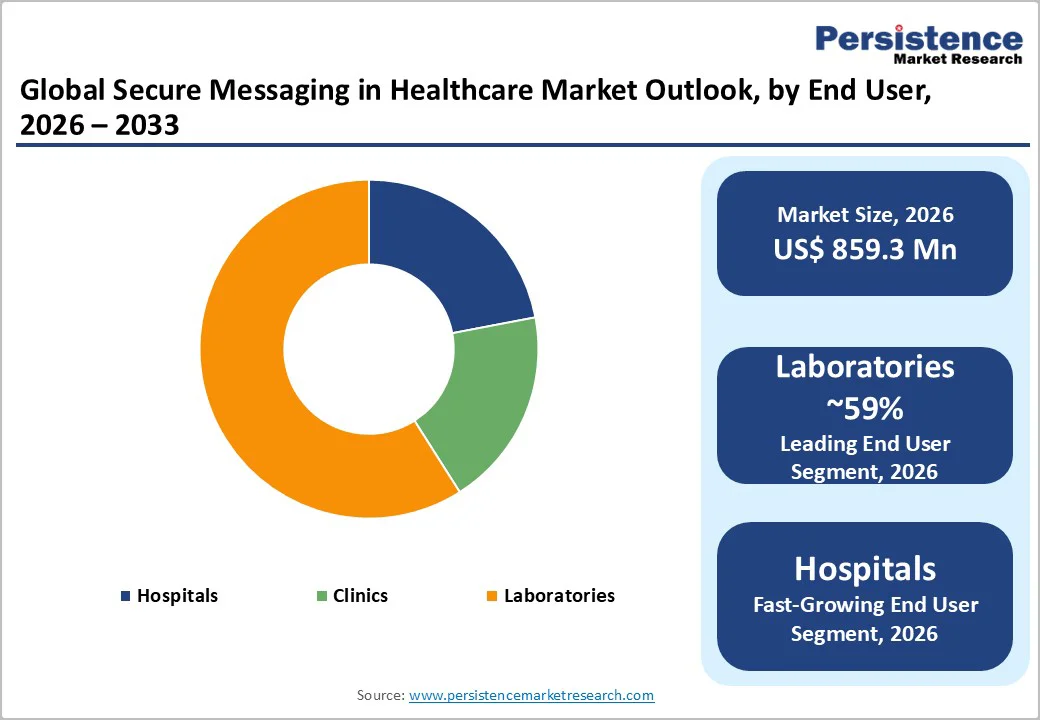
- Fastest Growing Segment: Hospitals represent the fastest-growing end-user segment as providers seek efficient, compliant messaging to improve workflows, reduce delays, and support patient-centered care.
| Key Insights | Details |
|---|---|
| Secure Messaging in Healthcare Market Size (2026E) | US$ 859.3 Mn |
| Market Value Forecast (2033F) | US$ 2,955.5 Mn |
| Projected Growth (CAGR 2026 to 2033) | 19.3% |
| Historical Market Growth (CAGR 2020 to 2024) | 12.7% |
Market Dynamics
Driver - Rising regulatory pressure for HIPAA compliant communication
Regulatory bodies increasingly clarify that clinical text communication must be conducted through secure, encrypted platforms that protect protected health information (PHI) and maintain audit trails.
In February 2024, the Centers for Medicare & Medicaid Services (CMS) confirmed that hospitals and critical access hospitals may exchange patient orders via secure texting platforms if those platforms are encrypted, identity verified, and compliant with HIPAA Conditions of Participation, reinforcing demand for enterprise grade solutions.
At the same time, high profile breaches involving unsecured messaging have highlighted the financial risk of non compliance, with average healthcare data breach costs exceeding US$ 10 million per incident according to independent industry analyses. Collectively, these factors are pushing providers to replace standard SMS with purpose built secure messaging in healthcare environments.
Restraints - Budget constraints and competing digital priorities in provider organizations
One of the major restraints for the Secure Messaging in Healthcare Market is the limited budget available in many hospitals and clinics, especially smaller and mid-sized providers.
These organizations already face heavy financial pressure to invest in other digital areas such as EHR upgrades, cybersecurity improvements, data analytics tools, and telehealth platforms. As a result, secure messaging is often viewed as an additional feature rather than a core system, causing decision-makers to delay purchases or restrict its use to a few departments instead of adopting it across the entire facility.
Another challenge is the overall cost involved in setting up secure messaging platforms. Integration with existing hospital systems, managing mobile devices for staff, and paying ongoing subscription fees can raise the total cost of ownership. This becomes difficult for price-sensitive markets and community hospitals that have limited IT teams.
These providers may struggle to maintain, update, or fully utilize secure messaging tools. In such environments, financial limitations and competing digital priorities slow down wider adoption of secure messaging solutions.
Opportunity - Expansion of Secure Messaging for Virtual Care and Patient Engagement
The rapid growth of telehealth and remote-care services is creating a strong opportunity for the secure messaging in healthcare market. As more patients connect with their doctors from home, there is a rising need for safe, easy, and reliable communication tools that work outside the hospital setting. Secure messaging platforms that support both provider-to-provider and provider-to-patient communication are well placed to benefit from this shift.
Hospitals and clinics are adopting digital front-door strategies that make it easier for patients to manage appointments, share updates, and receive care without visiting a facility. Secure messaging can support these efforts by enabling appointment reminders, routine follow-ups for chronic conditions, and the exchange of images or medical documents.
When these platforms are connected with patient portals or remote-monitoring systems, they allow clinicians to communicate asynchronously in a HIPAA-compliant manner, reducing pressure on call centers and improving response times.
This opportunity is further strengthened by the growing focus on patient satisfaction and population health programs, where secure messaging plays an important role in engaging large and widely spread patient groups.
Category-wise Analysis
By Component, Software Dominates Market
In the Secure Messaging in Healthcare market, the software segment is expected to hold the largest share, likely surpassing 70% of total revenue in 2025. Most of the market’s value comes from cloud-based platforms, on-premises solutions, mobile applications, and integration tools used daily by hospitals and clinicians.
These software systems include essential features such as end-to-end encryption, role-based access controls, user directory management, audit trails, automated escalation rules, and APIs that connect with EHR systems and medical devices. Such capabilities are necessary for meeting HIPAA standards and internal security policies.
As healthcare facilities move toward standardized, enterprise-level communication platforms, software subscriptions and licensing fees make up the biggest portion of spending. Vendors like Vocera and Imprivata offer extensive communication suites that hospitals rely on to streamline clinical workflows.
In comparison, service components such as installation, configuration, and staff training remain smaller but still recurring areas of investment. This strong dependence on secure, integrated software solutions continues to drive the dominance of the software segment in the overall market.
By End-user, Laboratories Leads the Market
The laboratories segment is projected to hold around 59% of the market share by product type in 2025 and is expected to grow at a CAGR of 18.1% over the forecast period.
Laboratories play a central role in healthcare communication because they must share sensitive patient information and test results quickly and securely with physicians and other care teams. As digital communication becomes more common, there is a rising need for secure channels that protect medical data while supporting fast turnaround times.
Laboratories are well equipped to meet these needs, as they already manage large volumes of confidential health information and follow strict security and privacy standards. They also possess the technical expertise and infrastructure required to adopt or develop secure messaging platforms that align with regulatory guidelines.
As healthcare providers rely more heavily on digital workflows, laboratories are expected to remain key users of secure messaging solutions. Their ability to deliver timely, secure, and compliant communication positions them to continue leading the market in the coming years.
Region-wise Insights
North America Secure Messaging in Healthcare Market Analysis
North America, led by the U.S., remains the largest market for secure messaging in healthcare, holding nearly 43% of the global share in 2025. The region benefits from early adoption of electronic health records, strict privacy regulations, and a well-established health IT industry.
Rules under HIPAA, along with state-level breach-notification laws, strongly encourage hospitals to use encrypted communication tools with features such as audit logs, identity verification, and mobile-device management.
Recent guidance from CMS and the Joint Commission has also supported the use of secure texting for sharing patient information and certain clinical orders, as long as platforms meet encryption and authentication standards. This has helped position secure messaging as a central communication tool in hospitals rather than an optional add-on.
Healthcare facilities across North America are increasingly adopting platforms like Vocera Collaboration Suite and Imprivata Cortext®, which combine voice, messaging, and alert management to improve response times and reduce alarm fatigue. Large health systems and academic medical centers in the region also provide a strong environment for testing new innovations, including AI-based alert routing and workflow analytics within secure messaging solutions.
Asia and Pacific Secure Messaging in Healthcare Market Trends
Asia Pacific is becoming the fastest-growing region in the secure messaging in healthcare market, driven by rapid digital transformation in China, Japan, India, and key ASEAN countries. Governments and healthcare providers are heavily investing in hospital information systems, EHR platforms, and telehealth services.
This shift naturally increases the need for secure messaging solutions that support safe, efficient communication while meeting new data-protection rules across the region.
In Japan and Australia, advanced hospital networks are adopting enterprise-level secure messaging to manage aging populations and reduce staff workload. These systems often focus on mobile-first communication and integrate with nurse-call and patient-monitoring systems.
In India and Southeast Asia, private hospital chains and digital-health startups are turning to cloud-based secure messaging tools to support teleconsultations, diagnostic coordination, and remote patient follow-up. Many of these providers are moving directly to modern communication platforms, bypassing older pager-based systems.
As regional governments strengthen privacy and cybersecurity regulations, demand for encrypted and auditable communication platforms is expected to grow even further, supporting strong market expansion in Asia Pacific.
Competitive Landscape
The Secure Messaging in Healthcare market is moderately fragmented, with a mix of specialized clinical communication vendors, broader health IT companies, and digital identity providers competing on workflow integration, usability, and regulatory compliance rather than purely on price.
Key players such as Vocera Communications, Inc. (now part of Stryker), Imprivata Inc., Spok Inc., Cerner Corporation, Athena Health, Inc., TigerText, and others differentiate themselves through features like real time role based routing, multi modal communication (voice, text, alerts), HIPAA verified encryption, and tight integration with leading EHRs and scheduling systems.
Emerging business models emphasize subscription based cloud platforms, mobile device management, and analytics dashboards that provide insight into communication patterns, while partnerships with device manufacturers and telehealth platforms extend vendors’ reach across hospital and ambulatory settings.
Key Industry Developments:
- In May 2024, the Vocera Collaboration Suite mobile app was highlighted for its ability to deliver real-time situational updates and essential patient information to support clinical decision-making. The platform enables care team members to communicate and coordinate more efficiently, helping to enhance both patient care and the caregiver experience.
- February 2024: CMS issued guidance confirming that hospitals may use HIPAA compliant secure texting platforms for sharing patient information and orders, provided systems are encrypted, identity verified, and regularly assessed for security and integrity, boosting confidence in secure messaging adoption.
Companies Covered in Secure Messaging in Healthcare Market
- Vocera Communications, Inc.
- Imprivata Inc.
- Spok Inc.
- Cerner Corporation
- Athena Health, Inc.
- TigerText
- Patientsafe Solutions, Inc.
- CellTrust Corporation
- Voalte
- Amtelco
- Others
Frequently Asked Questions
The global secure messaging in healthcare market is projected to be valued at US$ 859.3 Mn in 2026.
The global secure messaging in healthcare market is primarily driven by the increasing need to protect and safeguard patient data.
The global secure healthcare messaging in healthcare market is expected to witness a CAGR of 19.3% between 2026 and 2033.
A major opportunity lies in extending secure messaging to virtual‑care and patient‑engagement use cases, integrating platforms with telehealth, remote monitoring, and digital‑front‑door solutions.
Prominent firms include Vocera Communications, Inc., Imprivata Inc., Spok Inc., Cerner Corporation, Athena Health, Inc., TigerText, and Patientsafe Solutions, Inc.


