




- Rail
- Railway Window Market
Railway Window Market Size, Share, and Growth Forecast 2026 - 2033
Railway Window Market by Window Type (Fixed Windows, Sliding Windows, Hatch Windows, Emergency Exits), Material Type (Glass, Polycarbonate, Acrylic, Aluminum), Application (Passenger Trains, Freight Trains, High-Speed Trains, Suburban Trains), End Use (Public Transport, Private Railways, Cargo Transportation), and Regional Analysis for 2026 - 2033

Railway Window Market Size and Trend Analysis
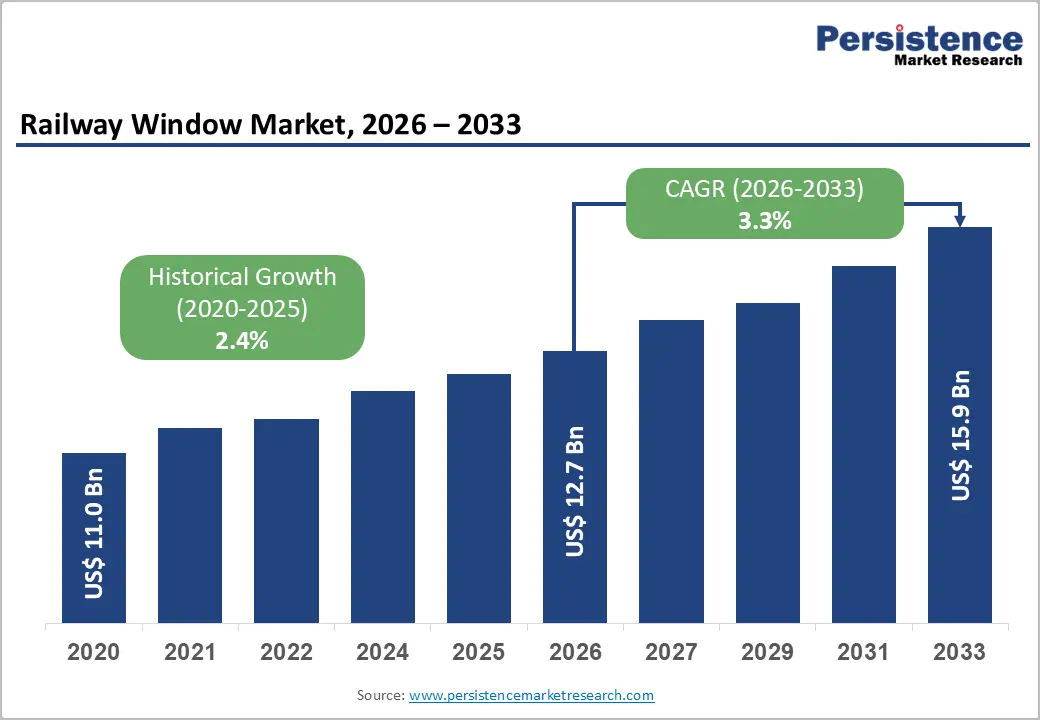
The global Railway Window market size is valued at US$ 12.7 Bn in 2026 and is projected to reach US$ 15.9 Bn by 2033, growing at a CAGR of 3.3% between 2026 and 2033.
The market is being propelled by accelerating global investment in railway infrastructure modernization and the rapid expansion of high-speed rail networks across Asia Pacific and Europe. According to the International Union of Railways (UIC), the global high-speed rail network surpassed 65,000 km in operation as of 2024, with an additional 16,600 km under construction. This sustained infrastructure buildout translates into robust demand for advanced railway glazing and window systems, reinforced by tightening safety regulations, growing passenger comfort expectations, and the proliferation of smart glass technologies.
Key Market Highlights
- Leading Region: Asia Pacific dominates the global railway window market, holding approximately 45% of revenue, driven by China's 50,000 km high-speed rail network and India's USD 130 billion railway investment plan, making it the most critical demand hub through 2033.
- Fastest Growing Region: North America represents a mature and steadily advancing market for railway windows, anchored by the United States' extensive freight rail network spanning over 140,000 route-miles the world's largest and growing investments in passenger rail modernization.
- Dominant Segment: Glass holds approximately 52% share in the Material Type category, supported by regulatory mandates from bodies such as ERA requiring laminated and tempered glass across high-speed and passenger rail applications for safety and optical clarity compliance.
- Fastest Growing Segment: High-Speed Trains represent the fastest growing application segment, fueled by global HSR network expansion targeting over 16,600 km currently under construction, demanding premium pressure-resistant and aerodynamically designed window systems across new trainset deliveries.
- Key Market Opportunity: Smart glass retrofit and new installation programs across aging suburban and intercity fleets in Europe and North America represent a multi-billion-dollar addressable opportunity, with Indian Railways and luxury rail operators pioneering commercial-scale smart window deployments through 2033.
| Key Insights | Details |
|---|---|
|
Railway Window Market Size (2026E) |
US$ 12.7 Bn |
|
Market Value Forecast (2033F) |
US$ 15.9 Bn |
|
Projected Growth CAGR (2026–2033) |
3.3% |
|
Historical Market Growth (2020–2025) |
2.4% |
DRO Analysis
Market Growth Drivers
Rapid Expansion of Global Railway Infrastructure and High-Speed Rail Networks
A sustained surge in global railway infrastructure investment is the foremost driver of the railway window market. According to the China State Railway Group, China's national railway network reached 162,000 km by end of 2024, with 48,000 km dedicated to high-speed rail the world's largest such network and fixed-asset investment in railways touching 850.6 billion yuan in 2024 alone, rising further to 901.5 billion yuan in 2025.
India's government has committed USD 130 billion toward railway development through 2030, while the European Union's TEN-T program mandates track upgrades across core network corridors. Each new high-speed trainset or metro car requires specially engineered windows capable of withstanding aerodynamic pressure, UV exposure, and stringent safety standards, directly boosting procurement volumes for railway window manufacturers.
Rising Passenger Comfort Standards and Smart Glass Technology Adoption
Evolving passenger expectations and increasingly stringent regulatory safety standards are compelling rail operators worldwide to upgrade their rolling stock window systems. Modern travellers demand windows offering superior acoustic insulation, thermal management, anti-glare properties, and privacy control, creating fertile ground for smart electrochromic and laminated glazing solutions.
The global rolling stock market reached approximately EUR 65 billion in total revenues in 2024, representing an 11% increase compared to 2022, driven by robust passenger and freight demand. Technological developments such as automated dimming, UV-protective coatings, and dual-pane thermal insulation systems are being integrated into new generation trains by manufacturers including Siemens Mobility, Alstom, and Hitachi Rail, amplifying demand for premium window components across all rolling stock categories.
Market Restraints
High Cost of Advanced Glazing Technologies
The elevated cost of next-generation railway window technologies including laminated smart glass, polycarbonate composites, and electrochromic glazing presents a significant barrier to market uptake, particularly in developing economies. Advanced window systems can cost 30–50% more than conventional glass alternatives, straining procurement budgets for state-owned rail operators in price-sensitive markets.
Furthermore, budget reallocations observed in markets such as the United Kingdom and Australia in 2024 caused funding gaps in rail programs, delaying orders for new rolling stock and consequently restraining window component procurement. This financial pressure limits the pace at which operators can transition to premium glazing systems, moderating overall market growth.
Supply Chain Disruptions and Raw Material Cost Volatility
The railway window market remains susceptible to supply chain disruptions and volatility in raw material costs. Steel prices experienced significant fluctuations in recent years, while copper crossed USD 9,200 per ton, inflating manufacturing costs for railway component suppliers. Specialty glass raw materials and polycarbonate resins are subject to similar price pressures.
Global supply chain fragility as evidenced during the COVID-19 pandemic and compounded by geopolitical tensions led to production delays at multiple rolling stock manufacturing facilities. Such disruptions extend lead times, increase operational costs, and reduce profitability for window manufacturers, particularly smaller and mid-tier suppliers that lack integrated supply chain capabilities or diversified sourcing networks.
Market Opportunities
High-Speed Rail Expansion Driving Demand for Specialized Window Systems
The accelerating global rollout of high-speed rail presents a compelling opportunity for manufacturers of specialized railway window systems. According to the UIC Atlas – High-Speed Rail 2024 report, over 16,600 km of high-speed rail lines are currently under construction worldwide. Countries with the most planned future capacity include China (6,983 miles), India (4,647 miles), and the U.S. (3,145 miles).
High-speed rail windows must meet exacting standards for aerodynamic pressure resistance, noise attenuation, thermal stability, and emergency egress functionality commanding premium price points compared to conventional segment windows. The debut of CRRC's CR450 next-generation high-speed prototype in 2024 and Siemens Mobility's Mireo Smart EMU unveiled in October 2024 underscore the pipeline of new rolling stock requiring advanced window solutions, representing a sustained multi-year demand opportunity.
Smart Glass Integration and Retrofit Upgradation Programs
The global shift toward digitally integrated and energy-efficient railway systems is unlocking a significant opportunity in smart glass window retrofitting and new installation programs. Electrochromic, photochromic, and suspended particle device (SPD) glass technologies capable of auto-adjusting tint levels are transitioning from prototype to commercial-scale railway applications.
In January 2021, Indian Railways installed smart windows in trains to enhance passenger experience and privacy, signaling a trend that is expected to scale across the Asia Pacific and Middle East regions. The Saudi Arabia Railways (SAR) unveiled the 'Dream of the Desert' luxury train with premium glazing in January 2025, reflecting rising demand for high-end window systems. Retrofit programs covering aging suburban and intercity fleets across Europe and North America offer addressable revenue streams beyond new rolling stock procurement.
Category-wise Analysis
Window Type Insights
Fixed Windows represent the leading segment within the window type category, accounting for approximately 43% of the global railway window market. The dominance of fixed windows is attributable to their structural simplicity, cost efficiency, superior sealing properties, and inherent ability to meet pressure differential requirements for high-speed rail applications. Unlike sliding or hatch variants, fixed windows provide an unbroken glazing panel, enabling better acoustic and thermal insulation characteristics that are especially critical on high-speed rail corridors operating at 250–350 km/h.
Major rolling stock manufacturers such as CRRC Corporation and Alstom standardize fixed window assemblies across their high-volume passenger train platforms. Emergency Exit windows represent a growing sub-segment as regulatory bodies tighten evacuation standards for metro and intercity trains worldwide.
Material Type Insights
Glass remains the dominant material in the railway window market, commanding approximately 52% of total market share. Laminated and tempered glass variants are widely mandated across global regulatory frameworks including the European Railway Agency's (ERA) Technical Specifications for Interoperability (TSI)due to their well-established impact resistance, optical clarity, and fire tolerance.
The Chinese high-speed rail system has implemented advanced glass homogenization techniques to reduce thickness variance and improve flatness, setting a global quality benchmark. Meanwhile, Polycarbonate is identified as the fastest-growing material segment, gaining traction in metro and suburban applications where weight reduction is a priority. Polycarbonate windows are approximately 50% lighter than glass equivalents, supporting energy efficiency goals for rolling stock operators.
Application Insights
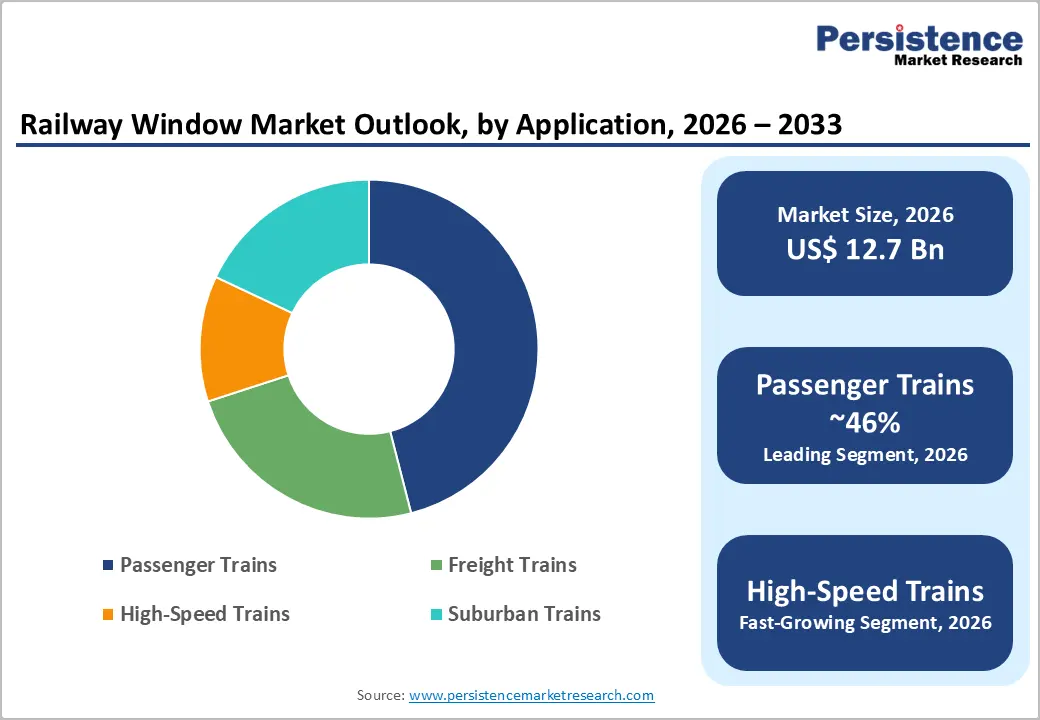
Passenger Trains constitute the leading application segment in the railway window market, accounting for an estimated 46% of total demand. This leadership is underpinned by the sheer scale of global passenger rail fleets and the persistent focus on passenger comfort and safety upgrades. According to the UIC, 72% of all rail passengers worldwide are transported in the Asia Pacific region, anchoring consistent procurement demand.
In 2024 alone, China's national railway handled a record 4.08 billion passenger trips, driving substantial rolling stock additions and refurbishments. High-Speed Trains represent the fastest-growing application sub-segment, as each new high-speed trainset demands specialized pressure-resistant, aerodynamically optimized window assemblies that fetch premium commercial values and support higher average selling prices for window manufacturers.
End Use Insights
Public Transport is the leading end-use segment in the global railway window market, capturing approximately 58% of total market share. Public transport rail systems encompassing metro, suburban, intercity, and national passenger rail networks receive the lion's share of government railway infrastructure budgets worldwide. The European Union's TEN-T program and India's USD 130 billion railway modernization plan through 2030 are testament to the depth of public spending in this segment.
Public transport operators procure windows at scale for fleet renewals and new line commissions, supporting sustained volume demand. Private Railways are gaining relevance in premium and luxury passenger segments, while Cargo Transportation remains a niche but structurally important end use requiring durable, weather-resistant window solutions for locomotive and freight wagon applications.
Regional Analysis
Asia Pacific
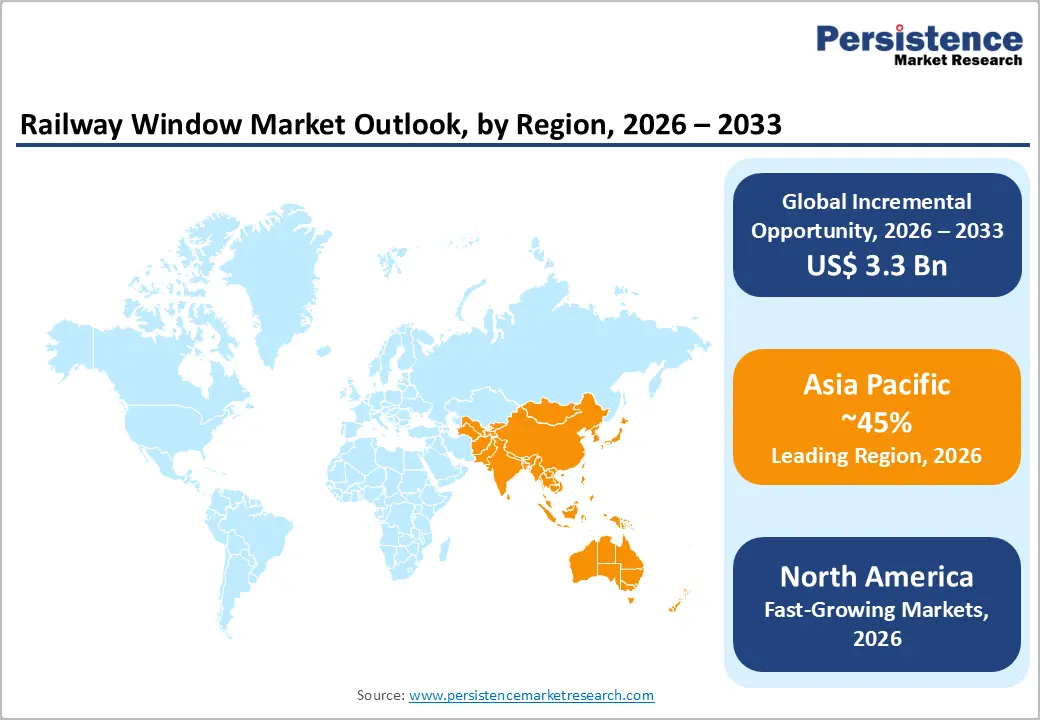
Asia Pacific is the dominant region in the global railway window market, accounting for an estimated 45% of global revenue, underpinned by massive railway infrastructure investments and the world's largest high-speed rail networks. China's railway fixed-asset investment reached 850.6 billion yuan in 2024 and rose to 901.5 billion yuan in 2025, delivering 3,109 km of new lines. With the national network targeting 180,000 km by 2030including 60,000 km of high-speed rail demand for railway windows across China's rolling stock additions is unprecedented.
India represents the fastest-growing market in the region, backed by a government commitment of USD 130 billion in rail development through 2030 and the rollout of semi-high-speed Vande Bharat trainsets. In October 2021, Indian Railways introduced Vistadome panoramic coaches using laminated glass windows, establishing a premium product category. Japan's Shinkansen network modernization and ASEAN metro expansions in Indonesia, Vietnam, and Philippines further solidify Asia Pacific's regional market leadership.
North America
North America represents a mature and steadily advancing market for railway windows, anchored by the United States' extensive freight rail network spanning over 140,000 route-miles the world's largest and growing investments in passenger rail modernization. The Federal Railroad Administration (FRA) enforces rigorous crashworthiness and glazing standards for passenger railcars, mandating laminated safety glass and minimum impact resistance thresholds that drive quality upgrade cycles. Brightline West, a privately-owned high-speed rail project linking Las Vegas and Southern California with construction commenced in 2024, represents an immediate procurement opportunity for advanced window systems.
The U.S. market is also characterized by a vibrant innovation ecosystem, with leading rolling stock suppliers including Siemens Mobility and Bombardier (now Alstom) integrating smart and lightweight glazing solutions into new commuter and intercity trainsets. The region's planned high-speed rail future capacity of 3,145 miles positions North America as an important growth market through the forecast period, with Canada's Via Rail modernization program adding additional impetus to window system procurement.
Europe
Europe holds a significant share of the global railway window market, driven by its established and extensively utilized rail networks and a regulatory framework that sets some of the world's most stringent glazing safety standards. The European Railway Agency (ERA) and the European Union's TEN-T Regulation mandate harmonized standards across member states, compelling rail operators in Germany, France, Spain, and the United Kingdom to adopt certified laminated and impact-resistant window solutions across their fleets.
Spain's Adif and Renfe continue infrastructure modernization under the TEN-T framework, while Swiss Federal Railways (SBB) awarded €1.5 billion in digital interlocking framework contracts in October 2025 to Hitachi, Siemens, and Stadler. The EU's commitment to doubling rail freight volumes by 2030 and the ongoing Green Deal prioritization of sustainable transport ensures a steady pipeline of new rolling stock procurement, sustaining window market demand across the region.
Competitive Landscape
Market Structure Analysis
The global railway window market exhibits a moderately consolidated competitive structure, with major rolling stock manufacturers including CRRC Corporation, Alstom, and Siemens Mobility commanding significant influence through vertically integrated supply chains and proprietary glazing specifications embedded in their train platforms.
Key market differentiators include glazing safety certifications, material innovation (lightweight polycarbonate and smart glass), and the ability to deliver large-volume, multi-year supply agreements aligned with rolling stock contracts. Leading players are pivoting from one-off component supply toward lifecycle service partnerships.
Key Market Developments
- In October 2024, AGS Holland achieved a significant milestone by becoming the first glass company in the Benelux region to receive full certification for installing glass components in trains. This development established the firm as a verified partner for certified window replacements in the heavy rail sector, expanding its service portfolio beyond its traditional stronghold in bus and light rail glazing.
- In November 2024, Alstom signed a €2.5 billion contract with Deutsche Bahn to supply 90 next-generation ICE high-speed trains featuring improved energy efficiency and advanced interior systems, reinforcing Alstom's leadership in European high-speed rolling stock.
Companies Covered in Railway Window Market
- Alstom
- Bombardier
- Siemens Mobility
- Hitachi Rail
- CAF
- Stadler Rail
- Kawasaki Heavy Industries
- CRRC Corporation Limited
- Thales Group
- Knorr-Bremse AG
- Wabtec Corporation
- Saint-Gobain S.A.
- AGC Inc.
- Nippon Sheet Glass Co., Ltd.
Frequently Asked Questions
The global Railway Window Market is valued at US$ 12.7 Bn in 2026 and is projected to reach US$ 15.9 Bn by 2033, expanding at a CAGR of 3.3% during the forecast period.
The primary growth drivers include rapid expansion of global railway networks particularly high-speed rail with over 65,000 km of HSR lines operational globally per UIC Atlas 2024. Additionally, rising passenger comfort standards, mandatory safety glazing regulations, growing smart glass technology adoption, and accelerating urbanization fuelling public transport investment are the principal demand catalysts for the railway window market.
Glass is the dominant material type segment in the railway window market, holding approximately 52% of total market share. Laminated and tempered glass variants are mandated by regulatory bodies including the European Railway Agency (ERA) for high-speed and passenger rail applications.
Asia Pacific is the leading region, accounting for approximately 45% of global railway window market revenue. China's network expansion toward 180,000 km total railway by 2030, India's USD 130 billion rail investment commitment, and rapid metro buildouts across ASEAN nations collectively anchor the region's dominant and growing market position.
Leading companies operating in the global railway window market include Alstom, Siemens Mobility, CRRC Corporation Limited, Hitachi Rail, Bombardier (Alstom), CAF, Stadler Rail, Kawasaki Heavy Industries, and Thales Group.


