




- Chipsets & Processors
- RAID Controllers Market
RAID Controllers Market Size, Share, and Growth Forecast, 2026 - 2033
RAID Controllers Market by Product Type (Hardware RAID, Software RAID), Application (Internet Industry, Manufacturing Industry, Service Industry, Financial, Others), End-user (BFSI, IT and Telecommunications, Others), and Regional Analysis for 2026 – 2033

RAID Controllers Market Size and Trends Analysis
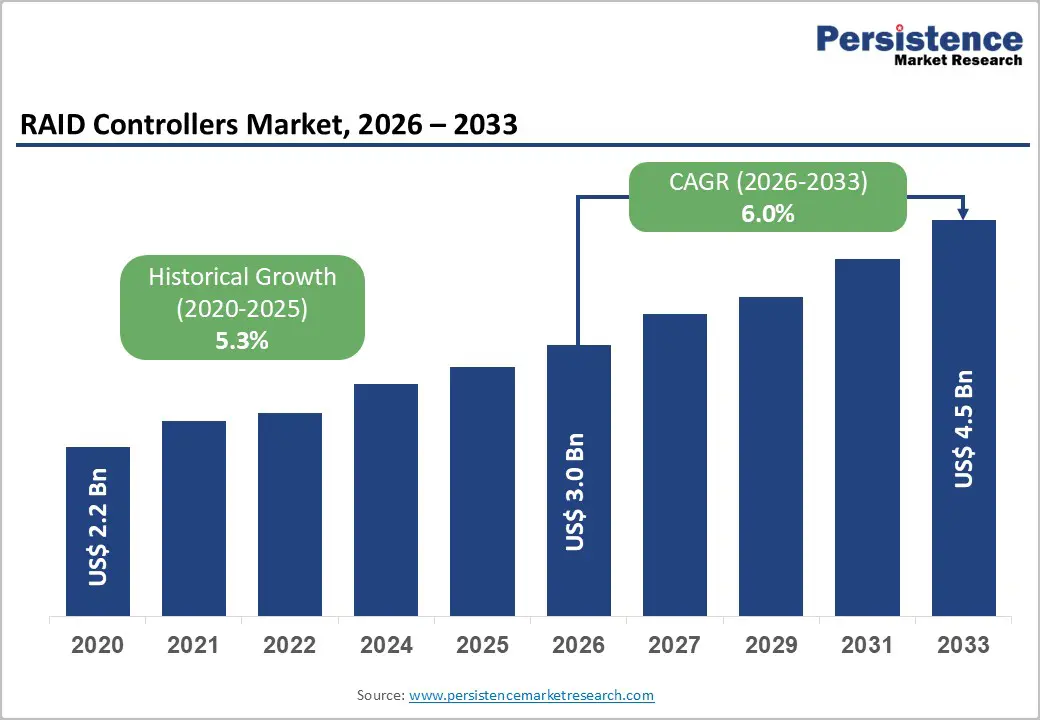
The global RAID controllers market size is likely to be valued at US$3.0 billion in 2026, and is expected to reach US$4.5 billion by 2033, growing at a CAGR of 6.0% during the forecast period from 2026 to 2033, driven by the increasing prevalence of data-intensive applications, rising demand for high-availability storage in data centers, and advancements in PCIe Gen5 and NVMe RAID controllers.
Growing demand for reliable, scalable RAID controllers, particularly hardware-based solutions in BFSI and IT & telecommunications, is accelerating adoption among end users. Developments in software-defined RAID and hybrid controllers are further boosting uptake by offering cost-effective, flexible performance. Increasing recognition of RAID controllers as critical for data protection, redundancy, and performance in emerging cloud and enterprise markets remains a major driver of market growth
Key Industry Highlights:
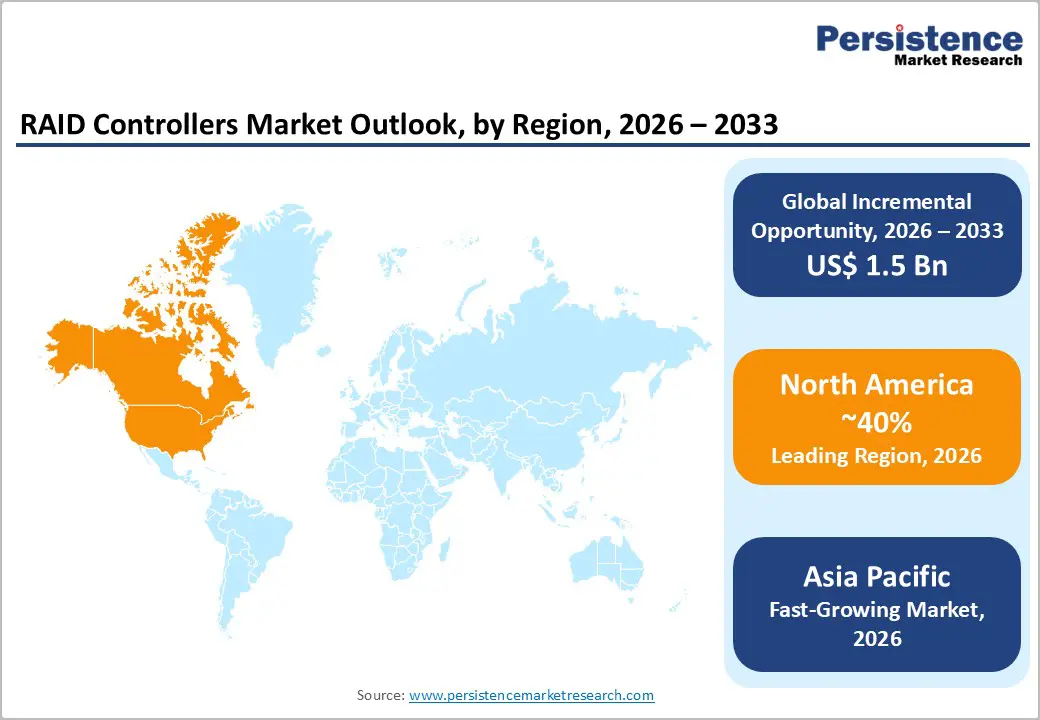
- Leading Region: North America, anticipated to account for a 40% market share in 2026, driven by massive data center expansion, high cloud adoption, and strong demand in the U.S.
- Fastest-growing Region: Asia Pacific, to be fueled by rapid digital transformation, expanding hyperscale facilities, and growing investments in IT infrastructure in China and India.
- Dominant Product Type: Hardware RAID, to hold approximately 65% of the market share, as it delivers superior performance and dedicated processing.
- Leading Application: The internet industry is expected to account for over 35% of the market revenue, due to hyperscale and CDN storage needs.
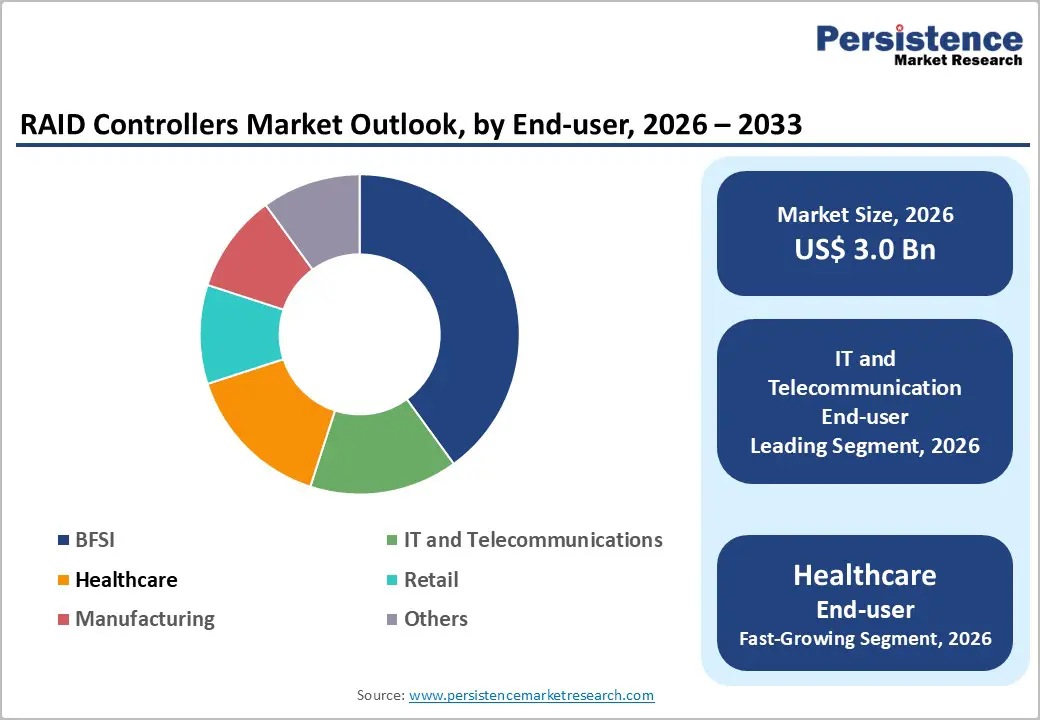
- Leading End-user: IT and telecommunications, to contribute nearly 40% of the market revenue, due to server and storage array deployments.
| Report Attribute | Details |
|---|---|
|
RAID Controllers Market Size (2026E) |
US$3.0 Bn |
|
Market Value Forecast (2033F) |
US$4.5 Bn |
|
Projected Growth (CAGR 2026 to 2033) |
6.0% |
|
Historical Market Growth (CAGR 2020 to 2025) |
5.3% |
Market Factors – Growth, Barriers, and Opportunity Analysis
Increasing Demand for Data-Intensive Applications and High-Availability Storage
The increasing demand for data-intensive applications and high-availability storage is being driven by rapid digital transformation across industries. Organizations are generating and processing massive volumes of structured and unstructured data from sources such as cloud platforms, IoT devices, artificial intelligence models, video analytics, and real-time business systems. These applications require fast data access, low latency, and the ability to handle continuous workloads without performance degradation. Enterprises are prioritizing storage architectures that can scale seamlessly while maintaining consistent throughput.
High-availability storage has become critical as downtime directly impacts revenue, customer trust, and regulatory compliance. Businesses operating in sectors such as banking, healthcare, e-commerce, and telecommunications rely on uninterrupted data access for mission-critical operations. To meet these expectations, organizations are adopting redundant storage systems, automated failover mechanisms, and distributed data architectures to ensure continuous availability even during hardware failures or maintenance.
High Cost of Advanced RAID Solutions
The high cost of advanced RAID solutions remains a significant restraint for the RAID controllers market, particularly for small and mid-sized organizations with limited IT budgets. Modern RAID controllers equipped with features such as high-speed cache memory, battery-backed or flash-backed write protection, support for NVMe and SAS interfaces, and advanced data protection capabilities command a premium price. Beyond the initial hardware investment, organizations also incur additional expenses for compatible enterprise-grade drives, cooling, and power consumption, further increasing total ownership costs.
Deployment and maintenance costs also contribute to the financial burden. Advanced RAID solutions often require skilled IT professionals for configuration, firmware updates, performance tuning, and troubleshooting. This dependence on specialized expertise increases operational expenses throughout the storage system's lifecycle. As storage capacity requirements grow, scaling RAID-based infrastructure may require purchasing additional controllers or upgrading existing ones, resulting in incremental capital expenditure.
Advancements in PCIe Gen5 and NVMe RAID Delivery Platforms
Advancements in PCIe Gen5 and NVMe RAID delivery platforms are reshaping storage performance and scalability in modern computing environments. PCIe (Peripheral Component Interconnect Express) Gen5 doubles the bandwidth of its predecessor, enabling data transfer rates that align with the throughput demands of today’s data-intensive applications. When integrated with RAID (Redundant Array of Independent Disks) architectures, PCIe Gen5 enables controllers to manage multiple high-speed NVMe (Non-Volatile Memory Express) drives without bottlenecks, delivering significantly faster read/write performance than earlier systems.
NVMe is designed for low latency and parallelism, leveraging flash memory capabilities. Combining NVMe with RAID enhances data protection while maintaining high throughput and low latency. The latest platforms support more PCIe lanes and deeper queues, enabling RAID controllers to handle more concurrent operations efficiently. This is particularly beneficial for workloads such as real-time analytics, virtualization, and large-scale databases, where both speed and reliability are critical. These advancements improve system responsiveness and reduce latency in multi-drive configurations, enabling enterprises to scale storage solutions more effectively. Enhanced driver support, firmware optimization, and improved power management further enhance stability and energy efficiency.
Category-wise Analysis
Product Type Insights
Hardware RAID is projected to hold a dominant 65% market share by 2026. This dominance is driven by its ability to deliver dedicated processing power, superior performance, and greater reliability than software-based solutions. By offloading tasks such as parity calculations and data management from the host CPU, hardware RAID ensures stable speeds and low latency, even under heavy workloads. It also offers advanced features like battery-backed cache, faster rebuild times, and robust data protection, making it the preferred option for enterprise servers, data centers, and mission-critical applications. Leading companies like Dell Technologies and Hewlett Packard Enterprise (HPE) integrate hardware RAID controllers into their server platforms (e.g., Dell PowerEdge and HPE Smart Array series) to deliver consistent throughput, advanced caching, and improved rebuild performance, key requirements for enterprise, cloud, and virtualization environments that demand high availability and performance.
Software RAID is likely to be the fastest-growing segment, due to its flexibility, cost-effectiveness, and ease of deployment. Unlike hardware RAID, it does not require dedicated controllers, allowing organizations to implement RAID configurations using existing server resources. It supports dynamic scaling and is compatible with cloud, virtualized, and hybrid environments, meeting the needs of modern, distributed workloads. Microsoft Windows Storage Spaces is a widely adopted software RAID implementation used by large enterprises and service providers to create resilient storage pools without dedicated hardware RAID controllers. Storage Spaces lets administrators configure mirrored and parity-protected virtual drives across multiple physical disks directly within the Windows Server operating system, improving storage utilization and redundancy while reducing upfront hardware costs.
Application Insights
The internet industry is expected to lead the market, holding approximately 35% of the market share in 2026, driven by strong demand for high-speed, reliable, and scalable storage solutions. Internet-based businesses, including cloud service providers, e-commerce platforms, and content streaming companies, generate vast volumes of data that require continuous availability and fast access. RAID controllers ensure data redundancy, fault tolerance, and high performance, making them critical for maintaining uninterrupted services and meeting user expectations. Dell Technologies’ PowerEdge servers, widely deployed in large web hosting and cloud data centers, are integrated with Dell PERC RAID controllers to manage data redundancy and performance across multiple drives in storage arrays. These RAID controllers help ensure reliable access to user data and minimize downtime for services such as web hosting, streaming, and online applications.
The manufacturing industry is likely to be the fastest-growing segment, driven by increasing reliance on automation, IoT-enabled machinery, and data-driven production processes. Modern factories generate large volumes of operational and sensor data that require secure, high-speed storage with minimal downtime. RAID controllers provide the necessary fault tolerance, data redundancy, and fast access to ensure continuous production and prevent costly disruptions. Hewlett Packard Enterprise (HPE) offers digital manufacturing IT solutions that integrate storage with compute and analytics infrastructure to process large volumes of sensor and production data. Their IT systems support smart factory initiatives where reliable RAID-backed storage is essential for collecting, storing, and analyzing real-time operational data to improve efficiency and reduce downtime.
End-use Insights
The IT and telecommunications segment is expected to dominate the market, contributing nearly 40% of revenue in 2026, due to its critical need for high-performance, reliable, and always-on storage infrastructure. Telecom networks, data centers, and IT service providers manage massive volumes of user, transaction, and network data that require fault-tolerant storage solutions. RAID controllers ensure data redundancy, rapid access, and minimal downtime, supporting uninterrupted services, scalability, and robust data protection, which are essential for IT and telecom operations. Dell Technologies supplies enterprise servers such as the Dell PowerEdge XR8720t, which are purpose-built for telecom and edge infrastructure deployments that require high reliability and storage performance. These servers integrate advanced storage systems, often paired with RAID controllers, to ensure data redundancy, fault tolerance, and consistent performance for telecom network workloads such as Cloud RAN and Open RAN deployments.
Healthcare is likely to be the fastest-growing segment, due to the increasing digitization of medical records, imaging data, and telemedicine applications. Hospitals, diagnostic centers, and research institutions generate massive volumes of sensitive data that require secure, high-speed, and fault-tolerant storage. RAID controllers ensure data redundancy, rapid access, and protection against system failures, supporting uninterrupted patient care, regulatory compliance, and real-time analytics. Hewlett Packard Enterprise (HPE) provides storage solutions, including HPE Alletra, that are certified and optimized to support electronic health record (EHR) systems such as Epic Systems, widely used by hospitals worldwide. These systems incorporate high-availability storage features to protect patient data and minimize downtime, ensuring continuous access for care providers and compliance with healthcare data needs.
Regional Insights
North America RAID Controllers Market Trends
North America is expected to lead, accounting for nearly 40% of the market share in 2026, driven by the region’s massive data center footprint, strong research and development capabilities, and high public awareness of performance benefits. Deployment systems in the U.S. and Canada provide extensive support for storage programs, ensuring the broad availability of RAID controllers across IT & telecommunications, healthcare, and financial sectors. Increasing demand for PCIe Gen5, convenient, and easy-to-integrate forms is further accelerating the adoption, as these formats improve throughput and reduce barriers associated with legacy controllers.
Innovation in RAID controller technology, including stable hardware offload, improved NVMe performance, and targeted latency reduction, is attracting significant investment from both the public and private sectors. Government initiatives and cloud campaigns continue to promote adoption to address data loss risks, performance bottlenecks, and emerging AI threats, creating sustained market demand. The growing focus on software RAID grades and specialized use cases, particularly in healthcare and other sectors, is expanding the target applications for RAID controllers.
Europe RAID Controllers Market Trends
Europe is driven by increasing awareness of reliability benefits, strong regulatory systems, and government-led digital programs. Countries such as Germany, France, and the U.K. have well-established data frameworks that support routine RAID use and encourage adoption of innovative controller delivery methods, including RAID controllers. These high-performance formulations are particularly appealing to IT populations, regulatory-conscious operators, and manufacturing users, improving availability and coverage.
Technological advancements in RAID controllers development, such as enhanced offload, application-targeted delivery, and improved low-latency grades, are further boosting market potential. European authorities are increasingly supporting research and trials for controllers against both routine and specialized needs, strengthening market confidence. The growing emphasis on convenient, scalable options is aligned with the region’s focus on preventive data protection and reducing downtime. Public awareness campaigns and promotion drives are expanding reach in both urban and rural areas, while suppliers are investing in silicon and novel variants to increase efficacy.
Asia Pacific RAID Controllers Market Trends
Asia-Pacific is likely to be the fastest-growing region, driven by rising digitalization, increased government initiatives, and expanding application programs. Countries such as India, China, Japan, and Southeast Asian nations are actively promoting controller campaigns to address data center growth and emerging cloud needs. RAID controllers are particularly attractive in these regions due to their scalable administration, ease of integration, and suitability for large-scale server drives in both urban and rural populations.
Technological advancements are enabling the development of stable, effective, and easy-to-deploy RAID controllers that can withstand challenging workloads and minimize failure risk. These innovations are critical for reaching remote facilities and improving overall storage coverage. Growing demand for IT & telecommunications, manufacturing, and BFSI applications is contributing to market expansion. Public-private partnerships, increased digital expenditure, and rising investments in controller research and manufacturing capacity are further accelerating growth. The convenience of RAID delivery, combined with improved redundancy and reduced risk of data loss, positions RAID controllers as a preferred choice.
Competitive Landscape
The global RAID controllers market is characterized by competition between leading semiconductor companies and enterprise hardware providers. In North America and Europe, Broadcom and Intel Corporation dominate, leveraging their robust R&D capabilities, extensive distribution networks, and strong ties with OEMs, all supported by cutting-edge PCIe Gen5 and NVMe initiatives. In the Asia-Pacific region, Fujitsu stands out for region-specific solutions that improve accessibility. Hardware delivery plays a crucial role in boosting performance, reducing latency risks, and enabling large-scale integrations across various regions. Strategic partnerships, collaborations, and acquisitions are driving the combination of expertise, expansion of product portfolios, and faster commercialization. Software RAID solutions address cost challenges, facilitating deeper market penetration in cloud-driven sectors.
Key Industry Developments
- In September 2025, Dell Technologies announced the new Dell PowerEdge XR8720t, designed to transform edge and telecom infrastructure by delivering unprecedented performance and connectivity, especially for Open RAN and Cloud RAN deployments.
Companies Covered in RAID Controllers Market
- Broadcom
- Intel Corporation
- Dell Inc.
- Hewlett Packard Enterprise Development LP
- Cisco Systems, Inc.
- Fujitsu
- Advantech Co. Ltd.
- ATTO Technology
Frequently Asked Questions
The global RAID controllers market is projected to reach US$3.0 billion in 2026.
The rising prevalence of data-intensive applications and demand for high-availability storage are the key drivers.
The RAID controllers market is poised to witness a CAGR of 6.0% from 2026 to 2033.
Advancements in PCIe Gen5 and NVMe RAID delivery platforms are the key opportunities.
Broadcom, Intel Corporation, Dell Inc., Hewlett Packard Enterprise Development LP, and Cisco Systems, Inc. are the key players.


