




- Hardware & Software IT Services
- Push Notification Software Market
Push Notification Software Market Size, Share, and Growth Forecast, 2026 - 2033
Push Notification Software Market by Component (Software, Services), Application (Marketing, Customer Engagement, Others), End-user (Retail, BFSI, Healthcare, Media and Entertainment, Travel and Hospitality, Others), and Regional Analysis for 2026 - 2033

Push Notification Software Market Size and Trends Analysis
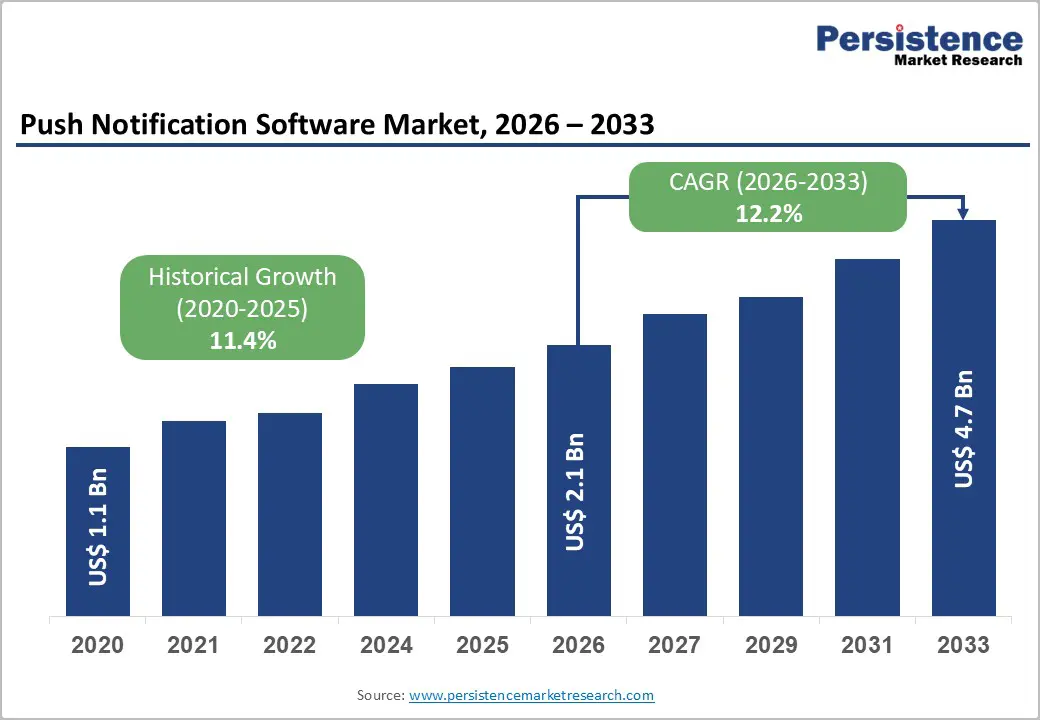
The global push notification software market size is likely to be valued at US$2.1 billion in 2026, and is expected to reach US$4.7 billion by 2033, growing at a CAGR of 12.2% during the forecast period from 2026 to 2033, driven by the increasing prevalence of mobile app engagement strategies, rising demand for personalized real-time communication, and advancements in AI-driven push notification platforms.
Rising demand for effective and scalable push notification software, particularly for marketing and customer engagement use cases, is driving increased adoption across end-user segments. Ongoing advancements in cloud-based platforms and analytics capabilities are further supporting market growth by enabling more precise targeting and measurable campaign performance. The growing recognition of push notification software as a key tool for enhancing user retention and improving conversion rates in emerging digital markets continues to act as a significant growth driver.
Key Industry Highlights:
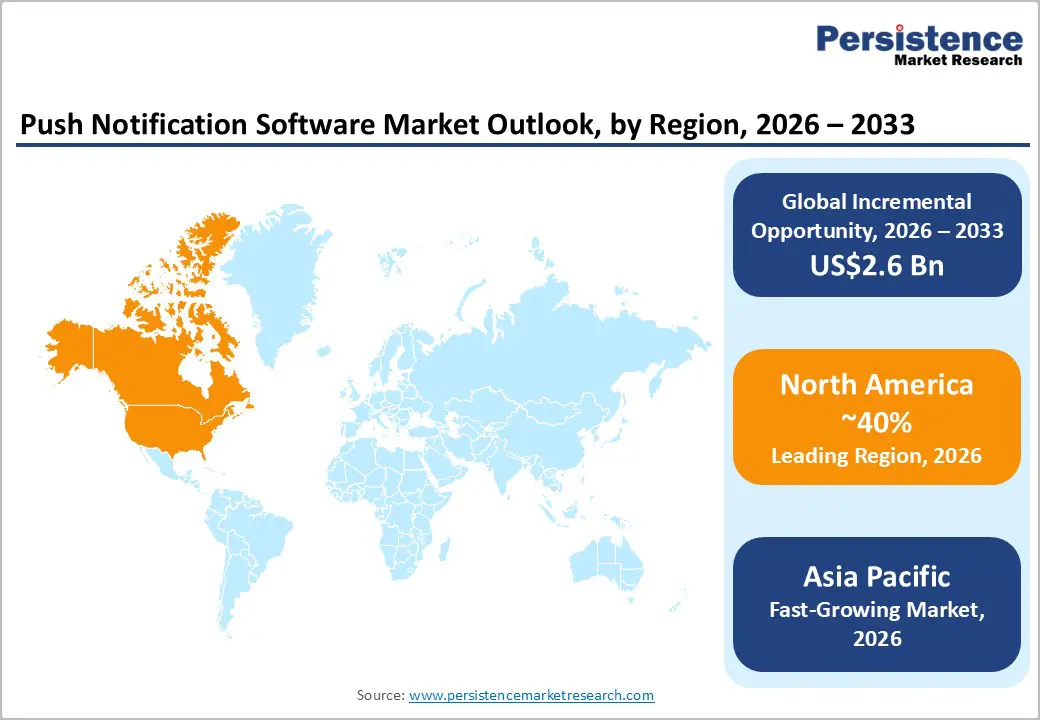
- Leading Region: North America, anticipated to account for a 40% market share in 2026, driven by advanced digital marketing, high app penetration, and strong demand in the U.S.
- Fastest-growing Region: Asia Pacific, fueled by rapid smartphone adoption, e-commerce boom, and growing investments in customer engagement tools in China and India.
- Dominant Component: Software, to hold approximately 65% of the market share, as it provides core notification capabilities.
- Leading Application: Marketing is expected to account for over 40% of the market revenue, due to promotional and re-engagement needs.
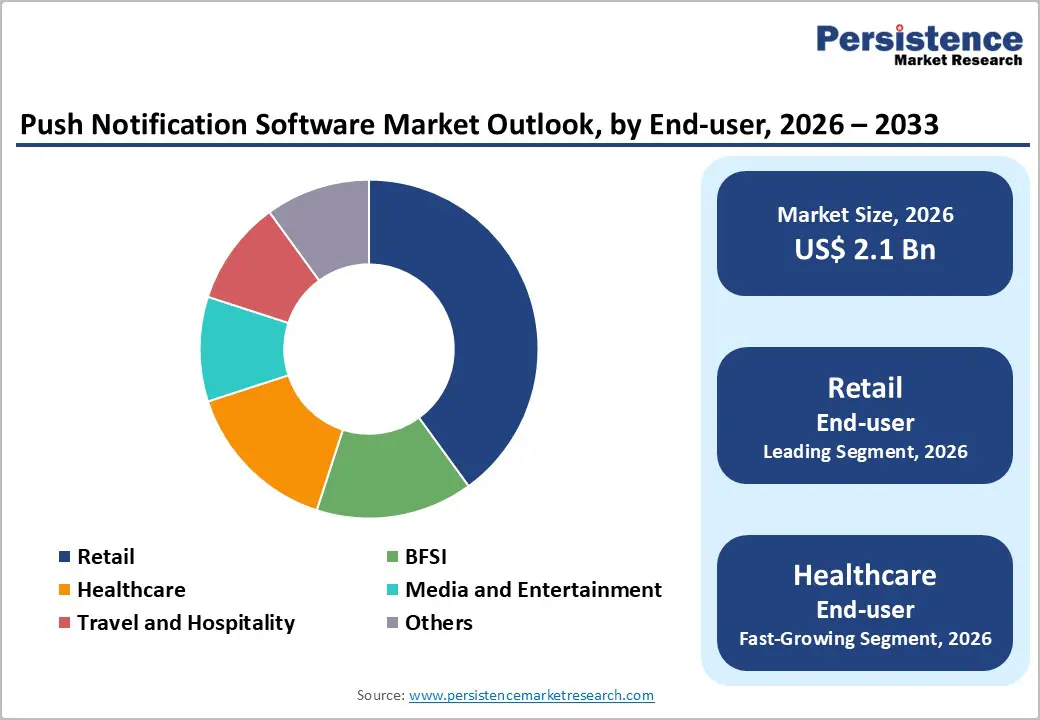
- Leading End-user: Retail, to contribute nearly 35% of the market revenue, due to cart abandonment recovery and sales alerts.
| Key Insights | Details |
|---|---|
| Push Notification Software Market Size (2026E) | US$2.1 Bn |
| Market Value Forecast (2033F) | US$4.7 Bn |
| Projected Growth (CAGR 2026 to 2033) | 12.2% |
| Historical Market Growth (CAGR 2020 to 2025) | 11.4% |
Market Factors - Growth, Barriers, and Opportunity Analysis
Rising Prevalence of Mobile App Engagement Strategies
The growing emphasis on mobile app engagement strategies highlights a shift by businesses from merely establishing an app presence to fostering continuous user interaction and long-term value. As smartphones become an integral part of everyday life, organizations are prioritizing sustained activity, loyalty, and emotional connection over simple download metrics. Modern engagement strategies focus on personalization, leveraging behavioral data to deliver tailored content, offers, and notifications that resonate with individual users.
Gamification has become a highly effective method for driving repeat usage by incorporating rewards, progress indicators, and interactive challenges. Elements such as loyalty programs, achievement badges, and usage streaks encourage users to return more often and spend longer periods within the app. Push notifications and in-app messaging are increasingly optimized through intelligent timing, ensuring messages reach users when they are most receptive while minimizing notification fatigue. Seamless user journeys also play a critical role, with streamlined onboarding, intuitive navigation, and smooth transactions reducing friction, lowering drop-off rates, and ultimately strengthening user engagement.
Privacy and Data Protection Concerns
Privacy and data protection issues have emerged as major challenges for digital engagement technologies, as users become increasingly aware of how their personal data is collected, processed, and utilized. Contemporary software systems often depend on extensive user information, such as location data, browsing patterns, device identifiers, and interaction histories, to deliver personalized experiences. This heavy reliance on data heightens concerns about unauthorized access, excessive tracking, and potential misuse, which can significantly undermine user trust.
At the same time, stricter data protection regulations across various regions have added layers of compliance complexity for organizations. Businesses are now obligated to obtain explicit user consent, provide transparent explanations of data usage, and implement robust safeguards to protect personal information. These requirements can restrict the volume and granularity of data available for analysis and personalization, thereby reducing the effectiveness of targeted engagement strategies. Repeated consent requests may disrupt the user experience and lead to lower opt-in rates. Security risks further intensify these challenges, as data breaches, system vulnerabilities, or third-party integrations can expose sensitive information, resulting in reputational harm and substantial financial penalties.
Advancements in AI-Driven and Cross-Platform Delivery Platforms
Advances in AI-driven and cross-platform push notification delivery platforms are reshaping the global digital engagement landscape by addressing two critical challenges, personalization limitations and channel fragmentation. AI-powered platforms enable predictive message timing, reducing dependence on manual scheduling while supporting highly targeted and context-aware communication. Innovations such as machine learning-based segmentation, behavioral triggers, rich media capabilities, and sentiment analysis significantly increase open rates, lower user churn, and reduce customer acquisition costs for mobile applications and marketing initiatives.
At the same time, progress in cross-platform delivery systems, including unified SDKs, web push integration, in-app messaging, and omnichannel orchestration, facilitates more cohesive and seamless communication experiences. By minimizing channel silos, these platforms help prevent user drop-off and ensure consistent engagement across devices and touchpoints. Their ability to overcome platform-specific constraints, expand reach, and operate through a single integrated solution makes them particularly effective for large-scale retail and marketing programs. Emerging technologies such as geofencing, advanced behavioral analytics, and Visitor-Level Personalization (VLP-based) optimization further enhance message relevance, responsiveness, and overall engagement effectiveness.
Category-wise Analysis
Component Insights
The software is expected to dominate the market, accounting for approximately 65% of the market share in 2026. Its dominance is fueled by core functionality, scalability, and recurring demand, making it preferred for notification delivery. The software offers robust personalization features, seamless integration options, and advanced analytics, making it well-suited for large-scale engagement campaigns. OneSignal is a widely used push notification platform that supports multi-platform delivery, audience segmentation, A/B testing, and real-time analytics. Its intuitive dashboard and strong integration capabilities for both web and mobile applications make OneSignal a preferred choice for developers and marketers seeking to automate personalized notifications at scale.
The services segment is expected to experience the fastest growth, driven by its high level of customization and increasing adoption in implementation. Its consulting-oriented approach makes it ideal for targeted optimization, reducing the need for extensive in-house resources. Ongoing innovations in managed services are enhancing its value, fueling rapid uptake across North America and Europe, where demand for expert support is rising. InboxArmy, a digital marketing agency, offers comprehensive push notification services, covering strategy development, implementation, audience segmentation, timing optimization, automated workflows, and analytics reporting. Their team of specialists collaborates directly with clients to manage campaigns from setup to execution, tailoring messages based on user behavior, demographics, and platform specifics to maximize engagement and conversions.
Application Insights
The marketing segment is estimated to lead the market, holding approximately 40% of the share in 2026, supported by promotional needs, large campaign programs, and strong global demand for conversions. Their dominance continues as brands expand digital spend. Rising adoption of customer engagement and expanded retention campaigns highlight the growing focus on multi-purpose benefits. SuperJeweler is a retail brand that leverages push notifications to announce daily deals, new products, and abandoned cart reminders directly to customers’ devices. This type of push marketing engagement has been shown to increase revenue and reinforce campaign performance by keeping buyers informed and encouraging them to complete purchases.
Customer engagement is likely to be the fastest-growing segment, due to strong momentum in real-time interaction and expanding inclusion in loyalty programs. The growing shift toward conversational platforms, along with better feedback, accelerates the adoption. Advances in rich notification features and the continued evolution of in-app blending technologies entering consumer trials are contributing to market growth. Attentive’s integration with loyalty data, through partnerships such as Yotpo, enables businesses to deliver highly personalized loyalty reminders, reward updates, and incentive-based notifications directly to users’ devices. This approach strengthens customer retention and encourages repeat engagement by combining real-time communication with meaningful incentives, such as points balance updates and exclusive reward alerts that resonate with users.
End-user Insights
The retail segment is projected to dominate the market, accounting for nearly 35% of total revenue in 2026. This leadership is driven by retail’s central role in cart recovery initiatives, large-scale e-commerce operations, and the management of extensive and diverse product portfolios that require timely and targeted alerts. Strong system integrations, skilled marketing teams, and the capacity to deliver high-volume as well as personalized notification campaigns contribute to higher platform adoption and usage. Retailers are also at the forefront of launching new marketing initiatives and piloting emerging engagement technologies. For example, Amazon leverages push notifications to deliver real-time, personalized product recommendations and deal alerts based on users’ browsing and purchase histories. Such strategies have been reported to increase sales by up to 30% by re-engaging customers with tailored offers and relevant product updates.
Healthcare, in contrast, represents the fastest-growing segment, driven by its expanding patient base and increasing reliance on digital communication for reminders and care coordination. Push notifications provide a convenient, rapid, and accessible channel, making them especially attractive to healthcare providers seeking compliant, low-effort engagement solutions. Growth is further supported by expanded patient outreach programs, greater emphasis on telemedicine, and the wider availability of both routine and advanced digital platforms, accelerating adoption across urban and semi-urban regions. An example is DocVilla’s healthcare platform, which offers HIPAA-compliant push notifications for appointment reminders, consultation alerts, and follow-up messages across mobile and web applications. These automated notifications help reduce missed appointments, improve patient engagement, and relieve clinical staff from time-consuming manual outreach tasks.
Regional Insights
North America Push Notification Software Market Trends
North America is projected to account for nearly 40% of the global push notification software market in 2026, driven by the region’s mature digital infrastructure, strong research and development capabilities, and high public awareness of engagement benefits. Platforms in the U.S. and Canada provide extensive support for notification programs, ensuring wide accessibility of push notification software across retail, healthcare, and telecom populations. Increasing demand for AI-driven, convenient, and easy-to-integrate solutions is further accelerating adoption, as these formats improve retention and reduce barriers associated with legacy messaging.
Innovation in push notification software technology, including stable personalization, improved cross-platform delivery, and targeted analytics enhancement, is attracting significant investment from both public and private sectors. Government initiatives and privacy campaigns continue to promote use against churn risks, spam concerns, and emerging mobile threats, creating sustained market demand. The growing focus on healthcare grades and specialty uses, particularly for BFSI, is expanding the target applications for push notification software.
Europe Push Notification Software Market Trends
Europe is supported by increasing awareness of privacy benefits, strong regulatory systems, and government-led digital programs. Countries such as Germany, France, and the U.K. have well-established frameworks that support routine engagement and encourage the adoption of innovative software delivery methods, including push notification software. These compliant formulations are particularly appealing for retail populations, regulation-conscious operators, and healthcare users, improving retention and coverage rates.
Technological advancements in push notification software development, such as enhanced AI targeting, application-targeted delivery, and improved GDPR compliance, are further boosting market potential. European authorities are increasingly supporting research and trials for software against both routine and specialized needs, strengthening market confidence. The growing emphasis on convenient, opt-in options is aligned with the region’s focus on preventive marketing and reducing intrusion. Public awareness campaigns and promotion drives are expanding reach in both urban and rural areas, while suppliers are investing in analytics and novel variants to increase efficacy.
Asia Pacific Push Notification Software Market Trends
Asia Pacific is the fastest-growing market for push notification software between 2026 and 2033, fueled by rising mobile penetration, increasing government initiatives, and expanding application programs across the region. Countries such as India, China, Japan, and Southeast Asian nations are actively promoting software campaigns to address e-commerce growth and emerging app needs. Push notification software is particularly attractive in these regions due to its scalable administration, ease of integration, and suitability for large-scale consumer drives in both urban and rural populations.
Technological advancements are supporting the development of stable, effective, and easy-to-deploy push notification software, which can withstand challenging network conditions and minimize spam dependence. These innovations are critical for reaching remote facilities and improving overall engagement coverage. Growing demand for retail, BFSI, and healthcare applications is contributing to market expansion. Public-private partnerships, increased digital expenditure, and rising investment in platform research and manufacturing capacity are further accelerating growth. The convenience of software delivery, combined with improved personalization and reduced risk of churn, positions push notification software as a preferred choice.
Competitive Landscape
The global push notification software market features competition between established engagement leaders and emerging digital providers. In North America and Europe, OneSignal and Airship lead through strong R&D, distribution networks, and industry ties, bolstered by innovative platforms and analytics programs. In Asia Pacific region, CleverTap advances with localized solutions, enhancing accessibility. AI-driven delivery boosts relevance, cuts opt-out risks, and enables mass integrations across regions. Strategic partnerships, collaborations, and acquisitions merge expertise, expand features, and speed commercialization. Privacy-focused formulations solve compliance issues, aiding penetration in regulated areas.
Key Industry Developments
- In August 2025, Buddy Healthcare, a Finnish health tech company, entered into a collaboration with InterSystems to strengthen the technical foundation of its Care Coordination Platform, which focuses on streamlining the patient care pathway and simplifying care coordination. As part of the partnership, Buddy Healthcare will adopt the InterSystems Health Connect solution, enabling it to provide customers with more extensive and reliable interoperability between different electronic health record (EHR) systems.
- In September 2024, DocVilla, a leader in healthcare technology solutions, launched the best all-in-one customizable cloud-based EHR software, specifically designed as the EHR for multi-specialty practices, EHR for solo providers, and EHR for small practices. This innovative platform is set to revolutionize how healthcare providers manage their practices by integrating advanced features such as telemedicine, e-prescriptions software (eRx), medical insurance billing software, patient engagement portal software, and comprehensive medical practice management software into a single, user-friendly EHR system.
Companies Covered in Push Notification Software Market
- OneSignal
- Airship
- PushEngage
- Firebase Cloud Messaging
- CleverTap
- WebEngage
- Braze
- Pushwoosh
Frequently Asked Questions
The global push notification software market is projected to reach US$2.1 billion in 2026.
Key drivers include rising mobile-first strategies, demand for personalized real-time communication, high engagement rates, and integration with e-commerce/marketing tools.
The push notification software market is poised to witness a CAGR of 12.2% from 2026 to 2033.
Opportunities include AI personalization, cross-platform expansion, IoT integration, and growth in emerging markets such as Asia Pacific for customer retention and marketing.
OneSignal, Airship, CleverTap, Braze, and PushEngage are the key players.


