




- Industrial Machinery
- Pump Casting Market
Pump Casting Market Size, Share, and Growth Forecast 2026 – 2033
Pump Casting Market by Types of Pumps (Silica Sol, Sand Casting, Die Casting), Material Used (Cast Iron, Stainless Steel), Pump Size (Small Pump, Medium Pump), End-user Industry (Water & Waste Management, Oil & Gas), Application, and Regional Analysis 2026 – 2033

Pump Casting Market Share and Trends Analysis
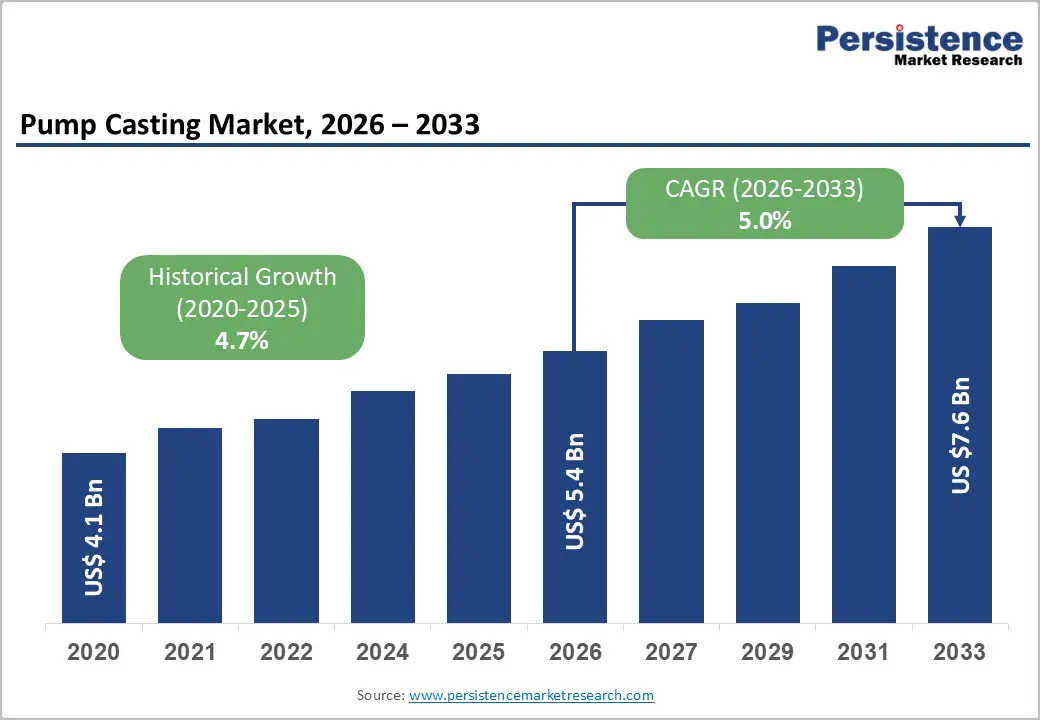
The global pump casting market size is projected to be valued at US$5.4 billion in 2026 and is projected to reach US$7.6 billion by 2033, growing at a CAGR of 5.0% between the forecast period 2026 – 2033, driven by a shift toward precision manufacturing techniques, such as silica sol casting, which reduces machining costs and improves hydraulic efficiency.
Furthermore, advancements in smart casting processes and advanced materials are enhancing product performance and cost-effectiveness across a range of end-use industries.
Key Industry Highlights:
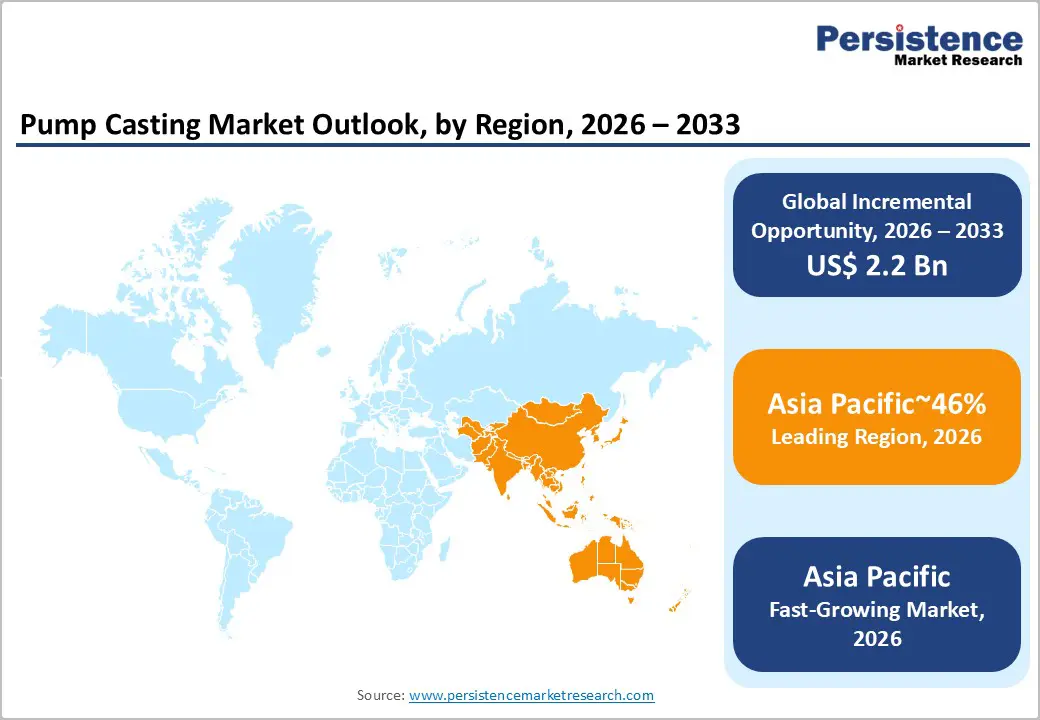
- Leading Region: Asia Pacific to command approximately 46% share, led by China’s manufacturing scale, India’s infrastructure programs, and Japan/Korea’s industrial standards.
- Fastest-growing Region: Asia Pacific, supported by cost-efficient labor, advanced production tech, urban resilience projects, and export-oriented precision casting investments.
- Leading Material: Cast iron to dominate with approximately 45% share, valued for vibration damping, castability, and machinability across municipal, HVAC, irrigation, and industrial pumps.
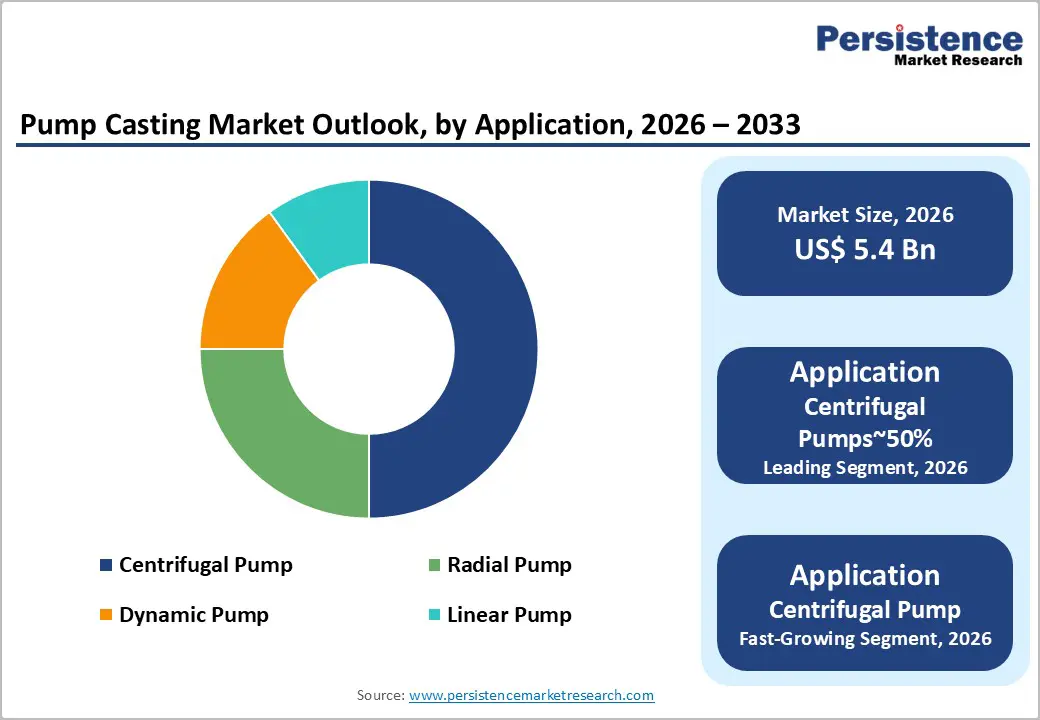
- Leading Application: Centrifugal pumps to hold around 50% share, favored for simplicity, high flow, and reliability across water utilities, HVAC, and chemical sectors. Standardized casting and low maintenance sustain their industrial dominance.
- Key Industry Developments: In December 2025, ITT Inc. signed a definitive agreement to acquire 'SPX FLOW' for US$4.8 billion, a major consolidation move within the flow technology market.
| Key Insights | Details |
|---|---|
| Pump Casting Market Size (2026E) | US$ 5.4 Bn |
| Market Value Forecast (2033F) | US$ 7.6 Bn |
| Projected Growth (CAGR 2026 to 2033) | 5.0% |
| Historical Market Growth (CAGR 2020 to 2025) | 4.7% |
Market Factors – Growth, Barriers, and Opportunity Analysis
Growth Analysis – Industrial Energy Efficiency Regulations
Energy efficiency regulations are exerting direct structural pressure on the industrial pump casting value chain, particularly in regulated end-use sectors such as water treatment, chemicals, and power generation. Policy frameworks in Europe and the U.S. increasingly mandate lower specific energy consumption at the pump system level, forcing OEMs to optimize hydraulic performance rather than rely on motor efficiency gains alone. This shifts engineering focus toward impeller geometry, volute smoothness, and dimensional precision, where casting quality materially influences flow behavior, cavitation resistance, and efficiency curves under variable load conditions.
Within this context, silica sol investment casting is gaining preference over conventional sand casting for critical pump components. The process enables tighter dimensional tolerances, thinner wall sections, and superior surface finishes that reduce boundary layer turbulence and hydraulic losses. These attributes are increasingly embedded into OEM design specifications for compliance-driven pump platforms. As a result, foundries capable of delivering repeatable precision, metallurgical consistency, and post-casting machining accuracy are capturing higher-value contracts. This regulatory-led transition is accelerating value migration within the pump casting market toward specialized precision foundries for energy-efficient pump designs.
Barrier Analysis – Leakage and Pressure Integrity Requirements
Pressure integrity requirements impose significant constraints on pump casing manufacturing, particularly for high-pressure industrial applications. Even microscopic defects such as blowholes or microcracks can compromise sealing performance. These imperfections are relatively common in steel castings subjected to complex solidification behavior. As operating pressures increase, tolerance for leakage narrows across the chemical, oil, and power sectors. Pump casings, therefore, face stringent acceptance thresholds before entering service. Failure risks elevate safety concerns and expose operators to unplanned shutdowns.
To mitigate these risks, manufacturers must deploy advanced nondestructive testing regimes. Hydro pressure and air leak tests are conducted well above normal operating conditions. Radiographic and ultrasonic inspections are increasingly mandatory for critical pump components. These testing requirements raise production costs and extend lead times across casting operations. Smaller foundries face challenges in absorbing testing infrastructure investments. These dynamics raise entry barriers and structurally favor casting suppliers with certified inspection capabilities and process control maturity.
Opportunity Analysis – Green Technology and Energy-Efficient Solutions
The accelerating global focus on sustainability and carbon reduction is reshaping demand patterns within the pump casting market. Energy-efficient pump architectures increasingly rely on optimized cast components to improve hydraulic efficiency. Designs integrating variable frequency drives place higher performance requirements on casings and impellers. Reduced friction losses and stable pressure performance directly translate into lower operational energy consumption. This improves total cost economics despite higher upfront capital intensity. Public policy support for green infrastructure further reinforces adoption across regulated industrial applications.
Demand momentum is particularly visible in renewable-powered pumping systems and energy transition projects. Government-backed programs supporting solar-driven and hybrid pumping solutions are driving specification shifts toward lightweight, efficiency-optimized castings. Circular economy frameworks are accelerating interest in recycled alloys and low-carbon foundry processes. Foundries adopting waste-minimizing casting parameters and advanced manufacturing techniques gain structural advantages. Compliance with energy management and sustainability standards is becoming procurement-critical. This environment creates a distinct growth segment for pump castings aligned with low-emission production and high-efficiency system design.
Category–wise Analysis
Material Insights
Cast Iron is projected to dominate the pump casting market, accounting for approximately 45% share, underpinned by its vibration-damping graphite flake structure, excellent castability, and superior machinability across municipal, HVAC, irrigation, and general industrial pumps. Adoption remains anchored by low-cost production, scalability for housings and impellers, and reliability under non-corrosive fluid conditions, with foundries prioritizing ductile iron development, epoxy-coated finishes, and standardized grey iron grades to meet global OEM requirements. Ongoing platform evolution, including high-silicon alloys, green sand binders, and energy-efficient induction melting, reinforces quality and operational resilience. Vendors such as Kirloskar Brothers, KSB SE, Wilo SE, and Victaulic are expanding their casting capabilities to serve both high-volume and specialized pump applications.
Stainless steel is anticipated to be the fastest-growing segment, driven by corrosion resistance, lighter weight for energy efficiency, and compliance with stringent sanitization standards in the food, beverage, and pharmaceutical sectors. Growth is catalyzed by precision investment casting, near-net shape production, and alloy enhancements, including nitrogen and molybdenum, which increase strength without adding bulk. Accelerating adoption is supported by emerging applications such as green hydrogen, cryogenic fluid transfer, and carbon capture systems, which demand stainless steel’s intrinsic resistance to corrosion, chemical attack, and low-temperature brittleness. Companies including Grundfos, Sulzer, ITT Goulds Pumps, and Ebara are scaling super duplex, 316L, and hybrid alloy stainless steel castings to capture industrial and cryogenic demand.
Application Insights
Centrifugal pumps are projected to dominate the pump market, accounting for approximately 50% share in 2026, underpinned by its simplicity of design, high flow capacity, and entrenched use across water utilities, HVAC networks, chemical processing, and municipal infrastructure. Adoption remains anchored by low maintenance requirements, scalable casting options from micro-pumps to multi-ton flood-control units, and operational reliability under continuous load, with foundries and OEMs prioritizing standardized casting methodologies, precision impeller balancing, and compliance with international efficiency standards. Vendors such as Flowserve Corporation, Xylem Inc., Kirloskar Brothers Ltd, and Wilo SE are expanding product portfolios with high-pressure, leak-free, and digitally integrated centrifugal systems to support enterprise workflows and long-term infrastructure contracts. This combination of mature industrial standards, versatile casting, and predictable demand sustains centrifugal pumps’ dominance in global fluid handling applications.
Centrifugal pumps are anticipated to be the fastest-growing segment, driven by the global adoption of Variable Frequency Drives (VFDs), micro-centrifugal deployments, and extensive infrastructure replacement across water, energy, and industrial sectors. Growth is catalyzed by high-fatigue-resistant castings for fluctuating pressure cycles, hybrid manufacturing combining 3D-printed cores with traditional casings, and digital twin simulations that optimize design and reduce lead times by up to 30%. Accelerating adoption is supported by the rise of the hydrogen economy, cryogenic transport, zero-liquid-discharge water systems, and smart-grid automation, which lower operational friction for first-time industrial and municipal users. As regulatory compliance, performance validation, and automation integration advance, this segment is expected to outpace overall market growth over the forecast period.
Regional Insights
Asia Pacific Pump Casting Market Trends
Asia Pacific is expected to lead with approximately 46% of the market share in 2026, reflecting its role as the primary production and demand center across diverse economic profiles. China anchors regional leadership through large-scale manufacturing capacity, infrastructure modernization, and export-oriented industrial activity, establishing strong supply-side depth. India contributes to accelerating demand momentum, supported by national water, irrigation, and urban infrastructure programs that expand end-use requirements for pump castings. Japan, South Korea, and ASEAN economies add structural balance, combining advanced industrial standards with expanding urban and industrial investment pipelines.
The region that is fastest growing benefits from structural manufacturing advantages, including cost-efficient labor, abundant capacity, and improved access to advanced production technologies. ASEAN markets support incremental demand through flood control, desalination, and urban resilience projects, while nearshoring strategies enhance regional supply chain diversification. Investment flows increasingly favor higher value, precision casting capabilities to meet export quality and regulatory expectations. Combined scale, policy momentum, and manufacturing depth position Asia Pacific as the dominant global supply base with sustained leadership relative to other regions.
North America Pump Casting Market Size Trends
North America, led by the U.S., is expected to represent a mature industrial base and stringent regulatory oversight. Demand is anchored in replacement cycles tied to aging municipal and industrial infrastructure, alongside renewed activity in shale gas and energy-related applications. Energy efficiency mandates and environmental compliance requirements shape procurement behavior, reinforcing demand for high-quality, domestically sourced pump castings. The presence of tier-1 OEMs prioritizing supply chain resilience further strengthens near-shore and local sourcing preferences across the region.
The regional manufacturing environment emphasizes advanced capabilities, automation upgrades, and compliance-driven production standards. Policy alignment across federal and state levels supports market efficiency while elevating barriers to entry for smaller or less capitalized suppliers. Investment priorities increasingly focus on automation, digital integration, and reliability enhancement to meet efficiency standards and aftermarket service requirements. Combined regulatory rigor, infrastructure maturity, and supply chain localization position North America as a stable, compliance-led market with moderate growth potential relative to other regions.
Europe Pump Casting Market Trends
Europe is expected to position itself as a mature market with its growth, defined by advanced manufacturing depth, long-established engineering expertise, and harmonized EU regulatory frameworks that support cross-border standardization. Energy efficiency mandates, emissions controls, and circular economy policies shape procurement priorities, accelerating the adoption of precision casting techniques and premium material selections. Germany functions as the primary manufacturing anchor, supported by strong R&D intensity and sustainability-led production practices across the region.
Market demand is driven by industrial retrofit activity, wastewater treatment compliance, and energy transition applications within chemicals and renewables. Investment patterns emphasize low-carbon manufacturing, recyclable materials, and automation aligned with EU Green Deal objectives. High demand for stainless steel and specialized alloy castings reflects regulatory pressure and performance requirements in geothermal and hydrogen-related systems. Combined regulatory leadership, industrial maturity, and sustainability alignment position Europe as a stable, premium-oriented regional market relative to other global regions.
Competitive Landscape
The global pump casting market remains moderately fragmented, with vertically integrated pump OEMs and independent merchant foundries jointly shaping the competitive structure. The top tier of manufacturers, including Grundfos, Flowserve, KSB, Xylem, and Sulzer, collectively reflects advantages in certification compliance, metallurgical capability, and captive demand alignment. Market concentration is highest in North America and Western Europe, where ISO and API compliance, alloy complexity, and delivery reliability drive supplier selection, while Asia Pacific remains fragmented due to a dense base of cost-competitive regional foundries serving industrial and municipal demand.
Competitive dynamics increasingly favor consolidation and vertical control as OEMs pursue supply security, lead time reduction, and margin stability. Strategic emphasis centers on regionalized production, digital foundry implementation for quality control, and material innovation targeting abrasive and high-pressure applications. Independent foundries remain relevant through flexibility and volume responsiveness, but scale, automation, and integration are expected to determine long-term positioning as pump manufacturers prioritize resilience, sustainability compliance, and aftermarket lifecycle optimization.
Key Industry Developments:
- In December 2025, Kirloskar Brothers Limited opened a dedicated pump refurbishment and service center in Bellary, India. By offering specialized maintenance and component replacement, the center extends the lifecycle of industrial pumps and reduces the environmental footprint of heavy industrial operations.
- In November 2025, KSB Limited secured NORSOK Phase 1 certification for its specialized casting foundry operations. This certification allows the company to cast high-end components for Middle Eastern oil and gas giants such as ADNOC, opening massive high-margin export revenue streams.
Companies Covered in Pump Casting Market
- Flowserve Corporation
- Xylem Inc.
- KSB SE & Co. KGaA
- Sulzer Ltd.
- Grundfos Holding A/S
- The Weir Group PLC
- Ebara Corporation
- Wilo SE
- ITT Inc.
- Pentair plc
- Andritz Group
- Impro Precision Industries
- MetalTek International
- Georg Fischer
- Peekay Steel Castings Pvt Ltd
- OTTOMMO Casting
- Kirloskar Brothers Ltd.
Frequently Asked Questions
The global pump casting market is projected to be valued at US$5.4 billion in 2026 and is expected to reach US$7.6 billion by 2033, reflecting steady expansion across water, energy, and industrial fluid handling applications.
Demand is rising due to rapid urbanization, expanding water and wastewater infrastructure, increasing energy sector investments, and growing adoption of precision casting techniques that enhance hydraulic efficiency and reduce lifecycle costs.
The pump casting market is expected to grow at a CAGR of 5.0% between 2026 and 2033, supported by smart manufacturing adoption and rising demand for high-performance pump systems.
The fastest growth opportunities are emerging in Asia Pacific, driven by large-scale industrialization, municipal infrastructure spending, and capacity expansion by regional pump and component manufacturers.
Key players include Grundfos Holding A/S, KSB SE & Co. KGaA, Flowserve Corporation, Sulzer Ltd., ITT Inc., Xylem Inc., The Weir Group PLC, Ebara Corporation, Wilo SE, Pentair plc, Kirloskar Brothers Limited, and Georg Fischer.


