




- Specialty & Fine Chemicals
- Propionic Acid Market
Propionic Acid Market Size, Share, and Growth Forecast 2026 - 2033
Propionic Acid Market by Product Type (Industrial Grade, Food Grade, Pharmaceutical Grade), Application (Animal Feed, Food & Beverages, Others), and Regional Analysis for 2026 - 2033

Propionic Acid Market Size and Trends Analysis
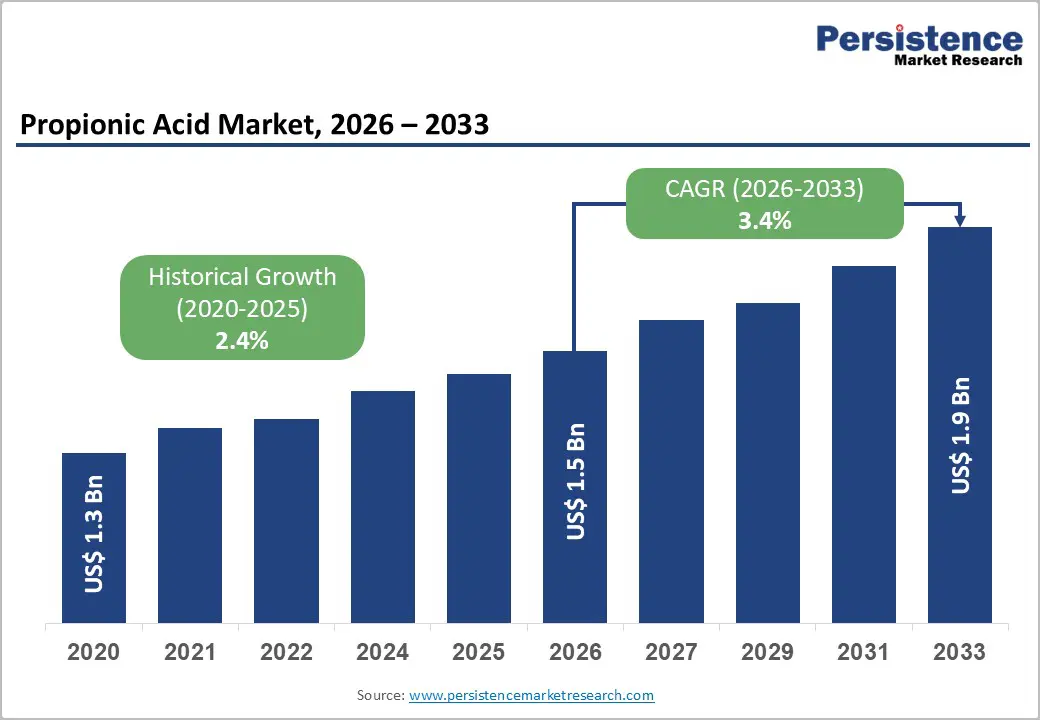
The global propionic acid market size is likely to be valued at US$1.5 billion in 2026 and is expected to reach US$1.9 billion by 2033, growing at a CAGR of 3.4% during the forecast period from 2026 to 2033, driven by widespread use as a preservative in food and animal feed, and as a versatile chemical intermediate in herbicides, pharmaceuticals, and industrial applications.
Demand continues to be anchored in its effectiveness for extending product shelf life and maintaining feed quality, particularly in regions with large agriculture and food-processing sectors. Recent industry reports emphasize an increasing emphasis on sustainable production practices and broader applications in specialty chemicals, reflecting shifting end-use priorities. Market trends show consistent demand in food preservation and livestock feed, while chemical intermediates and agrochemical uses are driving further diversification.
Key Industry Highlights
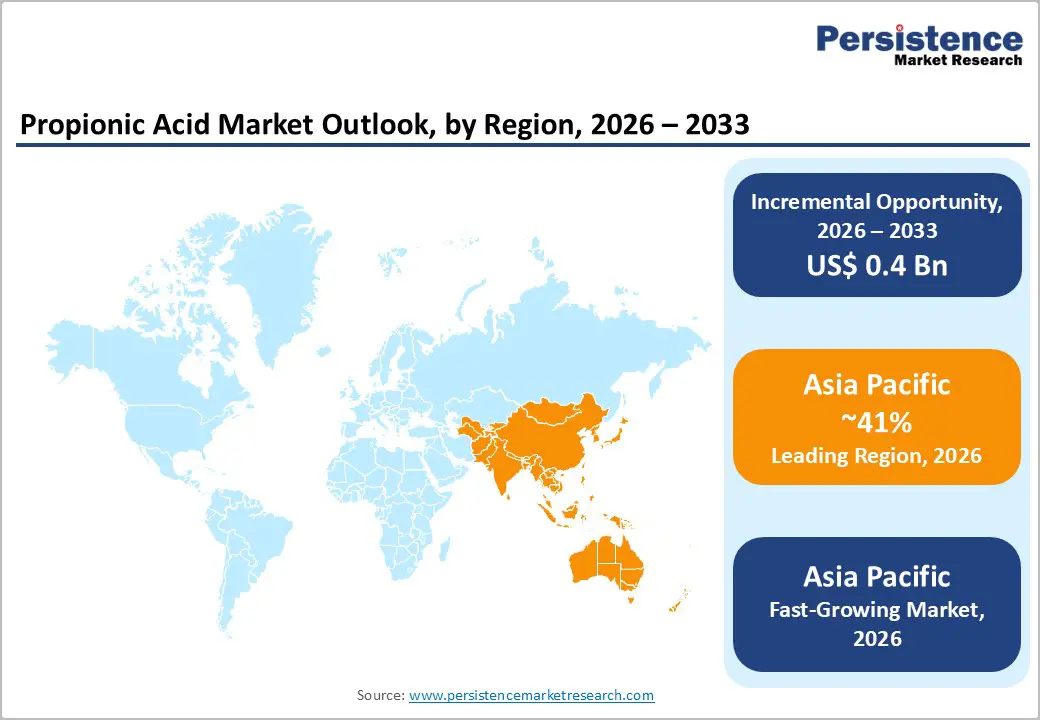
- Leading Region: Asia Pacific is anticipated to be the leading region, accounting for a market share of 41% in 2026, due to strong demand in animal feed, food preservation, and chemical intermediates.
- Fastest Growing Region: Asia Pacific is likely to be the fastest-growing region, driven by rapid industrialization, rising population, agricultural mechanization, and expanding FMCG industries in China, India, and Japan.
- Leading Product Type: The industrial grade segment is projected to represent the leading product type in 2026, accounting for 63.3% of the revenue share, driven by its extensive use in chemical synthesis, industrial intermediates, and other high-volume manufacturing applications where cost efficiency is critical.
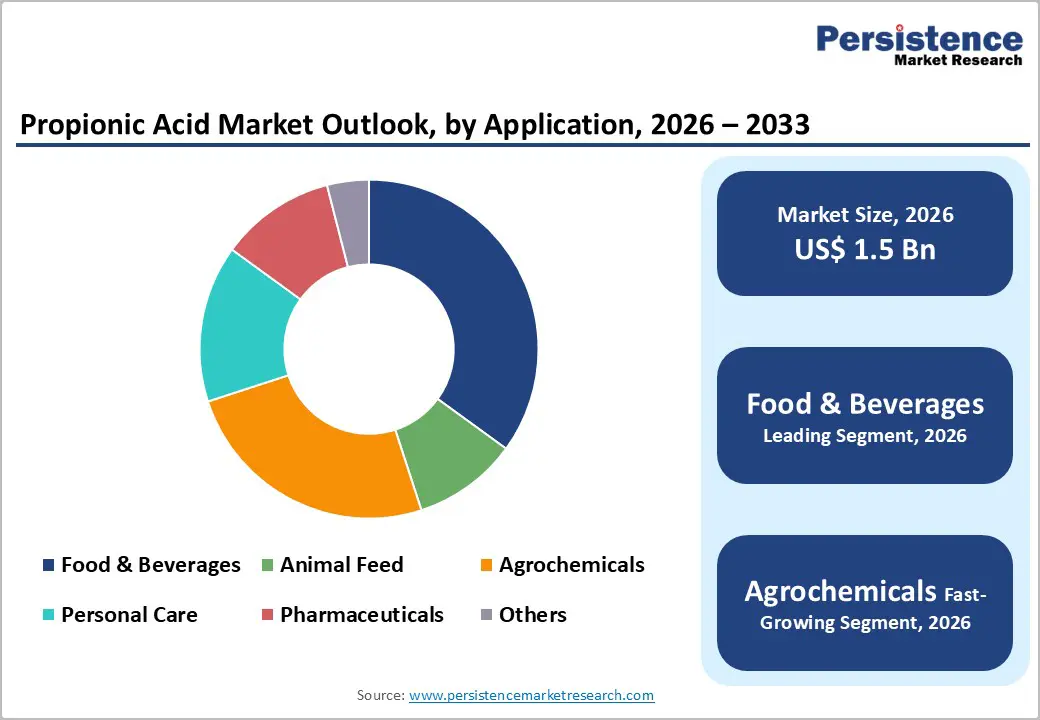
- Leading Application: The food & beverages segment is anticipated to be the leading application type, accounting for over 40% share in 2026, driven by the use of propionic acid as a preservative in baked goods, dairy, jams, and beverages to extend shelf life.
| Key Insights | Details |
|---|---|
|
Propionic Acid Market Size (2026E) |
US$1.5 Bn |
|
Market Value Forecast (2033F) |
US$1.9 Bn |
|
Projected Growth CAGR (2026-2033) |
3.4% |
|
Historical Market Growth (2020-2025) |
2.4% |
Market Factors - Growth, Barriers, and Opportunity Analysis
Growing Demand in Animal Feed and Food Preservation
The rise in livestock production and increasing demand for meat, dairy, and other animal-derived protein has significantly increased the need for high-quality, long-lasting feed, and propionic acid plays a vital role in meeting this requirement. As a feed preservative, propionic acid inhibits mold, bacterial, and fungal growth in stored feeds and silage, helping maintain nutritional value and safety over time. As livestock production expands to support rising protein consumption, reliance on feed additives such as propionic acid continues to strengthen. The shift toward intensive farming practices and longer feed storage cycles further supports its adoption. Feed producers also prefer propionic acid due to its effectiveness across varied climatic and storage conditions.
The food industry’s emphasis on extending product shelf life and maintaining safety has accelerated propionic acid usage in food preservation. It is commonly applied in bakery products, dairy, jams, and beverages to prevent spoilage and microbial contamination. With consumers increasingly seeking fresh, ready-to-eat, and packaged foods, propionic acid has become vital in ensuring product stability and freshness. Its compatibility with existing food processing methods supports widespread use across applications. Manufacturers value propionic acid for maintaining product quality without significantly altering taste or texture.
Stringent Environmental and Regulatory Constraints
The propionic acid market faces significant restraints due to increasingly stringent environmental regulations across the globe. As a chemical produced primarily through petrochemical routes, its manufacturing process can generate emissions and effluents that require careful handling and disposal. Regulatory authorities in regions such as North America and Europe have implemented strict guidelines on air quality, wastewater management, and chemical handling, which increase compliance costs for manufacturers. These requirements often necessitate investments in advanced treatment systems and cleaner production technologies. Smaller and mid-sized producers may face challenges in meeting these standards while maintaining cost competitiveness.
Environmental regulations and food and feed safety standards place strict limits on the use and concentration of propionic acid and its derivatives. Regulatory authorities require extensive testing, labeling, and documentation to ensure safe use in food, feed, and pharmaceutical applications, which can slow approval processes and raise operational costs. Navigating multiple regulatory and environmental compliance frameworks across regions often delays product launches and acts as a significant restraint on overall market growth.
Growing Pharmaceutical and Personal Care Applications
The expanding pharmaceutical industry is creating strong growth prospects for propionic acid. It is increasingly utilized as an intermediate in the production of various drugs and active pharmaceutical ingredients (APIs) due to its chemical stability and versatility. As healthcare demand continues to rise, driven by population growth, aging populations, and the increasing incidence of chronic diseases, pharmaceutical manufacturers are prioritizing dependable chemical intermediates to support large-scale manufacturing. The growing focus on high-purity raw materials is also boosting demand for pharmaceutical-grade propionic acid, while stricter regulatory and quality standards in drug production are further reinforcing the need for consistent and compliant inputs.
In the personal care industry, propionic acid and its derivatives are being adopted for use as preservatives, pH regulators, and specialty ingredients in cosmetics, skincare, and hair care products. Heightened consumer awareness regarding product safety, along with the demand for extended shelf life, is driving their use in personal care formulations. Manufacturers are also emphasizing formulation stability and protection against microbial growth, areas where propionic acid delivers reliable performance. The shift toward natural and functional ingredients is supporting its role as a multifunctional component, and its broad formulation compatibility enables integration across a wide range of personal care applications.
Category-wise Analysis
Product Type Insights
Industrial grade propionic acid is projected to dominate the market, accounting for about 63.3% of total revenue in 2026. This leadership is driven by its extensive use in high-volume applications such as chemical synthesis, animal feed preservatives, herbicides, and industrial plastics, where ultra-high purity is not essential, and cost efficiency is a key priority. Supported by a broad base of industrial consumers and large-scale consumption, industrial grade holds the largest share among product types worldwide. It benefits from economies of scale and plays a foundational role in agriculture, feed, and chemical intermediate industries. For instance, it is widely applied in animal feed preservation to inhibit mold growth in stored grains and silage.
Pharmaceutical grade propionic acid is expected to be the fastest-growing segment in 2026, fueled by rising demand from the global pharmaceutical industry. High-purity propionic acid is essential as an intermediate in drug synthesis, including anti-inflammatory medications and specialty chemicals. In addition to drug production, stricter regulatory requirements, increasing healthcare expenditures, and the expansion of pharmaceutical manufacturing, particularly in emerging economies, are driving sustained demand for pharmaceutical-grade inputs. For example, pharmaceutical-grade propionic acid is used in the production of anti-inflammatory drug intermediates that require precise purity levels and full regulatory compliance.
Application Type Insights
The food and beverages segment is expected to dominate the market, accounting for nearly 40% of revenue in 2026. Propionic acid is extensively used as a preservative in bakery products, dairy goods, jams, and beverages to extend shelf life, prevent spoilage, and preserve product quality. Its strong ability to inhibit mold and bacterial growth makes it a preferred option for manufacturers focused on ensuring food safety and freshness. Animal feed applications continue to contribute significantly to market demand, supported by the expansion of the livestock industry and increasing need for safe, durable feed additives. For instance, propionic acid is widely used in commercial bread manufacturing to prevent mold growth during storage and distribution.
The agrochemicals segment is anticipated to be the fastest-growing application in 2026, driven by increasing agricultural mechanization, higher usage of herbicides and pesticides, and expanding crop protection efforts. Rapid growth in agricultural productivity and technological adoption in Asia Pacific countries such as India and China is further accelerating demand. Propionic acid is increasingly used in agrochemical formulations as an intermediate for herbicides and pesticides, supporting effective crop protection strategies. For example, it plays a key role in the production of selective herbicides used to protect cereal and grain crops.
Regional Insights
North America Propionic Acid Market Trends
North America is anticipated to remain a key market for propionic acid in 2026, supported by its well-established food processing, livestock, and agricultural industries. The acid is extensively used for food preservation in bakery products, dairy items, and packaged foods, as well as for preserving animal feed and grain silage. Its fungistatic properties effectively prevent mold and microbial growth, helping manufacturers meet strict food-safety standards under regulatory frameworks that recognize propionic acid as “generally recognized as safe” (GRAS). For example, leading ingredient suppliers such as Eastman Chemical Company offer propionic acid solutions that are widely utilized by food and feed producers across North America.
The region is also experiencing consistent growth in the use of propionic acid in animal feed and livestock health applications. Increasing focus on animal nutrition and feed quality is driving demand for propionic acid derivatives, including calcium and sodium propionate, for use in silage preservation, grain storage, and feed additives. Propionic acid continues to see adoption in industrial chemicals, herbicides, and specialty chemical applications, reflecting North America’s mature chemical supply chain, diverse end-use industries, and strong manufacturing and processing infrastructure in the U.S. and Canada.
Europe Propionic Acid Market Trends
Europe is likely to be a significant market for propionic acid, due to its well-established food processing and livestock industries that drive consistent demand. The acid is widely used as a preservative in bakery products, dairy, and packaged foods, helping extend shelf life and prevent microbial spoilage. Its application in animal feed is also important, supporting feed quality and safety under strict European regulatory standards. For example, companies such as Perstorp Holding AB supply propionic acid solutions extensively used across European food and feed applications.
The region emphasizes high-quality production and compliance, which has led to the steady adoption of food-grade and industrial-grade propionic acid. Propionic acid is utilized in chemical intermediates and agrochemical formulations, reflecting Europe’s mature chemical and agricultural sectors. The focus on sustainability and clean-label food solutions has encouraged the use of effective, safe preservatives such as propionic acid across multiple applications, reinforcing its role as a key ingredient in both the food and feed industries.
Asia Pacific Propionic Acid Market Trends
Asia Pacific is expected to dominate the propionic acid market, accounting for approximately 41% of the total market share in 2026. This leadership is driven by the region’s expansive agriculture and livestock industries, along with a rapidly growing food processing sector. Propionic acid is extensively used in animal feed preservation to protect nutritional value and inhibit microbial growth, as well as in food preservation for bakery products, dairy items, and packaged foods to extend shelf life and reduce spoilage. Major economies such as China, India, Vietnam, and other Southeast Asian countries represent key consumption hubs, supported by rising demand for meat, dairy, and processed food products. For example, BASF maintains a strong presence in the Asia Pacific region, supplying propionic acid for food, feed, and industrial applications across major regional markets.
The Asia Pacific region is also projected to be the fastest-growing market in 2026, fueled by rapid industrial expansion, modernization of agriculture, and the increasing adoption of advanced farming techniques. Growing awareness of feed safety, improved storage infrastructure, and the expansion of pharmaceutical and personal care manufacturing are further boosting demand for high-quality propionic acid. Manufacturers are increasingly investing in bio-based propionic acid produced through fermentation processes to address environmental concerns and meet rising demand for clean-label preservatives. Its use in chemical intermediates and agrochemical formulations further reflects the region’s broad and diversified industrial landscape.
Competitive Landscape
The global propionic acid market exhibits a moderately fragmented structure, driven by a mixture of large multinational chemical firms and specialized regional producers operating worldwide. Major players control a substantial portion of the market. With key leaders including BASF SE, Dow Chemical, Perstorp, Eastman Chemical, and BASF-YPC, competition in this domain centers on production capacity, vertical integration, product purity, and regional distribution strength.
These players compete through strategic capacity expansions, adoption of varied production routes, including petrochemical and emerging bio-based processes, and offering differentiated product grades, industrial, food-grade, and high-purity. The competition is also shaped by regional diversification, as firms invest in expanding presence across Asia, Europe, and North America to capture demand in food preservation, animal feed, agrochemicals, and pharmaceutical-grade propionic acid.
Key Industry Developments:
- In December 2025, Afyren, in partnership with Esse Skincare, launched the first bio-based propionic acid for personal care applications. Produced via fermentation, the low-carbon, COSMOS-certified ingredient is designed for microbiome-focused skincare. Production is supported by Afyren’s circular biorefinery in Saint-Avold, France, with formulation expertise from Esse Skincare.
- In November 2025, the European Commission approved Regulation (EU) 2025/2186, authorizing propionic acid and its salts (sodium and ammonium propionate) as feed additives for all terrestrial animals. The authorization, valid until November 19, 2035, provides long-term regulatory clarity under Regulation (EC) No 1831/2003.
Companies Covered in Propionic Acid Market
- BASF SE
- Dow Chemical Company
- Eastman Chemical Company
- Perstorp Holdings AB
- Corbion NV
- Celanese Corporation
- OQ Chemicals GmbH
- Macco Organiques
- Merck KGaA
Frequently Asked Questions
The global propionic acid market is expected to reach US$1.9 billion by 2033.
Key demand drivers include growing use in animal feed preservation, food & beverage preservation, expanding agrochemical applications, and rising pharmaceutical uses.
The industrial-grade segment is expected to be the leading product type in 2026, accounting for 63.3% of revenue, driven by its widespread use in chemical synthesis, industrial intermediates, and other large-scale manufacturing applications where cost efficiency is essential.
Asia Pacific leads the market with around 41% revenue share, due to strong demand in animal feed, food preservation, and chemical intermediates.
Key opportunities lie in expanding bio-based propionic acid production using sustainable technologies and growing demand in emerging markets such as Asia Pacific.


