




- Pharmaceuticals
- Prophylactic Antibiotics Market
Prophylactic Antibiotics Market Size, Share and Growth Forecast, 2026 - 2033
Prophylactic Antibiotics Market by Drug type (Cephalosporins, Gentamicin, Others), Route of Administration (Oral, Intravenous), Distribution channel (Hospital Pharmacies, Drug stores, Retail pharmacies, Online Pharmacies), and Regional Analysis for 2026 - 2033

Prophylactic Antibiotics Market Size and Trends Analysis
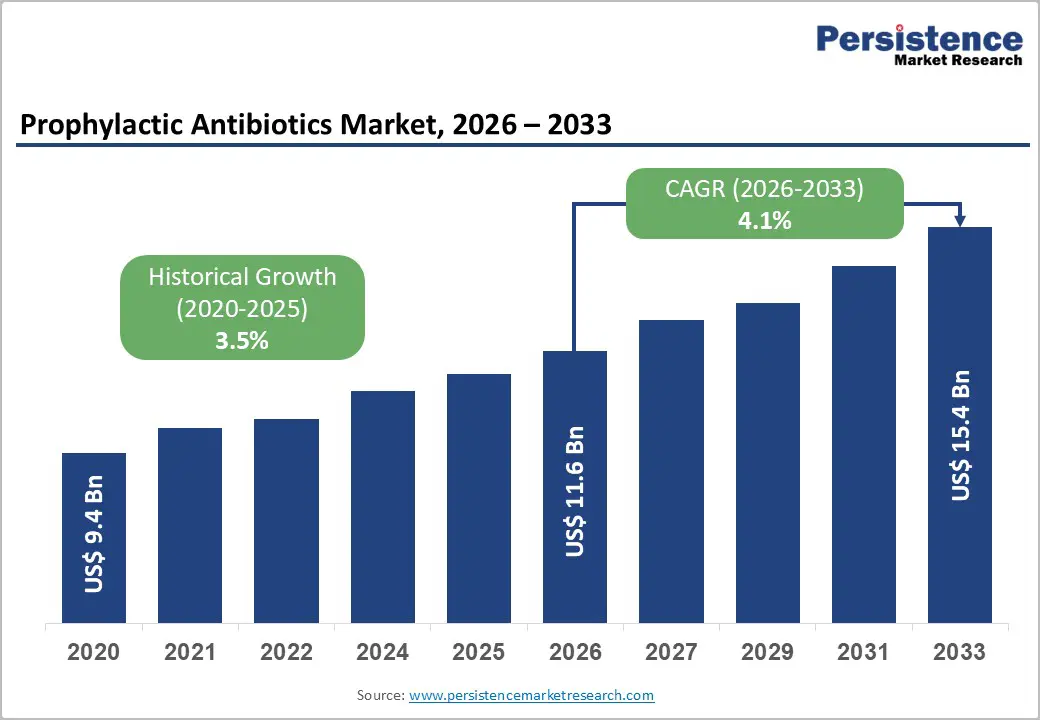
The global prophylactic antibiotics market size is likely to be valued at US$11.6 billion in 2026 and is projected to reach US$15.4 billion by 2033, growing at a CAGR of 4.1% during the forecast period from 2026 to 2033, driven by increasing surgical volumes, stronger infection prevention initiatives, and wider adoption of evidence-based antimicrobial prophylaxis protocols.
The use of prophylactic antibiotics across major surgical procedures continues to support demand, while investments in reducing surgical site infections (SSIs) and hospital readmissions strengthen market expansion. Additionally, antimicrobial stewardship regulations are promoting more targeted and efficient antibiotic utilization.
Key Industry Highlights:
- Dominant Drug Type: Cephalosporins are expected to lead with approximately 38% of market revenue in 2026, while vancomycin is likely to be the fastest-growing drug segment through 2033, driven by increasing concerns over resistant bacterial infections.
- Leading Route of Administration: Intravenous administration is anticipated to dominate with an estimated 67% share in 2026, while oral administration is projected to witness the fastest growth through 2033, supported by the expansion of outpatient and ambulatory surgical procedures.
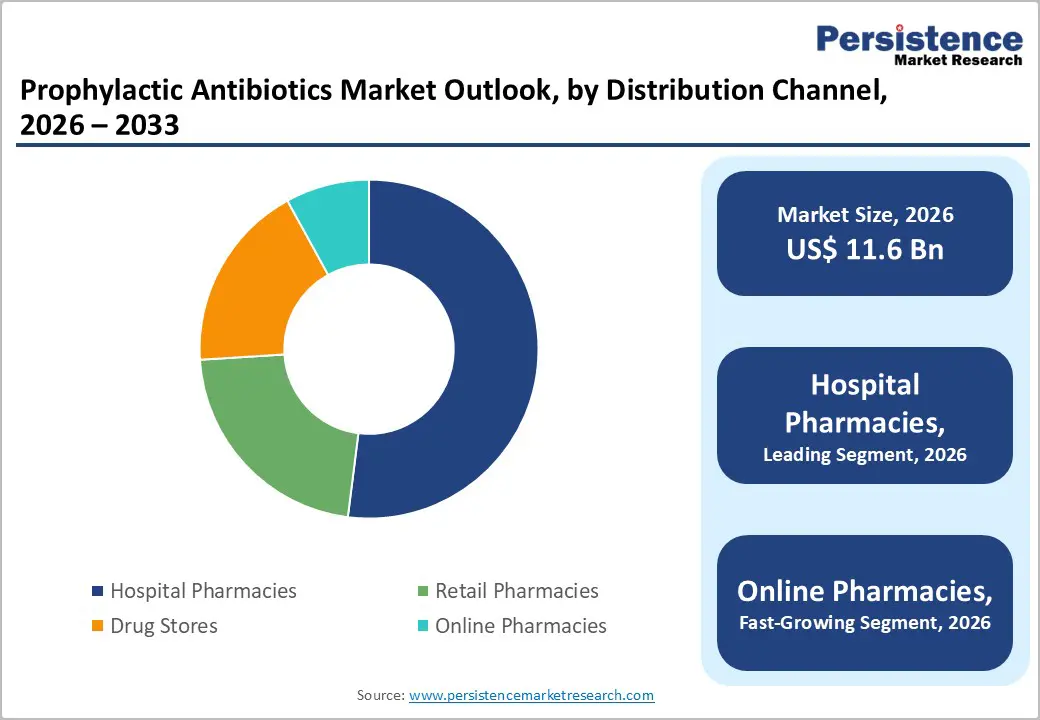
- Dominant Distribution Channel: Hospital pharmacies are projected to account for around 52% of market revenue in 2026, while online pharmacies are expected to be the fastest-growing distribution channel during the forecast period due to rising digital healthcare adoption.
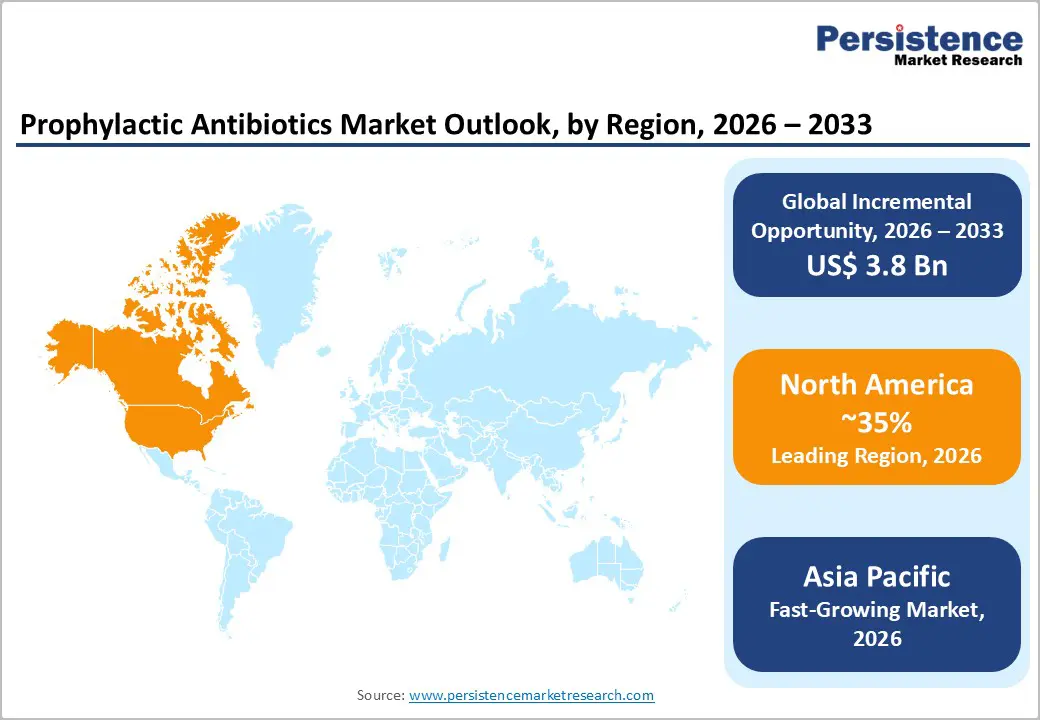
- Regional Leadership: North America is poised to remain the largest regional market in 2026, while Asia Pacific is expected to register the strongest growth through 2033, driven by healthcare infrastructure expansion and increasing surgical volumes.
- Competitive Environment: Market competition is centered on portfolio expansion, sterile injectable manufacturing investments, hospital partnerships, and antimicrobial stewardship compliance, alongside strategic expansion across emerging healthcare markets.
DRO Analysis
Driver - Growing Surgical Volumes and Rising Focus on Surgical Site Infection Prevention
The most significant growth driver for the prophylactic antibiotics market is the continuous increase in surgical procedures worldwide, combined with stricter infection prevention requirements. According to the World Health Organization (WHO), surgical site infections remain among the most common healthcare-associated infections, affecting approximately 11% of surgical patients in low- and middle-income countries. In the United States alone, surgical site infections contribute to more than 400,000 additional hospital days annually and approximately US$900 million in healthcare costs.
The WHO guidelines strongly recommend preoperative antibiotic prophylaxis for eligible procedures due to its proven effectiveness in reducing infection risks. Healthcare providers increasingly recognize that appropriate prophylactic antibiotic administration improves clinical outcomes, lowers postoperative complications, and reduces healthcare expenditures. Consequently, hospitals continue expanding standardized antibiotic prophylaxis protocols, supporting sustained market demand across both developed and emerging healthcare systems.
Restraint - Stringent Antibiotic Stewardship Programs and Prescribing Restrictions
Growing concerns regarding antimicrobial resistance have led healthcare authorities worldwide to implement increasingly stringent antibiotic stewardship programs, limiting the use of prophylactic antibiotics to evidence-based clinical scenarios. According to the Institute for Health Metrics and Evaluation (IHME), bacterial antimicrobial resistance was associated with approximately 4.71 million deaths globally in 2021, prompting regulators and healthcare systems to strengthen monitoring of antibiotic utilization.
Organizations such as the WHO continue to promote responsible prescribing practices to reduce the emergence of resistant pathogens. As a result, hospitals are increasingly adopting targeted prophylaxis protocols, shorter treatment durations, and stricter prescribing guidelines. While these measures improve patient safety and support resistance management, they can constrain volume growth for prophylactic antibiotics by reducing unnecessary or routine administration across healthcare settings.
Opportunity - Expansion of Infection Prevention Programs in Emerging Healthcare Markets
A significant growth opportunity exists across emerging economies where healthcare infrastructure investment and surgical capacity are expanding rapidly. According to the World Health Organization (WHO), an estimated 143 million additional surgical procedures are needed annually in low- and middle-income countries to save lives and prevent disability, highlighting a substantial unmet need for safe surgical care. At the same time, WHO reports that patients in low- and middle-income countries are up to twice as likely to develop surgical site infections (SSIs) compared with those in high-income nations, increasing demand for effective infection-prevention strategies.
As governments across Asia-Pacific, Latin America, the Middle East, and Africa continue investing in hospital construction, universal healthcare coverage, and quality-of-care initiatives, adoption of standardized prophylactic antibiotic protocols is expected to increase. The rapid expansion of private healthcare networks in countries such as India, China, Indonesia, Vietnam, and Saudi Arabia further supports spending on infection control programs, creating attractive long-term opportunities for prophylactic antibiotic manufacturers.
Category-wise Analysis
Drug Type Insights
Cephalosporins are estimated to remain the leading drug type segment, accounting for approximately 38% of global market revenue in 2026. Their leadership is expected to be supported by continued inclusion in major surgical prophylaxis guidelines and widespread adoption across hospital settings. According to the European Centre for Disease Prevention and Control (ECDC), cephalosporins remain among the most commonly utilized antibiotic classes in European hospitals, reflecting their established role in preventing postoperative infections. Their broad applicability across orthopedic, cardiovascular, gastrointestinal, and general surgical procedures is anticipated to sustain strong market penetration throughout the forecast period.
Vancomycin is projected to be the fastest-growing segment, advancing at an estimated CAGR of 5.6% through 2033. Growth is expected to be supported by increasing surveillance of resistant pathogens in healthcare facilities. According to the U.S. Centers for Disease Control and Prevention (CDC), approximately 120,000 bloodstream infections caused by Staphylococcus aureus occur annually in the United States, with many cases linked to resistant strains. As hospitals continue strengthening infection-control measures and targeted prophylaxis protocols for high-risk patients, demand for vancomycin-based prophylactic regimens is expected to increase.
Route of Administration Insights
Intravenous administration is estimated to dominate the market with approximately a 67% share in 2026, owing to its ability to achieve rapid and predictable therapeutic concentrations during surgical procedures. Its leadership is expected to remain supported by rising surgical activity and continued adherence to perioperative antibiotic guidelines. The Lancet Commission on Global Surgery has highlighted the need for significantly expanded surgical access globally, a trend that is anticipated to reinforce demand for reliable intravenous prophylactic antibiotic delivery across healthcare systems.
Oral administration is expected to record the fastest growth, registering an estimated CAGR of 5.3% through 2033. The segment is anticipated to benefit from broader adoption of Enhanced Recovery After Surgery (ERAS®) protocols, particularly within colorectal and gastrointestinal procedures where oral antibiotic preparation is frequently incorporated. Ongoing expansion of ERAS programs across the U.K.'s National Health Service (NHS) and major U.S. healthcare institutions is expected to support increasing utilization of oral prophylactic therapies as part of optimized patient recovery pathways.
Distribution Channel Insights
Hospital pharmacies are estimated to lead the market, accounting for approximately 52% of total revenue in 2026. Their dominance is expected to stem from the centralized management of surgical care, antibiotic stewardship programs, and inpatient medication administration. According to the Organisation for Economic Co-operation and Development (OECD), hospital services continue to account for the largest share of healthcare expenditure across many developed economies, a trend that is anticipated to support the continued importance of hospital pharmacies in prophylactic antibiotic distribution.
Online pharmacies are projected to be the fastest-growing distribution channel, expanding at an estimated CAGR of 6.1% through 2033. Growth is expected to be driven by increasing adoption of e-prescriptions, telehealth services, and digital healthcare platforms. Continued advancement of initiatives such as India's National Digital Health Mission (NDHM) and China's expanding internet hospital ecosystem, alongside investments by companies including Apollo 24/7, Tata 1mg, and JD Health, is anticipated to strengthen digital prescription fulfillment and support greater utilization of online pharmacy channels over the forecast period.
Regional Analysis
North America Prophylactic Antibiotics Market Trends
North America is estimated to account for approximately 35% of the global Prophylactic Antibiotics Market in 2026, maintaining its position as the largest regional market. Growth is expected to be supported by high surgical procedure volumes, advanced healthcare infrastructure, and widespread adoption of infection prevention protocols. The region continues to prioritize antimicrobial stewardship, healthcare-associated infection reduction, and evidence-based prophylaxis practices. Increasing investments in hospital surveillance systems and surgical quality improvement programs are anticipated to support stable market expansion over the forecast period.
U.S. Prophylactic Antibiotics Market Trends
The U.S., which is projected to represent approximately 84% of the North America market, remains the primary growth driver. According to the Centers for Disease Control and Prevention (CDC), approximately 1 in 31 hospitalized patients acquires at least one healthcare-associated infection on any given day, reinforcing the importance of effective prophylactic antibiotic strategies. Continued investments in antimicrobial resistance surveillance, infection-control technologies, and surgical quality initiatives are expected to sustain demand across hospitals and ambulatory care settings.
Canada Prophylactic Antibiotics Market Trends
Canada is estimated to account for nearly 16% of regional revenue in 2026, supported by its universal healthcare system and strong infection prevention framework. The country continues to strengthen national surveillance efforts through programs led by the Public Health Agency of Canada, with growing emphasis on reducing surgical site infections and improving patient safety outcomes. Increasing adoption of stewardship-driven prescribing practices is expected to support consistent demand for prophylactic antibiotics.
Europe Prophylactic Antibiotics Market Trends
Europe is projected to account for approximately 28% of global market revenue in 2026, supported by mature healthcare systems, advanced surgical infrastructure, and well-established antimicrobial stewardship programs. Regional healthcare providers continue emphasizing evidence-based antibiotic utilization to balance infection prevention with resistance management objectives. Investments in hospital quality improvement initiatives and surveillance networks are expected to maintain stable demand for prophylactic antibiotic therapies across the region.
Germany Prophylactic Antibiotics Market Trends
Germany is estimated to contribute approximately 22% of the Europe market and remains one of the region's most influential healthcare markets. The country continues to strengthen infection prevention efforts through its German Antimicrobial Resistance Strategy (DART) while maintaining one of Europe's largest hospital networks. Growing adoption of advanced surgical procedures and increased focus on postoperative outcome improvement are anticipated to support continued utilization of prophylactic antibiotics.
U.K. Prophylactic Antibiotics Market Trends
The U.K. is projected to account for nearly 18% of regional revenue, supported by ongoing infection-control initiatives implemented across the National Health Service (NHS). Recent NHS programs targeting reductions in surgical site infections and healthcare-associated infections have reinforced the use of standardized prophylactic antibiotic protocols. Continued expansion of data-driven antimicrobial stewardship programs is expected to further optimize antibiotic utilization and sustain market demand.
Asia Pacific Prophylactic Antibiotics Market Trends
Asia Pacific is estimated to hold approximately 25% of global market revenue in 2026 and is expected to register the fastest growth through 2033. Rapid healthcare infrastructure development, increasing surgical procedure volumes, and broader access to health insurance are anticipated to drive regional expansion. Governments across the region continue investing in hospital modernization, infection prevention standards, and healthcare capacity expansion, creating favorable conditions for market growth.
China Prophylactic Antibiotics Market Trends
China is projected to account for approximately 38% of the Asia Pacific market, supported by large-scale healthcare investments and expanding surgical care capacity. The National Health Commission of China continues to strengthen antimicrobial stewardship requirements and hospital infection-control standards, encouraging more structured prophylactic antibiotic utilization. Ongoing expansion of tertiary hospitals and standardized surgical care pathways is expected to support long-term demand growth.
India Prophylactic Antibiotics Market Trends
India is estimated to represent approximately 22% of regional revenue and is expected to emerge as one of the fastest-growing markets for prophylactic antibiotics. Government initiatives such as Ayushman Bharat continue expanding access to hospital services and surgical care for millions of patients. Rising investments in tertiary healthcare facilities, increasing procedural volumes, and growing awareness of infection prevention practices are anticipated to create substantial opportunities for market participants throughout the forecast period.
Competitive Landscape
The global prophylactic antibiotics market is moderately consolidated, with leading companies including Pfizer, Merck & Co., Sandoz, Teva Pharmaceutical Industries, and Fresenius Kabi accounting for a substantial share of global revenue. These players leverage extensive hospital relationships, established anti-infective portfolios, manufacturing scale, and regulatory expertise to maintain competitive positions. Investments in sterile injectable production, supply reliability, and antimicrobial resistance surveillance remain key strategic priorities.
Generic manufacturers such as Aurobindo Pharma, Cipla, Sun Pharmaceutical Industries, and Dr. Reddy’s Laboratories compete through cost-efficient production and strong regional distribution networks. Stringent regulatory requirements, quality standards, and antimicrobial stewardship policies create barriers for new entrants. Market consolidation is expected to increase gradually as major pharmaceutical companies pursue portfolio expansion, geographic growth, and strategic acquisitions, while partnerships with healthcare providers strengthen access to hospital-based antibiotic markets.
Key Industry Developments:
- In August 2025, CorMedix acquired Melinta Therapeutics for US$300 million upfront, along with potential milestone payments. The acquisition strengthened CorMedix’s position in infectious disease therapeutics by adding Melinta’s hospital-focused anti-infective portfolio and expanding its commercial presence across acute-care and hospital antibiotic markets.
- In April 2025, Lupin acquired Renascience Pharma in the United Kingdom. The transaction added specialty injectable products, including injectable cephalosporins, to Lupin’s portfolio, strengthening its hospital medicines business and enhancing its anti-infective presence in the UK healthcare market.
Companies Covered in Prophylactic Antibiotics Market
- Pfizer Inc.
- Merck & Co., Inc.
- GlaxoSmithKline plc
- Baxter International Inc.
- Sandoz Group AG
- Teva Pharmaceutical Industries Ltd.
- Fresenius Kabi AG
- Aurobindo Pharma Limited
- Sun Pharmaceutical Industries Ltd.
- Cipla Limited
- Dr. Reddy's Laboratories Ltd.
- Viatris Inc.
- Hikma Pharmaceuticals PLC
- Abbott Laboratories
- B. Braun SE
Frequently Asked Questions
The global prophylactic antibiotics market is projected to reach US$11.6 billion in 2026.
Increasing surgical volumes, infection prevention initiatives, and evidence-based prophylaxis protocols drive market growth.
The prophylactic antibiotics market is expected to grow at a CAGR of 4.1% from 2026 to 2033.
Manufacturers can capitalize on expanding healthcare infrastructure and rising adoption of infection prevention programs in emerging markets.
Pfizer Inc., Merck & Co., Sandoz Group AG, Teva Pharmaceutical Industries, and Fresenius Kabi AG are among the leading market participants.


