




- Bulk Chemicals
- Potassium Hydroxide (KOH) Market
Potassium Hydroxide (KOH) Market Size, Share, and Growth Forecast, 2026 - 2033
Potassium Hydroxide (KOH) Market by Form (Liquid, Flakes, Pellets, Powder), Grade (Industrial, Food, Pharmaceutical, Electronic), Application (Chemical Manufacturing, Fertilizer, Water Treatment, Food Processing, Pharmaceuticals, Biodiesel, Others), and Regional Analysis for 2026 - 2033

Potassium Hydroxide (KOH) Market Share and Trend Analysis
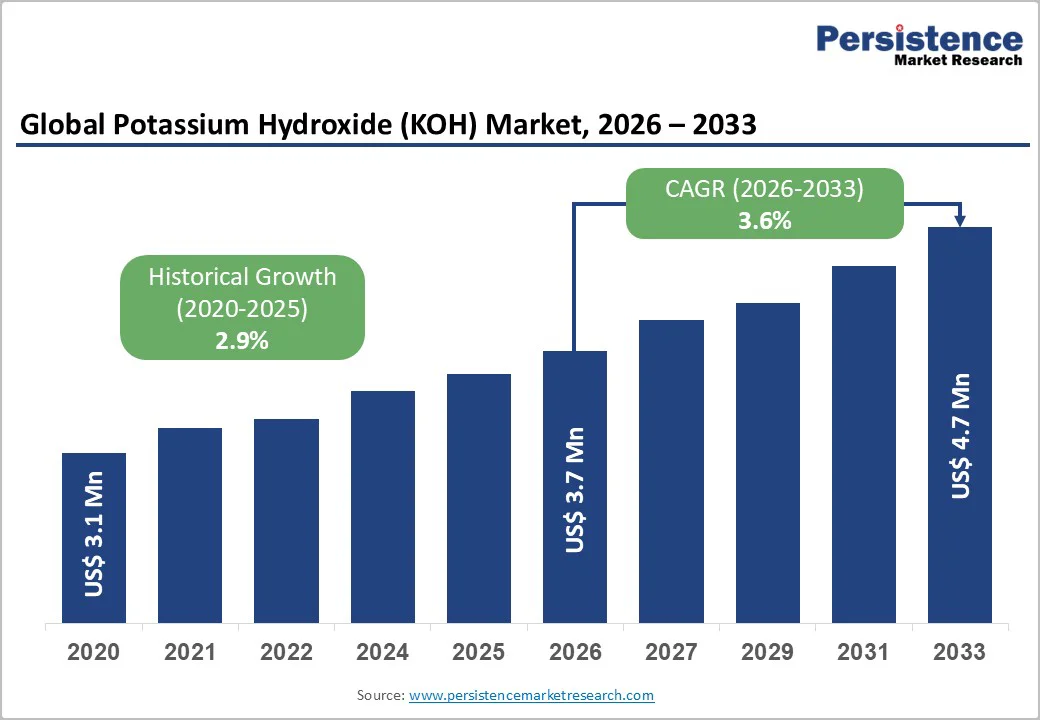
The global potassium hydroxide (KOH) market size is likely to be valued at US$3.7 billion in 2026. It is projected to reach US$4.7 billion by 2033, growing at a CAGR of 3.6% from 2026 to 2033. Expanding demand for KOH in agriculture as a fertilizer input, industrial chemicals for making soaps and detergents, and rising use in high-purity sectors such as pharmaceuticals, electronics, and biofuels are the factors favoring market growth.
Continued industrialization in the Asia Pacific, along with rising environmental and sustainability regulations favoring greener chemistries, underpins steady growth. The trend towards the solid forms, or pellets, and high-purity grades further ensures future gains.
Key Industry Highlights
- Leading Form: Liquid KOH is likely to lead the market in 2026 due to its ease of handling, immediate solubility, and widespread adoption across industries.
- Fastest-growing Form: Solid KOH is set to grow the fastest through 2033, driven by rising demand in fertilizers, food processing, and remote industrial applications.
- Dominant Grade: Industrial-grade KOH is slated to dominate in 2026, owing to its broad applicability in industries.
- Dominant Application: Fertilizer production is projected to be the leading application in 2026, driven by global demand for potassium-based fertilizers.
- Fastest-growing Application: Biodiesel production and green chemical processes are expected to be the fastest-growing applications, aided by the rising adoption of sustainable energy sources.
- Leading Region: Asia Pacific is set to lead in 2026, supported by large-scale KOH production and heavy economic dependence on agriculture.
| Key Insights | Details |
|---|---|
|
Potassium Hydroxide Market Size (2026E) |
US$3.7 Bn |
|
Market Value Forecast (2033F) |
US$4.7 Bn |
|
Projected Growth (CAGR 2026 to 2033) |
3.6 % |
|
Historical Market Growth (CAGR 2020 to 2025) |
2.9 % |
Market Factors - Growth, Barriers, and Opportunity Analysis
Rising Demand from Agriculture and Industrial Applications
Potassium hydroxide serves as a critical raw material in both fertilizer production and industrial consumer products. Fertilizer applications, including potassium-based salts and phosphates, are experiencing a surge in demand driven by rising food security requirements and the adoption of nutrient-efficient farming practices in Asia, Africa, and Latin America. Concurrently, KOH is widely used in the production of soaps, detergents, and cleaning agents, with industrial-grade KOH accounting for around 67.4% of market revenue. These factors establish agriculture and industrial manufacturing as consistent, long-term drivers of KOH consumption.
The global shift toward green chemistry, renewable energy, and specialty industrial applications is creating significant growth opportunities for KOH. Regulatory and environmental mandates are encouraging the adoption of chemicals that are less corrosive and more environmentally compatible. Potassium hydroxide is also being increasingly used in biodiesel production, energy storage technologies, water treatment, and high-purity pharmaceutical and electronic applications, aligning with global carbon reduction initiatives. This convergence of sustainability trends, regulatory compliance, and emerging high-value applications reinforces KOH’s role as a key enabler in eco-efficient and technologically advanced industrial processes.
Environmental Regulations, High Production Costs, and Raw Material Price Fluctuations
The potassium hydroxide market growth faces intensifying structural headwinds driven by regulatory tightening and energy-intensive production dynamics. The chlor-alkali process, which dominates global KOH manufacturing, is inherently energy-intensive, and regulatory mandates toward cleaner membrane-cell technologies are forcing producers to undertake costly capital retrofits and operational restructuring. Simultaneously, stricter environmental regulations across major producing regions are increasing compliance burdens, creating a bifurcated market in which producers with aging infrastructure face existential pressure to invest or exit.
A volatile input cost structure compounds profitability deterioration. Electricity prices and raw material sourcing fluctuate unpredictably, directly translating to margin compression with limited pricing power in downstream markets. Supply chain fragmentation, particularly for high-purity and solid-form KOH grades, creates logistical bottlenecks that complicate storage, transport, and consistent distribution to end-users. This combination of commodity price volatility, regulatory compliance investments, and fragmented supply networks creates a profitability squeeze, especially acute for mid-sized producers lacking scale economies or geographic diversification to absorb cost shocks.
Widening Adoption in Emerging Markets and High-Purity Industrial Applications
The burgeoning economies of the Asia Pacific, Africa, and Latin America present significant opportunities due to expanding agriculture, rapid industrialization, and increasing consumption of cleaning and personal care products. Asia Pacific alone accounted for about 39.8% of the global KOH revenue in 2025, reflecting a strong baseline demand. As governments focus on improving agricultural productivity and industrial capacity, KOH consumption in these regions could grow by 5–7% annually. At the same time, high-purity KOH grades are seeing rising demand from pharmaceuticals, electronics, and food processing, supported by the growing need for strict quality and safety standards.
Technological improvements in chlor-alkali production, especially the shift to membrane-cell systems, offer major efficiency gains by reducing energy use and lowering operating costs. These advancements help manufacturers improve margins while reducing environmental impact. Beyond production benefits, growing interest in green technologies, such as biofuels, biodegradable chemicals, advanced water treatment, and CO2 capture, creates new high-value application areas for KOH. These emerging uses could expand the market over the next decade, allowing producers to diversify into specialty segments and strengthen their presence in sustainability-focused industries.
Category-wise Analysis
Form Insights
Liquid potassium hydroxide is likely to remain the leading form in 2026, capturing 56.3% of the KOH market revenue share, supported by its widespread use in continuous industrial processes. Its rapid solubility, consistent concentration, and compatibility with automated dosing systems make it ideal for soaps and detergents, biodiesel production, water treatment, and chemical synthesis. Industries prefer liquid KOH because it reduces handling steps, improves operational efficiency, and ensures reliable performance across high-volume production environments.
Pellet-form KOH is projected to grow at a CAGR of 4.3% between 2026 and 2033, driven by its logistical and operational advantages in emerging economies. Pellets offer superior shelf life, low moisture content, and easy transport, making them suitable for remote industrial sites, fertilizer blending, and dry food-processing applications. Their precise dosing capability, reduced contamination risk, and stable storage profile position solid KOH as a preferred option in cost-sensitive and infrastructure-limited regions.
Grade Insights
Industrial-grade is expected to dominate the potassium hydroxide market in 2026, reflecting its essential role across large-volume sectors such as detergents, textiles, water treatment, pulp and paper, and chemical manufacturing. This grade is cost-effective and well-suited for operations where ultra-high purity is not required. Industries favor it because of its availability, stable performance in bulk processing, and compatibility with high-throughput production systems, making it the most widely consumed category.
Food-grade KOH is expected to grow at the fastest rate, registering a CAGR of 4.1% from 2026 to 2033, driven by strict food safety regulations and rising demand for clean-label products. Its use in pH stabilization, fruit and vegetable peeling, chocolate processing, and beverage formulation is rising across global markets. The shift toward higher-quality, contaminant-free inputs in food, pharmaceutical, and electronic applications further strengthens demand for high-purity KOH grades.
Application Insights
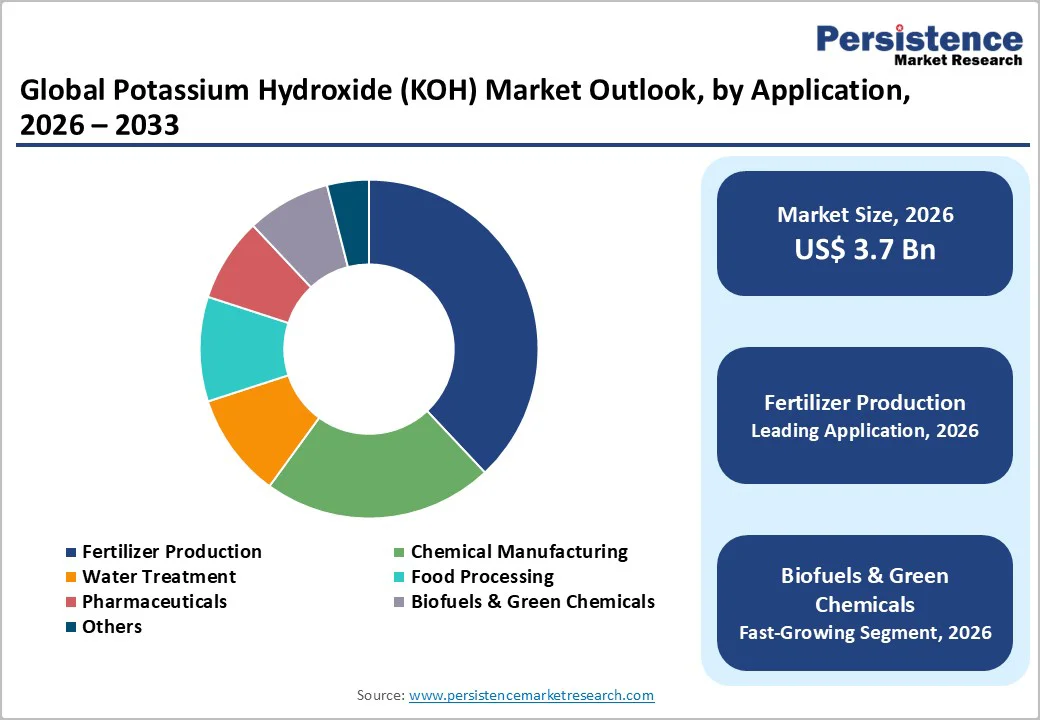
Fertilizer production is anticipated to account for about 34% of the potassium hydroxide market share in 2026. This leadership position is attributable to the urgent need to improve soil nutrient levels and increase agricultural productivity. KOH is a key input for manufacturing potassium-based fertilizers essential for crop growth, especially in regions with depleted or potassium-deficient soils. As food security initiatives expand worldwide, demand remains stable across Asia, Africa, and Latin America, where agriculture continues to underpin national economic activity.
The biodiesel segment is projected to be the fastest-growing, rising at a CAGR of 5.5% from 2026 to 2033. KOH’s role as an efficient catalyst in transesterification supports the global increase in biofuel production. Growing emphasis on renewable energy, low-carbon processes, biodegradable surfactants, and sustainable water treatment solutions is intensifying demand for KOH, enabling strong growth beyond traditional chemical and fertilizer markets.
Regional Insights
North America Potassium Hydroxide (KOH) Market Trends
North America is expected to account for around 23% of the KOH market share in 2026, with the U.S. serving as the primary demand hub. The region is expected to expand at a steady CAGR of around 3.6% through 2033, supported by a well-developed chemical industry and strong application base. Major consumption comes from soaps and detergents, water treatment, personal care, and specialty chemical manufacturing. Although biofuel production is relatively low, it continues to add incremental demand as the region adopts low-emission fuel policies. Robust infrastructure and the need for high-purity grades support stable long-term growth for local producers.
Regulatory initiatives from the U.S. Environmental Protection Agency (EPA) and sustainability programs encourage cleaner production methods, which indirectly increase the use of KOH in renewable chemicals, water treatment, and energy-related applications. The region benefits from efficient logistics that support a reliable supply of both liquid and solid forms. Innovation in batteries, advanced electrolytes, and premium personal care ingredients further strengthens the demand for high-purity potassium hydroxide. With rising focus on recycling, clean manufacturing, and environmentally responsible consumer products, companies with compliant production systems and strong downstream partnerships are positioned to capture emerging opportunities.
Europe Potassium Hydroxide (KOH) Market Trends
Europe is expected to account for 27% of the global market and is likely to be one of the fastest-growing regional market, with a projected CAGR of 4.6% from 2025 to 2033. Growth here is supported by the European Union (EU) Green Deal, stringent environmental regulations, and rising demand for sustainable chemical inputs. Key consuming industries include detergents, pharmaceuticals, personal care, and water treatment, which rely heavily on high-purity KOH. Western Europe, especially Germany, the U.K., France, and Spain, maintains strong industrial demand, while increasing focus on renewable fuels and eco-friendly manufacturing enhances long-term prospects.
The region’s unified regulatory framework, advanced industrial capabilities, and strict quality requirements create favorable conditions for specialized KOH applications. The increasing adoption of biodegradable detergents, green solvents, and cleaner production pathways continues to rise, with potassium hydroxide serving as an essential processing material. Strengthening renewable energy commitments and biodiesel programs further expands its role in low-carbon manufacturing. Europe’s blend of established industries and fast-developin,g sustainability-driven markets positions it as a high-value market. Companies investing in high-purity grades, circular operations, and compliant supply chains are likely to benefit from Europe’s shift toward greener chemical technologies.
Asia Pacific Potassium Hydroxide (KOH) Market Trends
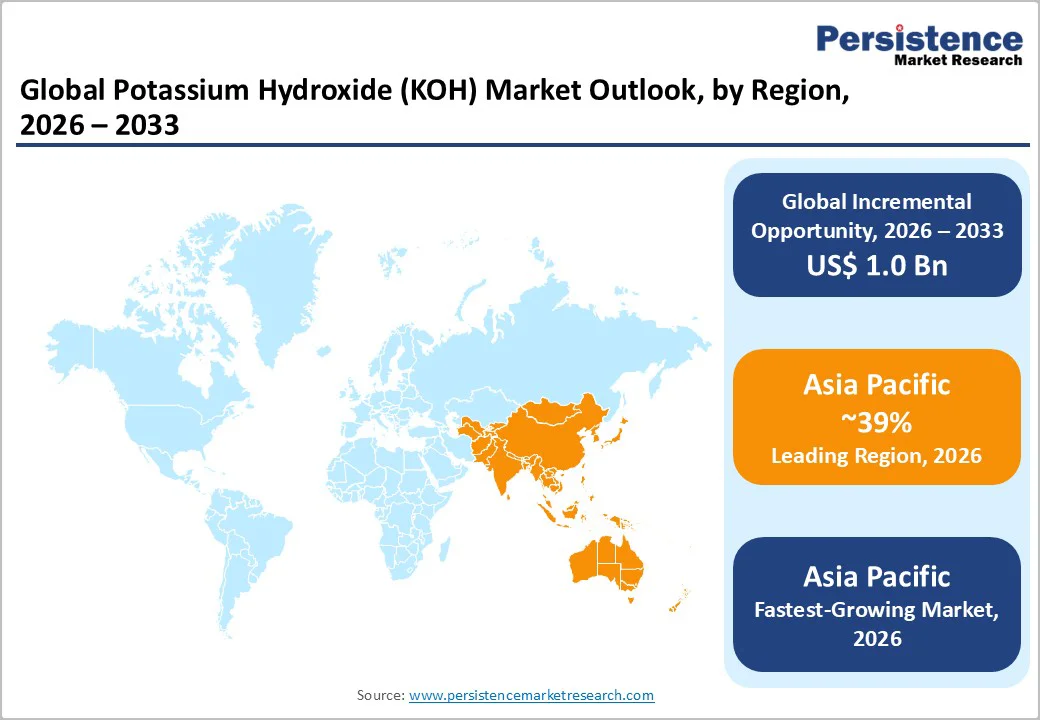
Asia Pacific is projected to dominate the potassium hydroxide market, accounting for an estimated 42% of the market share in 2026, making it the leading producer and consumer. The regional market is expected to grow at a strong CAGR of 5.4% through 2033, driven by industrial expansion, rising population, and agricultural needs. China leads with large chlor-alkali capacity, integrated chemical manufacturing, and extensive use of KOH across fertilizers, detergents, water treatment, and electronics. India and ASEAN nations contribute additional growth as urbanization, chemical production, and government support for agricultural development accelerate regional demand.
Asia Pacific’s cost advantages, reliable raw-material access, and improving infrastructure make it a preferred destination for large-scale production. The demand for KOH here is also bolstered by government policies promoting sustainable industrial practices and renewable energy, further strengthening KOH's role in green manufacturing. Export-oriented production in China and Southeast Asia enhances regional supply capability and global competitiveness. With rapidly expanding domestic consumption and strong export potential, Asia Pacific is expected to remain the most influential region shaping future capacity expansion, pricing trends, and global market dynamics.
Competitive Landscape
The global potassium hydroxide market landscape is dominated by major players such as Olin Corporation, Occidental Chemical (OxyChem), INOVYN, Arkema, Evonik Industries, Formosa Plastics, and Tokuyama Corporation. These companies operate large membrane-cell chlor-alkali facilities that ensure consistent output and stable quality. Their strengths include strong integration across potassium derivatives, efficient energy use, and wide-grade availability. Investments in cleaner technologies and high-purity formulations help them stay competitive in developed markets. Strong distribution networks and long-term partnerships with industrial users further reinforce their leadership.
In Asia Pacific, emerging producers such as Qingdao Huatai, Chengdu Chemical, Shandong Binhai, GACL, and TGV SRAAC are enhancing their production capacity to meet the fast-growing regional demand. These companies benefit from lower operating costs, access to raw materials, and proximity to major agricultural and manufacturing hubs. Several of them are upgrading infrastructure to membrane-cell technology to improve efficiency and meet global compliance norms. Competition is likely to intensify even more as producers focus on cost optimization, purity improvement, and greener production processes.
Key Industry Developments
- In December 2025, Karnalyte Resources' Wynyard Potash-Magnesium Mine Project in Saskatchewan secured a 70-year mine life with CA$ 2.04 billion, leveraging a unique carnallite deposit to produce both potash fertilizer and magnesium hydroxide, with a long-term offtake agreement with India's Gujarat State Fertilizers & Chemicals Ltd.
- In December 2025, University of Toronto researchers developed "evaporative carbonate crystallization," a passive direct air capture (DAC) technique using polypropylene fibers immersed in potassium hydroxide solution that leverages natural wind and evaporation to concentrate the capture liquid and accelerate CO2 reaction rates.
- In February 2025, UNID Co. completed the first phase of its potassium hydroxide plant in Yichang, Hubei Province, China with 90,000 tons annual capacity, and plans a second phase by 2027 to increase total capacity to 500,000 tons. The strategic expansion reduces logistics costs, strengthens market dominance in central and western China, and establishes a stable supply chain for global markets.
Companies Covered in Potassium Hydroxide (KOH) Market
- Olin Corporation
- Occidental Petroleum Corporation (OxyChem)
- BASF SE
- Solvay S.A.
- INEOS KOH Inc.
- Merck KGaA
- American Elements
- Airedale Chemical Company Limited
- Altair Chemical S.r.l.
- Gujarat Alkalies & Chemicals Ltd. (GACL)
- UNID Co., Ltd.
- ERCO Worldwide
Frequently Asked Questions
The global potassium hydroxide market is projected to reach US$ 3.7 billion in 2026.
Key drivers include increasing agricultural and fertilizer demand, expansion of industrial and personal care applications, growing interest in high-purity KOH for pharmaceuticals and electronics, and the global shift toward green and sustainable chemical processes.
The market is poised to witness a CAGR of 3.6% from 2026 to 2033.
Increasing demand for high-purity KOH in pharmaceuticals, electronics, and bio-based chemicals, and growing adoption of greener chlor-alkali production processes are key market opportunities.
Olin Corporation, Occidental Petroleum Corporation (OxyChem), BASF SE, and Solvay S.A. are some of the key players in the market.


