




- Renewable Energy
- Portable Solar Charger Market
Portable Solar Charger Market Size, Share, and Growth Forecast 2026 - 2033
Portable Solar Charger Market by Product Type (Foldable Solar Chargers, Backpack Solar Chargers, Solar Power Banks, Rigid Panel Portable Chargers, Hybrid Portable Solar Chargers), Panel Type (Monocrystalline, Polycrystalline, Thin-Film), Power Output (Below 10W, 10W-50W, 50W-100W, 100W-500W, Above 500W), Battery Capacity (Without Battery Storage, Below 10,000 mAh, 10,000-20,000 mAh, Above 20,000 mAh), Distribution Channel (Online Retail, Offline Retail), and Regional Analysis, 2026 - 2033

Portable Solar Charger Market Size and Trend Analysis
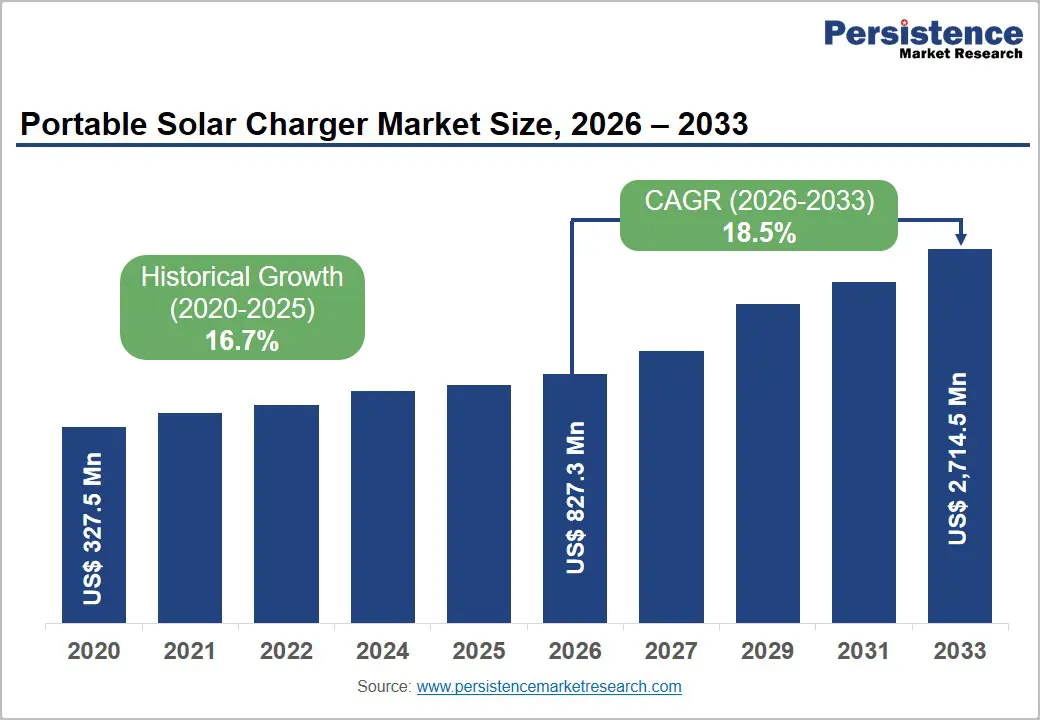
The global portable solar charger market size is expected to be valued at US$ 827.3 million in 2026 and projected to reach US$ 2,714.5 million, growing at a CAGR of 18.5% between 2026 and 2033. This sustained trajectory reflects a convergence of three reinforcing demand forces;
- Mainstreaming of outdoor and adventure lifestyle consumption,
- Accelerating urgency of personal energy resilience in the face of climate-driven grid disruptions
- Dramatic cost reduction of solar panel technology that is progressively making portable solar a mass-market rather than a premium product category.
The International Renewable Energy Agency (IRENA) affirmed that the solar module prices declined by over 90% between 2010 and 2023, directly enabling the consumer-grade price points that have brought portable solar chargers into mainstream retail channels globally.
Key Industry Highlights:
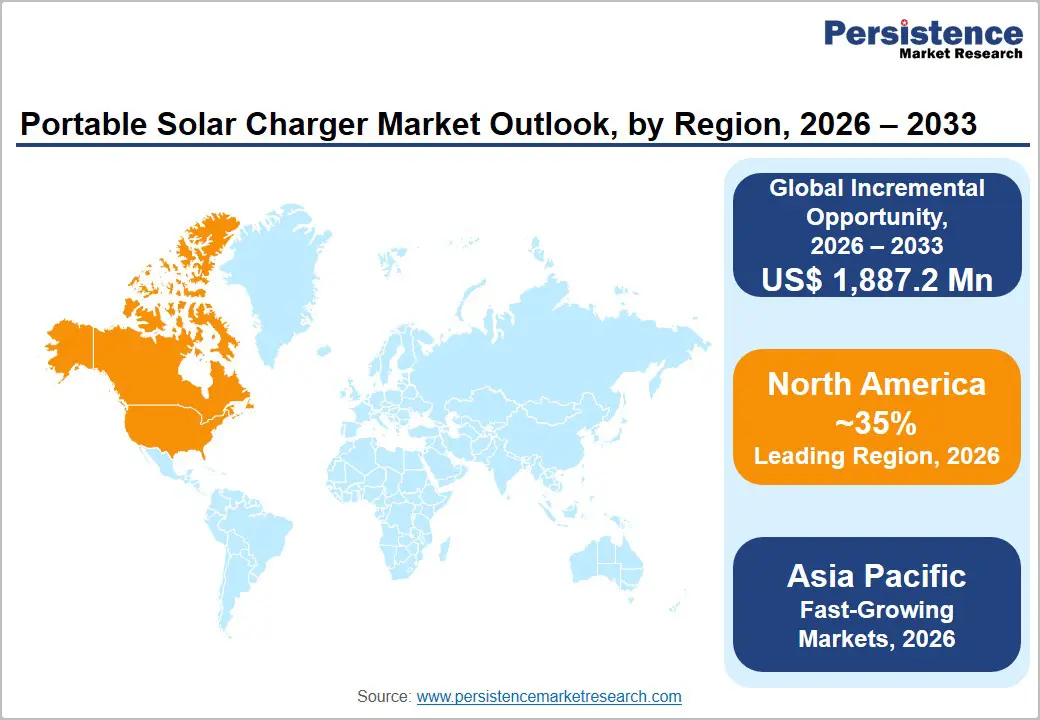
- Leading Region: North America is likely to lead the global portable solar charger market with approximately 35% share in 2026, anchored by the world's highest outdoor recreation participation, FEMA-documented emergency preparedness normalisation, and the most developed e-commerce discovery ecosystem sustaining premium brand ASPs for Goal Zero, Jackery, and EcoFlow at scale.
- Fast-Growing Market: Asia Pacific is the fast-growing regional market at a projected CAGR of approximately 21% driven by India's 200 million+ intermittent-supply households creating genuine off-grid utility demand, China's manufacturing scale enabling aggressive new product launches, and South Korea's technology-forward consumer base sustaining premium portable solar adoption.
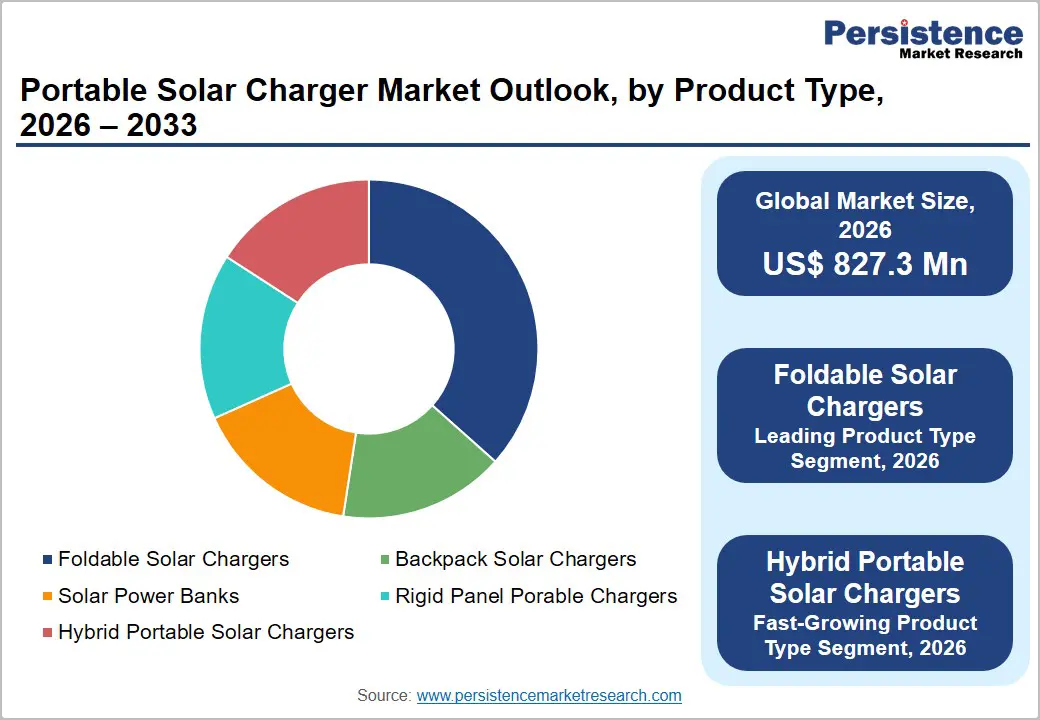
- Dominant Product Type: Foldable solar chargers dominate the product type segment with approximately 32% share in 2026, driven by their optimal portability-to-wattage ratio for outdoor recreation applications and strong affiliate content ecosystems that position multi-panel foldable designs as the canonical premium outdoor charging solution for the category's core consumer demographic.
- Fastest Growing Product Type: Hybrid portable solar chargers are the fastest-growing product type at an estimated CAGR of approximately 22%, driven by consumer demand for integrated solar-plus-storage solutions that deliver whole-home backup capability, a use case amplified by the U.S. DOE's USD 10.5 billion GRIP Program elevating household energy resilience as a mainstream infrastructure priority.
- Key Market Opportunity: The highest-value market opportunity lies in institutional and government emergency preparedness procurement, where FEMA preparedness mandates, OCHA humanitarian deployment standards, and the World Bank's Universal Energy Access program, targeting 675 million electricity-access-deficient people (IEA), are creating structured, certification-gated procurement channels accessible to brands investing in IEC 62133 and IEC 61215 compliance credentials.
Market Dynamics
Drivers - Outdoor Recreation and Emergency Preparedness Spending Creating Durable, Multi-Segment Consumer Pull
Market participants should recognise that portable solar charger demand is no longer confined to adventure enthusiasts, it has become a household resilience purchase driven by documented grid vulnerability and cultural normalisation of off-grid readiness. The U.S. Federal Emergency Management Agency (FEMA) reports that the number of federally declared natural disasters averaging above 70 per year since 2020 has elevated emergency preparedness awareness to mainstream consumer behaviour, with portable solar chargers now prominently featured in government-endorsed disaster supply checklists.
The Outdoor Industry Association (OIA) documented that the outdoor recreation economy contributed USD 862 billion to U.S. GDP in 2021, and camping equipment, the primary category that co-purchases with portable solar chargers, grew at above-average retail rates through 2022-2024. This dual demand from outdoor recreation and emergency preparedness creates a resilient, non-cyclical purchase rationale that sustains market momentum even during consumer spending contractions in other discretionary categories.
Solar Module Cost Deflation and Energy Density Improvements Unlocking Mass-Market Adoption
The structural decline in solar photovoltaic costs is the single most powerful enabler of portable solar charger market expansion, translating laboratory efficiency gains into affordable consumer products at accelerating velocity. IRENA's Renewable Power Generation Costs 2023 report confirmed that utility-scale solar module costs fell to below USD 0.20 per watt in 2023, a cost trajectory that directly benefits portable consumer solar because component costs represent the primary cost of goods for charger manufacturers.
The adoption of monocrystalline PERC (Passivated Emitter and Rear Cell) technology in consumer-grade panels, delivering 20-23% cell efficiency versus 15-17% for standard polycrystalline, is enabling manufacturers to deliver higher wattage output in lighter, more compact form factors that address the portability-performance tension that historically limited mass-market appeal. For manufacturers, this cost and performance trajectory signals that the strategic window to capture mainstream retail positioning is now, before market structure consolidates around a handful of scaled, low-cost producers.
Restraints - Real-World Performance Gap Between Rated and Delivered Output Suppressing Repeat Purchase Intent
One of the biggest restraints in the portable solar charger market is the gap between advertised charging performance and actual real-world output. Manufacturers typically rate products under Standard Test Conditions, but consumers rarely experience such ideal environments during outdoor use. Factors such as cloud cover, panel angle, dust, heat, and partial shading significantly reduce charging efficiency, often lowering real output by 25-40%.
As a result, users frequently encounter slower charging times than expected, leading to dissatisfaction and negative reviews. This weakens consumer trust, reduces repeat purchases, and increases the marketing and customer education burden for manufacturers across the industry.
Commoditisation and Low-Cost Import Pressure Compressing Margins Across the Value Tier
Rising competition from low-cost manufacturers, particularly from China’s major electronics manufacturing hubs, is creating severe pricing pressure in the portable solar charger market. Entry-level products are increasingly available at very low prices, especially through e-commerce marketplaces, making it difficult for mid-tier brands to maintain profitability. Companies that cannot match low manufacturing costs are forced to either accept shrinking margins or move toward premium product positioning with advanced features and stronger branding.
However, building premium brand recognition requires continuous investment in marketing and distribution, which places additional financial strain on emerging players and limits long-term profitability within the mass-market segment.
Market Opportunities
Hybrid Solar-Battery Power Stations as the Category's Fastest-Growing and Highest-Value Innovation Frontier
The convergence of portable solar charging and integrated battery storage systems is creating the fastest-growing and highest-value opportunity in the portable solar charger market. Products such as the EcoFlow RIVER 2 Pro and Jackery Explorer series are transforming portable solar from a simple device-charging accessory into a broader home backup and mobile energy solution capable of powering appliances, communication systems, and outdoor equipment.
The U.S. Department of Energy identified residential energy resilience as a national infrastructure priority under its Grid Resilience and Innovation Partnerships Program, allocating nearly USD 10.5 billion toward grid resilience funding. This growing awareness of off-grid power reliability is increasing consumer willingness to invest in hybrid portable energy systems. Manufacturers investing in proprietary battery management systems, bidirectional inverter technology, and app-connected energy management platforms are expected to build stronger customer retention and create higher switching costs that protect margins from low-cost competition.
Disaster Resilience Policy and Grid-Edge Electrification: Creating Institutional and Government Procurement Channels
The increasing institutional adoption of portable solar chargers for emergency response and humanitarian relief is creating a significant long-term procurement opportunity for manufacturers. Organizations such as the United Nations Office for the Coordination of Humanitarian Affairs and its operational partners have increasingly standardized portable solar charging systems within disaster response kits used in Ukraine during 2022-2024, Libya in 2023, and the Turkey-Syria earthquake response in 2023.
In addition, the World Bank’s Universal Energy Access program and the International Energy Agency’s World Energy Outlook 2023 highlighted that nearly 675 million people globally still lack electricity access, positioning portable solar as a critical bridge technology for off-grid electrification. Companies achieving IEC 62133 battery safety certification and IEC 61215 solar panel quality certification are expected to gain qualification advantages in institutional tenders and development-finance-backed procurement programs.
Category-wise Analysis
Product Type Insights
Foldable solar chargers are likely to account for approximately 32% of the portable solar charger market in 2026, making them the leading product type segment. Their dominance is driven by the strong balance between portability, charging efficiency, and ease of outdoor use. Most foldable chargers provide 20-40W charging capability while weighing below 500 grams, allowing users to carry them easily during camping, hiking, trekking, and travel activities.
Major brands such as Goal Zero, BigBlue, and Renogy have strengthened consumer awareness through outdoor retail partnerships and digital marketing campaigns. The segment also benefits from rising recreational tourism and emergency preparedness demand, where compact and lightweight charging solutions remain highly preferred by consumers.
Panel Type Insights
Monocrystalline panels hold nearly 54% of the portable solar charger market by panel type in 2026 due to their superior energy conversion efficiency and compact design advantages. Modern monocrystalline PERC panels deliver conversion efficiencies of around 20-23%, significantly higher than many alternative panel technologies. This efficiency advantage enables faster charging speeds and smaller product footprints, which are critical purchasing factors for portable charging applications.
Falling manufacturing costs have also reduced the historical price gap between monocrystalline and other panel technologies, accelerating adoption across both premium and mid-range products. Consumer preference for lightweight, space-efficient chargers continues to strengthen demand for monocrystalline-based portable solar charging systems globally.
Power Output Insights
The 10W-50W power output category leads the portable solar charger market with approximately 43% share in 2026. This range offers the most practical balance between charging performance, portability, and affordability for mainstream consumers. Chargers within this category can efficiently power smartphones, tablets, cameras, portable speakers, and even selected USB-C laptops under favorable solar conditions. The segment benefits from the enormous global installed base of mobile electronic devices, with worldwide smartphone users reached nearly 7 billion in 2025. Popular products such as the Anker 21W, Goal Zero Nomad 20, and Renogy 40W continue to dominate online sales rankings, reinforcing strong consumer familiarity and sustained demand.
Battery Capacity Insights
The 10,000-20,000 mAh battery capacity segment holds nearly 38% of the portable solar charger market in 2026, supported by its suitability for short-term outdoor and emergency backup applications. This capacity range allows users to charge smartphones multiple times and operate tablets or smaller devices during camping trips, travel, or temporary power outages.
Products within this segment have gained significant traction due to their manageable size, reasonable weight, and attractive price range of approximately USD 150-250. Brands such as Jackery and BLUETTI have strengthened this category through strong e-commerce visibility, retail expansion, and extensive content marketing, helping establish consumer confidence in mid-capacity portable solar power solutions.
Distribution Channel Insights
Online retail is likely to account for approximately 68% market share in 2026. This aligns with digital purchasing behavior as consumers typically conduct extensive online research before purchasing portable energy products. Buyers frequently compare product specifications, wattage ratings, charging efficiency, and user reviews across platforms such as Amazon, REI.com, and brand-owned websites.
Online channels also provide access to a significantly wider product portfolio than physical retail stores, where shelf space limitations restrict SKU availability. Leading companies including Jackery, EcoFlow, and BLUETTI generate an estimated 60-70% of their direct sales through online platforms, reinforcing the industry’s digital-first commercial strategy.
Regional Insights
North America Portable Solar Charger Market Trends and Insights
North America leads the global portable solar charger market, accounting for approximately 35% of global market share in 2026, driven by the world's highest outdoor recreation participation rates, deeply embedded emergency preparedness culture shaped by recurring climate-driven grid outages, and one of the most developed e-commerce retail ecosystems globally.
The region's consumer base combines high average order values with strong brand loyalty, supporting premium product positioning by brands such as Goal Zero and Jackery. North America is poised to consolidate its leadership as IRA-incentivised residential energy resilience investment normalises solar-adjacent household purchases, creating an expanding household cross-sell pathway from utility-scale solar installation into portable solar accessories.
U.S. Portable Solar Charger Market Size
The United States accounts for approximately 88% of North American market revenues, contributing an estimated US$ 219 million in 2026 at an approximate CAGR of 18%. U.S. demand is anchored by the intersection of 3 million+ annual camping participants (KOA North American Camping Report), a hurricane and wildfire-exposed population increasingly investing in personal power resilience, and the strongest affiliate content ecosystem for outdoor gear globally, driving above-average discovery and conversion rates for portable solar products. The IRA's expanded household energy incentives are expected to structurally increase awareness of portable solar as an adjacent resilience category through 2033.
Europe Portable Solar Charger Market Trends and Insights
Europe is poised to register approximately 22% of global portable solar charger market share in 2026, shaped by a distinctive combination of strong sustainability values, high outdoor recreation participation, and an increasingly fragmented grid reliability narrative following the 2021-2023 European energy crisis that elevated household energy security awareness to mainstream political discourse. The European Environment Agency (EEA) and national governments across Germany, the Netherlands, and Scandinavia are actively promoting renewable energy self-sufficiency at the household level, creating a policy climate highly favourable to portable solar adoption. Europe is positioned for sustained double-digit growth as its younger demographic cohorts, who combine high outdoor recreation participation with strong climate consciousness, increasingly invest in solar-integrated personal power equipment.
Germany Portable Solar Charger Market Size
Germany is likely to contribute approximately 20% of European portable solar charger revenues in 2026. Germany's market is structurally supported by Europe's highest per-capita outdoor recreation investment, the country's deep-rooted Energiewende sustainability culture that actively dispositions consumers toward solar-adjacent products, and a mature e-commerce infrastructure through Amazon.de and Otto that facilitates premium product discovery. Germany's trajectory as Europe's leading portable solar market is expected to accelerate as grid-edge energy resilience becomes a consumer household planning priority.
U.K. Portable Solar Charger Market Size
The United Kingdom accounts for approximately 22% of European portable solar charger revenues in 2025, contributing an estimated US$ 34 million at an approximate CAGR of 18% through 2033. The U.K. market benefits from an exceptionally strong outdoor and adventure travel culture. The Association of Outdoors estimates over 22 million UK adults participate in outdoor recreation annually, creating a large addressable consumer base with established gear investment habits.
The UK Energy Security Strategy 2022 has elevated household energy resilience awareness, and growing consumer willingness to invest in portable power solutions positions the U.K. among Europe's highest-growth portable solar markets through 2033.
France Portable Solar Charger Market Size
France is expected to account for 16% of European portable solar charger market revenues in 2026. French consumer demand is driven by strong participation in hiking, cycling, and outdoor adventure tourism, the Fédération Française de la Randonnée Pédestre counts over 3 million registered members, and rising awareness of clean energy alternatives amplified by the government's France Relance decarbonisation program. As French consumers increasingly prioritise sustainable product credentials, the portable solar charger category is well-positioned to benefit from a brand narrative alignment with national clean energy transition objectives.
Asia Pacific Portable Solar Charger Market Trends and Insights
Asia Pacific holds approximately 30% of global portable solar charger market in 2025 and is the fastest-growing regional market, projected at a CAGR of approximately 21% driven by China's manufacturing scale advantage, India's rapidly expanding middle class, and the region's structural electricity access deficit that creates genuine off-grid utility demand beyond recreational applications. China represents the dominant regional force, both as the world's largest consumer electronics market and the primary manufacturing base for global portable solar components, with Chinese domestic brands including ALLPOWERS and X-DRAGON capturing significant share alongside international brands in online retail. For companies seeking to scale globally, Asia Pacific is the unavoidable manufacturing and increasingly significant consumer geography through the forecast horizon.
India Portable Solar Charger Market Size
India is likely to contribute approximately 18% of Asia Pacific portable solar charger revenues in 2026, and is the fastest-growing market at an approximate CAGR of 24%. India's growth is anchored in the country's 200 million+ households still experiencing intermittent grid supply, creating genuine utilitarian demand for portable solar charging beyond recreational use. The government's PM-KUSUM and PRADHAN MANTRI SURYA GHAR rooftop solar programs are normalising solar energy at the household level, accelerating consumer readiness for portable solar products that offer comparable energy independence at lower entry cost.
Japan Portable Solar Charger Market Size
Japan accounts for approximately 22% of Asia Pacific portable solar charger revenues in 2026 at an approximate CAGR of 18.5% through 2033. Japan's market is structurally unique: post-2011 Tohoku disaster preparedness culture has embedded emergency power equipment as a standard household purchase, with portable solar chargers increasingly recommended alongside traditional emergency power banks in government disaster preparedness guidelines. Japan's outdoor gear market, supported by a dedicated culture of mountain hiking, cycling, and camping with high average equipment spend, further sustains premium product demand that global brands including Goal Zero and domestic retailers increasingly serve.
South Korea Portable Solar Charger Market Size
South Korea contributes approximately 15% of Asia Pacific portable solar charger revenues in 2026. South Korea's technology-forward consumer culture and exceptionally high smartphone penetration, among the world's highest at 97%, create an ideal demand environment for feature-rich portable solar chargers that integrate with premium mobile devices. The government's Korean Green New Deal and national renewable energy targets are building a favourable policy backdrop, with South Korean consumers among the most receptive globally to solar-branded consumer electronics from both domestic and international suppliers.
Competitive Landscape
The portable solar charger market is characterized by a dual-tier competitive structure where premium brands compete through technological differentiation while mass-market participants focus on manufacturing scale and aggressive pricing strategies. Premium-market companies are increasingly investing in integrated energy ecosystems that combine portable solar panels, battery storage systems, smart energy management applications, and bidirectional inverter technologies to create long-term customer lock-in and justify higher average selling prices. In contrast, value-tier manufacturers emphasize cost efficiency, high-volume online sales, and marketplace visibility to capture price-sensitive consumers.
The market is also witnessing growing investment in product durability, lightweight panel materials, faster charging capability, and compact foldable designs to strengthen competitive positioning. E-commerce optimization, direct-to-consumer business models, and strategic partnerships with outdoor recreation and emergency preparedness retailers remain key go-to-market strategies shaping market competition globally.
Key Developments:
- May 2026, Solly launched a 20,000 mAh solar power bank with integrated solar panels, multiple USB ports, international socket compatibility, and up to 300W output, targeting travelers, remote workers, and emergency backup users seeking portable off-grid charging solutions.
- June 2025, Anker launched the SOLIX F3000 portable power station featuring 3.1 kWh battery capacity, 3.6 kW output, dual solar inputs, EV charging compatibility, and expandable storage up to 12.3 kWh for home backup applications.
- June 2024, GoSun introduced a portable rooftop solar EV charger featuring 1,100W solar output, integrated battery storage, and up to 20 miles of solar-powered driving range per day, targeting off-grid mobility and sustainable transportation applications.
Companies Covered in Portable Solar Charger Market
- Goal Zero
- Jackery Inc.
- EcoFlow Technology Inc.
- Anker Innovations Limited
- BLUETTI Power Inc.
- BioLite Inc.
- Renogy
- BigBlue
- Powertraveller
- SunJack LLC
- Voltaic Systems
- ALLPOWERS
- X-DRAGON
- FlexSolar
- RAVPower
- Nekteck
- Blavor Technology
Frequently Asked Questions
The global Portable Solar Charger market is valued at US$ 827.3 million in 2026 and is projected to reach US$ 2,714.5 million by 2033, growing at a CAGR of 18.5%.
Surge in outdoor recreation activities, emergency preparedness spending among consumers, and more than 90% decline in solar module prices since 2010.
North America leads the market with approximately 35% share in 2026 due to strong outdoor recreation participation and growing emergency backup power demand.
Institutional procurement for disaster response, humanitarian aid, and rural electrification programs represents the largest near-term market opportunity.
Major companies include Goal Zero, Jackery, EcoFlow, Anker, BLUETTI, and Renogy.


