




- Medical Devices
- Pediatric Wheelchair Market
Pediatric Wheelchair Market Size, Share, Growth, and Regional Forecast, 2026 to 2033
Pediatric Wheelchair Market by Type (Manual, Powered, and Specialized), Mobility (Basic, Complex), Distribution Channel (Direct Sales, Medical Equipment Retailers, Online Retailers, and Hospitals and Clinics), by Regional Analysis, from 2026 to 2033.

Pediatric Wheelchair Market Share and Trends Analysis
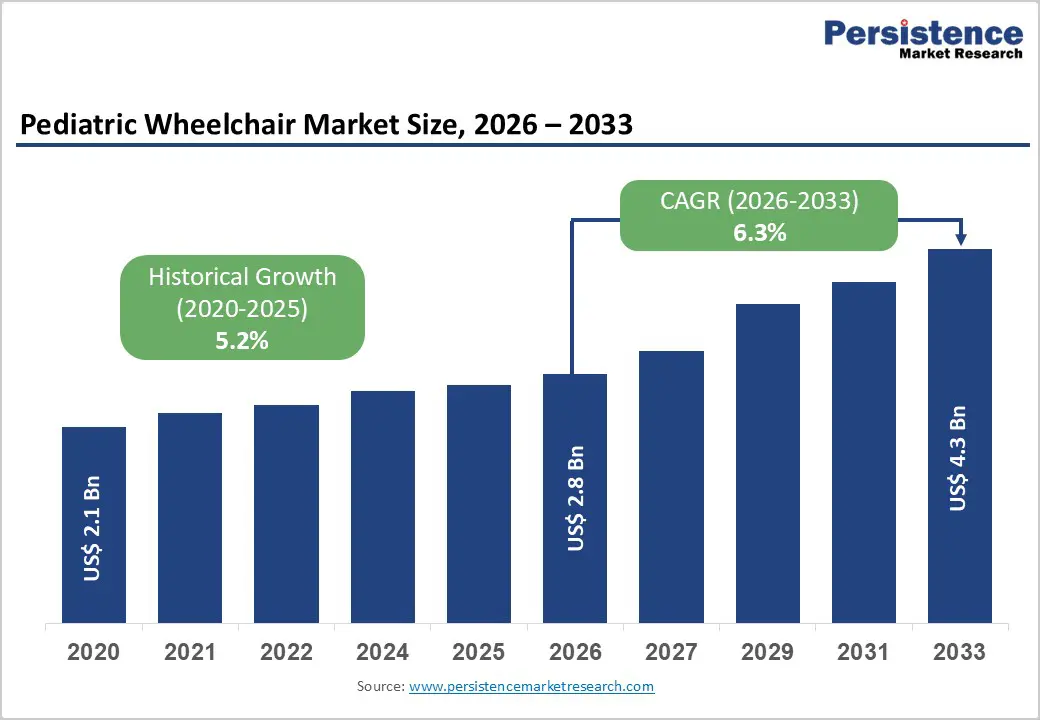
The global pediatric wheelchair market size is expected to be valued at US$ 2.8 billion in 2026 and projected to reach US$ 4.3 billion by 2033, growing at a CAGR of 6.3% between 2026 and 2033. The market focuses on mobility solutions designed to meet the physical, developmental, and comfort needs of children with mobility impairments. These wheelchairs support daily activities, rehabilitation, and long-term care across hospitals, rehabilitation centers, schools, and homecare settings. Growing awareness of early mobility intervention and inclusive healthcare is strengthening demand worldwide.
Key trends include rising adoption of lightweight and ergonomic designs, increasing demand for powered and customized wheelchairs, and integration of smart features such as posture support and monitoring systems. Expanding healthcare access in emerging economies and supportive reimbursement policies are further accelerating market growth.
Key Industry Highlights
- The trend toward increased customization in pediatric wheelchairs is transforming the market by placing a strong emphasis on tailoring products.
- The development and integration of smart technology and assistive devices present a key opportunity for the market players.
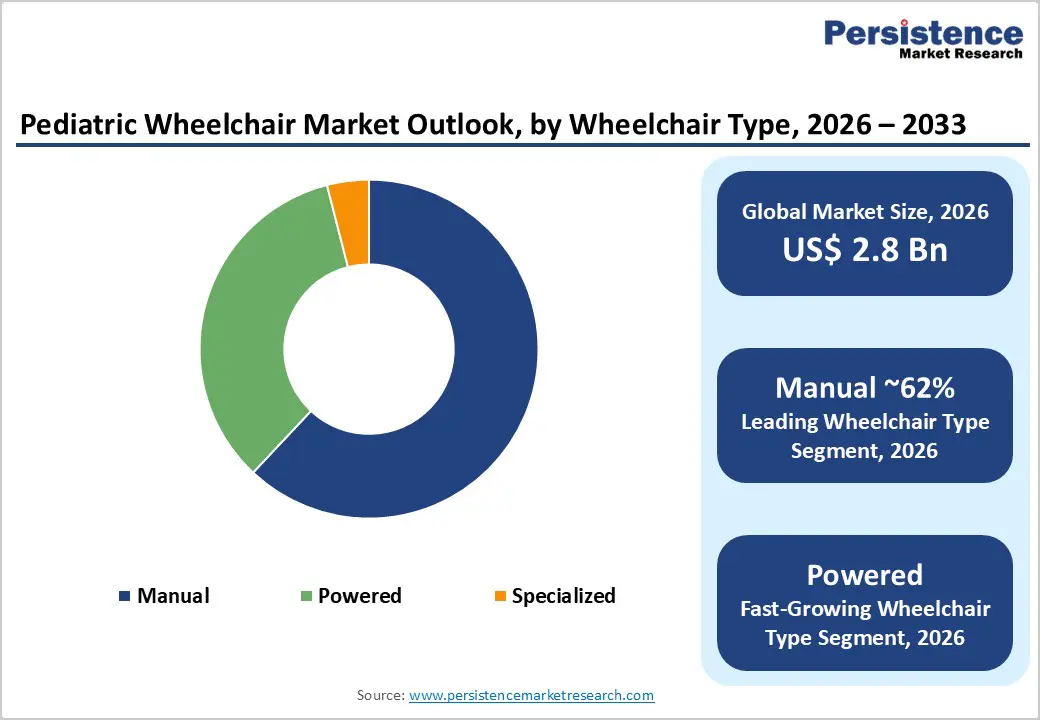
- Based on type, manual wheelchair segment to account for the significant share in the market.
- An increasing number of children with disabilities or mobility impairments drives demand for specialized wheelchairs tailored to their unique need.
| Key Insights | Details |
|---|---|
| Pediatric Wheelchair Market Size (2026E) | US$ 2.8 Bn |
| Market Value Forecast (2033F) | US$ 4.3 Bn |
| Projected Growth (CAGR 2026 to 2033) | 6.3% |
| Historical Market Growth (CAGR 2020 to 2024) | 5.2% |
Market Dynamics
Driver – Rising Awareness of Pediatric Disabilities
The rising awareness of pediatric disabilities plays a pivotal role in driving the demand for specialized wheelchairs tailored to the unique needs of children facing mobility challenges. Over recent years, there has been a significant increase in public and medical community awareness about various pediatric disabilities such as cerebral palsy, muscular dystrophy, and spinal cord injuries.
Rising awareness of pediatric disabilities drives the market by increasing demand for specialized mobility solutions and advocating for improved accessibility. As awareness grows, more families and healthcare providers recognize the critical need for tailored wheelchairs that cater to the unique needs of children with disabilities.
Heightened understanding leads to greater advocacy and support for better-designed, more functional wheelchairs. Additionally, increased awareness prompts more funding and resources from both public and private sectors, enhancing the availability and development of innovative wheelchair solutions
Increasing Prevalence of Pediatric Disabilities
The increasing prevalence of pediatric disabilities is significantly influencing the demand for specialized mobility solutions including wheelchairs designed to meet the unique needs of affected children. Conditions such as cerebral palsy, muscular dystrophy, and spinal cord injuries are becoming increasingly recognized due to advances in medical diagnostics and improved reporting.
Conditions often present significant challenges in terms of mobility and daily functioning, Cerebral palsy, for instance, affect muscle coordination and movement leading to a high demand for wheelchairs that offer both postural support and manoeuvrability.
Muscular dystrophy leads to progressive muscle weakness requiring wheelchairs that can be adjusted to accommodate changing physical conditions and provide comfort during extended use. Spinal cord injuries, often resulting from trauma or congenital issues, demand highly customizable wheelchairs to support proper alignment and prevent complications such as pressure sores.
Restraints – High Cost of Advanced Models
The high cost of advanced and customizable pediatric wheelchairs represents a substantial barrier to accessibility particularly in regions with limited healthcare funding. This factor remains a key factor restraining the pediatric wheelchair market.
Pediatric wheelchairs equipped with cutting-edge technology, such as sophisticated power-assist features, specialized seating systems designed to meet the specific needs of young users. This high cost can be prohibitive for many families and healthcare systems.
The financial burden is compounded by the fact that insurance coverage for these advanced models can be inconsistent leaving families to bear a significant portion of the expense out-of-pocket. This economic challenge can lead to delays in obtaining necessary mobility aids, potentially affecting the quality of life and developmental opportunities for children with disabilities.
Increased investment in affordable solutions and subsidies that can help bridge the cost gap is needed to mitigate this issue. Additionally, efforts to streamline regulatory processes and encourage insurance companies to offer better coverage for high-end pediatric wheelchairs could alleviate some of the financial pressures.
Durability and Maintenance Concerns
Durability and maintenance concerns play a crucial role in the long-term adoption and effective use of pediatric wheelchairs, impacting both user satisfaction and healthcare costs. Pediatric wheelchairs especially those designed for active children are subjected to significant wear and tear making durability a critical factor.
High-quality materials and robust construction are essential to withstand daily use and varying environmental conditions. However, advanced models with intricate designs and high-tech components may face challenges in maintaining their structural integrity over time potentially leading to increased repair needs or premature replacements.
The complexity of some modern wheelchairs can complicate maintenance procedures. Specialized components and advanced features often require regular upkeep by skilled technicians, which may not be readily available in all regions.
Families and caregivers might find it challenging to perform routine maintenance or repairs, particularly if they lack the technical expertise or access to professional support. This can result in extended periods without proper mobility aids, affecting the child’s overall quality of life and hindering their ability to engage in daily activities.
Opportunity – Integration with Smart Technologies
Integration with smart technologies in pediatric wheelchairs presents a transformative opportunity to enhance mobility and health management for children with physical disabilities. By incorporating the Internet of Things (IoT) and smart technology, these wheelchairs can evolve beyond traditional mobility aids to become sophisticated health management tools. For instance, integrating sensors and IoT devices enables real-time monitoring of crucial health metrics, such as posture, pressure distribution, and movement patterns. This data can be continuously analyzed to prevent pressure sores, adjust seating positions, and provide alerts to caregivers or healthcare providers if any issues arise.
Smart technologies can facilitate a personalized user experience. Advanced control systems can adapt to a child’s specific physical abilities and preferences, making it easy to operate and maneuver the wheelchair. Features such as voice controls or adaptive interfaces can further enhance usability, accommodating children with varying levels of motor function.
Category-wise Analysis
By Product Type Insights
The manual wheelchair segment is projected to account for a significant share of the pediatric wheelchair market due to several compelling factors that underline its enduring popularity and practical advantages. Manual wheelchairs offer a cost-effective solution compared to their powered counterparts, making them a more accessible option for many families and healthcare systems.
The affordability of manual wheelchairs aligns with budget constraints often faced by parents and medical providers, especially in regions with limited resources. Another key factor is the simplicity and reliability of manual wheelchairs. These devices require less maintenance and are less prone to technical issues compared to powered models. Their mechanical design eliminates concerns about battery life and electrical malfunctions, offering a dependable option for everyday use.
Manual wheelchairs provide a level of physical activity that can be beneficial for children. Pushing a manual wheelchair encourages upper body strength and can contribute to physical therapy goals, which is particularly advantageous in pediatric care.
By Distribution Channel Insights
The direct sales distribution channel holds a significant share in the pediatric wheelchair market. It is due to several compelling factors including catering to both the specific needs of the consumers and the unique characteristics of the products.
Personalized service is a critical advantage of direct sales. Pediatric wheelchairs often require customization to meet the specific needs of individual children such as adjustments for growth, medical conditions, and personal preferences. Direct sales channels allow for better control over product quality and support. Manufacturers and specialized dealers can ensure that the wheelchairs meet high standards of quality and safety.
Regional Insights
North America Pediatric Wheelchair Market Trends
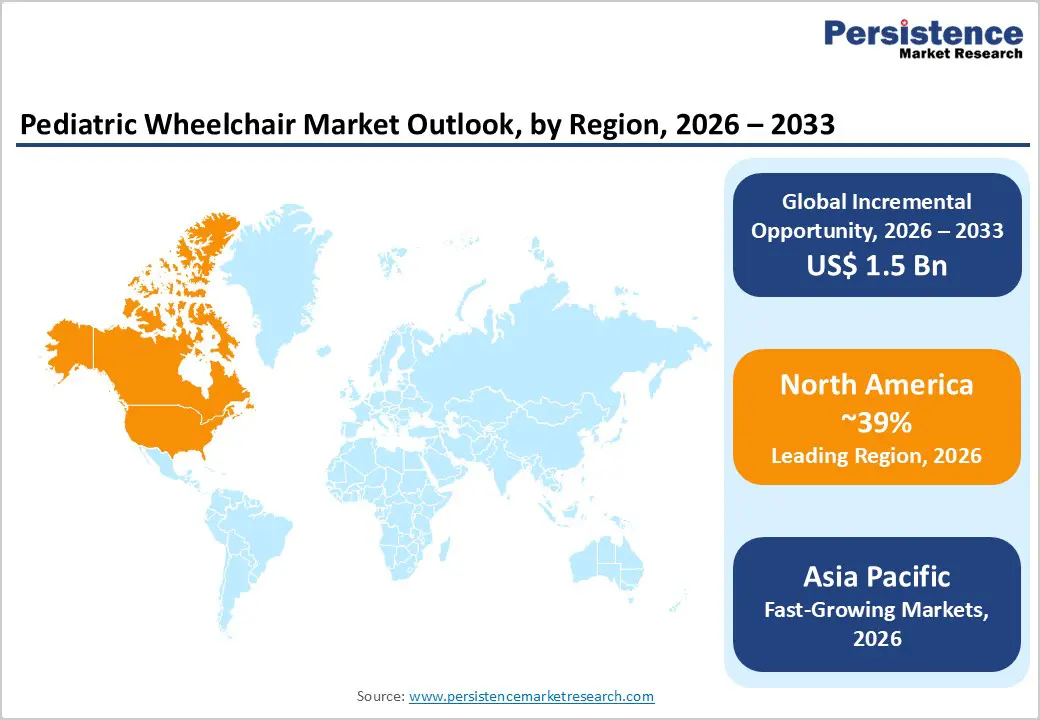
North America is expected to account for a substantial share of the pediatric wheelchair market, supported by a well-developed healthcare ecosystem and strong reimbursement structures. The region benefits from advanced medical facilities, early diagnosis of pediatric mobility disorders, and widespread availability of rehabilitation services. These factors enable timely prescription and adoption of pediatric wheelchairs across hospitals, specialty clinics, and homecare settings. Government initiatives supporting children with disabilities and inclusive education policies further encourage wheelchair adoption.
Technological innovation is another key strength of the North American market. Manufacturers in the U.S. and Canada actively introduce powered and specialized pediatric wheelchairs with smart controls, lightweight materials, and ergonomic designs tailored for children. High awareness among caregivers, coupled with insurance coverage for assistive devices, improves affordability and access. Additionally, the presence of leading manufacturers and continuous product customization to meet clinical needs positions North America as a mature yet innovation-driven market for pediatric wheelchairs.
Europe Pediatric Wheelchair Market Trends
Europe represents a significant market for pediatric wheelchairs, driven by strong public healthcare systems and supportive social welfare policies. Many European countries provide government-funded or reimbursed mobility aids for children with physical disabilities, improving access across income groups. Early intervention programs and growing emphasis on pediatric rehabilitation services contribute to steady demand for manual, powered, and specialized wheelchairs throughout the region.
Innovation and quality standards play a central role in Europe’s market dynamics. Strict regulatory oversight ensures high product safety and performance, encouraging the adoption of advanced pediatric wheelchair designs. Countries such as Germany, the U.K., and France lead in clinical research and assistive technology development, focusing on comfort, posture support, and long-term usability. Rising awareness of inclusive mobility, along with increasing collaboration between healthcare providers and manufacturers, continues to strengthen Europe’s position in the pediatric wheelchair market.
Asia Pacific Pediatric Wheelchair Market Trends
Asia Pacific is poised to exhibit a notable CAGR of 9.0% in the market due to a combination of demographic, economic, and healthcare factors. The region's burgeoning population, particularly its growing number of children with special needs, creates a substantial demand for pediatric wheelchairs.
As economies in countries like China, India, and Southeast Asian nations continue to develop, there is an increased focus on improving healthcare infrastructure and access to medical equipment, including specialized wheelchairs. Economic growth in Asia Pacific has led to high disposable incomes and expanding middle-class populations, which enhances the ability of families and healthcare systems to invest in advanced and customized pediatric wheelchairs.
Government initiatives and healthcare policies aimed at supporting people with disabilities are improving access to necessary medical equipment and services. This policy shift is supported by rising awareness about disability rights and the importance of mobility aids in enhancing the quality of life for children with physical disabilities.
Competitive Landscape
Collaborations and partnerships to develop innovative products and accelerate their launch across nations are the key growth strategies followed by the key players in the market. Companies are continuously investing in research and development to introduce innovative and novel interference blockers.
Strategic partnerships with healthcare providers, rehabilitation centers, and research institutions are common. These collaborations can lead to the development of advanced products and expand market reach. The market includes companies that are leveraging advanced technologies, such as smart wheelchairs with integrated sensors and connectivity features. These innovators are often smaller or emerging companies that focus on integrating cutting-edge technology into mobility solutions.
Key Industry Developments:
- In September 2022, Sunrise Medical has unveiled two new wheelchair models: the Zippie Q300 M Mini and the Quickie Q200 R. The Zippie Q300 M Mini, specifically designed for children, provides a compact and highly maneuverable option suitable for both indoor and outdoor environments.
Companies Covered in Pediatric Wheelchair Market
- MEYRA GmbH
- Sunrise Medical
- SORG Rollstuhltechnik GmbH
- Invacare
- Momentum Healthcare
- MEYRA GmbH
- Sunrise Medical
- SORG Rollstuhltechnik GmbH
- Invacare
- Momentum Healthcare
Frequently Asked Questions
The global pediatric wheelchair market is projected to be valued at US$ 2.8 Bn in 2026.
Rising pediatric disabilities, improved diagnosis, supportive reimbursement policies, technological advancements, and growing awareness of mobility and inclusive care.
The global market is expected to witness a CAGR of 6.3% between 2026 and 2033.
Smart wheelchairs, lightweight customized designs, emerging markets expansion, homecare adoption, and partnerships with pediatric hospitals and rehabilitation centers.
North America is the leading region in the global pediatric wheelchair market.


