




- Home Appliances
- Noodle Making Machine Market
Noodle Making Machine Market Size, Share, Trends, Growth, Regional Forecasts, 2026 - 2033
Noodle Making Machine Market by Machine Type (Fully Automatic, Semi-Automatic, Manual), Noodle Type (Fresh, Instant, Specialty), Application (Home, Restaurant, Food Processing Plants), and Regional Analysis for 2026 - 2033

Noodle Making Machine Market Share and Trends Analysis
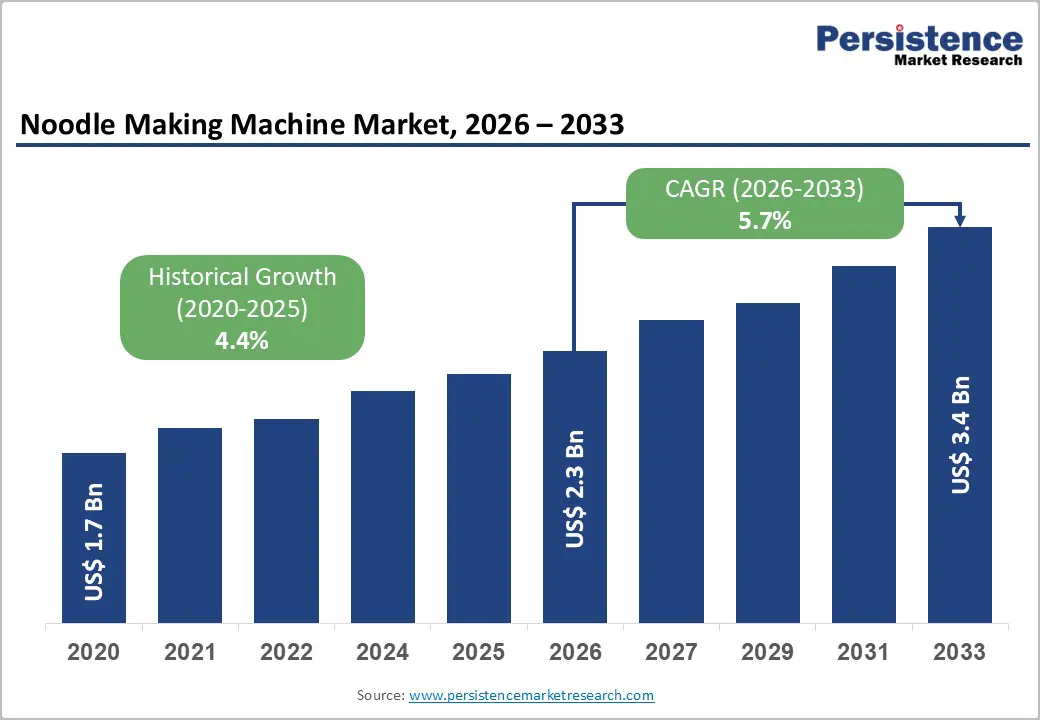
The global noodle making machine market size is likely to be valued at US$ 2.3 billion in 2026, and is projected to reach US$ 3.4 billion by 2033, growing at a CAGR of 5.7% during the forecast period 2026 - 2033. The growth of the market is primarily driven by the rising consumption of noodle products across diverse demographics, fueled by busy lifestyles and increasing demand for convenient, ready-to-eat foods.
Technological adoption in food production equipment, including automation, IoT-enabled process monitoring, and energy-efficient designs, is enabling manufacturers to improve productivity, consistency, and product quality. The expanding applications of these machines in commercial foodservice, quick-service restaurants (QSRs), catering, and large-scale industrial processing plants are contributing to market growth. Regional trends highlight the dominance of the Asia Pacific due to cultural preference and high consumption, while Western markets increasingly adopt automated systems to meet quality and efficiency standards.
Key Industry Highlights
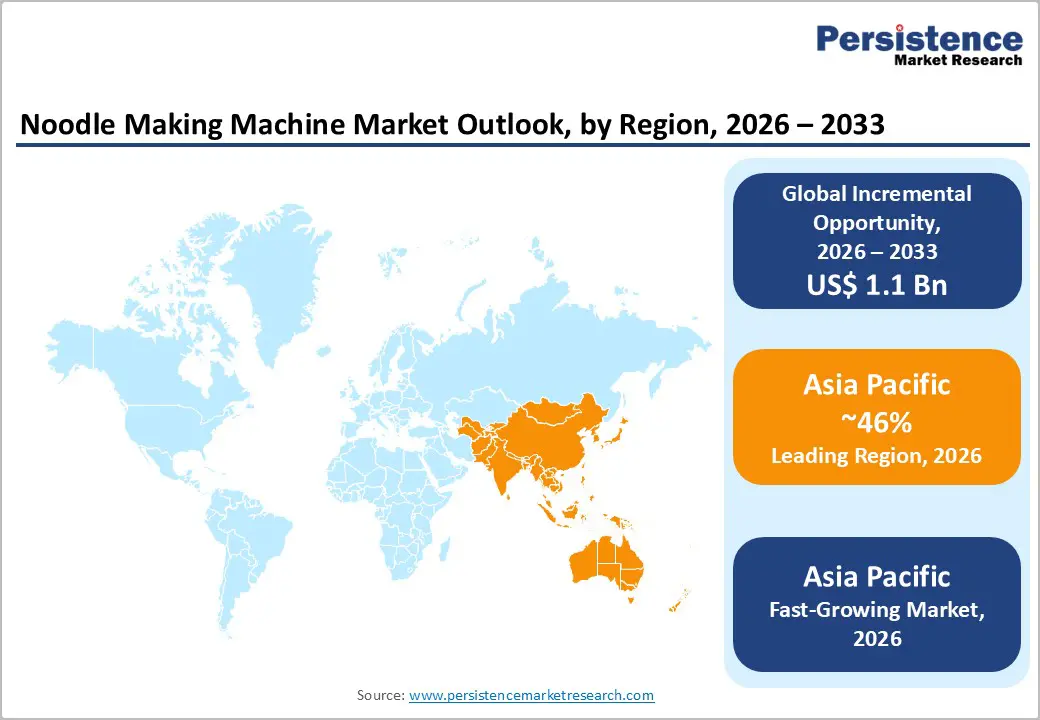
- Regional Leadership: Asia Pacific is expected to dominate with an estimated 46% market share in 2026 and to maintain a CAGR of 6.2% through 2033, driven by automation adoption and foodservice modernization.
- Dominant Machine Type: Fully automatic machines are projected to account for approximately 57% of the market share in 2026, while semi-automatic machines are expected to register the fastest growth through 2033, driven by their widespread use in restaurants.
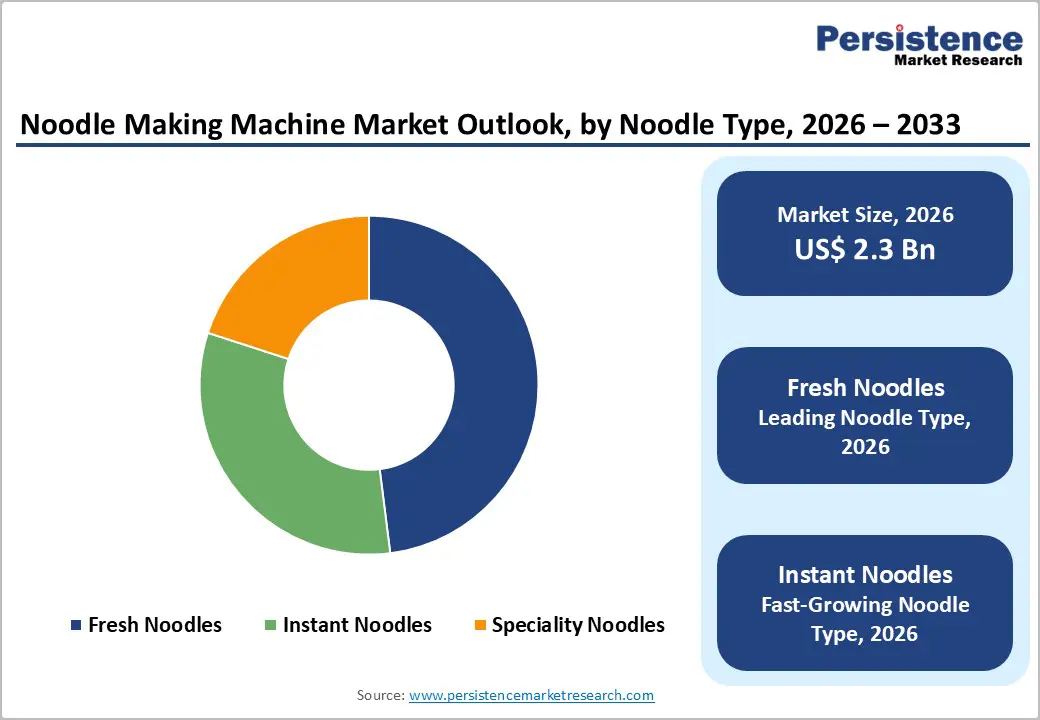
- Leading Noodle Type: Fresh noodles are anticipated to lead with around 48% revenue share in 2026, while instant noodles are poised to grow at a CAGR of 6.4% during 2026–2033, reflecting rising global demand for convenient, ready-to-eat foods.
- Leading Application: Commercial foodservice is projected to account for 50% of market revenue in 2026, while food processing plants are likely to register the fastest growth at a 6.0% CAGR, driven by industrial-scale automation and export-oriented production lines.
- Strategic Developments: Modular production line launches, global expansions, and specialty machine introductions are anticipated to impact over 25% of new market investments, enabling manufacturers to capture diversified applications and improve operational flexibility.
| Key Insights | Details |
|---|---|
|
Noodle Making Machine Market Size (2026E) |
US$ 2.3 Bn |
|
Market Value Forecast (2033F) |
US$ 3.4 Bn |
|
Projected Growth (CAGR 2026 to 2033) |
5.7% |
|
Historical Market Growth (CAGR 2020 to 2025) |
4.4% |
DRO Analysis
High Global Noodle Consumption and Convenience Food Demand
Global noodle consumption continues to expand significantly as urban lifestyles grow more time-constrained and consumers increasingly demand convenient meal solutions. According to the World Instant Noodles Association, countries such as Indonesia consumed approximately 14.68 billion servings of instant noodles in 2024, ranking among the highest in the world, with other Asian markets maintaining robust volumes. This sustained growth in consumption reinforces noodles as a staple across diverse demographic groups and cultural diets. Consumer preference for easy-to-prepare meals also encourages packaged noodle innovation, including fortified and specialty products, further sustaining demand.
In response, producers are turning toward mechanized production to sustain quality and scale output efficiently. The popularity of instant and fresh noodle formats compels manufacturers to invest in machinery capable of supporting round-the-clock operations while ensuring consistent product quality. This aligns with broader food sector trends, such as expanded investment in automation technology in the food processing industry, which support higher throughput and reduced reliance on manual labor. Moreover, manufacturers are increasingly leveraging advanced equipment to minimize waste, extend shelf life, and comply with evolving food safety regulations.
Technological Advancements and Growth in Commercial Food Processing
Technological innovation is reshaping the landscape of noodle-making machines, with automation, robotics, AI, and sensor integration gaining traction across food production environments. Industry reporting on automation trends in food manufacturing highlights a surge in the adoption of advanced systems, including AI-enabled quality control, robotics for repetitive tasks, and real-time monitoring, all aimed at improving efficiency, safety, and compliance. These developments strengthen the value proposition of automated noodle production lines, particularly for commercial and industrial users, and also support the creation of multiple product SKUs without major downtime.
Simultaneously, the expansion of commercial and industrial food processing, spanning quick-service restaurants, catering services, and packaged noodle manufacturers, continues to drive demand for machinery. Larger facilities, in particular, prefer fully automated systems to ensure productivity, hygiene compliance, and operational consistency. The broader context of increasing automation adoption across food production supports this structural shift and underscores sustained investment in advanced noodle-making equipment. In addition, integrating modern machinery enables processors to respond quickly to changing consumer preferences and regulatory updates, thereby maintaining a competitive advantage.
High Initial Capital Investment and Cost Barriers
Advanced noodle making machines, particularly fully automated production lines, require substantial upfront investment, which can limit adoption among smaller producers and emerging market participants. Costs extend beyond equipment purchase to include facility retrofitting, infrastructure upgrades, staff training, and ongoing maintenance. Several small and medium enterprises (SMEs) find it difficult to justify these expenditures without predictable short term return on investment (ROI). Moreover, the need for high-quality components and precision engineering increases initial expenditure and lengthens the payback period, creating financial hesitation among smaller operators.
In 2025, shifts in global tariff policies, such as U.S. adjustments on steel and electronic control components, have further inflated capital costs for imported machinery, elevating landed prices and complicating procurement planning for international buyers. These tariff impacts add timeline risk and higher total cost of ownership, forcing some producers to delay modernization projects or choose less advanced equipment to manage budget constraints. Fluctuating energy costs in manufacturing facilities compound operational expenses, further challenging the adoption of high-capital systems.
Technical Complexity and Skilled Labor Requirements
Sophisticated noodle-making machines with automated controls and real-time monitoring demand trained technicians for setup, operation, and maintenance, making them less accessible in regions with labor skill shortages. Without adequate expertise, facilities may experience increased downtime or inconsistent performance, undermining the value of automation investments despite higher capital costs. The complexity also introduces challenges for troubleshooting, calibration, and integration with existing production lines, requiring ongoing supervision and periodic upgrades.
Workforce challenges remain a structural constraint across manufacturing sectors. For example, the U.K. manufacturing industry reported nearly 49,000 job vacancies in early 2025, with nearly all manufacturers citing talent acquisition and retention as a major concern. This highlights broader industry skill gaps that extend to food equipment operation and maintenance. Efforts to address these gaps, such as digital upskilling, vocational programs, and immersive training technologies, are emerging but have yet to fully bridge the shortfall in specialized labor, thereby slowing the adoption of complex machinery. Furthermore, the ongoing digital transformation in food processing demands continuous learning, which small-scale operators struggle to implement efficiently.
Specialty and Flexible Production Lines
Consumer preferences are becoming increasingly segmented, with growing demand for gluten-free, multi-grain, rice-based, and specialty noodles that cater to health, cultural, and dietary needs. This shift is supported by broader foodservice trends that show a rising appetite for customizable, technology-enabled menus, including automated kitchens and AI-assisted food preparation, which help restaurants deliver diverse formats with precision and consistency. In 2025, leading food operators in Asia and Europe began piloting modular production lines capable of switching between multiple product types in a single facility, reflecting the tangible application of flexible machinery.
The trend toward configurable manufacturing lines enables processors to switch formats quickly without significant downtime or manual changeovers. This is increasingly critical in 2025, as food operators focus on innovation and agility in product offerings, not only for traditional noodles but also for premium and niche categories that appeal to health-conscious consumers. Flexible production systems help manufacturers reduce inventory risk, introduce new stock keeping units (SKUs), and improve responsiveness to sudden market shifts. Combined with digital monitoring tools, these machines allow manufacturers to track ingredient performance, maintain consistent quality, and adjust processes on-the-fly, positioning suppliers to capture emerging consumer segments and expand into adjacent specialty product lines.
Emerging Market Expansion and Digital Integration
Emerging economies across Africa, Latin America, and Southeast Asia continue to exhibit strong urbanization and rising disposable incomes, driving increased consumption of processed and convenience foods. Recent food industry reporting highlights that manufacturers are investing more in automation and smart production technologies to sustain growth, respond to consumer demand, and improve operational efficiency in these fast-growing markets. Governments in Southeast Asia have also started providing incentives for modernization in food processing plants, including subsidies for machinery upgrades and digital integration, further supporting market expansion.
Concurrently, the integration of connected machines and IoT-enabled systems is reshaping production and quality monitoring. In 2025, food processing plants increasingly leverage real-time production monitoring, robotics, and digital automation to improve traceability, predictive maintenance, and energy efficiency — a trend that directly supports value-added services beyond hardware. Leading trade analysis shows that such connected systems enhance uptime, reduce waste, improve regulatory compliance, and optimize energy consumption, creating recurring revenue opportunities for suppliers that couple software services with machine sales. This combination of regional market expansion and digital integration is positioning suppliers to scale rapidly while building long-term customer loyalty in emerging economies.
Category-wise Analysis
Fully Automatic Machines Insights
Fully automatic machines are likely to dominate with an estimated 57% of the noodle making machine market revenue share in 2026, driven by their capability to handle high volume industrial production with minimal manual input. These systems automate dough mixing, extrusion, cutting, and shaping, enabling large manufacturers and central kitchens to ensure consistent quality and output while streamlining labor and reducing cost. Their integration with downstream modules such as automated packaging and weighing enhances workflow continuity and hygiene control. In early 2026, a fully automated noodle restaurant in Kaohsiung, Taiwan, began operating without staff, with robots preparing and serving hot noodle bowls from scratch, demonstrating rising acceptance of end to end mechanized food production. This reflects broader industrial trends toward automation and efficiency in noodle production and service environments.
Semi automatic machines are projected to be the fastest growing category with an estimated CAGR of 6.1% through 2033, appealing to SMEs, restaurants, and regional producers. By automating key stages such as mixing and cutting while allowing manual oversight for customization, they strike a balance between efficiency and cost effectiveness, making them attractive for businesses with limited capital budgets. In 2025, a notable number of small and mid tier restaurant operators in Taiwan and Southeast Asia adopted semi automatic systems to address labor shortages and deliver fresh noodle products more consistently. This trend underscores how flexible, mid range machinery supports growth in diverse production environments that prioritize adaptability over full automation.
Noodle Type Insights
Fresh noodles are expected to hold the largest share at around 48% in 2026, fueled by strong demand from restaurants, foodservice chains, and central kitchens that emphasize freshness, texture, and customization. Automated fresh noodle equipment delivers consistent dough handling, cutting, and cooked output, allowing operators to meet quality expectations while maintaining high throughput. Several regional foodservice groups introduced fresh noodle preparation stations in central kitchen operations to ensure consistency across multiple outlets and improve service speed, reflecting continuing consumer preference for freshly prepared meals in casual and upscale dining. These developments highlight how fresh noodle capabilities remain crucial to menu differentiation and operational efficiency for foodservice operators adapting to evolving tastes.
Instant noodle production is anticipated to be the fastest growing category with an expected CAGR of 6.4% through 2033, driven by global demand for convenient and affordable meals. Instant production lines offer high speed processing, rapid drying/frying, and packaging automation, features critical for meeting both domestic retail demand and export market growth. In 2025, leading global noodle manufacturers announced multi hundred million dollar investment plans to expand production capacity in Asia and other regions, indicating confidence in sustained demand for instant noodles. Such investments support broader industry expansion and reinforce the role of instant noodles as a long term growth segment within machinery demand.
Regional Insights
North America Noodle Making Machine Market Trends and Insights
The market for noodle making machines in North America is shaped by rising interest in Asian cuisine and broader adoption of automation in commercial kitchens and food processing plants. In the U.S. and Canada, operators increasingly integrate automated systems to ensure consistent product quality and output while complying with stringent food safety and hygiene standards. Regulatory developments, including updated traceability mandates taking effect in January 2026, are encouraging the deployment of data enabled production equipment to improve transparency and compliance. Investment in smart, connected platforms also supports energy monitoring, reporting, and predictive maintenance, ensuring higher operational reliability across processing and foodservice environments.
The region is experiencing rapid growth through investment in smart, connected platforms capable of predictive maintenance and remote monitoring, enabling optimized workflow and reduced downtime. In 2025–2026, several foodservice chains deployed AI powered robotic systems for automated cooking, assembly, and packaging to boost efficiency and reduce labor dependency. These initiatives strengthen operational capabilities, enhance consistency, and position North America as a key adopter of modern automation technologies in noodle production. The combination of regulatory incentives and technological adoption is expected to further accelerate regional market expansion.
Europe Noodle Making Machine Market Trends and Insights
In Europe, the market is led by Germany, the U.K., France, and Spain, with demand driven by mature foodservice sectors, consumer interest in diverse noodle formats, and modernization of production processes. European Union (EU) regulatory initiatives focusing on sustainability, traceability, and digital transparency are prompting manufacturers to adopt hygienic, energy-efficient machinery. The introduction of policies such as the Digital Product Passport, expected by 2026, is accelerating the shift toward traceable, compliant production systems. Additionally, growth in e-commerce and quick-service restaurant chains across Europe is stimulating demand for reliable automated production capable of supporting consistent product quality at scale.
Growth is supported by automation upgrades to enhance productivity, reduce energy consumption, and meet evolving consumer preferences for fresh and artisanal noodles. In 2025, food processors across Germany and Italy implemented smart cooking and heating systems with automated controls to improve efficiency and hygiene compliance. These moves illustrate a regional trend toward automated, sustainable production systems that can accommodate diverse product lines while meeting stringent regulatory standards, reinforcing Europe’s strategic importance in the global noodle making machine market.
Asia Pacific Noodle Making Machine Market Trends and Insights
Asia Pacific is expected to remain the largest regional market for noodle making machines at an estimated 46% share in 2026, led by China, India, Japan, and ASEAN countries, where noodles are culturally ingrained and food processing infrastructure is rapidly modernizing. High per-capita consumption, industrial food processing expansion, and strong original equipment manufacturer (OEM) clusters provide a competitive advantage. National policies promoting modernization and export-oriented production further support investment and capacity expansion.The region also benefits from strong domestic manufacturing networks and lower production costs, which further incentivize industrial investment in high-throughput noodle making machines.
The regional market is also the fastest-growing globally, with an anticipated 6.2% CAGR through 2033, fueled by rising domestic demand and export growth. In February 2026, several noodle manufacturers across China and Southeast Asia invested in fully automated, high-throughput production lines to improve efficiency, maintain quality standards, and meet surging consumer demand. Expansion into tier 2 and tier 3 cities in India and ASEAN has also contributed to growth, reflecting the region’s strategic role as both a production hub and a growth engine for the global noodle making machine market.
Competitive Landscape
The global noodle-making machine market structure is moderately consolidated, with top vendors including Foshan Noodle Machinery Co., Jinan Tianwei Food Machinery, Rheon Food Machinery, and Roff Industries collectively commanding a significant portion of global revenue. These leading companies leverage established relationships with food processing plants, central kitchens, and large-scale noodle producers to maintain market leadership. They invest heavily in R&D, focusing on automation, modular machine lines, energy efficiency, and IoT-enabled process monitoring, thereby strengthening their competitive advantage and positioning them as technology leaders in industrial and commercial noodle production.
Regional and niche players, such as Shanghai Dongguan Food Machinery and Samwoo Noodle Systems, target specialized segments, including fresh noodle restaurants, boutique producers, and smaller-scale instant noodle manufacturers. Market entry barriers include high capital requirements, technical complexity, and compliance with local food safety regulations, which limit new competitors. However, digitalization, including cloud-connected predictive maintenance and AI-assisted monitoring, is enabling software and technology firms to collaborate with traditional equipment manufacturers, driving innovation and market expansion. Market consolidation is expected to continue gradually as global leaders pursue strategic acquisitions, expand into emerging markets in Asia Pacific and Latin America, and enhance integrated hardware-software solutions for advanced noodle production systems.
Key Industry Developments
- In October 2025, Nestlé India invested INR 85 crore (around US$ 10 million) to add a new Maggi noodles production line at its Sanand plant in Gujarat, increasing annual capacity by 20,600 tons. This expansion aims to meet rising domestic demand and strengthen supply chain resilience for one of India’s most popular instant noodle brands.
- In May 2025, Yoshinoya announced a strategic growth plan to significantly expand its ramen business, including acquiring local ramen brands. The move is designed to increase operating profits and enhance the company’s presence in the competitive noodle restaurant segment.
- In January 2025, JBT and Marel completed a EUR 3.6 billion (about US$ 3.9 billion) acquisition agreement, marking one of the largest consolidation moves in global food processing automation. The merger combines capabilities in automated production systems, boosting operational scale and technological integration across industrial food manufacturing.
Companies Covered in Noodle Making Machine Market
- Bühler Group
- GEA Group
- ANKO Food Machine Co., Ltd.
- Henan Gelgoog Machinery Co., Ltd.
- Yamato Manufacturing Co., Ltd.
- VEMAG Maschinenbau GmbH
- Fengyang Machinery Co., Ltd.
- Jinan Qianli Machinery Co., Ltd.
- Shanghai Yonghui Food Machinery Co., Ltd.
- Sainty Food Machinery Co., Ltd.
- Dalian Asia Foods Machinery Co., Ltd.
- Rheon Automatic Machinery Co., Ltd.
- Shandong Jinjia Group Co., Ltd.
Frequently Asked Questions
The global noodle making machine market is projected to reach US$ 2.3 billion in 2026.
Increasing global noodle consumption, adoption of automated production systems, and expansion of commercial and industrial food processing are driving the market.
The market is poised to witness a CAGR of 5.7% from 2026 to 2033.
Growth in specialty and flexible production lines and expansion into emerging markets are major opportunities.
Foshan Noodle Machinery, Jinan Tianwei Food Machinery, Rheon Food Machinery, Roff Industries, and Samwoo Noodle Systems are some of the leading players.


