




- Industrial Machinery
- Non-Woven Fabric Machines Market
Non-Woven Fabric Machines Market Size, Share, and Growth Forecast, 2026 - 2033
Non-Woven Fabric Machines Market by Machine Type (Semi-automatic, Automatic), Application (Industrial Fibers, Agricultural Fibers, Others), End-user (Automotive, Construction, Healthcare & Pharmaceuticals, Others), and Regional Analysis for 2026 – 2033

Non-Woven Fabric Machines Market Size and Trends Analysis
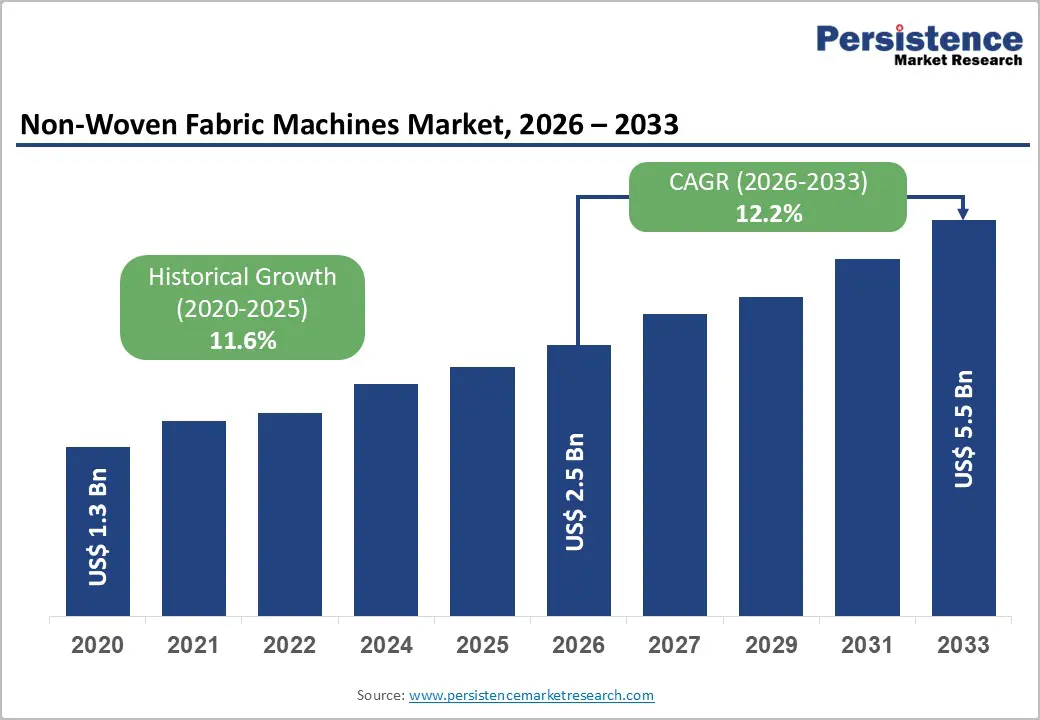
The global non-woven fabric machines market size is likely to be valued at US$2.5 billion in 2026, and is expected to reach US$5.5 billion by 2033, growing at a CAGR of 12.2% during the forecast period from 2026 to 2033, driven by the rising demand for non-woven fabrics in hygiene, medical, and industrial applications, along with increasing automation in textile manufacturing. Increasing adoption of high-speed automatic machines for efficient and cost-effective non-woven fabric production remains a major driver of the non-woven fabric machines market growth.
Key Industry Highlights:
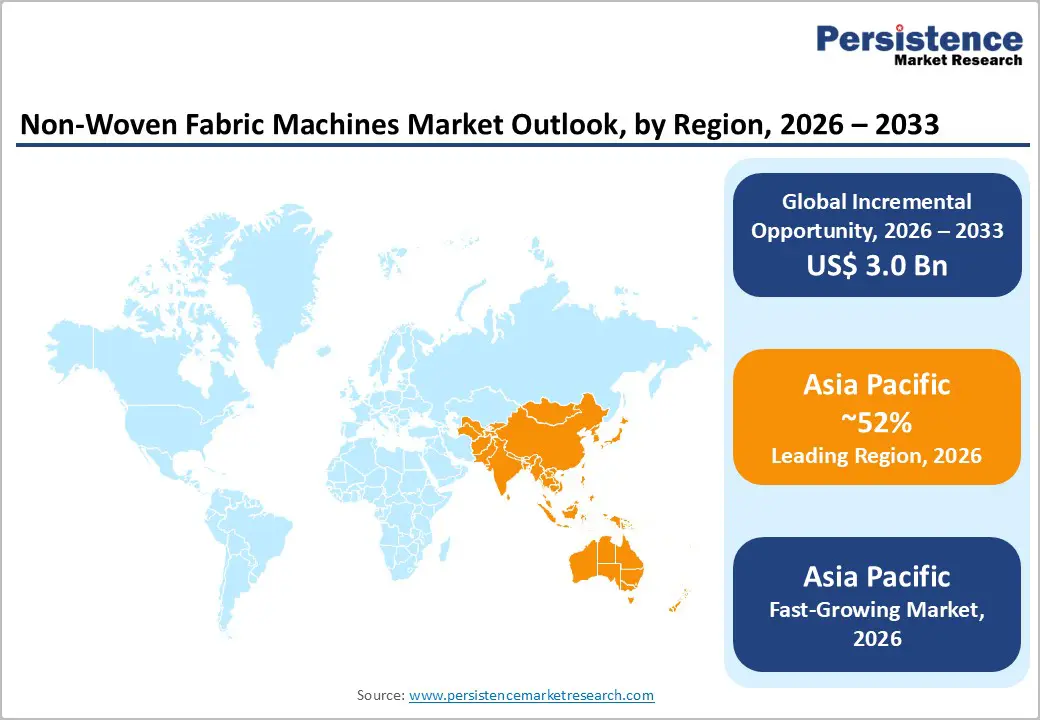
- Leading Region: Asia Pacific, anticipated to account for a 52% market share in 2026, driven by large-scale textile and hygiene product manufacturing in China and India.
- Fastest-growing Region: Asia Pacific, fueled by expanding production capacities and rising domestic demand for non-woven materials.
- Dominant Machine Type: Automatic, to hold approximately 68% of the market share, as manufacturers prioritize speed, efficiency, and consistency.
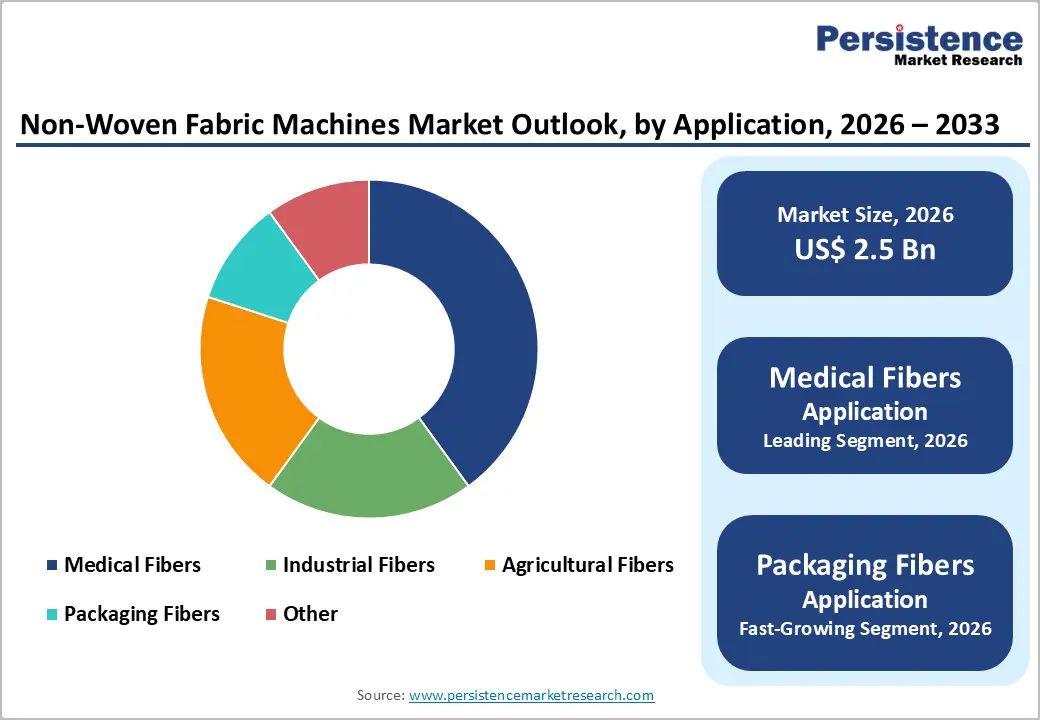
- Leading Application: Medical fibers, set to dominate due to surging demand for disposable medical products.
| Key Insights | Details |
|---|---|
|
Non-Woven Fabric Machines Market Size (2026E) |
US$2.5 Bn |
|
Market Value Forecast (2033F) |
US$5.5 Bn |
|
Projected Growth CAGR (2026-2033) |
12.2% |
|
Historical Market Growth (2020-2025) |
11.6% |
Market Factors – Driver, Restraint, and Opportunity Analysis
Driver Analysis - Rising Demand for Hygiene Products
Growing awareness of personal hygiene and health has significantly increased the consumption of products such as baby diapers, sanitary napkins, wet wipes, and adult incontinence items. This surge is driven by factors including rising population, higher disposable incomes, and improved access to healthcare and sanitation products, especially in developing regions. Urbanization and changing lifestyles have further encouraged the use of convenient, disposable hygiene solutions that rely heavily on nonwoven fabrics due to their softness, absorbency, and cost-effectiveness.
Aging populations in many countries are contributing to higher demand for adult incontinence products, while increased female workforce participation is supporting the widespread use of sanitary hygiene products. Nonwoven fabrics are preferred in these applications because they offer superior properties such as lightweight structure, breathability, and high absorbency, making them ideal for single-use hygiene products.
Growth in Healthcare & Medical Applications
Expanding healthcare infrastructure and increasing patient volumes are driving significant consumption of disposable medical products across hospitals, clinics, and diagnostic centers. Items such as surgical masks, gowns, drapes, sterilization wraps, and wound care materials rely heavily on nonwoven fabrics due to their superior hygiene, barrier protection, and cost efficiency. These materials are designed for single-use applications, reducing the risk of cross-contamination and hospital-acquired infections, which have become a critical priority for healthcare providers worldwide.
Rising awareness of infection prevention, along with stricter regulatory standards for medical safety and cleanliness, is further accelerating the adoption of high-quality nonwoven materials. The experience of global health crises has also reinforced the need for scalable production of medical disposables, encouraging healthcare systems to maintain adequate stockpiles and strengthen local manufacturing capabilities. Nonwoven fabrics offer key advantages such as high filtration efficiency, breathability, and customizable properties, making them suitable for a wide range of medical applications.
Restraint Analysis - Technical Complexity and Skilled Workforce Requirement
Modern nonwoven fabric machines incorporate advanced technologies such as automation, precision controls, and high-speed production systems, making them inherently complex to operate and maintain. These machines often require operators with specialized technical knowledge to manage parameters such as fiber distribution, bonding techniques, temperature control, and quality consistency. Without skilled personnel, manufacturers may face inefficiencies, production errors, and increased material wastage.
In many regions, especially developing economies, there is a shortage of adequately trained workers who can handle such sophisticated equipment. This creates a barrier for companies looking to adopt advanced machinery, as they must invest additional time and resources in training and skill development. Maintenance and troubleshooting of these machines require experienced technicians, further adding to operational challenges.
Environmental Concerns Related to Synthetic Materials
Increasing reliance on petroleum-based polymers such as polypropylene and polyester in nonwoven fabric production has raised significant environmental concerns. These materials are non-biodegradable and contribute to long-term waste accumulation, particularly because many nonwoven products are designed for single-use applications. Growing awareness about plastic pollution and its impact on ecosystems is influencing both consumers and regulatory bodies to push for more sustainable alternatives.
Governments in various regions are introducing stricter regulations related to plastic usage, waste management, and emissions, which can create compliance challenges for manufacturers. Companies may need to invest in eco-friendly raw materials, recycling technologies, or process modifications, leading to higher production costs.
Opportunity Analysis - Rising Demand for Sustainable & Biodegradable Nonwovens
Growing environmental awareness and stricter regulations on plastic usage are encouraging industries to shift toward eco-friendly materials. Consumers and businesses alike are increasingly prioritizing products that minimize environmental impact, leading to higher adoption of biodegradable and recyclable nonwoven fabrics. These materials are often derived from natural fibers such as cotton, bamboo, or other plant-based sources, as well as innovative bio-based polymers that decompose more easily than conventional synthetic alternatives.
This transition is creating strong opportunities for manufacturers to develop advanced nonwoven fabric machines capable of processing a wider range of sustainable raw materials without compromising on performance or efficiency. Producing biodegradable nonwovens often requires specialized equipment with precise control over temperature, bonding techniques, and fiber handling, which drives demand for technologically upgraded machinery. Brands are actively incorporating sustainability into their product offerings to meet regulatory requirements and enhance their market positioning.
Growth in E-commerce & Packaging Industry
Rapid expansion of online retail has significantly increased the need for efficient and protective packaging solutions. As more consumers shift toward digital shopping platforms, the volume of shipped goods continues to rise, creating strong demand for lightweight, durable, and cost-effective packaging materials. Nonwoven fabrics are increasingly being used in this space due to their strength, flexibility, cushioning properties, and ability to protect products during transit.
These materials are widely applied in protective wraps, reusable shopping bags, insulation layers, and cushioning components for fragile items. Their versatility allows manufacturers to design packaging that meets both functional and environmental requirements, especially as sustainability becomes a key focus in logistics. Many companies are also exploring recyclable and reusable nonwoven packaging options to reduce waste and comply with evolving regulations. As e-commerce companies scale operations and optimize supply chains, there is a growing need for high-speed and efficient production of packaging materials.
Category-wise Analysis
Machine Type Insights
Automatic machines are expected to lead the market and register the fastest growth, accounting for approximately 70% of the market share in 2026. This dominance is driven by their ability to deliver continuous, high-speed production with minimal human intervention. Equipped with advanced control systems, these machines ensure uniform fiber distribution and consistent product quality, which is critical for applications in hygiene and medical sectors. By reducing dependence on manual labor, they minimize errors and enhance overall operational efficiency. Zhejiang Yanpeng Nonwoven Machinery Co., Ltd. is a well-known manufacturer of fully automatic spunbond nonwoven production lines. Its systems can achieve production speeds of up to 150 m/min, while advanced configurations such as SSMMS lines can reach speeds of up to 600 m/min, enabling high-volume, continuous manufacturing.
Application Insights
Medical fibers are projected to dominate with over 40% share in 2026, due to their critical role in healthcare applications that require high levels of safety, hygiene, and performance. Nonwoven medical fibers are extensively used in products such as surgical masks, gowns, drapes, and wound dressings, where properties such as barrier protection, absorbency, and breathability are essential. These materials help prevent infections and cross-contamination, making them indispensable in clinical environments. Mercator Medical S.A., a Poland-based company, specializes in producing disposable medical products using nonwoven materials. The company offers a broad range of healthcare items, including surgical drapes, gowns, and protective clothing, all of which utilize medical-grade nonwoven fibers to ensure hygiene and provide effective barrier protection.
Packaging fibers represent the fastest-growing application, supported by increasing demand for protective, lightweight, and eco-friendly packaging solutions. The surge in e-commerce has led to higher volumes of shipped goods, creating a need for materials that can cushion and safeguard products during transit. Nonwoven packaging fibers are ideal because they combine strength, flexibility, and recyclability, making them suitable for protective wraps, reusable bags, and insulation layers. Go Green Non-Woven Bags is an Indian company that manufactures eco-friendly nonwoven packaging solutions for retail and promotional purposes. The company produces durable, reusable polypropylene nonwoven bags, which are widely utilized by businesses for shopping, gifting, and marketing, offering a sustainable alternative to single-use plastic products.
Regional Insights
North America Non-Woven Fabric Machines Market Trends
North America market is experiencing notable growth driven by increasing demand across healthcare, hygiene, and industrial applications. Rising awareness of personal hygiene and safety has fueled the production of disposable medical and hygiene products such as surgical masks, gowns, wipes, and diapers, all of which rely heavily on nonwoven fabrics. This has encouraged manufacturers to invest in high-speed, automated nonwoven fabric machines that can meet the large-scale production requirements of hospitals, clinics, and consumer markets.
The e-commerce boom and growing need for protective packaging materials are creating opportunities for nonwoven production in the packaging sector. Businesses are increasingly adopting lightweight, reusable, and recyclable nonwoven materials for shipping and retail applications. Sustainability is also shaping market trends, as companies are developing biodegradable and recyclable nonwoven fabrics to comply with environmental regulations and meet consumer expectations. Technological innovation is another key trend, with companies integrating automation, digital monitoring, and IoT-enabled controls into production lines.
Europe Non-Woven Fabric Machines Market Trends
Europe market is propelled by strong demand in healthcare, hygiene, automotive, and industrial applications. Increasing awareness of infection control and personal hygiene has led to higher consumption of disposable medical and hygiene products, including surgical masks, gowns, wipes, and diapers. This demand is pushing manufacturers to invest in high-speed, fully automated nonwoven fabric machines that ensure consistent quality, efficiency, and scalability to meet rigorous industry standards.
Sustainability is a major trend shaping the European market. Regulatory pressure to reduce plastic waste and promote environmentally friendly products has encouraged the adoption of biodegradable and recyclable nonwoven fabrics. Manufacturers are developing machinery capable of processing sustainable fibers without compromising performance, reflecting the region’s strong focus on green manufacturing practices. The rise of e-commerce and innovative packaging solutions also contributes to market growth, with nonwoven fabrics increasingly used in protective, reusable, and lightweight packaging applications.
Asia Pacific Non-Woven Fabric Machines Market Trends
Asia Pacific is expected to dominate and be the fastest growing, capturing 52% of revenue in 2026, fueled by increasing industrialization, urbanization, and rising consumer demand for hygiene and medical products. Countries in the region are witnessing a surge in disposable hygiene items such as diapers, sanitary napkins, adult incontinence products, and wet wipes, which rely heavily on nonwoven fabrics. To meet this growing demand, manufacturers are investing in high-speed, fully automated nonwoven fabric machines that can deliver large-scale, consistent production efficiently.
Healthcare applications are also driving market expansion, as hospitals and clinics require disposable surgical masks, gowns, drapes, and wound care materials. The growing emphasis on infection control and hygiene, particularly in densely populated areas, is further encouraging the adoption of advanced nonwoven machinery. Sustainability is emerging as an important trend, with companies exploring biodegradable fibers and recyclable materials to reduce environmental impact. The region’s expanding e-commerce and packaging industries are creating demand for lightweight, durable, and reusable nonwoven materials for protective packaging solutions.
Competitive Landscape
The global nonwoven fabric machines market is highly competitive, with manufacturers striving to differentiate themselves through technological innovation, production efficiency, and customization capabilities. Companies are investing in advanced automation technologies, including digital controls, IoT integration, and smart monitoring systems, to enhance production speed, maintain consistent fabric quality, and reduce operational costs. These innovations allow manufacturers to meet the growing demand from healthcare, hygiene, packaging, and industrial sectors while ensuring efficiency and precision in high-volume production.
In addition to technology, companies focus on providing excellent after-sales services, including installation support, maintenance, and training, which helps build long-term customer relationships and trust. Customization is another critical factor, as manufacturers must adapt machines to process different fiber types, fabric weights, and layer configurations according to specific client requirements.
Key Industry Developments:
- In March 2026, ANDRITZ showcased its latest sustainable nonwoven and textile solutions at Techtextil 2026 in Frankfurt. The company presented technologies for fiber recycling, textile sorting, and natural fiber processing to support circular, low-impact production. It introduced the X Pro™ crosslapper, offering higher speeds and improved web uniformity, and demonstrated integration with the ProWin™ profile correction system for enhanced fabric quality.
- In September 2025, Reifenhäuser Reicofil, a business unit of the Reifenhäuser Group, unveiled its new RF5 XHL production platform at INDEX 23. The RF5 XHL, which stands for Extra High Loft, evolved from the proven RF5 technology and was designed to produce super soft and drapeable nonwovens for the hygiene industry.
Companies Covered in Non-Woven Fabric Machines Market
- Shandong Tongjia Machinery
- Hubei Huiyu Machinery
- Varaoke International Oy
- Wenzhou Allwell Machinery Share
- Edilfloor S.p.A
- Franz Beyer GmbH & Co. KG
- Sojitz Machinery Corporation
- Elpie Engineers
- HG Nonwoven Machinery
- Santex Rimar Group
Frequently Asked Questions
The global non-woven fabric machines market is projected to reach US$2.5 billion in 2026.
The non-woven fabric machines market is primarily driven by rising demand for medical and hygiene non-woven products and growing applications in automotive, construction, and agricultural sectors.
The non-woven fabric machines market is poised to witness a CAGR of 12.2% from 2026 to 2033.
Key opportunities in the non-woven fabric machines market include the development of sustainable and biodegradable fabric production lines, the adoption of Industry 4.0 technologies, and the rising demand from emerging markets for medical and packaging applications.
Key players in the non-woven fabric machines market include Shandong Tongjia Machinery, Santex Rimar Group, HG Nonwoven Machinery, and Wenzhou Allwell Machinery.


