




- Technology
- Neuromorphic Computing Market
Neuromorphic Computing Market Size, Share, and Growth Forecast, 2026 - 2033
Neuromorphic Computing Market by Component (Processors, Accelerators, Memory, Sensors, Software, Services), Deployment (Edge, Cloud, Hybrid), Application (Image Recognition / Vision Processing, Signal Processing, Data Mining & Data Processing, Object Detection / Pattern Recognition, Sensor Fusion & Event-Based Processing, Autonomous Decision Systems, Others), Industry and Regional Analysis for 2026 - 2033

Neuromorphic Computing Market Size and Trends
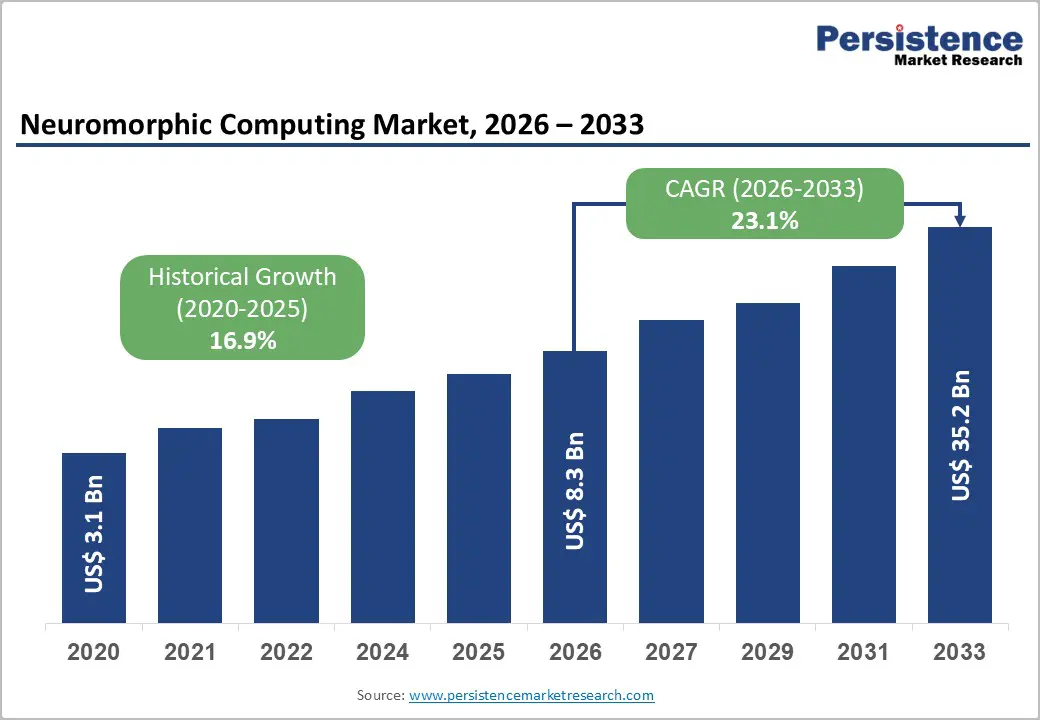
The global neuromorphic computing market size is projected to rise from US$8.3 Bn in 2026 to US$35.2 Bn by 2033. It is anticipated that the market will grow at a CAGR of 23.1% from 2026 to 2033, driven by the growing demand for energy-efficient artificial intelligence processing across edge computing environments and real-time autonomous systems.
Neuromorphic chips, which emulate the human brain's neural architecture, deliver orders-of-magnitude improvements in power efficiency compared to conventional processors, a critical advantage as global data center energy consumption surpassed 200 TWh annually, according to the International Energy Agency (IEA). Rapid proliferation of IoT devices, AI-accelerated robotics, and autonomous vehicles is further amplifying the need for low-latency, in-memory computing solutions that neuromorphic architectures uniquely provide.
Key Industry Highlights:
- Leading Component: Processors dominate the neuromorphic computing market with over 36% market share in 2026, valued at more than US$ 3.0 Bn, as they enable energy-efficient, real-time brain-inspired computations for robotics, edge AI devices, and autonomous systems. Software is the fastest-growing component, driven by the growing need for frameworks, simulation tools, and programming environments for spiking neural networks that simplify the deployment of neuromorphic hardware.
- Leading Deployment: Edge holds over 55% share in 2026, valued at more than US$ 4.6 Bn, driven by the need for ultra-low-latency processing close to data sources in applications such as autonomous vehicles, drones, and IoT devices. Cloud is the fastest-growing, enabling scalable infrastructure for neuromorphic simulations, neural model training, and collaborative AI research across enterprises and institutions.
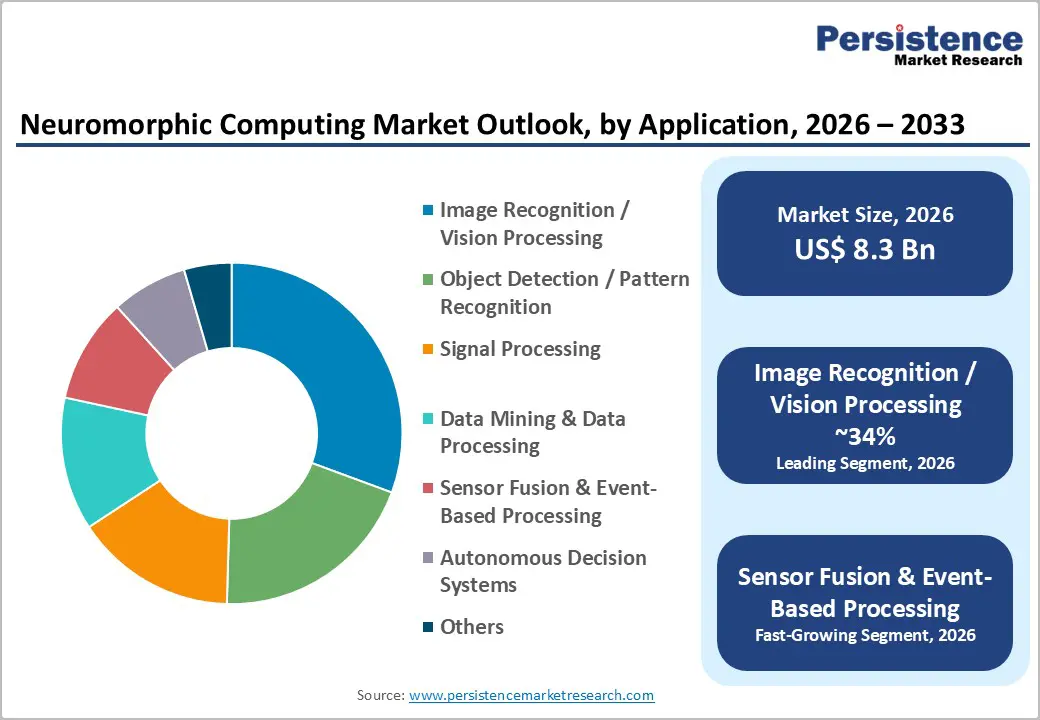
- Leading Application: Image Recognition / Vision Processing commands the largest market share at over 34% in 2026, valued at more than US$ 2.8 Bn, driven by the need for real-time visual intelligence in surveillance systems, robotics, and smart cameras. Sensor Fusion & Event-Based Processing is the fastest-growing application, with a 27.3% CAGR, driven by demand for adaptive perception systems that combine multiple sensor inputs for accurate, energy-efficient decision-making.
- Leading End-Use Industry: Consumer Electronics leads with over 40% market share in 2026, valued at more than US$ 3.3 Bn, as neuromorphic processors enhance battery efficiency and real-time AI capabilities in wearables, AR/VR headsets, and smart cameras. Automotive is the fastest-growing sector, fueled by rising investments in autonomous driving and ADAS technologies that require ultra-low-latency perception and decision-making capabilities.
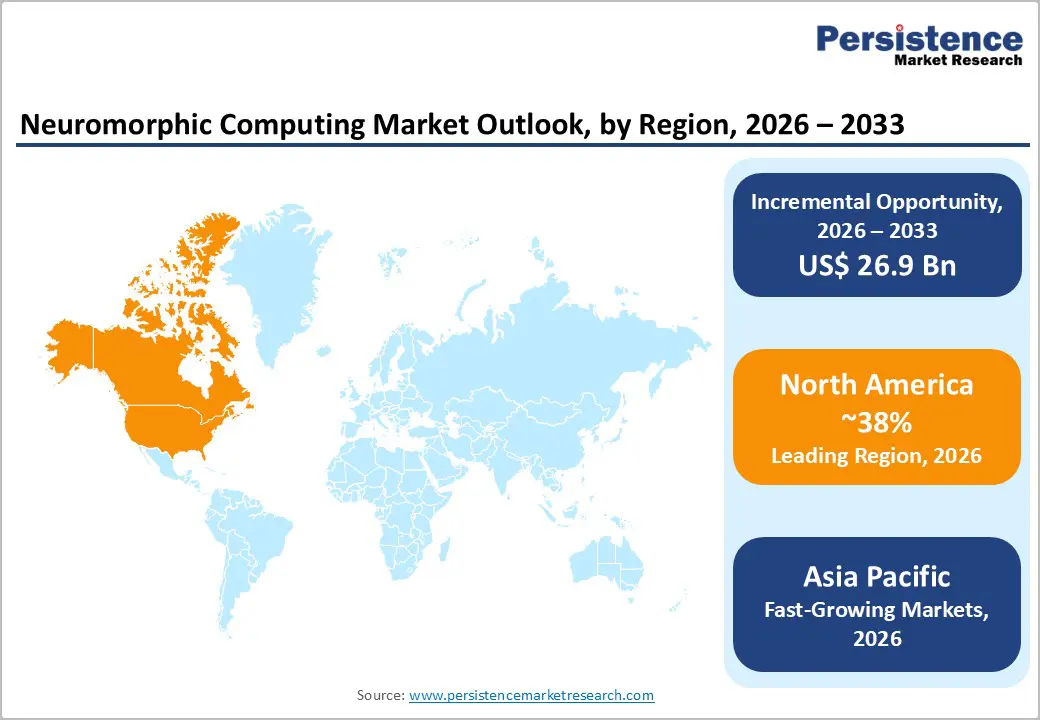
- Leading Region: North America dominates the market with over 38% share in 2026, valued at approximately US$ 3.2 Bn, supported by strong semiconductor innovation, AI research ecosystems, and government initiatives such as the US$ 52.7 Bn CHIPS and Science Act. Asia Pacific is the fastest-growing region with a CAGR of 28.1%, driven by significant AI chip investments in China, Japan, South Korea, and India, alongside expanding semiconductor manufacturing and national AI strategies.
| Key Insights | Details |
|---|---|
| Neuromorphic Computing Market Size (2026E) | US$8.3 Bn |
| Market Value Forecast (2033F) | US$35.2 Bn |
| Projected Growth (CAGR 2026 to 2033) | 23.1% |
| Historical Market Growth (CAGR 2020 to 2025) | 16.9% |
Market Dynamics
Driver - Surging Demand for Energy-Efficient AI Processing
The exponential growth in AI workloads has created a structural demand for computing hardware that delivers high throughput at minimal energy cost. Traditional von Neumann architectures face a well-documented memory wall bottleneck that results in significant energy losses during data transfer between the processor and memory. Neuromorphic chips, by contrast, perform computation in-memory using spike-based signals that dramatically reduce power draw. Intel Corporation's Loihi 2 chip, for instance, demonstrated up to 60× lower energy per inference compared to conventional GPU-based alternatives for specific event-driven tasks, as reported in Intel Labs technical briefs. As global AI server deployments scale, enterprises are actively evaluating neuromorphic architectures as a sustainable alternative, particularly for always-on sensory processing in edge deployments where battery life and thermal constraints are paramount.
Expanding Adoption in Autonomous Systems and Robotics
The proliferation of autonomous vehicles, industrial robots, and unmanned aerial vehicles (UAVs) is creating high-volume demand for real-time, low-latency sensory processing, a domain where neuromorphic computing excels. Unlike conventional processors, which process data in frames, neuromorphic systems respond asynchronously to sensory changes, offering sub-millisecond reaction times critical for collision avoidance and dynamic path planning. According to the International Federation of Robotics (IFR), global robot installations are expected to grow by 6% to 575,000 units in 2025, with industrial automation investments continuing to climb. Qualcomm Technologies, Inc. has integrated neuromorphic-inspired neural processing units (NPUs) into its Snapdragon platforms specifically targeting automotive-grade autonomous applications, signaling strong commercial momentum.
Restraint - High Development Complexity and Lack of Standardized Programming Frameworks
One of the principal barriers hindering mainstream adoption of neuromorphic computing is the absence of standardized, developer-friendly programming frameworks and tools. Unlike GPUs or FPGAs, which benefit from mature ecosystems, neuromorphic platforms require developers to master spike-timing-dependent plasticity models, event-driven programming paradigms, and hardware-specific APIs. According to a survey published in the journal Nature Electronics, the steep learning curve and fragmented tooling landscape remain a critical bottleneck for enterprise adoption. This complexity significantly extends time-to-deployment, increasing R&D costs and deterring organizations from committing resources to neuromorphic hardware in competitive product cycles.
Limited Commercial Scalability and Fabrication Challenges
Neuromorphic chips currently face constraints in commercial-scale fabrication due to the unique material and design requirements of synaptic transistors and memristive elements. Manufacturing devices with the required nanoscale precision demands advanced semiconductor fabrication nodes and novel materials such as phase-change memory (PCM) and resistive RAM (RRAM), which are not yet in mainstream production volumes. According to the Semiconductor Industry Association (SIA), developing and certifying new materials for advanced nodes requires multi-year qualification cycles, limiting the scalability of the supply chain. These factors collectively constrain the market's ability to ramp production to meet growing demand from the automotive and consumer electronics sectors.
Opportunity - Integration with Edge AI and Internet of Things (IoT) Infrastructure
The rapid expansion of edge computing infrastructure presents a transformative opportunity for neuromorphic chip vendors. As organizations push AI inference workloads closer to data sources to reduce latency and bandwidth consumption, the inherent energy efficiency of neuromorphic processors positions them as ideal edge AI accelerators. According to Ericsson's Mobility Report, the number of IoT connections is projected to reach 34.7 billion by 2028, generating vast volumes of real-time sensory data that demand efficient, on-device processing. As enterprises in smart manufacturing, smart cities, and wearable healthcare sensors scale their IoT deployments, the demand for neuromorphic edge processors is expected to intensify considerably over the forecast horizon.
Growing Government Investment in Brain-Inspired Computing Research
Government-led initiatives and public research funding are creating significant near-term opportunities for neuromorphic computing companies through collaborative R&D programs and procurement. The European Union's Human Brain Project developed the SpiNNaker2 neuromorphic platform and has catalyzed continued European investment in brain-inspired computing through the Horizon Europe framework programs. The U.S. Department of Energy (DOE) announced targeted funding for next-generation neuromorphic computing research under its Advanced Scientific Computing Research (ASCR) program. China's Ministry of Science and Technology has prioritized the development of neuromorphic chips within its national AI strategy. Such government patronage de-risks early-stage R&D for private players, accelerates commercialization timelines, and creates assured demand from defense, intelligence, and public research sectors.
Category-wise Analysis
Component Insights
Processors dominate, capturing more than 36% market share in 2026 with a value exceeding US$ 3.0 Bn, as they are critical for executing brain-inspired computations with high efficiency and minimal energy consumption. The need for fast, low-latency decision-making in robotics, AI devices, and edge systems drives their adoption. These processors enable real-time data analysis while maintaining compact form factors. Their reliability and scalability make them the backbone of neuromorphic solutions in multiple industries.
Software is expected to grow rapidly as enterprises and research labs seek frameworks to implement spiking neural networks. The demand for simulation tools, optimization algorithms, and AI workflow management is increasing. Organizations need software to make neuromorphic hardware more accessible and programmable. It allows seamless integration of neural-inspired architectures into devices and systems. The growth is fueled by the rising focus on adaptive AI applications and customizable computing solutions.
Deployment Insights
Edge holds over 55% market share in 2026, with a value exceeding US$ 4.6 Bn. It addresses the need for real-time processing close to the data source, reducing latency for critical applications. Edge neuromorphic devices are essential in autonomous vehicles, drones, and IoT systems where milliseconds matter. They reduce dependency on cloud connectivity while enabling faster local decision-making. Energy efficiency and responsiveness are the key factors for this deployment segment.
Cloud is expected to grow rapidly due to businesses' requirements for scalable, centralized computation for large-scale AI tasks. It supports neural network training, simulations, and collaborative projects across geographies. Organizations benefit from flexible resource allocation, cost-effective infrastructure, and high-performance computing. Cloud-based neuromorphic solutions make complex AI applications more accessible. The rising demand for enterprise-wide AI analytics and neural computing accelerates growth.
Application Insights
Image Recognition / Vision Processing commands the largest market share at over 34% in 2026, with a value exceeding US$ 2.8 Bn, due to the need for rapid interpretation of visual data in autonomous systems, robotics, and smart cameras. Neuromorphic hardware enables low-power, real-time vision processing and outperforms conventional AI models. Applications include surveillance, object detection, and augmented reality. The efficiency and speed offered meet the growing demand for intelligent visual computing.
Sensor Fusion & Event-Based Processing is expected to grow at a 27.3% CAGR, driven by the need for adaptive perception systems. By combining multiple sensor inputs, it enables accurate and responsive decision-making. Neuromorphic architectures support high temporal resolution and event-driven processing. The segment grows due to increasing demand for energy-efficient, real-time sensing systems in complex environments.
Industry Insights
Consumer electronics hold over 40% share in 2026, with a value exceeding US$ 3.3 Bn, due to the need for low-power, intelligent devices such as wearables, AR/VR headsets, and smart cameras. Neuromorphic processors enable rapid responses while preserving battery life. Devices are becoming more portable, efficient, and capable of performing real-time AI tasks. This drives continuous innovation and adoption in the consumer technology market.
The automotive industry is expected to grow significantly due to rising demand for autonomous driving and advanced driver-assistance systems (ADAS). Neuromorphic computing enables ultra-low-latency perception and decision-making required for real-time vehicle control. It addresses the need for safer, smarter, and energy-efficient mobility solutions. The growth is driven by the increasing complexity of in-vehicle AI systems and regulatory pressures to improve transportation safety. Autonomous and connected vehicle technologies are key growth enablers.
Regional Insights
North America Neuromorphic Computing Market Trends
North America holds over 38% share in 2026, reaching US$ 3.2 Bn value, supported by strong semiconductor innovation and AI research infrastructure. The United States hosts key technology players such as Intel Corporation, IBM Corporation, and Qualcomm Technologies, which are advancing neuromorphic processors and AI hardware platforms. Government policy also supports innovation, particularly through the CHIPS and Science Act, which allocates US$52.7 billion for semiconductor manufacturing and R&D. Research programs led by DARPA and breakthroughs from universities such as the Massachusetts Institute of Technology, Stanford University, and Carnegie Mellon University sustain technological leadership. Canada complements this ecosystem through AI hubs in Toronto and Montreal, supported by the Pan-Canadian Artificial Intelligence Strategy.
Asia Pacific Neuromorphic Computing Market Trends
Asia Pacific is expected to grow at a significant rate with a CAGR of 28.1%, due to large-scale government investment in AI and semiconductor technologies. In China, researchers at Tsinghua University developed the Tianjic Chip, a processor that integrates spike-based neuromorphic computing and deep learning, which was reported in Nature in 2019. National initiatives such as the New Generation Artificial Intelligence Development Plan allocate billions of dollars toward AI chip research through 2030. In Japan, the New Energy and Industrial Technology Development Organization supports neuromorphic research through the Moonshot R&D Program, while Samsung Electronics explores neuromorphic memory architectures under the K-Semiconductor Strategy. India is emerging as a participant through the India Semiconductor Mission, launched with a US$10 billion incentive package to strengthen domestic chip innovation.
Europe Neuromorphic Computing Market Trends
Europe is expected to hold more than 22% share by 2026, driven by strong public research funding and deep-tech innovation. Programs such as Horizon Europe have continued investments in brain-inspired computing following the Human Brain Project, which operated from 2013 to 2023 with a budget of approximately €600 million. The SpiNNaker neuromorphic platform, initially developed at the University of Manchester and expanded through the SpiNNaker2 initiative at Technische Universität Dresden, demonstrates Europe’s research leadership. Semiconductor policy support also comes from the European Chips Act, which aims to secure 20% of global semiconductor production by 2030. Additionally, companies like Arm Holdings contribute low-power processor architectures that indirectly support the development of neuromorphic systems.
Competitive Landscape
The global neuromorphic computing market exhibits a moderately fragmented competitive structure, with a mix of large diversified semiconductor corporations and specialized deep-tech startups. Leading companies are focusing on leveraging their mature silicon R&D capabilities and are gaining traction through application-specific neuromorphic processors targeting edge AI verticals. Strategic R&D alliances between universities and corporations serve as key competitive differentiators in the market. Mergers, acquisitions, and venture capital activity are intensifying as hyperscalers begin evaluating neuromorphic intellectual property (IP) for their AI hardware roadmaps.
Key Industry Developments:
- In December 2025, BrainChip Holdings Ltd. raised $25 million to accelerate the development and commercialization of its neuromorphic AI technology and expand its chip and module portfolio. The company showcased innovations at CES, including AKD1500 modules, Akida Cloud always-on AI, AI-driven cybersecurity with Quantum Ventura, and a 1.2B parameter on-device LLM for mobile and embedded devices, strengthening its position in the growing neuromorphic computing.
- In April 2024, Intel announced the world’s largest neuromorphic computing system, Hala Point, deployed at Sandia National Laboratories, using the Loihi 2 processor to advance research in brain-inspired AI. The system significantly improves upon Intel’s earlier Pohoiki Springs, delivering over 10× greater neuron capacity and up to 12× higher performance to address efficiency and sustainability challenges in modern AI.
Companies Covered in Neuromorphic Computing Market
- Intel Corporation
- IBM Corporation
- BrainChip Holdings Ltd.
- SynSense AG
- Qualcomm Technologies, Inc.
- Samsung Electronics Co., Ltd.
- GrAI Matter Labs
- Eta Compute Inc.
- Gyrfalcon Technology Inc.
- Applied Brain Research Inc.
- Nepes Corporation
- Cortical Labs
- Others
Frequently Asked Questions
The global neuromorphic computing market is projected to be valued at US$8.3 Bn in 2026.
The growing demand for energy-efficient artificial intelligence systems capable of processing complex data in real time are key driver of the market.
The market is expected to witness a CAGR of 23.1% from 2026 to 2033.
Increasing adoption of brain-inspired chips for edge AI, robotics, and IoT devices is accelerating the need for neuromorphic architectures that mimic human neural networks while consuming significantly lower power, creating strong growth opportunities.
Intel Corporation, IBM Corporation, BrainChip Holdings Ltd., SynSense AG, Qualcomm Technologies, Inc., Samsung Electronics Co., Ltd., GrAI Matter Labs, Eta Compute Inc. are among the leading key players.


