




- Agrochemicals
- Micronutrients Fertilizers Market
Micronutrients Fertilizers Market Size, Share, and Growth Forecast 2026–2033
Micronutrients Fertilizers Market by Product (Boron, Copper, Iron, Manganese, Molybdenum, Zinc, Others), Application Mode (Fertigation, Foliar, Soil), Crop Type (Field Crops, Horticultural Crops, Turf and Ornamental), and Regional Analysis, 2026–2033

Micronutrients Fertilizers Market Size and Trend Analysis
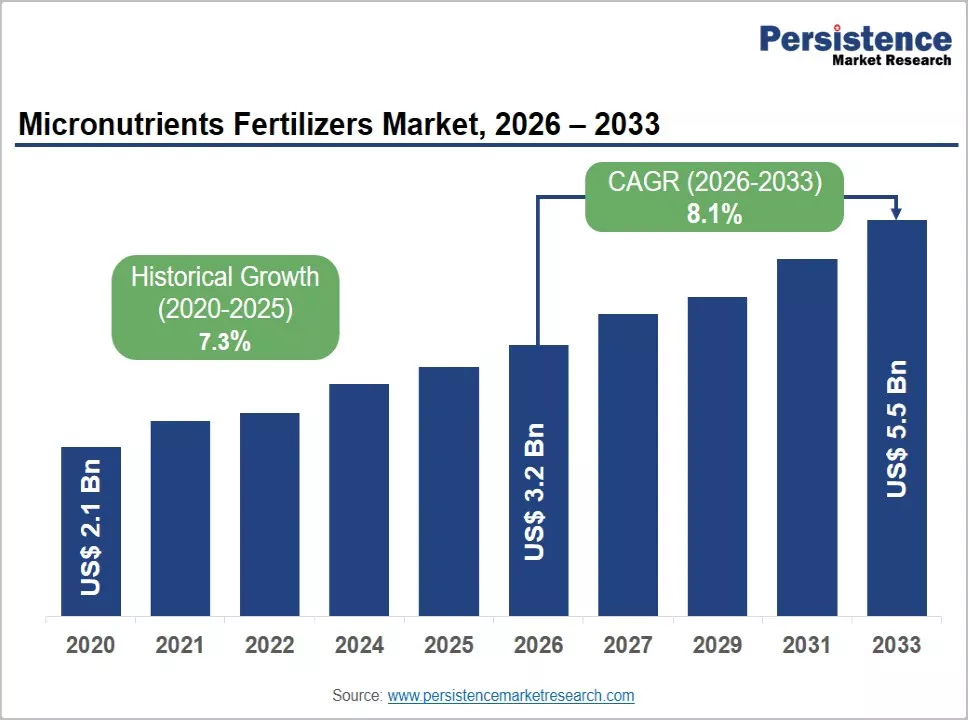
The global micronutrients fertilizers market size is likely to be valued at US$ 3.2 billion in 2026 and is projected to reach US$ 5.5 billion by 2033, growing at a CAGR of 8.1% during the forecast period between 2026 and 2033.
Micronutrients fertilizers have moved from a corrective input to a planned part of crop nutrition programmes, and value growth is now earned through formulation quality rather than tonnage. The forecast period favors chelated, water-soluble, and foliar products delivered through fertigation and precision sprayers, supported by diagnostic tools that tell farmers exactly what a crop lacks. Fertilizer producers and specialty nutrition companies should read this as a steady, innovation-led category in which crop-specific formulations, local manufacturing, and agronomic services decide who earns premium pricing.
Key Industry Highlights
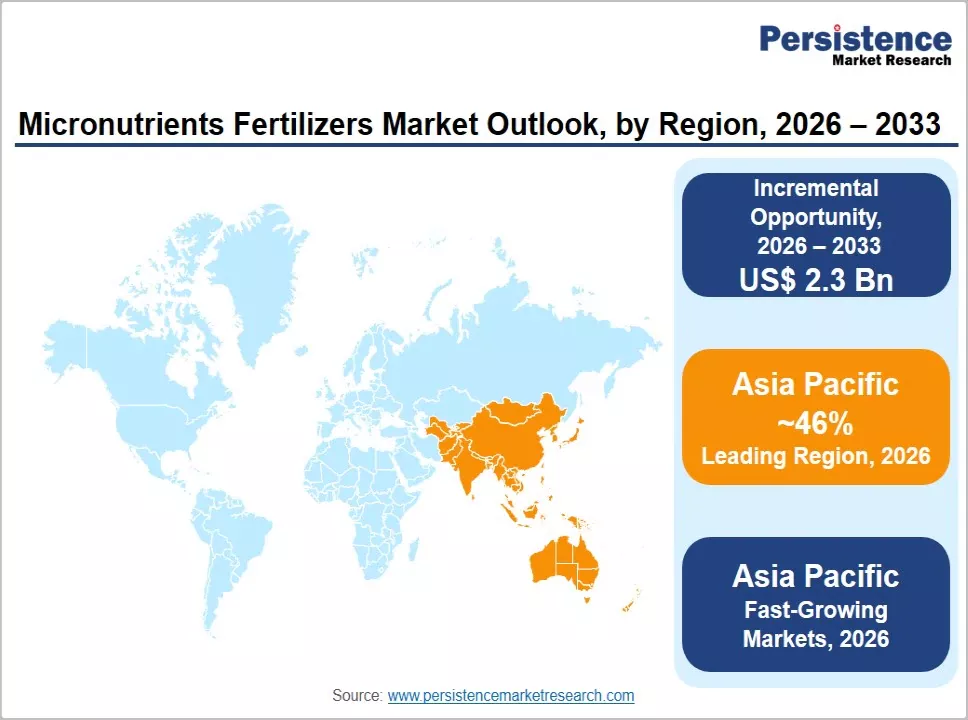
- Dominant Region: Asia Pacific holds 46% of the micronutrients fertilizers market in 2026, reflecting widespread zinc and boron deficiency in intensive rice, wheat, and pulse systems, and government subsidy support in India. The region's farm scale means procurement and policy decisions there shape global volumes.
- Fastest-growing Region: Asia Pacific is also projected to grow at an estimated 9.2% CAGR through 2033, as India and Southeast Asia expand soil testing, water-soluble fertilizer use, and protected cultivation. India's Kharif 2026 nutrient-based subsidy framework retained support for boron- and zinc-fortified products.
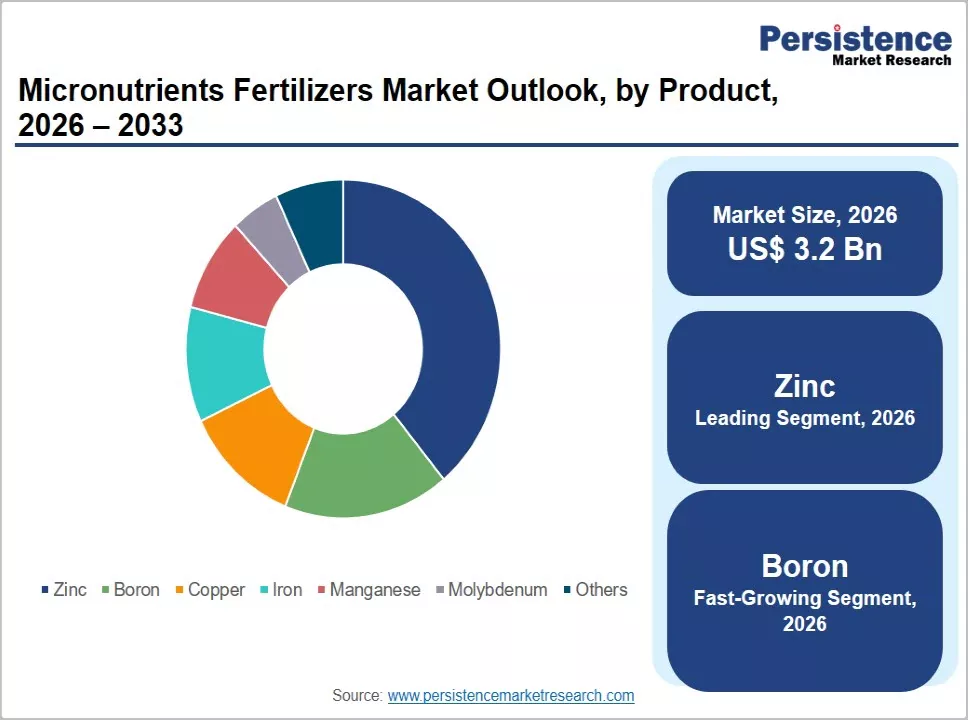
- Leading Product: Zinc command about 39% of 2026 sales, supported by its importance for cereals, the breadth of documented soil deficiencies, and a wide range of sulfate, oxide, and chelated forms. Yara International ASA, The Mosaic Company, and Coromandel International Ltd anchor supply in this product.
- Fastest-growing Application Mode and Emerging Opportunity: Fertigation is the fastest-growing mode as drip irrigation spreads and growers shift to fully soluble nutrients. ICL Group Ltd opened a new water-soluble fertilizer plant in Maharashtra, India, in March 2026, demonstrating how quickly manufacturers are localizing specialty capacity.
DRO Analysis
Driver- Rising Soil Deficiencies, Yield-Quality Pressure, and Precision Nutrition
Intensive cropping, high-yield varieties, and the use of macronutrient-only fertilizers have left many soils short of zinc, boron, and other trace elements, and farmers are increasingly aware that these gaps cap yields and nutritional quality. Soil testing programs and plant diagnostics are turning awareness into purchases: ICL launched its NutroScan real-time plant diagnostic in Brazil in January 2026, and government schemes in India link soil analysis to recommended micronutrient applications. Manufacturers that can pair a formulation with a diagnosis, such as foliar chelates matched to crop stage, earn stronger loyalty and higher prices than commodity salts.
Restraint- Price Sensitivity, Input Cost Volatility, and Uneven Farmer Awareness
Micronutrients are applied in small quantities, so farmers often treat them as optional when crop prices are low or when fertilizer budgets are strained. Chelated and water-soluble products carry higher prices than plain sulfates, and growers will choose cheaper mineral salts if a premium product does not show clear field benefit. Raw material costs for zinc, boron, and chelating agents are volatile, and disruptions to shipping routes, as seen in 2026, can interrupt supply to import-dependent countries. Limited extension services in parts of Africa and South Asia also slow adoption.
Opportunity- Localized Production, Biostimulant Combinations, and Fertigation in Horticulture
Localizing production reduces supply risk and cost. ICL's Maharashtra plant, which covers about 28,000 square meters and produces water-soluble fertilizers, was opened to reduce reliance on cross-border supply and support India's Make in India agenda. Product innovation is also combining nutrients with biostimulants: ICL's Bioz Kellus, launched in April 2026, pairs micronutrients with peptide-based and organic acid molecules for foliar use to improve uptake and plant resilience. Rapid growth in protected cultivation and drip-irrigated fruit and vegetable production gives suppliers of soluble micronutrients a premium channel.
Category-wise Analysis
Why Does Zinc Command the Largest Share of the Global Micronutrients Fertilizers Market?
Zinc is projected to lead the segment, account for nearly 39% of market share in 2026. It is the most commonly deficient micronutrient in cereal-growing regions, and it directly affects yield and grain zinc content, which supports both agronomic and public health goals. Zinc sulfate, zinc oxide, and chelated zinc are widely used across rice, wheat, and maize, and companies such as Yara International ASA, The Mosaic Company, and Coromandel International Ltd supply a broad range of forms. Coromandel's specialty nutrient range includes zinc-based products designed for foliar use.
Boron is likely to be the fastest-growing product, propelled by rising deficiency in oilseeds, pulses, and horticultural crops, and by its importance for flowering and fruit set. Government support for boron-fortified fertilizers in India, and use in canola, soybean, and fruit crops in other regions, are lifting volumes. Iron and manganese remain important in high-pH soils and in turf and ornamentals, while copper and molybdenum serve narrower but consistent needs.
Application Mode Insights
What Is Driving Soil Application Dominance Across the Micronutrients Fertilizers Industry?
Soil application is expected to lead the segment, hold about 56% of market share in 2026. Granular and blended products that carry micronutrients alongside primary nutrients are easy for farmers to apply with existing equipment, and fortified fertilizers are subsidized in several countries. K+S Aktiengesellschaft, Koch Agronomic Services, Compass Minerals International Inc., and The Mosaic Company are active in granular and blended soil-applied products.
Fertigation is likely to be the fastest-growing mode, driven by drip irrigation growth and by growers' preference for fully soluble, residue-free products that do not clog emitters. Haifa Group, ICL Group Ltd, Nouryon, and Yara International ASA supply chelated and water-soluble formulations designed for fertigation. Foliar application remains important for rapid correction of in-season deficiencies, particularly in fruit and vegetable crops.
Crop Type Insights
Why Do Field Crops Hold the Largest Share of the Global Micronutrients Fertilizers Market?
Field crops are projected to lead the segment, account for around 62% of market share in 2026. Rice, wheat, maize, soybean, cotton, and canola occupy very large acreages, and even low per-hectare rates create substantial volume. Policy support, such as fortified fertilizer subsidies and soil health programs, is concentrated on these crops, and companies including Yara International ASA, Coromandel International Ltd, and BASF SE sell tailored blends for them.
Horticultural crops are likely to be the fastest-growing segment, supported by protected cultivation, drip irrigation, and premium prices for quality fruit and vegetables. Growers in this segment pay more for chelated and foliar products that correct deficiencies quickly and improve appearance and shelf life, and suppliers such as FMC Corporation, Nufarm Limited, and BMS Micro-Nutrients NV target them with specialized products. Turf and ornamental uses remain a smaller, stable niche.
Regional Insights
Asia Pacific Micronutrients Fertilizers Market Trends and Insights
Asia Pacific is forecast to dominate the regional market, account for around 46% of the micronutrients fertilizers market share in 2026 and expanding at an estimated 9.2% CAGR through 2033. Large smallholder farm populations, widespread zinc and boron deficiency, and subsidy-supported fortified fertilizers drive volumes, while irrigation expansion is increasing demand for soluble products. Global suppliers are building local production and distribution to serve the region's scale.
China Micronutrients Fertilizers Market Size
China is projected to hold 41% of the Asia Pacific regional market in 2026. Large domestic producers supply zinc, boron, and chelated products, and government emphasis on fertilizer efficiency and balanced nutrition is supporting adoption in cereals, fruit, and vegetables.
India Micronutrients Fertilizers Market Size
India is expected to account for around 27% of the Asia Pacific regional market in 2026. The government's nutrient-based subsidy framework retains support for boron- and zinc-fortified fertilizers, and demand for water-soluble fertilizers is growing rapidly. Coromandel International Ltd is a leading domestic supplier, and ICL Group Ltd localized production in Maharashtra in March 2026.
North America Micronutrients Fertilizers Market Trends and Insights
North America is anticipated to command around 20% of the micronutrients fertilizers market in 2026. Farmers on large corn, soybean, wheat, and specialty crop acreages use precision application equipment and soil testing, and retail agronomy networks sell micronutrients as part of fertility programs. Supply chain and trade conditions affect pricing and product availability.
U.S. Micronutrients Fertilizers Market Size
The U.S. is estimated to hold around 86% of the North America regional market in 2026. Corn and soybean growers apply zinc, manganese, and boron with variable-rate technology, and large producers such as The Mosaic Company and Koch Agronomic Services provide blended and specialty products.
Canada Micronutrients Fertilizers Market Size
Canada is expected to account for over 14% of the North America regional market in 2026. Canola and pulse growers on the Prairies use boron, zinc, and copper to correct deficiencies, and distributors increasingly bundle micronutrients with biological and foliar products.
Europe Micronutrients Fertilizers Market Trends and Insights
Europe is projected to account for about 19% of the micronutrients fertilizers market in 2026. Advanced farming practices, high-value horticulture, and strong environmental regulation favour efficient chelated and foliar products. Regulatory emphasis on nutrient use efficiency and on sustainable chelating agents guides product development.
Germany Micronutrients Fertilizers Market Size
Germany is projected to account for around 22% of the Europe regional market in 2026. K+S Aktiengesellschaft and BASF SE are based in the country, and growers of cereals, rapeseed, and sugar beet use micronutrients to correct local deficiencies while meeting strict nutrient management rules.
U.K. Micronutrients Fertilizers Market Size
The U.K. is estimated to account for nearly 11% of the Europe regional market in 2026. Arable farmers and horticultural growers use foliar manganese, copper, and boron to protect yield and quality, and agronomists play a major role in prescribing products.
Competitive Landscape
The global micronutrients fertilizers market is moderately consolidated, with large fertilizer producers, specialty nutrition companies, and chelate suppliers competing on formulation, distribution, and agronomic support. Yara International ASA, The Mosaic Company, ICL Group Ltd, K+S Aktiengesellschaft, and Coromandel International Ltd lead on scale and product breadth, while BASF SE, Nouryon, Haifa Group, Koch Agronomic Services, FMC Corporation, SQM S.A., Compass Minerals International Inc., Nufarm Limited, Brandt Consolidated Inc., and BMS Micro-Nutrients NV hold strong positions in chelates, soluble fertilizers, and foliar products. Competitive intensity is rising as companies localize production, add biostimulant combinations, and introduce diagnostic tools. Winning requires reliable raw material access, crop-specific formulations, and strong relationships with distributors and agronomists.
Key Industry Developments
- In August 2026, Paradeep Phosphates Limited (PPL) launched JAI KISAAN NAVRATNA CROPFIT, a customized fertilizer developed specifically for sugarcane cultivation in Karnataka. The fertilizer features an NPK 14:14:13 formulation, supplemented with 4% sulfur, 1% zinc, 0.1% boron, and 1% iron, providing primary, secondary, and micronutrients through a single basal application. The FCO-approved product was recommended for sugarcane-growing districts across Karnataka. The launch aimed to improve nutrient use efficiency, promote healthier crop growth, address micronutrient deficiencies, and support higher sugarcane yields and sugar recovery while strengthening farm productivity and profitability.
- In April 2026, ICL Group launched Bioz Kellus, an innovative micronutrient chelates and biostimulants designed to accelerate nutrient absorption and improve plant resilience. The product combines peptide-based molecules and organic acids to create a biologically active, fully biodegradable nutrient carrier that enhances nutrient release and stimulates plant physiological processes. Trials conducted at the University of São Paulo Centre for Nuclear Energy in Agriculture demonstrated zinc absorption through leaves within 13 hours, outperforming traditional chelates and insoluble salts.
Companies Covered in Micronutrients Fertilizers Market
- BASF SE
- BMS Micro-Nutrients NV
- Brandt Consolidated Inc.
- Compass Minerals International Inc.
- Coromandel International Ltd
- FMC Corporation
- Haifa Group
- ICL Group Ltd
- K+S Aktiengesellschaft
- Koch Agronomic Services (Koch Industries)
- Nouryon
- Nufarm Limited
- SQM S.A.
- The Mosaic Company
- Yara International ASA
Frequently Asked Questions
The global micronutrients fertilizers market is valued at US$ 3.2 billion in 2026.
Widespread soil deficiencies of zinc and boron, pressure for higher yield and crop quality, precision and diagnostic tools, subsidy support in India, and growth in fertigation and protected cultivation, partly offset by price sensitivity and raw material volatility.
Zinc holds around 39% of the market. It is the most widely deficient micronutrient in cereal systems, affects both yield and grain quality, and is available in many cost-effective and chelated forms.
Asia Pacific leads with a 46% share in 2026, driven by intensive cropping with documented zinc and boron deficiency, large smallholder populations, and government subsidy support, particularly in India.
The largest opportunities are localized production of water-soluble fertilizers, micronutrient and biostimulant combinations, diagnostic-led selling, and fertigation in horticulture and protected cultivation.
Leading companies include Yara International ASA, The Mosaic Company, ICL Group Ltd, K+S Aktiengesellschaft, and Coromandel International Ltd. The market is moderately consolidated, with large fertilizer producers and specialty chelate and soluble-product suppliers competing on formulation and service.


