




- Hardware & Software IT Services
- Merchandise Assortment Management Applications Market
Merchandise Assortment Management Applications Market Size, Share, and Growth Forecast, 2026 – 2033
Merchandise Assortment Management Applications Market by Deployment Type (On-Premise, Cloud-Based, Hybrid), Application (Retail Merchandising, E-commerce Merchandising, Others), and Regional Analysis for 2026 – 2033

Merchandise Assortment Management Applications Market Size and Trends Analysis
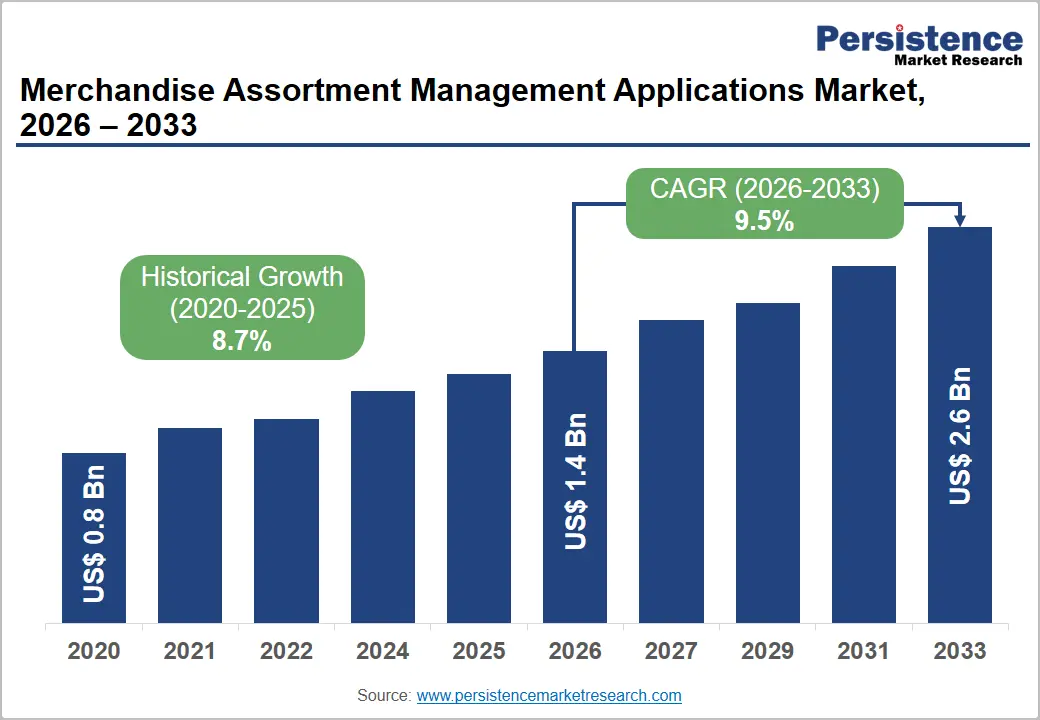
The global merchandise assortment management applications market size is likely to be valued at US$1.4 billion in 2026 and is expected to reach US$2.6 billion by 2033, growing at a CAGR of 9.5% during the forecast period from 2026 to 2033, driven by retailers increasingly relying on AI-driven analytics, demand forecasting, and omnichannel merchandising to improve product selection and inventory efficiency.
Cloud-based deployment continues to dominate as retailers seek real-time visibility across channels and locations. Industry trends also show growing use of predictive analytics and localized assortment strategies to meet changing consumer preferences, while AI-enabled merchandising platforms are helping retailers reduce stockouts, optimize inventory, and enhance profitability across physical and digital stores.
Key Industry Highlights:
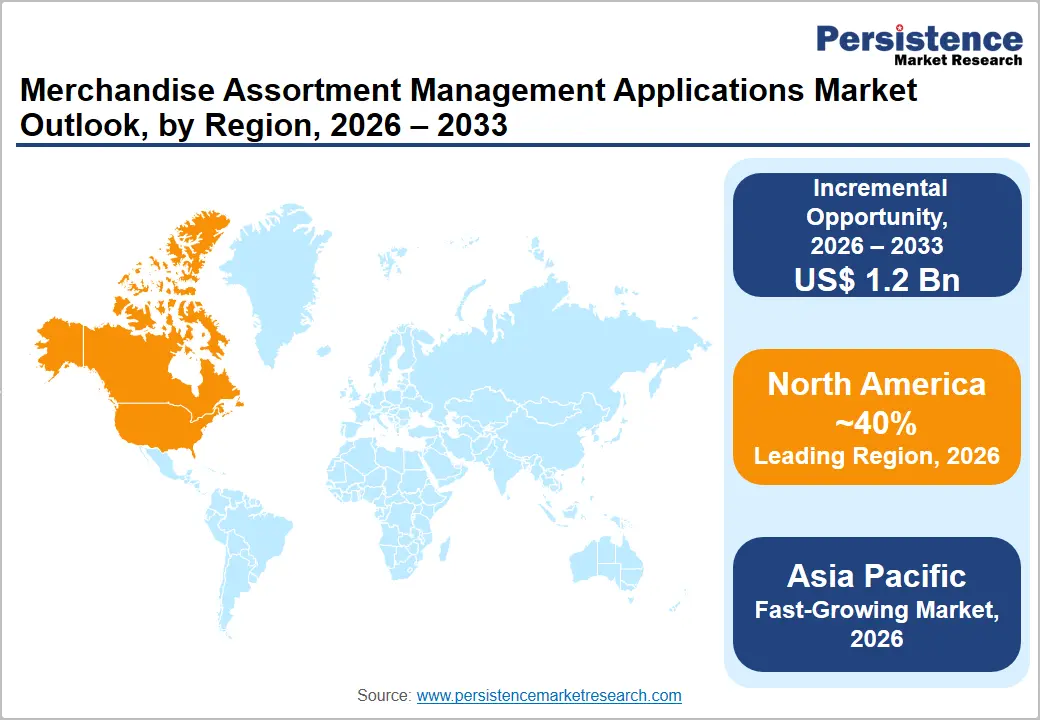
- Leading Region: North America is anticipated to be the leading region, accounting for a market share of 40% in 2026, driven by high adoption of AI-powered retail analytics, advanced omnichannel merchandising strategies, and strong digital transformation across the retail sector.
- Fastest-growing Region: Asia Pacific is likely to be the fastest-growing region, supported by rapid e-commerce expansion, increasing retail digitalization, and growing adoption of AI-driven merchandising solutions across major economies.
- Leading Deployment Type: The cloud-based segment, accounting for 50% of the revenue share, for its increasing adoption of SaaS-based retail solutions, scalability benefits, and growing demand for real-time merchandising analytics.
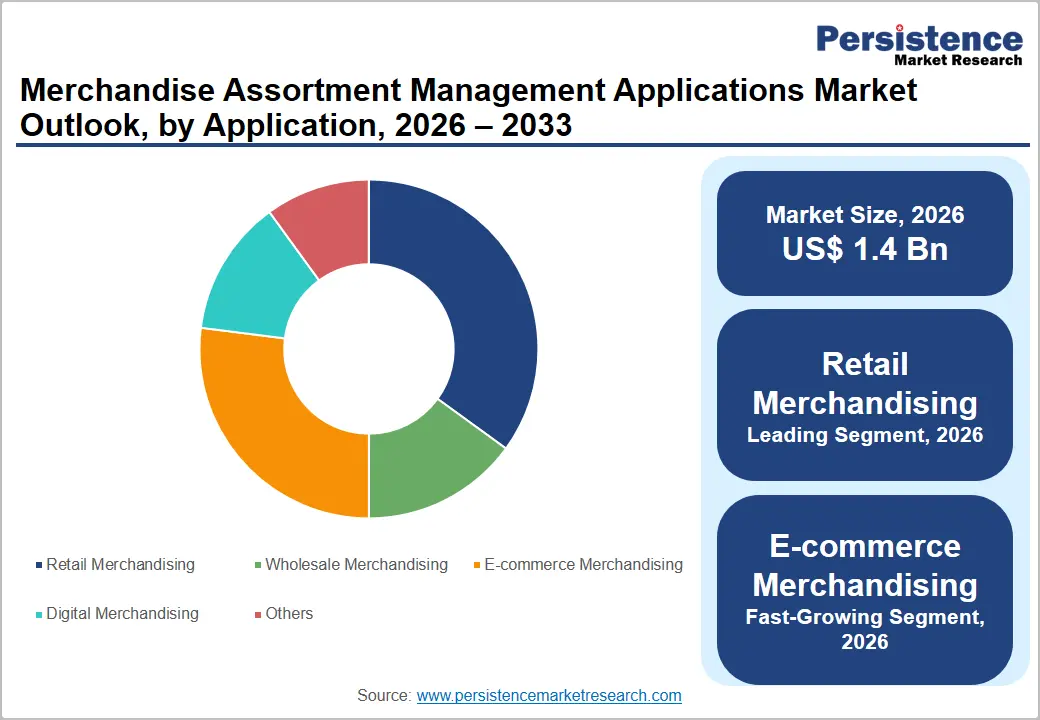
- Leading Application: Retail merchandising is anticipated to account for over 45% of the revenue share in 2026, supported by widespread use of assortment planning tools across physical retail stores and the need to optimize product mix and inventory performance.
- Key Opportunity: The greatest opportunity in the merchandise assortment management applications market lies in the integration of AI-driven, cloud-based assortment optimization platforms that enable personalized, sustainable, and omnichannel merchandising strategies across retail operations.
DRO Analysis
Driver - Adoption of AI, Machine Learning, and Advanced Analytics
Retailers are increasingly leveraging intelligent algorithms to analyze customer behavior, sales trends, seasonal demand patterns, and inventory performance across channels. These technologies enable businesses to make data-driven assortment decisions that improve product availability while reducing excess stock.
AI-powered forecasting tools help retailers anticipate shifts in consumer demand with greater accuracy, allowing them to optimize product placement and category strategies. As competition intensifies across physical and digital retail environments, predictive analytics has become essential for merchandising efficiency. Machine learning capabilities are transforming how retailers manage assortments by continuously learning from transaction data, customer interactions, and market trends.
Modern assortment management platforms can automatically recommend product mixes tailored to specific stores, regions, and customer segments. Advanced analytics also supports pricing optimization, promotion planning, and inventory allocation, helping retailers improve profitability and customer satisfaction simultaneously. The growth of omnichannel retailing has accelerated demand for intelligent merchandising solutions capable of delivering real-time insights.
Restraint - Skill Gaps and Organizational Resistance
Many retailers continue to rely on traditional merchandising methods and manual planning processes, making the transition to advanced digital platforms difficult. Successful implementation of assortment management software requires expertise in analytics, data interpretation, and technology integration, which may not be readily available within all organizations. Employees often require extensive training to understand new workflows and leverage advanced functionalities effectively.
Resistance to organizational change restricts adoption, particularly among companies with long-established merchandising practices. Decision-makers may hesitate to replace familiar planning methods with AI-driven recommendations due to concerns regarding accuracy, transparency, and control. Integration challenges with legacy retail systems can also create operational disruptions during implementation. In some cases, departments may struggle to align around data-driven decision-making approaches, leading to inconsistent utilization of the platform.
Opportunity - Sustainability-Focused Assortment Optimization
Retailers are increasingly prioritizing environmentally responsible business practices while responding to growing consumer demand for sustainable products. Assortment management applications help organizations evaluate product portfolios based on environmental impact, sourcing practices, packaging efficiency, and waste reduction objectives.
By utilizing advanced analytics, retailers can identify underperforming products, minimize overstock situations, and reduce unnecessary inventory disposal. These capabilities support broader sustainability goals while improving operational efficiency. As environmental considerations become increasingly important in retail decision-making, demand for sustainability-oriented merchandising tools continues to expand.
Modern assortment management platforms are evolving to incorporate sustainability metrics alongside traditional financial and operational indicators. Retailers can use these solutions to balance profitability with responsible sourcing strategies, optimize local assortments, and reduce transportation-related emissions through improved inventory planning.
Category-wise Analysis
Deployment Type Insights
The cloud-based segment is expected to lead, accounting for 50% of the revenue share in 2026. Retailers increasingly prefer cloud platforms because they provide centralized access to merchandising data, faster implementation, seamless software updates, and greater scalability across multiple locations and sales channels. A notable example includes Oracle Retail Assortment Planning Cloud Service, which enables retailers to optimize assortments and improve planning efficiency through a cloud-native merchandising platform.
The hybrid deployment segment is likely to represent the fastest-growing segment. Organizations increasingly favor hybrid models as they combine the security and control of on-premise infrastructure with the flexibility and scalability of cloud environments. This approach is particularly attractive for large retailers that manage sensitive operational data while simultaneously pursuing digital transformation initiatives. For example, SAP Retail solutions often integrate the existing on-premise retail systems with cloud-based merchandising and analytics platforms to improve assortment planning capabilities.
Application Insights
Retail merchandising is projected to lead the market, capturing around 45% of the revenue share in 2026. Physical retail stores continue to rely heavily on assortment planning solutions to optimize product selection, inventory allocation, shelf space utilization, and category performance. A notable example is Walmart, which leverages advanced merchandising analytics and assortment optimization strategies to efficiently manage product portfolios across its extensive retail network.
E-commerce merchandising is likely to be the fastest-growing application. The rapid expansion of online retailing has increased the demand for intelligent merchandising tools capable of delivering personalized product assortments and dynamic shopping experiences. A prominent example includes Amazon, which leverages advanced algorithms and data analytics to continuously optimize product assortments and personalize recommendations for customers.
Regional Insights
North America Merchandise Assortment Management Applications Market Trends
North America is anticipated to be the leading region, accounting for a global market share of 40% in 2026, supported by the region’s mature retail ecosystem, widespread adoption of cloud technologies, and strong investments in artificial intelligence-driven merchandising. For example, Oracle continues to expand its cloud-based retail merchandising portfolio, enabling retailers to improve assortment decisions through data-driven planning and analytics capabilities.
U.S. Merchandise Assortment Management Applications Market Trends
The U.S. is expected to dominate the regional market, accounting for approximately 80% of the market share in 2026. Retailers continue investing heavily in AI-powered merchandising and inventory optimization platforms. Omnichannel retail strategies remain a key priority among major retailers. Growing adoption of predictive analytics is improving demand forecasting accuracy. Retailers are increasingly using localized assortment planning to address changing consumer preferences. Digital commerce expansion continues to create demand for advanced merchandising tools.
Canada Merchandise Assortment Management Applications Market Trends
Canada is likely to be a significant market for merchandise assortment management applications, holding approximately 20% of the market share in 2026. Retailers are increasingly focusing on digital transformation initiatives to improve operational efficiency. Omnichannel commerce continues to expand throughout the country. Demand for cloud-based merchandising applications is rising due to scalability advantages. Retailers are utilizing advanced analytics to improve product allocation and inventory planning. Growing consumer expectations for personalized shopping experiences are encouraging technology investments.
Europe Merchandise Assortment Management Applications Market Trends
Europe is likely to be a significant market for merchandise assortment management applications in 2026, due to the rising demand for omnichannel retail management, inventory optimization, and personalized product recommendations. Sustainability considerations are also influencing assortment planning decisions, encouraging retailers to use advanced analytics for more efficient product selection. For instance, SAP SE continues to strengthen its retail solutions portfolio by providing integrated assortment planning and merchandising tools that support digital retail transformation.
U.K. Merchandise Assortment Management Applications Market Trends
The U.K. is expected to account for approximately 15% of the European merchandise assortment management applications market in 2026, driven by retailers’ increasing investments in omnichannel capabilities to enhance customer engagement. Strong growth in digital commerce continues to support technology spending, while assortment optimization solutions help businesses adapt to rapidly evolving consumer preferences. The adoption of AI-powered analytics for merchandising decisions is rising, alongside a growing focus on personalized product recommendations and real-time inventory visibility.
Germany Merchandise Assortment Management Applications Market Trends
Germany is anticipated to dominate the regional market, accounting for around 37% of the Europe market share in 2026. Retailers are increasingly investing in intelligent assortment planning solutions. The country’s strong retail infrastructure supports adoption of advanced merchandising platforms. AI-driven demand forecasting is becoming more widely utilized. Retailers are emphasizing inventory efficiency and category optimization. Sustainability-focused retail initiatives are influencing assortment decisions. E-commerce growth continues to encourage digital merchandising investments.
Asia Pacific Merchandise Assortment Management Applications Market Trends
The Asia Pacific region is likely to be the fastest-growing region in the merchandise assortment management applications market, driven by its rapid retail digitalization, expanding e-commerce activity, and growing adoption of cloud technologies. Retailers are increasingly implementing AI-powered merchandising tools to improve product selection and inventory management across diverse consumer markets. For instance, Infor continues to expand its retail merchandising capabilities in Asia Pacific by supporting retailers with cloud-based assortment planning and inventory optimization solutions.
China Merchandise Assortment Management Applications Market Trends
China is expected to lead the regional merchandise assortment management applications market, accounting for approximately 30% of market revenue in 2026. Growth is driven by the country’s vast e-commerce ecosystem and increasing demand for advanced merchandising solutions. Retailers are leveraging AI and machine learning to optimize product assortments, while personalized shopping experiences have become a key strategic priority. Continued expansion of digital retail platforms across both urban and regional markets, coupled with rising investments in predictive analytics to enhance forecasting accuracy, is further supporting market growth. The integration of online and offline retail channels also remains a major focus for businesses.
India Merchandise Assortment Management Applications Market Trends
India is expected to emerge as a significant market, accounting for approximately a 22% share in 2026. The rapid expansion of organized retail is increasing technology adoption. E-commerce growth continues to create demand for advanced merchandising platforms. Retailers are investing in cloud-based solutions to improve operational agility. AI-powered analytics are enabling businesses to optimize inventory management and refine product assortment decisions. At the same time, the growing adoption of omnichannel retail strategies among major retailers and increasing smartphone penetration are accelerating the expansion of digital commerce.
Competitive Landscape
The global merchandise assortment management applications market exhibits a moderately fragmented structure, driven by the presence of established enterprise software providers, specialized retail technology vendors, and emerging cloud-based merchandising solution developers. The market is evolving rapidly as retailers increasingly prioritize AI-powered assortment planning, demand forecasting, inventory optimization, and omnichannel merchandising capabilities.
With key leaders, including Oracle, Infor, SAS Institute, Logility, and The Nielsen Company, the competitive environment remains innovation-focused. These players compete through continuous product enhancements, AI-driven analytics capabilities, cloud-based deployment offerings, strategic partnerships, acquisitions, and deeper integration with retail planning ecosystems.
Key Industry Developments:
- In June 2026, Blue Yonder released its Q1 2026 company highlights, introducing enhanced AI-powered capabilities for Merchandise Financial Planning and Assortment Planning. The company expanded its retail supply chain solutions with advanced AI agents that help retailers identify profit risks, optimize assortments, analyze consumer trends, and improve merchandising decisions.
- In January 2026, o9 Solutions expanded its next-generation Category Management solution for grocery retailers, integrating assortment planning, merchandise financial planning, pricing, promotions, and demand planning into a unified AI-driven platform. The enhancement enables retailers to optimize category strategies, evaluate assortment changes through advanced analytics, and improve merchandising decisions using agentic AI recommendations.
Companies Covered in Merchandise Assortment Management Applications Market
- SAS Institute
- Blue Yonder
- TXT e-solutions
- Oracle
- JustEnough
- Island Pacific
- Infor
- 7thonline
- Logility
- The Nielsen Company
Frequently Asked Questions
The global merchandise assortment management applications market is projected to reach US$1.4 billion in 2026.
The merchandise assortment management market is driven by increasing adoption of AI-powered analytics, growing omnichannel retail operations, and rising demand for data-driven assortment optimization.
The merchandise assortment management applications market is expected to grow at a CAGR of 9.5% from 2026 to 2033.
Key opportunities lie in sustainability-focused assortment planning, cloud-based merchandising solutions, and the expansion of personalized retail experiences through advanced analytics.
SAS Institute, JDA Software Group, TXT e-solutions, Oracle., and JustEnough are the leading players.


