


- Executive Summary
- Global Medical Robots Market Snapshot, 2025 and 2032
- Market Opportunity Assessment, 2025 - 2032, US$ Mn
- Key Market Trends
- Future Market Projections
- Premium Market Insights
- Industry Developments and Key Market Events
- PMR Analysis and Recommendations
- Market Overview
- Market Scope and Definition
- Market Dynamics
- Drivers
- Restraints
- Opportunity
- Key Trends
- Macro-Economic Factors
- Global Sectorial Outlook
- Global GDP Growth Outlook
- COVID-19 Impact Analysis
- Forecast Factors - Relevance and Impact
- Value Added Insights
- Product & Services Adoption Analysis
- Regulatory Landscape
- Reimbursement Scenario
- Key Deals and Mergers
- PESTLE Analysis
- Porter’s Five Force Analysis
- Global Medical Robots Market Outlook:
- Key Highlights
- Market Size (US$ Mn) and Y-o-Y Growth
- Absolute $ Opportunity
- Market Size (US$ Mn) Analysis and Forecast
- Historical Market Size (US$ Mn) Analysis, 2019-2024
- Market Size (US$ Mn) Analysis and Forecast, 2025-2032
- Global Medical Robots Market Outlook: Product & Services
- Introduction / Key Findings
- Historical Market Size (US$ Mn) Analysis, By Product & Services, 2019-2024
- Market Size (US$ Mn) Analysis and Forecast, By Product & Services, 2025-2032
- Instrument & Accessories
- Robotic Systems
- Services
- Market Attractiveness Analysis: Product & Services
- Global Medical Robots Market Outlook: Application
- Introduction / Key Findings
- Historical Market Size (US$ Mn) Analysis, By Application, 2019-2024
- Market Size (US$ Mn) Analysis and Forecast, By Application, 2025-2032
- Surgery
- General Surgery
- Gynecological Surgery
- Urological Surgery
- Orthopedic Surgery
- Neurosurgery
- Rehabilitation
- Diagnostics
- Radiation Therapy
- Hospital Automation
- Others
- Surgery
- Market Attractiveness Analysis: Application
- Global Medical Robots Market Outlook: End User
- Introduction / Key Findings
- Historical Market Size (US$ Mn) Analysis, By End User, 2019-2024
- Market Size (US$ Mn) Analysis and Forecast, By End User, 2025-2032
- Hospitals & Clinics
- Research Institutions and Universities
- Ambulatory Surgical Centers
- Diagnostic Imaging Centers
- Rehabilitation Centers
- Others
- Market Attractiveness Analysis: End User
- Key Highlights
- Global Medical Robots Market Outlook: Region
- Key Highlights
- Historical Market Size (US$ Mn) Analysis, By Region, 2019-2024
- Market Size (US$ Mn) Analysis and Forecast, By Region, 2025-2032
- North America
- Europe
- East Asia
- South Asia and Oceania
- Latin America
- Middle East & Africa
- Market Attractiveness Analysis: Region
- North America Medical Robots Market Outlook
- Key Highlights
- Historical Market Size (US$ Mn) Analysis, By Market, 2019-2024
- By Country
- By Product & Services
- By Application
- By End User
- Market Size (US$ Mn) Analysis and Forecast By Country, 2025-2032
- U.S.
- Canada
- Market Size (US$ Mn) Analysis and Forecast, By Product & Services, 2025-2032
- Instrument & Accessories
- Robotic Systems
- Services
- Market Size (US$ Mn) Analysis and Forecast, By Application, 2025-2032
- Surgery
- General Surgery
- Gynecological Surgery
- Urological Surgery
- Orthopedic Surgery
- Neurosurgery
- Rehabilitation
- Diagnostics
- Radiation Therapy
- Hospital Automation
- Others
- Surgery
- Market Size (US$ Mn) Analysis and Forecast, By End User, 2025-2032
- Hospitals & Clinics
- Research Institutions and Universities
- Ambulatory Surgical Centers
- Diagnostic Imaging Centers
- Rehabilitation Centers
- Others
- Market Attractiveness Analysis
- Europe Medical Robots Market Outlook
- Key Highlights
- Historical Market Size (US$ Mn) Analysis, By Market, 2019-2024
- By Country
- By Product & Services
- By Application
- By End User
- Market Size (US$ Mn) Analysis and Forecast, By Country, 2025-2032
- Germany
- France
- U.K.
- Italy
- Spain
- Russia
- Türkiye
- Rest of Europe
- Market Size (US$ Mn) Analysis and Forecast, By Product & Services, 2025-2032
- Instrument & Accessories
- Robotic Systems
- Services
- Market Size (US$ Mn) Analysis and Forecast, By Application, 2025-2032
- Surgery
- General Surgery
- Gynecological Surgery
- Urological Surgery
- Orthopedic Surgery
- Neurosurgery
- Rehabilitation
- Diagnostics
- Radiation Therapy
- Hospital Automation
- Others
- Surgery
- Market Size (US$ Mn) Analysis and Forecast, By End User, 2025-2032
- Hospitals & Clinics
- Research Institutions and Universities
- Ambulatory Surgical Centers
- Diagnostic Imaging Centers
- Rehabilitation Centers
- Others
- Market Attractiveness Analysis
- East Asia Medical Robots Market Outlook
- Key Highlights
- Historical Market Size (US$ Mn) Analysis, By Market, 2019-2024
- By Country
- By Product & Services
- By Application
- By End User
- Market Size (US$ Mn) Analysis and Forecast, By Country, 2025-2032
- China
- Japan
- South Korea
- Market Size (US$ Mn) Analysis and Forecast, By Product & Services, 2025-2032
- Instrument & Accessories
- Robotic Systems
- Services
- Market Size (US$ Mn) Analysis and Forecast, By Application, 2025-2032
- Surgery
- General Surgery
- Gynecological Surgery
- Urological Surgery
- Orthopedic Surgery
- Neurosurgery
- Rehabilitation
- Diagnostics
- Radiation Therapy
- Hospital Automation
- Others
- Surgery
- Market Size (US$ Mn) Analysis and Forecast, By End User, 2025-2032
- Hospitals & Clinics
- Research Institutions and Universities
- Ambulatory Surgical Centers
- Diagnostic Imaging Centers
- Rehabilitation Centers
- Others
- Market Attractiveness Analysis
- South Asia & Oceania Medical Robots Market Outlook
- Key Highlights
- Historical Market Size (US$ Mn) Analysis, By Market, 2019-2024
- By Country
- By Product & Services
- By Application
- By End User
- Market Size (US$ Mn) Analysis and Forecast, By Country, 2025-2032
- India
- Southeast Asia
- ANZ
- Rest of South Asia & Oceania
- Market Size (US$ Mn) Analysis and Forecast, By Product & Services, 2025-2032
- Instrument & Accessories
- Robotic Systems
- Services
- Market Size (US$ Mn) Analysis and Forecast, By Application, 2025-2032
- Surgery
- General Surgery
- Gynecological Surgery
- Urological Surgery
- Orthopedic Surgery
- Neurosurgery
- Rehabilitation
- Diagnostics
- Radiation Therapy
- Hospital Automation
- Others
- Surgery
- Market Size (US$ Mn) Analysis and Forecast, By End User, 2025-2032
- Hospitals & Clinics
- Research Institutions and Universities
- Ambulatory Surgical Centers
- Diagnostic Imaging Centers
- Rehabilitation Centers
- Others
- Market Attractiveness Analysis
- Latin America Medical Robots Market Outlook
- Key Highlights
- Historical Market Size (US$ Mn) Analysis, By Market, 2019-2024
- By Country
- By Product & Services
- By Application
- By End User
- Market Size (US$ Mn) Analysis and Forecast, By Country, 2025-2032
- Brazil
- Mexico
- Rest of Latin America
- Market Size (US$ Mn) Analysis and Forecast, By Product & Services, 2025-2032
- Instrument & Accessories
- Robotic Systems
- Services
- Market Size (US$ Mn) Analysis and Forecast, By Application, 2025-2032
- Surgery
- General Surgery
- Gynecological Surgery
- Urological Surgery
- Orthopedic Surgery
- Neurosurgery
- Rehabilitation
- Diagnostics
- Radiation Therapy
- Hospital Automation
- Others
- Surgery
- Market Size (US$ Mn) Analysis and Forecast, By End User, 2025-2032
- Hospitals & Clinics
- Research Institutions and Universities
- Ambulatory Surgical Centers
- Diagnostic Imaging Centers
- Rehabilitation Centers
- Others
- Market Attractiveness Analysis
- Middle East & Africa Medical Robots Market Outlook
- Key Highlights
- Historical Market Size (US$ Mn) Analysis, By Market, 2019-2024
- By Country
- By Product & Services
- By Application
- By End User
- Market Size (US$ Mn) Analysis and Forecast, By Country, 2025-2032
- GCC Countries
- Egypt
- South Africa
- Northern Africa
- Rest of Middle East & Africa
- Market Size (US$ Mn) Analysis and Forecast, By Product & Services, 2025-2032
- Instrument & Accessories
- Robotic Systems
- Services
- Market Size (US$ Mn) Analysis and Forecast, By Application, 2025-2032
- Surgery
- General Surgery
- Gynecological Surgery
- Urological Surgery
- Orthopedic Surgery
- Neurosurgery
- Rehabilitation
- Diagnostics
- Radiation Therapy
- Hospital Automation
- Others
- Surgery
- Market Size (US$ Mn) Analysis and Forecast, By End User, 2025-2032
- Hospitals & Clinics
- Research Institutions and Universities
- Ambulatory Surgical Centers
- Diagnostic Imaging Centers
- Rehabilitation Centers
- Others
- Market Attractiveness Analysis
- Competition Landscape
- Market Share Analysis, 2024
- Market Structure
- Competition Intensity Mapping By Market
- Competition Dashboard
- Company Profiles (Details - Overview, Financials, Strategy, Recent Developments)
- Intuitive Surgical Inc.
- Overview
- Segments and Product & Services
- Key Financials
- Market Developments
- Market Strategy
- Stryker Corporation
- Medtronic plc
- Zimmer Biomet
- Smith+Nephew plc
- Johnson & Johnson (through Ethicon and Auris Health)
- Siemens Healthineers AG
- Asensus Surgical, Inc.
- Renishaw plc
- Cyberdyne Inc.
- ReWalk Robotics Ltd.
- Ekso Bionics Holdings Inc.
- Brainlab AG
- Intuitive Surgical Inc.
- Appendix
- Research Methodology
- Research Assumptions
- Acronyms and Abbreviations


- Medical Devices
- Medical Robots Market
Medical Robots Market Size, Share, Trends, Growth, and Regional Forecasts 2025 - 2032
Medical Robots Market By Product & Services (Instrument & Accessories, Robotic Systems, Services), Application, End-user, and Regional Analysis for 2025 - 2032
Medical Robots Market Share and Trend Analysis
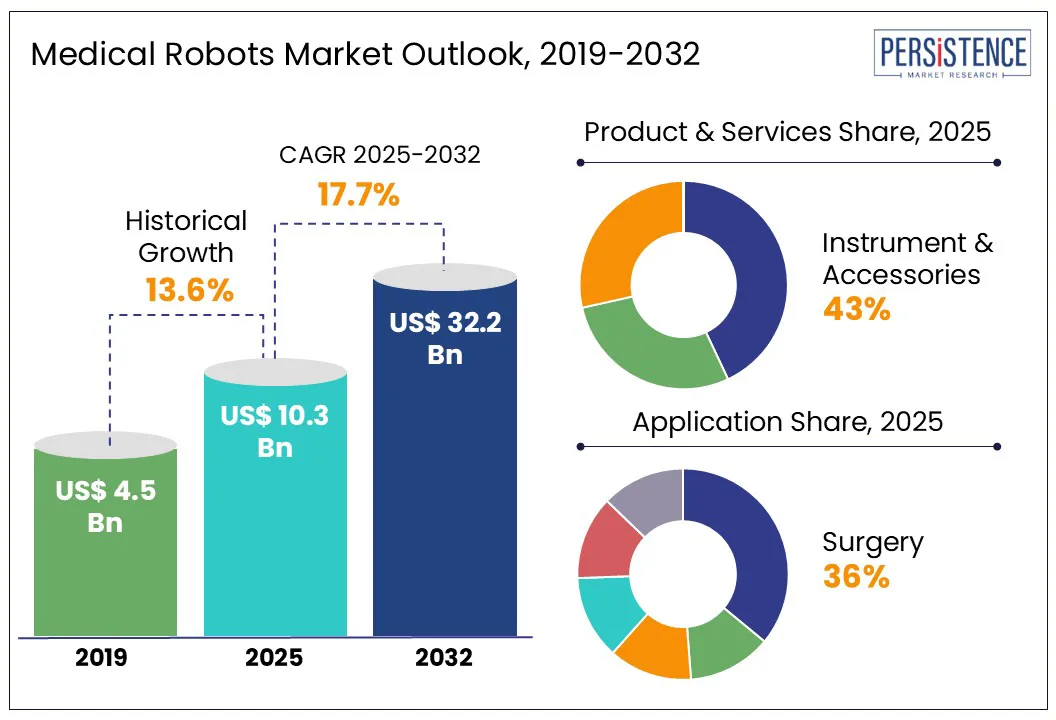
The global medical robots market is projected to witness a CAGR of 17.7% from 2025 to 2032. It is anticipated to increase from US$ 10.3 Bn in 2025 to a staggering US$ 32.2 Bn by 2032.
According to Persistence Market Research, the global medical robots market is witnessing significant expansion, primarily fueled by the growing need for precision in complex surgical procedures and the rising demand for automation in healthcare settings. Medical robots are increasingly used in a variety of applications, including surgery, diagnostics, rehabilitation, and patient care. Surgical robots, in particular, offer enhanced dexterity, reduced invasiveness, and quicker recovery times, making them a preferred choice for procedures such as urology, orthopedics, and neurosurgery. Rehabilitation robots support physical therapy by providing consistent and adaptive movement, improving recovery outcomes for patients with mobility impairments. Additionally, robotic systems are used to automate routine hospital tasks, such as disinfection and medication delivery, improving efficiency and reducing the risk of infections.
Key Industry Highlights:
- Medical robots are increasingly adopted due to their ability to perform highly precise and minimally invasive surgeries. These procedures result in smaller incisions, less blood loss, reduced postoperative pain, and faster recovery times for patients.
- The integration of AI and machine learning algorithms in medical robotics is revolutionizing clinical decision-making and operational efficiency.
- Medical robots are streamlining hospital operations by automating routine and labor-intensive tasks such as medication delivery, disinfection, patient transport, and inventory management
|
Global Market Attribute |
Key Insights |
|
Medical Robots Market Size (2025E) |
US$ 10.3 Bn |
|
Market Value Forecast (2032F) |
US$ 32.2 Bn |
|
Projected Growth (CAGR 2025 to 2032) |
17.7% |
|
Historical Market Growth (CAGR 2019 to 2024) |
13.6% |
Market Dynamics
Driver - Integration of digital twins for surgery simulation
The integration of digital twin technology in medical robotics is transforming surgical planning and execution. A digital twin is a highly detailed, real-time virtual model of a patient’s anatomy, created using imaging data such as MRI, CT, and ultrasound, allowing surgeons to simulate procedures before making a single incision. In robotic surgery, this enables precise preoperative planning, risk assessment, and even rehearsal in a simulated environment that mirrors the patient’s actual physiology. Unlike traditional models, digital twins adapt dynamically to new data, such as changes in organ size, tissue elasticity, or tumor growth. When synced with robotic systems, they guide intraoperative decisions, optimizing tool paths and minimizing tissue damage.
For instance, according to online study it stated about a launch of virtual-reality-based digital-twin robotic minimally invasive surgery (VRDT-RMIS) simulator. That effectively distinguished surgical skill proficiency between expert and novice surgeons, highlighting its potential in training and assessment for novices. The integration of haptic feedback and visual cues has further encouraged the training experience, making it more immersive and realistic. This approach significantly enhances accuracy and outcomes, especially in complex procedures involving the brain, spine, or heart. Moreover, digital twins facilitate personalized treatment strategies and monitoring. As AI and real-time data integration advance, digital twins are set to become a core component of intelligent robotic surgery ecosystems.
Restraint - Significant cost of robotic systems
The significant cost of robotic systems remains a major restraint in the medical robots market, particularly for mid-sized and resource-limited healthcare facilities. Acquiring a surgical robot can cost upwards of $1–2 million, with additional expenses for installation, maintenance, and disposable instruments adding to the financial burden. For instance, da Vinci Xi, estimated range between $1.5 million and $2.5 million. Moreover, training personnel is required to operate these machines along with dedicated time and investment, further increasing operational costs. Hospitals often face difficulty justifying these expenditures when reimbursement models do not fully compensate for robotic procedures. Unlike traditional surgical tools, robotic systems demand continuous software updates and periodic hardware upgrades, creating ongoing financial commitments. For many healthcare providers, especially in developing regions, this high cost-to-benefit ratio delays procurement or limits robotic use to a narrow range of procedures.
Opportunity - Robotic endoscopy and capsule navigation
Robotic endoscopy and capsule navigation represent a groundbreaking advancement in gastrointestinal diagnostics, offering a minimally invasive and highly patient-friendly alternative to conventional endoscopic procedures. These miniaturized robotic capsules, often no larger than a vitamin pill, can be ingested by the patient to navigate through the digestive tract while capturing high-resolution images or video in real-time. Unlike traditional endoscopes, which require sedation and can cause discomfort, robotic capsules enhance patient compliance and eliminate procedural anxiety. Advanced models are equipped with magnetic control systems or micro-motors that allow clinicians to remotely steer the capsule to target specific areas of interest. Some versions also incorporate sensors for pH, temperature, and pressure measurement, further enriching diagnostic capabilities.
According to a recent study, wireless capsule endoscopy (WCE) provides a non-invasive method for examining the digestive tract, removing the need for sedation and avoiding the complications linked to traditional endoscopic techniques. It plays a crucial role in identifying abnormalities in gastrointestinal tissues, particularly within the small intestine. These capsules are particularly useful in detecting bleeding, inflammation, tumors, and polyps in hard-to-reach regions such as the small intestine. As wireless communication, imaging, and robotic control technologies evolve, capsule-based endoscopy is poised to become a mainstream diagnostic tool in gastroenterology.
Category-wise Analysis
Product Insights
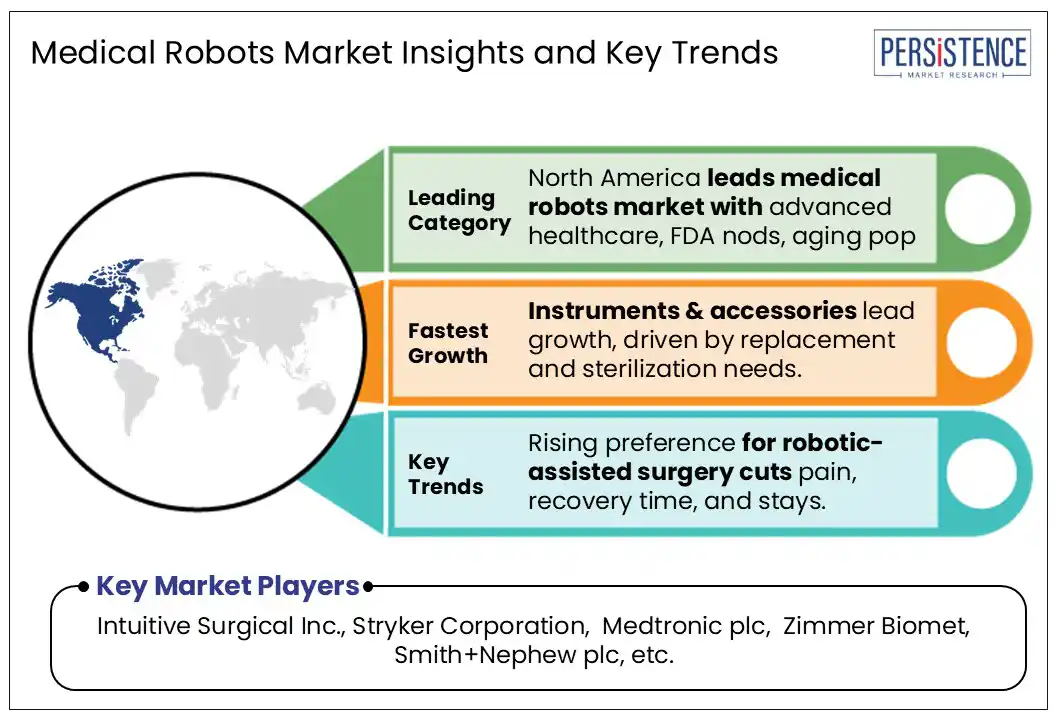
The instruments & accessories segment is expected to hold the largest market share of medical robots market due to its recurring demand and critical role in robotic-assisted procedures. Unlike robotic systems, which are high-cost capital investments purchased infrequently, instruments and accessories such as surgical tools, end-effectors, and sensors require regular replacement after each procedure to ensure sterility and precision. This leads to a continuous and predictable revenue stream for manufacturers. Additionally, as the number of robotic surgeries increases globally, particularly in fields like urology, orthopedics, and gynecology, the need for compatible consumables rises proportionally. Hospitals and surgical centers are more likely to invest consistently in these essential components to maintain operational efficiency and patient safety. Furthermore, advancements in instrument design and material durability are enhancing their adoption. Overall, the volume-driven demand, coupled with high turnover rates, positions the instruments & accessories segment as the primary revenue driver in the medical robots market.
Application Insights
The surgery application segment holds the major share in the medical robots market due to its transformative impact on modern surgical procedures. Robotic-assisted surgeries offer unmatched precision, dexterity, and control, enabling surgeons to perform complex, minimally invasive procedures with greater accuracy and fewer complications. This has significantly reduced patient trauma, minimized blood loss, shortened hospital stays, and accelerated recovery times, benefits that have made robotic surgery increasingly preferred in clinical settings. Moreover, growing demand for minimally invasive surgeries in specialties such as urology, gynecology, orthopedics, and cardiothoracic procedures has fueled the adoption of surgical robots globally.
Leading technologies, like the da Vinci Surgical System, have set new standards in the field by integrating 3D imaging, AI-assisted decision-making, and advanced instrumentation. The rising aging population, coupled with an increase in chronic diseases and surgical procedures, further amplifies the demand. Hospitals and surgical centers are also investing in robotic platforms to gain competitive advantages, reduce post-operative complications, and enhance patient satisfaction.
End-user Insights
Hospitals and clinics are the primary adopters of medical robots due to their broad service offerings, high patient inflow, and better financial capacity to invest in advanced robotic systems. These facilities routinely perform complex procedures, especially in surgery, diagnostics, and patient rehabilitation, where robotic assistance significantly improves precision, outcomes, and efficiency. Additionally, hospitals are often early adopters of cutting-edge technologies like robotic-assisted surgery and automated diagnostic tools to enhance care delivery and remain competitive. Their integration of robots across various departments, from operating rooms to pharmacy automation and patient care, makes them the leading contributor to overall market revenue in the medical robotics space.
Regional Insights and Trends
North America Medical Robots Market Trends
The North American medical robots market is witnessing strong growth, driven by the region’s advanced healthcare infrastructure, high adoption of minimally invasive surgeries, and rapid technological innovation. The United States leads in robotic surgery installations, with hospitals investing heavily in systems like the da Vinci Surgical System to enhance precision and reduce post-operative complications. Favorable reimbursement policies, increased healthcare spending, and a rising aging population with chronic conditions further accelerate demand. Moreover, growing partnerships between technology companies and healthcare providers are fueling robotic integration across hospitals and ambulatory surgical centers.
Europe Medical Robots Market Trends
The European medical robots market is gaining momentum due to its strategic emphasis on automation, precision medicine, and digital healthcare transformation. Countries such as Germany, the Netherlands, and Sweden are pioneering the integration of surgical and rehabilitation robots in both public and private hospitals. There is a growing focus on robotic rehabilitation solutions to address the rising incidence of stroke and neurodegenerative disorders among Europe’s aging population. This regional approach, balancing innovation with safety and accessibility, continues to drive adoption across multiple healthcare segments in Europe.
Asia Pacific Medical Robots Market Trends
The Asia Pacific medical robots market is rapidly evolving into a global innovation hotspot, with emerging economies prioritizing robotics to overcome healthcare access gaps and workforce shortages. Countries like China and India are not only adopting but also developing cost-effective, scalable robotic platforms to serve large patient populations. In Southeast Asia, governments are piloting AI-integrated tele-robotic systems to extend surgical expertise into rural and underserved areas. Japan, known for its advanced robotics ecosystem has excelled in humanoid and assistive robots for elderly care, while South Korea is investing heavily in robotics-as-a-service (RaaS) models for diagnostics and surgery. This regional dynamism positions Asia Pacific as the next frontier for medical robotics innovation and adoption.
Competitive Landscape
The global medical robots market is highly competitive, with a mix of established global players and emerging startups driving innovation. Companies compete by offering advanced surgical technologies, including minimally invasive procedures, robotic-assisted systems, and cutting-edge imaging solutions. The focus on improving patient outcomes, reducing recovery times, and enhancing precision is central to market strategies.
Key Industry Developments:
- In April 2025, Zimmer Biomet Holdings, Inc. announced that its RibFix Advantage® Fixation System had received CE Mark certification, marking the first CE Mark for an intrathoracic rib fixation system.
- In March 2024, Intuitive received 510(k) clearance from the U.S. Food and Drug Administration (FDA) for the da Vinci 5, the company’s next-generation multiport robotic system.
Companies Covered in Medical Robots Market
- Intuitive Surgical Inc.
- Stryker Corporation
- Medtronic plc
- Zimmer Biomet
- Smith+Nephew plc
- Johnson & Johnson (through Ethicon and Auris Health)
- Siemens Healthineers AG
- Asensus Surgical, Inc.
- Renishaw plc
- Cyberdyne Inc.
- ReWalk Robotics Ltd.
- Ekso Bionics Holdings Inc.
- Brainlab AG
- Others
Frequently Asked Questions
The global medical robots market is estimated to increase from US$10.3 Bn in 2025 to US$32.2 Bn by 2032.
Robotic systems enable greater precision, reduced blood loss, and quicker recovery times, making them increasingly preferred for procedures such as urology, orthopedics, and gynecology.
The market is projected to record a CAGR of 17.7% during the forecast period from 2025 to 2032.
Advancements in AI can enhance real-time decision-making, diagnostics, and autonomous robotic functions, opening new frontiers in robotic surgery, rehabilitation, and telepresence.
Intuitive Surgical Inc., Stryker Corporation, Medtronic plc, Zimmer Biomet, and Smith+Nephew plc are the key players within this market space.


