




- Automotive
- Maxi Scooters Market
Maxi Scooters Market Size, Share, and Growth Forecast, 2026 - 2033
Maxi Scooters Market by Engine Capacity (250–500 cc maxi scooters, 500–750 cc maxi scooters, Above 750 cc maxi scooters), Engine Type (Single Cylinder Engine, Parallel Twin Engine, Multi Cylinder Engine), and Regional Analysis for 2026 - 2033

Maxi Scooters Market Size and Trends Analysis
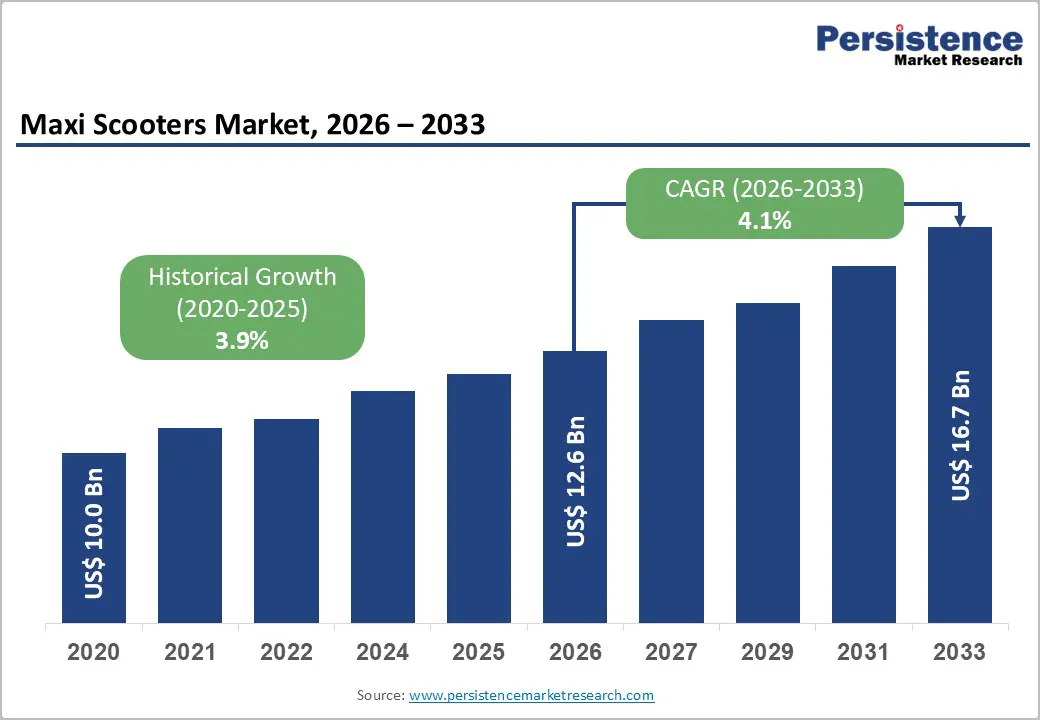
The global maxi scooters market size is likely to be valued at US$12.6 billion in 2026 and is expected to reach US$16.7 billion by 2033, growing at a CAGR of 4.1% during the forecast period from 2026 to 2033, driven by rising demand for efficient, comfortable, and versatile personal mobility solutions.
Rising fuel costs, stricter environmental laws, and increased awareness of carbon emissions are driving the shift to larger-engine and electric maxi scooters, offering better performance and practicality. Improved engine efficiency, safety features, and smart tech are enhancing the user experience. Growing disposable incomes and changing demographics are also fueling demand for premium scooters in both commuting and leisure segments.
Key Industry Highlights:
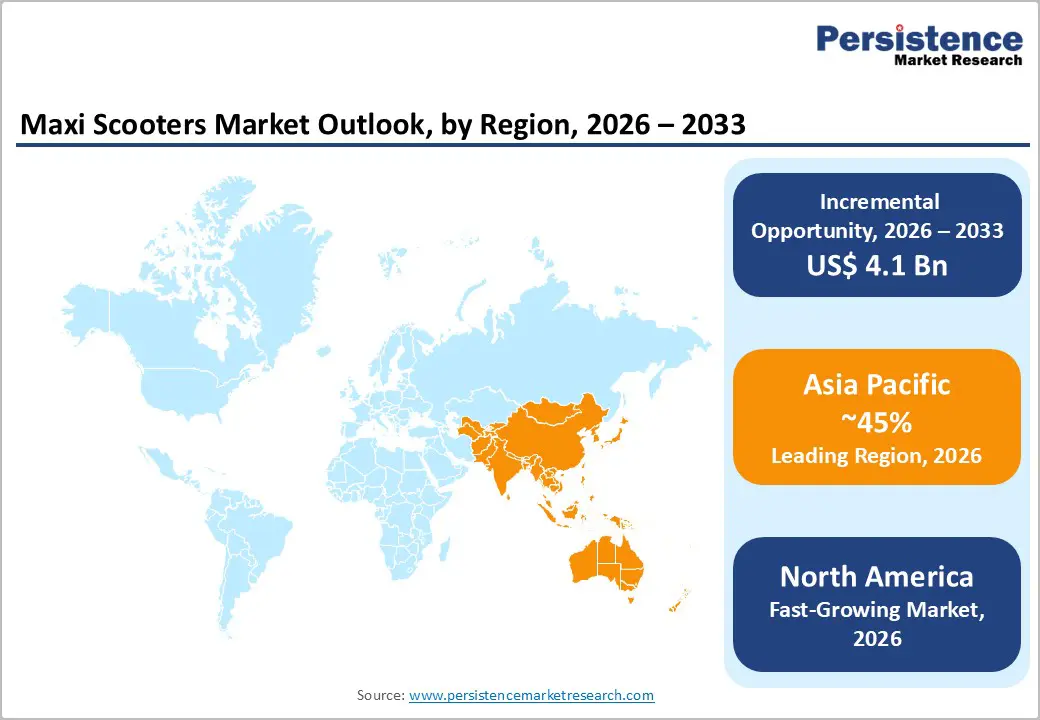
- Leading Region: Asia Pacific is anticipated to be the leading region, accounting for 45% of the market share in 2026, driven by urbanization, rising disposable incomes, and strong manufacturing capabilities.
- Fastest-growing Region: North America is likely to be the fastest-growing region in the maxi scooters in 2026, driven by premium model innovation, urban commuting demand, and regulatory support for efficient engines.
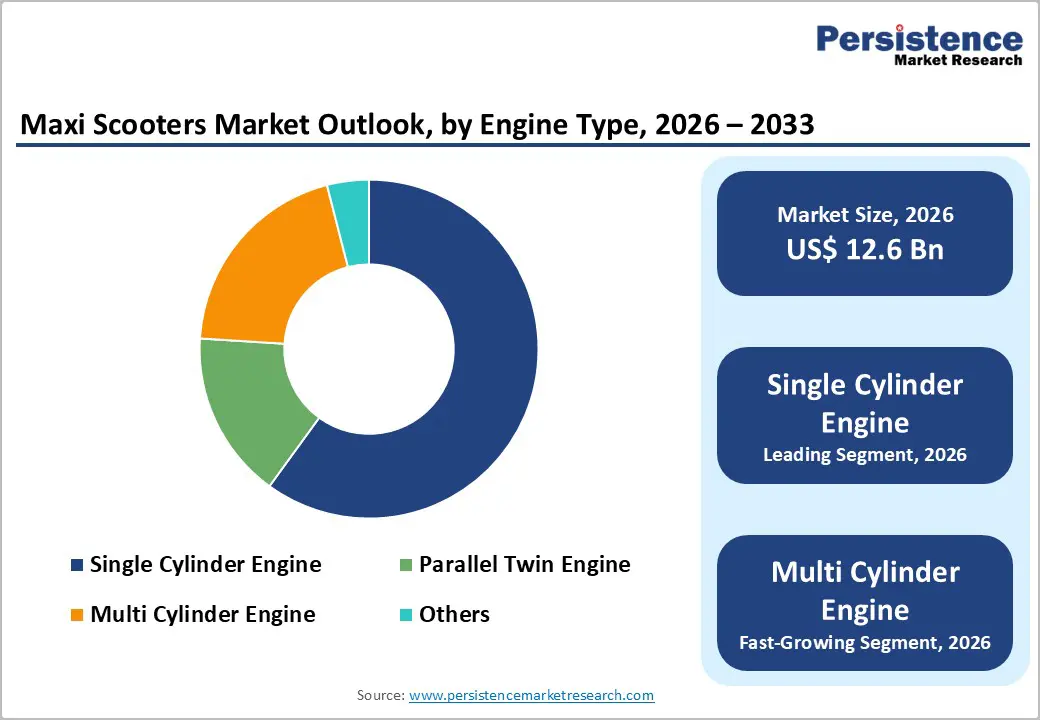
- Leading Engine Capacity: The 250–500 cc segment is projected to lead in 2026, accounting for 60% of revenue share, driven by a balance of performance, fuel efficiency, and affordability.
- Leading Engine Type: A single-cylinder engine is anticipated to be the leading engine type, accounting for over 70% of revenue share in 2026, supported by its cost-effectiveness, fuel efficiency, and widespread adoption in mid-range maxi scooters.
| Key Insights | Details |
|---|---|
|
Maxi Scooters Market Size (2026E) |
US$12.6 Bn |
|
Market Value Forecast (2033F) |
US$16.7 Bn |
|
Projected Growth (CAGR 2026 to 2033) |
4.1% |
|
Historical Market Growth (CAGR 2020 to 2025) |
3.9% |
Market Factors - Growth, Barriers, and Opportunity Analysis
Technological Advancements in Engine Efficiency and Safety
Manufacturers are increasingly adopting advanced fuel injection systems, electronic throttle control, and lightweight engine components to improve fuel efficiency while maintaining power. Both single- and multi-cylinder engines now feature liquid cooling, variable valve timing, and optimized combustion chamber designs, reducing fuel consumption and emissions without sacrificing performance. The rise of electric and hybrid maxi scooters highlights the shift toward sustainable mobility, backed by advancements in battery technology, regenerative braking, and energy management systems. Real-time engine diagnostics and performance monitoring also enable predictive maintenance, lowering operating costs and extending vehicle lifespan.
Safety innovations are driving market growth, with features such as advanced braking systems, traction control, and stability management now standard in many models. Anti-lock Braking Systems (ABS) help prevent wheel lock-up during sudden braking, especially on wet or uneven surfaces. Traction control and ride-by-wire systems improve handling by adjusting power delivery in challenging conditions. Leading manufacturers such as Yamaha, BMW, and Piaggio have introduced digital dashboards with real-time diagnostics, navigation, and collision alerts to enhance rider safety. Adaptive lighting, LED headlamps, and cornering assist technologies are improving visibility during night rides and sharp turns.
Supply Chain Constraints and Component Shortages
Modern maxi scooters rely heavily on advanced electronic components, including microchips for engine management systems, ABS, traction control, and smart connectivity features. Semiconductor shortages, coupled with delays in sourcing critical materials such as high-grade steel, aluminum, and specialized plastics, have disrupted production schedules, especially for premium and mid-range scooters. Asia Pacific, a major manufacturing hub, has experienced intermittent logistical bottlenecks, port congestion, and rising freight costs, which have impacted timely exports to Europe and North America. These disruptions often lead to extended lead times, production delays, and increased manufacturing costs, occasionally affecting pricing and market availability.
Manufacturers are addressing these challenges by diversifying supplier networks, localizing component sourcing, and investing in digital supply chain management systems to track and optimize production flow. Collaborative efforts with vendors and strategic inventory planning are helping to mitigate risks. Companies are entering long-term procurement contracts with semiconductor and battery suppliers to ensure stable availability and cost control. The use of predictive analytics and AI-based demand forecasting is enabling better production planning and faster response to market fluctuations. Manufacturers are strengthening supplier collaboration through joint development programs to ensure component compatibility and quality consistency.
Growth in Electric and Hybrid Maxi Scooter Variants
Governments across Europe and the Asia Pacific are implementing stricter emission norms, low-emission zones, and incentive programs that favor electric two-wheelers. Electric maxi scooters offer key advantages such as lower running costs, reduced maintenance requirements, and zero tailpipe emissions, making them ideal for dense urban environments. Continuous advancements in lithium-ion battery technology, improved energy density, and fast-charging capabilities have enhanced vehicle range and performance, increasing consumer confidence. The integration of smart connectivity, regenerative braking, and advanced thermal management systems improves efficiency and ride experience. Shared mobility operators and delivery fleets are increasingly adopting electric maxi scooters to meet sustainability targets and reduce operating expenses.
The growth of hybrid maxi scooter variants represents another promising opportunity within the market, particularly for consumers seeking a balance between performance and efficiency. Hybrid systems combine internal combustion engines with electric motors, enabling improved fuel economy, smoother acceleration, and reduced emissions without compromising riding range. This is especially appealing in regions where charging infrastructure is still developing. Hybrid maxi scooters cater to touring enthusiasts and premium commuters who require longer range and higher power output. Manufacturers are investing in advanced powertrain integration, lightweight materials, and energy management software to optimize hybrid performance. Rising fuel prices and increasing demand for premium, technologically advanced two-wheelers further support adoption.
Category-wise Analysis
Engine Capacity Insights
The 250–500 cc engine capacity is expected to lead the maxi scooter market, accounting for approximately 60% of total revenue in 2026, thanks to its optimal balance of performance, fuel efficiency, and affordability. This segment is widely preferred by urban and semi-urban riders who require sufficient power for highway cruising while maintaining ease of handling in congested city environments. Scooters in this range offer comfortable seating, adequate storage, and stable riding dynamics without the higher ownership and maintenance costs associated with larger engines. For example, the Yamaha XMAX series has gained strong market acceptance due to its practical performance, refined design, and versatility.
The 500–750 cc engine segment is likely to be the fastest-growing in 2026, driven by rising consumer interest in touring capability, premium features, and enhanced riding comfort. This segment appeals primarily to experienced riders and enthusiasts seeking higher power output, smoother acceleration, and long-distance riding comfort without transitioning to heavyweight motorcycles. Manufacturers are positioning these scooters as premium offerings, integrating advanced suspension systems, digital instrumentation, and enhanced safety features to justify higher price points. For example, the Yamaha TMAX is widely recognized for its strong performance, refined handling, and premium build quality.
Engine Type Insights
The single-cylinder engine is expected to dominate the market, accounting for around 70% of revenue in 2026, thanks to its cost-effectiveness, fuel efficiency, and mechanical simplicity. Widely used in mid-range maxi scooters, especially in popular engine capacity categories, single-cylinder engines provide sufficient power for urban commuting and moderate highway use while keeping production and maintenance costs low. Advances in engine tuning, cooling systems, and vibration control have also enhanced comfort, making these scooters more suitable for longer rides. For instance, the Honda Forza lineup showcases the balanced performance and efficiency of single-cylinder engines.
The multi-cylinder engine segment is projected to grow the fastest in 2026, driven by increasing demand for premium performance, smoother power delivery, and better riding dynamics. This segment caters to high-end consumers who prioritize comfort, stability, and touring capability over cost. Multi-cylinder engines reduce vibration and improve throttle response, making them ideal for long-distance and highway riding. Technological features such as advanced traction control and ride modes further boost the appeal of multi-cylinder maxi scooters. The BMW C Evolution, for example, exemplifies how refined power delivery and premium engineering can elevate the riding experience.
Regional Insights
North America Maxi Scooters Market Trends
North America is expected to be the fastest-growing region for maxi scooters in 2026, driven by a rising interest in alternative urban mobility and lifestyle-oriented two-wheelers. Increasing traffic congestion in major cities such as New York, Los Angeles, and San Francisco is prompting consumers to view maxi scooters as a practical alternative to cars for daily commuting. Recreational riding and weekend touring remain key demand drivers, particularly among middle-aged and premium buyers. Regulatory support for fuel-efficient, low-emission vehicles, along with favorable emission policies, is further boosting market adoption. In North America, consumers are placing greater emphasis on comfort, safety features, and performance, making maxi scooters an attractive option compared to smaller scooters or motorcycles.
A key trend in the region is the growing demand for premium and technologically advanced models, particularly in higher engine capacity segments. Imported scooters from Japanese and European manufacturers dominate the market, benefiting from strong brand loyalty and performance expectations. For instance, BMW Motorrad has gained popularity in North America with its premium maxi scooters, appealing to consumers who prioritize high performance and advanced safety features. Increased interest in electric and hybrid models, along with investments in electrification, signals a shift toward more sustainable mobility. The expansion of charging infrastructure and the rising availability of connected features, such as smart dashboards and rider-assist technologies, are further enhancing the appeal of maxi scooters.
Europe Maxi Scooters Market Trends
Europe is set to be a key market for maxi scooters in 2026, fueled by a strong two-wheeler culture and a well-established urban mobility infrastructure. With high urbanization, compact city layouts, and ongoing traffic congestion, many consumers are turning to maxi scooters as efficient and practical daily transportation. European riders prioritize comfort, safety, and environmental performance, driving demand for scooters equipped with advanced braking systems, stability control, and fuel-efficient engines. Strict emission regulations and the expansion of low-emission zones in major cities are accelerating the transition to cleaner, more efficient mobility options, including electric and hybrid maxi scooters.
The European maxi scooter market is particularly driven by a preference for premium, performance-focused models that combine practicality with touring capabilities. European manufacturers play a pivotal role in setting design and innovation standards. For instance, Piaggio Group, through its Aprilia and Vespa brands, has strengthened its market presence by offering stylish, technologically advanced maxi scooters suited for both urban and long-distance riding. Consumers are increasingly valuing connected features, ergonomic designs, and refined performance. The rising demand for advanced safety systems, alongside the need to meet stringent emission standards, is pushing manufacturers to continuously innovate.
Asia Pacific Maxi Scooters Market Trends
Asia Pacific is expected to be the leading region for maxi scooters, capturing a 45% market share by 2026, driven by rapid urbanization, growing traffic congestion, and rising disposable incomes in key economies such as China, Japan, India, and Southeast Asia. In densely populated cities, consumers are increasingly seeking mobility solutions that offer greater comfort, enhanced performance, and practicality compared to traditional scooters. Maxi scooters are gaining popularity for both daily commuting and intercity travel, thanks to their larger engine capacity, improved stability, and better storage options. The region also benefits from cost-effective manufacturing, established supply chains, and a large base of two-wheeler users moving toward premium models.
The market in the Asia Pacific is also seeing a shift toward premium models and technological innovation. Consumers are becoming more interested in scooters with advanced safety systems, digital displays, and connected features. Japanese manufacturers are playing a significant role in shaping market trends, with brands such as Honda strengthening their presence by offering reliable, technologically advanced maxi scooters designed for both urban commuting and long-distance touring. The region is also emerging as a key hub for the development of electric and hybrid maxi scooters, supported by government incentives and investments in charging infrastructure. Strong domestic manufacturing and export-driven production are further boosting the region’s competitiveness.
Competitive Landscape
The global maxi scooters market is moderately fragmented, with both well-established multinational companies and strong regional players shaping its dynamics. Market trends are driven by continuous innovation, brand positioning, and the expansion of product offerings across both mid-range and premium segments. Leading manufacturers focus on enhancing performance, comfort, and safety while ensuring compliance with evolving emission standards and shifting consumer preferences. The competitive landscape is further influenced by the growing demand for electric and hybrid maxi scooters, pushing manufacturers to invest significantly in research and development, platform electrification, and advanced technologies.
Key players such as Yamaha Motor, Honda, Piaggio Group (Vespa/Aprilia), BMW Motorrad, Suzuki, and Kymco, along with others, dominate the market through a blend of scale and regional specialization. These companies compete by innovating products, offering premium designs, integrating advanced technology, and expanding into new markets. Strategic moves also include partnerships with technology providers, the growth of electric scooter offerings, and the strengthening of dealer and service networks. Branding, after-sales support, and competitive pricing are critical factors that allow companies to capture a wide range of consumer segments and remain competitive in the evolving maxi scooters market.
Key Industry Developments:
- In October 2025, TVS Motor Company teased its upcoming M1-S electric maxi-scooter ahead of its debut at EICMA 2025 in Milan, marking a major milestone in the company’s electric mobility strategy. Developed in partnership with ION Mobility, a Singapore-based EV startup in which TVS holds a strategic stake, the M1-S is positioned as a premium electric maxi-scooter aimed at urban commuters in emerging markets. The M1-S showcases TVS's commitment to blending sporty design, high-performance electric powertrains, and cutting-edge connectivity features.
- In February 2025, Honda Motor Co. announced its entry into India's premium scooter market, revealing plans to launch the Honda ADV160 maxi-scooter by 2026. Codenamed K4LA, the ADV160 is a sporty, adventure-style scooter designed for both urban commuters and touring enthusiasts. It will directly compete with premium models such as the Yamaha Aerox 155 and Hero Xoom 160, heightening competition in India's expanding maxi and performance scooter segment. The ADV160 is expected to bolster Honda's premium portfolio in India, tapping into the growing demand for high-performance, technologically advanced scooters.
Companies Covered in Maxi Scooters Market
- Yamaha Motor
- Honda
- Piaggio/Vespa
- BMW Motorrad
- Suzuki
- Kymco
- SYM
- Aprilia
- Peugeot Motocycles
- Hero MotoCorp
- Kawasaki
- Zapp
Frequently Asked Questions
The global maxi scooters market is projected to reach US$12.6 billion in 2026.
The maxi scooters market is driven by increasing demand for comfortable, fuel-efficient transportation, advancements in safety and connectivity technologies, and a growing preference for premium and electric two-wheelers.
The maxi scooters market is expected to grow at a CAGR of 4.1% from 2026 to 2033.
Key market opportunities include the growth of electric and hybrid models, rising demand for premium and touring scooters, expansion into emerging urban markets, and the increasing adoption of connected and smart mobility technologies.
Yamaha Motor, Honda, Piaggio, Vespa, BMW Motorrad, Suzuki, Kymco, SYM, and Aprilia are the leading players.


