




- Inks, Coatings, Adhesives & Sealants (ICAS)
- Low Voc Paints and Coatings Market
Low Voc Paints and Coatings Market Size, Share, and Growth Forecast, 2025 - 2032
Low Voc Paints and Coatings Market By Product Type (Residential, Commercial, Automotive, Marine), Product Formulation (Acrylics, Alkyds, Epoxy, Polyurethane), Application and Regional Analysis for 2025 – 2032

Low Voc Paints and Coatings Market Size and Trends Analysis
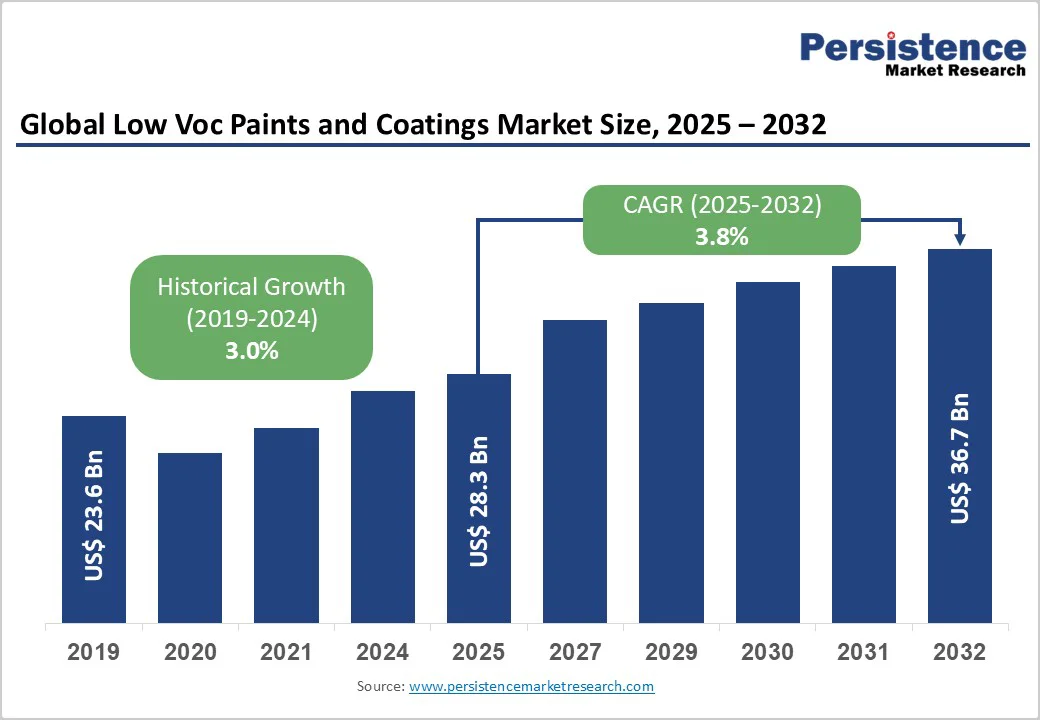
The global low Voc paints and coatings market size is likely to be valued US$28.3 Billion in 2025, expected to reach at US$36.7 Billion by 2032 growing at a CAGR of 3.8% during the forecast period from 2025 to 2032 driven by increasing environmental regulations, rising consumer demand for eco-friendly and health-safe building materials, and advancements in low-emission coating technologies. The need for improved indoor air quality to mitigate health risks like allergies and respiratory issues has significantly boosted the adoption of low Voc paints and coatings across residential, commercial, and industrial sectors, particularly in urbanized regions. The growing acceptance of low Voc paints and coatings as alternatives to high-VOC options, especially in green building projects certified by LEED and BREEAM, is a key growth factor.
Key Industry Highlights:
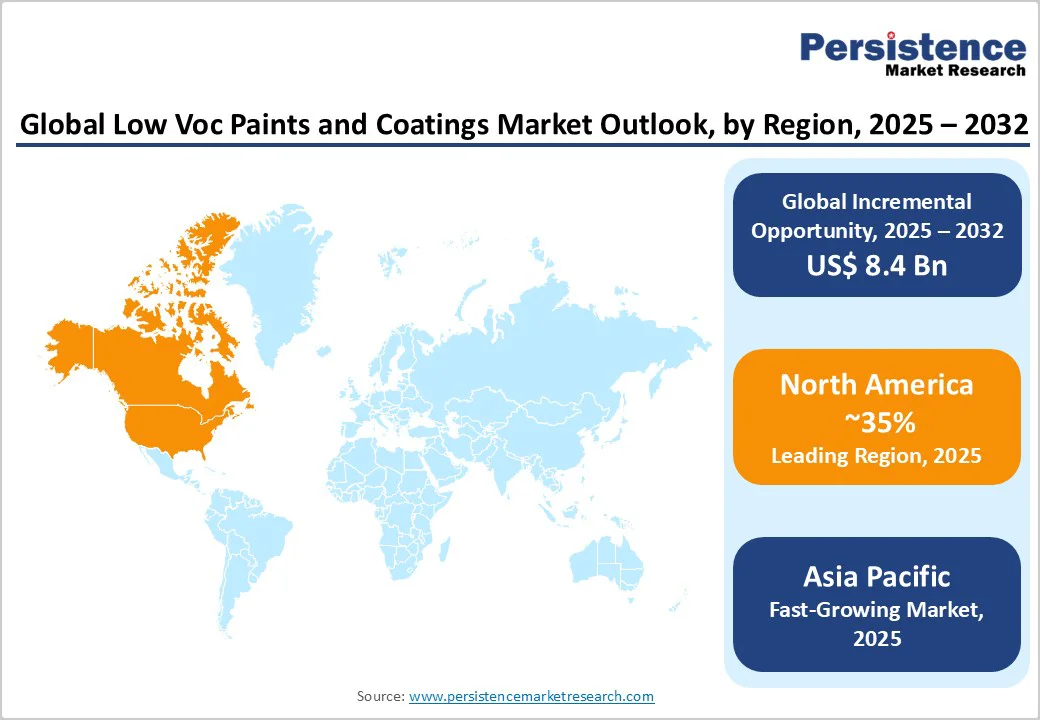
- Leading Region: North America, commanding a 35% market share in 2025, driven by stringent EPA regulations and high adoption in the U.S.
- Fastest-growing Region: Asia Pacific, fueled by rapid urbanization and green construction initiatives in China and India.
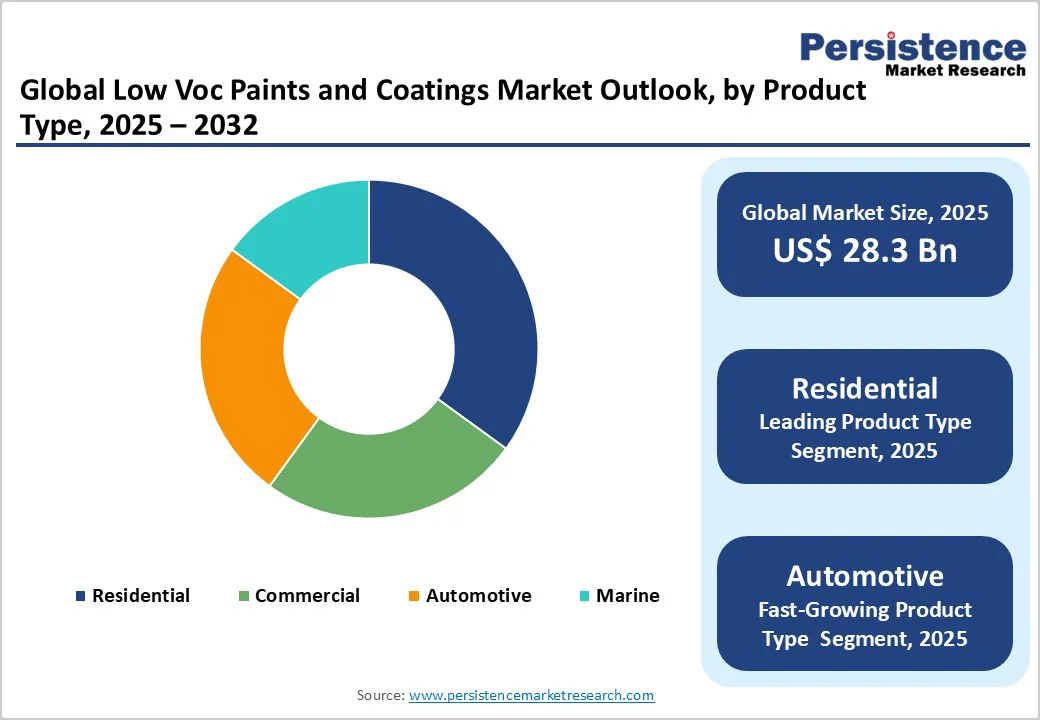
- Dominant Product Type: Residential, holding approximately 40% of the market share, due to rising home renovation trends and health-conscious consumers.
- Leading Product Formulation: Acrylics, accounting for over 45% of market revenue, driven by versatility and low-emission properties.
- Leading Application: Waterborne, contributing nearly 50% of market revenue, owing to regulatory compliance and ease of application.
| Key Insights | Details |
|---|---|
|
Low Voc Paints and Coatings Market Size (2025E) |
US$28.3 Bn |
|
Market Value Forecast (2032F) |
US$36.7 Bn |
|
Projected Growth (CAGR 2025 to 2032) |
3.8% |
|
Historical Market Growth (CAGR 2019 to 2024) |
3.0% |
Market Factors – Growth, Barriers, and Opportunity Analysis
Rising Environmental Regulations and Demand for Sustainable Materials
The low Voc paints and coatings market is primarily driven by strict environmental regulations and increasing consumer preference for sustainable, health-conscious building materials. Governments and international agencies have implemented regulations limiting volatile organic compound emissions, encouraging manufacturers to develop eco-friendly and low-emission alternatives. These coatings significantly improve indoor air quality by minimizing the release of harmful chemicals, reducing health risks such as respiratory irritation and allergies. Growing awareness about indoor pollution and its impact on well-being has led to greater adoption across residential, commercial, and industrial construction projects.
The expanding construction and real estate sectors, particularly in developing regions, are accelerating the demand for sustainable paints and coatings. Leading manufacturers are investing in research and innovation to enhance product performance, durability, and aesthetic appeal while maintaining environmental compliance. Initiatives promoting green buildings and sustainable urban development are also supporting market expansion.
Higher Costs and Performance Trade-Offs
Higher production costs and performance limitations of low Voc paints and coatings pose significant restraints on market growth. The use of specialized bio-based resins and eco-friendly additives significantly increases manufacturing expenses compared to conventional high-VOC paints, making it difficult for producers to compete in price-sensitive regions. Smaller manufacturers, in particular, struggle to balance cost efficiency with sustainability goals, creating a barrier to wider market adoption.
Performance limitations also affect growth, as some low VOC formulations may show reduced durability, gloss, or resistance when exposed to harsh environmental conditions such as extreme humidity or marine environments. These shortcomings can shorten coating lifespans and lead to higher maintenance requirements. Additionally, regulatory testing and certification for emissions compliance add further financial and operational burdens, requiring extensive R&D and documentation. Large companies can absorb these costs through advanced technologies and economies of scale, but smaller players often find it challenging to match their innovation pace.
Advancements In Bio-Based and Zero-VOC Technologies
Advancements in bio-based and zero-VOC technologies present significant growth opportunities for the low Voc paints and coatings market. he development of plant-derived resins from sources such as soy and algae is helping manufacturers reduce environmental impact while maintaining performance comparable to conventional formulations. These bio-based materials support sustainability goals by lowering carbon emissions and promoting renewable resource use. Additionally, hybrid powder coatings are emerging as a key innovation, offering improved durability and chemical resistance for demanding applications such as automotive and industrial coatings.
Technological innovations such as nanotechnology are enhancing adhesion, weatherability, and UV resistance, improving overall product lifespan and performance. Modular production techniques are also helping reduce operational costs and streamline manufacturing, making sustainable coatings more accessible. As global industries increasingly shift toward eco-friendly and energy-efficient materials, low VOC and bio-based coatings are gaining traction in sectors such as construction, automotive, and consumer goods. In regions with stringent environmental regulations, including Europe and North America, these advancements align with green building initiatives and net-zero emission standards, driving long-term market growth and innovation in sustainable coating technologies.
Category-wise Analysis
Product Type Insights
Residential dominates the sector, account for 40% of the share in 2025. due to growing home renovation and DIY trends. Increasing consumer preference for low-odour, health-safe, and eco-friendly paints in homes drives demand, as homeowners prioritize indoor air quality, aesthetic appeal, and sustainable solutions for interior and exterior applications.
Automotive is the fastest-growing segment, driven by stringent vehicle emission regulations and the rising demand for eco-friendly finishes in electric vehicle production. Manufacturers are increasingly adopting sustainable coatings that reduce environmental impact while providing superior durability, corrosion resistance, and high-performance aesthetics for modern automotive applications.
Product Formulation Insights
Acrylics lead the market, holding over 45% of the share in 2025. Due to their excellent weather resistance, durability, and compatibility with low-emission formulations. Widely used in waterborne systems for both interior and exterior applications, acrylics offer strong adhesion, colour retention, and environmental compliance, making them the preferred choice across residential, commercial, and industrial sectors.
Polyurethane is the fastest-growing segment, driven by rising demand for high-performance coatings in automotive, marine, and industrial applications. Its superior flexibility, abrasion resistance, and chemical durability make it ideal for harsh environments, while compatibility with low-VOC formulations supports sustainability and regulatory compliance across multiple end-use sectors.
Application Insights
Waterborne leads the market, accounting for 50% of the share in 2025. Due to their low emissions, easy cleanup, and strong environmental compliance. Preferred in residential and commercial applications, they offer excellent adhesion, durability, and finish quality while meeting stringent air quality regulations, making them the leading sustainable alternative to solvent-based coatings.
Powder Coatings are the fastest-growing segment, driven by their zero-VOC composition, superior durability, and eco-friendly nature. Widely adopted in automotive, industrial, and appliance manufacturing, these coatings offer excellent resistance to corrosion, chemicals, and wear, aligning with sustainability goals and regulatory standards for cleaner production and greener surface finishing.
Regional Insights
North America Low Voc Paints and Coatings Market Trends
North America accounts for 35% of the global low Voc paints and coatings market in 2025, supported by strict environmental regulations and growing awareness of sustainable building practices. The region’s leadership is driven by the enforcement of emission control standards that encourage the use of eco-friendly, low-odor coatings in both commercial and residential construction. The U.S. continues to be the primary hub for innovation, with major companies developing advanced zero-VOC formulations tailored for indoor environments and green-certified buildings. These products have become the preferred choice among consumers seeking healthier living spaces and long-lasting finishes.
In the United Kingdom, steady market expansion is being supported by sustainability-focused policies and industry-wide efforts to promote environmentally responsible materials. Government incentives and initiatives by the British Coatings Federation have accelerated the adoption of low VOC coatings in renovation and maintenance projects.
Europe Low Voc Paints and Coatings Market Trends
Europe holds about 30% market share, driven by stringent environmental regulations and sustainability initiatives. The implementation of REACH standards and the EU Green Deal has encouraged manufacturers to adopt low-emission, eco-friendly formulations, promoting the use of paints that minimize volatile organic compound emissions across residential, commercial, and industrial applications. This regulatory framework has created a favorable environment for innovation and the development of high-performance sustainable coatings.
Leading countries such as Germany, France, and the U.K. play a pivotal role in regional growth. In Germany, the automotive industry has fueled demand for polyurethane low VOC coatings, which offer superior durability, chemical resistance, and flexibility for vehicle finishes. France’s commercial construction sector emphasizes epoxy-based low VOC paints, which provide robust protection and long-lasting performance for large-scale buildings. In the U.K., eco-label schemes and green building certifications encourage the adoption of waterborne paints in residential and commercial interiors to improve indoor air quality.
Asia Pacific Low Voc Paints and Coatings Market Trends
Asia Pacific commands around 20% share and is the fastest-growing region, fueled by rapid urbanization, rising construction activities, and strengthening environmental policies. The expansion of residential, commercial, and industrial infrastructure in countries such as China and India has significantly increased the demand for eco-friendly and low-emission coatings. Governments and regulatory bodies in the region are promoting sustainable building practices, including VOC reduction mandates and green building certifications, which encourage the use of waterborne, acrylic, and bio-based paint formulations.
In China, large-scale urban construction projects across major cities are driving growth in both residential and commercial sectors. Strict regulations aimed at reducing VOC emissions further support the adoption of low-emission coatings, as developers and contractors seek products that meet environmental compliance while delivering durable performance. In India, the booming real estate market, combined with initiatives such as green rating systems for buildings, is increasing awareness and demand for sustainable paints. Acrylic and waterborne low VOC paints are particularly popular for their low odour, safety for indoor applications, and compatibility with modern construction practices.
Competitive Landscape
The global low Voc paints and coatings market is highly competitive, featuring global giants and regional innovators. In North America and Europe, PPG Industries and AkzoNobel lead with advanced R&D in sustainable coatings, while Asia Pacific sees Asian Paints offering cost-effective solutions. Emphasis on bio-based technologies and strategic partnerships intensifies competition. Key players focus on R&D for bio-based and zero-VOC innovations, acquisitions to expand portfolios, and partnerships for localized solutions. Sherwin-Williams emphasizes health-safe paints, AkzoNobel targets automotive sustainability, and BASF invests in bio-based resins.
Key Developments
- In August 2025, Sherwin-Williams has introduced a new zero-VOC interior paint line featuring built-in antimicrobial agents designed to inhibit the growth of mould and mildew on painted surfaces. This innovative product aims to enhance indoor air quality and provide long-lasting protection against microbial growth, making it ideal for residential spaces and healthcare environments.
- In February 2025, AkzoNobel has announced a strategic partnership with a leading biotechnology company to develop innovative plant-based, low volatile organic compound (VOC) coatings tailored for the automotive industry. This collaboration aims to enhance the sustainability of vehicle manufacturing by integrating renewable, bio-based materials into automotive finishes.
Companies Covered in Low Voc Paints and Coatings Market
- Axalta Coating Systems
- Valspar
- AkzoNobel
- Asian Paints
- Sika
- Tikkurila
- Nippon Paint Holdings
- RPM International
- DuPont
- BASF
- Kansai Paint
- PPG Industries
- Henkel
- Sherwin-Williams
- Benjamin Moore
- Others
Frequently Asked Questions
The global Low Voc Paints and Coatings Market is projected to reach US$28.3 Billion in 2025, driven by regulatory pressures and eco-friendly material demand.
The market is driven by stringent environmental regulations, growing consumer demand for health-safe and eco-friendly building materials, and rapid urbanization and construction growth.
The market is poised to witness a CAGR of 3.8% from 2025 to 2032, fueled by advancements in bio-based and zero-VOC technologies.
Bio-based and zero-VOC formulations offer key opportunities, reducing emissions by 40% and aligning with sustainable construction trends.
Axalta Coating Systems, AkzoNobel, PPG Industries, Sherwin-Williams, and BASF lead through innovations in eco-friendly and low Voc paints and coatings.


