




- Energy Storage Solutions
- Lithium Thionyl Chloride Battery Market
Lithium Thionyl Chloride Battery Market Size, Share, and Growth Forecast, 2026 - 2033
Lithium Thionyl Chloride Battery Market by Battery Type (Bobbin Cylindrical, Spiral, Others), Battery Capacity (Below 1000 mAh, 1000-5000 mAh, Others), End-user, Application, and Regional Analysis for 2026 - 2033

Lithium Thionyl Chloride Battery Market Size and Trends Analysis
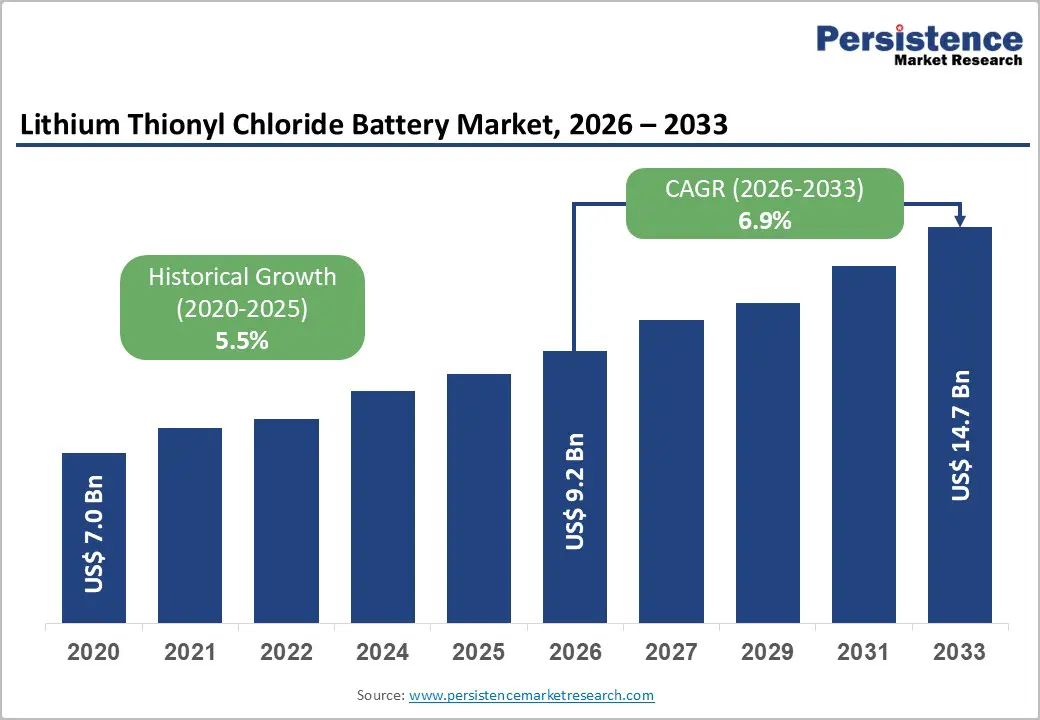
The global lithium thionyl chloride battery market size is likely to be valued at US$9.2 billion in 2026 and is expected to reach US$14.7 billion by 2033, growing at a CAGR of 6.9% between 2026 and 2033, driven by rising demand for long-life, low-maintenance power sources across smart metering, industrial IoT, medical devices, and defense electronics.
High energy density, low self-discharge rates, and extended operational lifespan position lithium thionyl chloride batteries as a preferred solution for remote and mission-critical applications. Growth is reinforced by infrastructure digitization and the increasing deployment of connected devices globally.
Key Industry Highlights:
- Leading Region: North America is projected to account for approximately 35.8% of the global market share, driven by extensive smart meter deployment, strong defense spending, and advanced industrial IoT adoption.
- Fastest-growing Region: Asia Pacific is the fastest-growing region, supported by rapid industrialization, large-scale smart meter rollouts, and expanding manufacturing capabilities across China, India, Japan, and ASEAN countries.
- Investment Plans: Investments are primarily focused on smart grid infrastructure, industrial IoT expansion, and predictive battery management solutions, with governments and private players allocating significant capital toward digital energy systems and automation.
- Dominant Battery Type: Bobbin cylindrical batteries dominate, holding an estimated 60.3% market share, due to their superior long-life performance and suitability for low-drain applications such as smart meters and remote sensors.
- Leading Battery Capacity: The below 1000 mAh segment is anticipated to lead with an approximate 49.2% market share, driven by high-volume usage in compact devices such as sensors, alarms, and tracking systems.
| Key Insights | Details |
|---|---|
| Lithium Thionyl Chloride Battery Market Size (2026E) | US$9.2 Bn |
| Market Value Forecast (2033F) | US$14.7 Bn |
| Projected Growth (CAGR 2026 to 2033) | 6.9% |
| Historical Market Growth (CAGR 2020 to 2025) | 5.5% |
DRO Analysis
Driver Analysis - Expansion of Smart Metering and Grid Modernization Programs
Smart metering continues to be a primary demand driver for lithium thionyl chloride batteries. Large-scale deployment across developed and emerging economies is significantly increasing battery consumption. In the U.S., advanced metering infrastructure (AMI) installations have reached substantial penetration levels, while countries such as India are implementing nationwide smart meter programs covering millions of consumers, feeders, and transformers. Europe is also accelerating deployments through regulatory mandates and energy efficiency targets. These meters require long-life, maintenance-free batteries, making Li-SOCl2 chemistry highly suitable.
Growth of Industrial IoT and Remote Monitoring Applications
The rapid expansion of industrial IoT ecosystems is significantly increasing the demand for reliable and long-duration energy sources. Applications such as asset tracking, environmental monitoring, oil and gas operations, and smart agriculture rely heavily on sensors deployed in remote or inaccessible locations. These devices must operate continuously for several years without battery replacement while maintaining stable voltage output. Lithium thionyl chloride batteries are well-suited for these requirements due to their low self-discharge rate, typically less than 1 percent per year, and their ability to perform efficiently across extreme temperature conditions. As industries continue to adopt connected technologies, the role of these batteries is evolving beyond simple power supply. Companies are increasingly integrating battery systems with monitoring and diagnostic capabilities to enhance performance and reduce maintenance costs. The market is therefore shifting from standalone battery sales toward integrated solutions that include lifecycle management and predictive maintenance.
Rising Demand from Medical Devices and Aging Population
The global rise in aging populations is driving the demand for advanced medical devices that require highly dependable and long-lasting power sources. Devices such as infusion pumps, portable patient monitors, and diagnostic equipment must operate reliably over extended periods without interruption. Lithium thionyl chloride batteries provide consistent voltage output and long shelf life, which are critical for ensuring patient safety and maintaining device accuracy. Healthcare systems are increasingly prioritizing reliability and reduced maintenance in medical equipment, especially in home healthcare and remote patient monitoring settings. These batteries enable extended device usage without frequent servicing, which is particularly important in critical care environments.
Restraint Analysis - Regulatory and Transportation Compliance Challenges
Lithium thionyl chloride batteries are subject to stringent regulatory requirements due to their chemical composition and classification as hazardous materials. Compliance involves meeting safety certifications, transportation regulations, labeling standards, and lifecycle management obligations across multiple jurisdictions. Recent regulatory developments, particularly in Europe, have introduced stricter requirements related to product testing, traceability, and environmental compliance. These regulatory obligations increase operational complexity for manufacturers and can extend product approval timelines. Companies operating across global markets must continuously update documentation and adhere to evolving standards, which adds to administrative and compliance costs. This creates barriers for new entrants and places pressure on smaller manufacturers with limited regulatory resources.
High Initial Cost Compared to Alternative Battery Chemistries
Lithium thionyl chloride batteries offer superior lifecycle performance, but their initial cost is significantly higher than that of conventional alkaline batteries and some rechargeable alternatives. This cost difference limits their adoption in applications where frequent battery replacement is acceptable and cost efficiency is prioritized. In price-sensitive consumer markets, manufacturers often opt for lower-cost alternatives despite the shorter lifespan. This restricts the penetration of lithium thionyl chloride batteries primarily to industrial, medical, and infrastructure applications where reliability and long operational life justify the higher upfront investment. As a result, cost considerations remain a key constraint on broader market expansion.
Opportunity Analysis - Integration of Predictive Battery Management Solutions
Battery manufacturers are increasingly integrating predictive analytics and monitoring technologies into their product offerings. These advanced systems enable real-time tracking of battery performance, remaining life, and usage patterns. By providing actionable insights, they help reduce premature battery replacement and improve overall operational efficiency in industrial and utility applications. This development represents a significant shift in the market, as companies move from selling standalone batteries to offering comprehensive energy management solutions. The integration of software and analytics creates new revenue opportunities and strengthens customer relationships by delivering ongoing value beyond the initial product sale.
Policy-Driven Infrastructure Digitization in Emerging Economies
Emerging economies, particularly in the Asia Pacific region, are investing heavily in infrastructure modernization initiatives such as smart grids, digital utilities, and industrial automation. These large-scale projects are driving the deployment of smart meters and connected devices that require long-life, maintenance-free batteries. Such initiatives not only generate immediate demand for battery installations but also create long-term replacement cycles as devices reach the end of their operational life. This provides sustained revenue potential for manufacturers and suppliers. Companies that establish a strong local presence and align with regulatory requirements are well-positioned to capitalize on these expanding opportunities.
Category-wise Analysis
Battery Type Insights
Bobbin cylindrical batteries are expected to dominate the market, accounting for an anticipated share of approximately 60.3% of the market in 2026. Their construction is specifically designed to support low and stable current discharge over extended durations, making them highly suitable for applications such as smart meters, utility infrastructure, industrial sensors, and remote monitoring systems. These batteries offer high energy density, extremely low self-discharge rates, and operational lifespans often exceeding 10-15 years, depending on usage conditions. Their widespread adoption is driven by the need for reliability in infrastructure deployments where maintenance access is limited or costly.
For instance, smart electricity and gas meters deployed in urban and rural grids rely heavily on bobbin cells to ensure uninterrupted operation over long billing cycles. Similarly, environmental monitoring sensors in agriculture and pipeline surveillance systems depend on these batteries for continuous low-power operation. This consistent demand across critical infrastructure ensures the segment’s sustained leadership.
Spiral lithium thionyl chloride batteries are expected to represent the fastest-growing segment, supported by an anticipated CAGR higher than the overall market average. Unlike bobbin cells, spiral designs are optimized for higher pulse current delivery, making them ideal for applications that require intermittent bursts of power. These include wireless communication devices, GPS tracking systems, and advanced industrial IoT nodes. The growth of this segment is closely linked to increasing IoT device sophistication, where sensors not only collect data but also transmit it frequently via wireless networks.
For example, asset tracking devices used in logistics and fleet management require batteries capable of handling repeated signal transmissions. Similarly, smart security systems and automated industrial equipment demand reliable pulse performance. As communication intensity increases across connected ecosystems, spiral batteries are becoming essential for balancing long standby life with high power bursts.
Battery Capacity Insights
The below 1000 mAh segment is expected to lead the market, holding an anticipated share of approximately 49.2% in 2026, primarily due to its extensive use in compact, low-power devices. These batteries are widely deployed in applications such as small sensors, alarm systems, RFID tags, and portable tracking devices, where size constraints and minimal energy consumption are critical factors. Their dominance is reinforced by large-scale deployments in smart infrastructure projects, including water and gas meters, as well as smart home devices such as motion detectors and door sensors.
For example, wireless environmental sensors used in smart agriculture or building automation systems typically operate on low-capacity batteries to maintain compact form factors while ensuring multi-year operation. The high volume of such devices significantly contributes to this segment’s leading position.
The 1000-5000 mAh segment is emerging as the fastest-growing category, driven by an anticipated CAGR exceeding the overall market growth rate. This capacity range is well-suited for applications requiring a balance between energy storage and compact size, such as smart meters, industrial IoT devices, and GPS-enabled tracking systems. Growth in this segment is fueled by increasing data transmission requirements and enhanced device functionality.
For instance, smart electricity meters with advanced communication modules and data logging capabilities require higher-capacity batteries to sustain operations over long periods. Similarly, industrial monitoring systems used in oil and gas pipelines or remote equipment tracking rely on this capacity range to support both sensing and communication functions. As IoT devices evolve toward higher performance and connectivity, demand for mid-capacity batteries continues to accelerate.
Regional Insights
North America Lithium Thionyl Chloride Battery Market Trends - Smart Meter Expansion and Defense-Driven Demand Growth
North America is projected to hold the largest market share at approximately 35.8% and remains the fastest-growing region, driven by strong adoption across utility, defense, and medical sectors. The U.S. leads the regional market due to extensive deployment of smart meters and ongoing grid modernization initiatives. The region benefits from a highly developed industrial IoT ecosystem, supported by advanced communication infrastructure and high investment in automation technologies.
A key example shaping the market is the continued expansion of advanced metering infrastructure (AMI) programs across U.S. utilities, where millions of smart meters require long-life batteries for uninterrupted operation. Companies such as Ultralife Corporation are actively supplying lithium-based battery solutions for defense, medical, and industrial applications, reinforcing domestic production capabilities. In parallel, increased defense spending has strengthened demand for reliable power sources in mission-critical systems such as communication equipment and surveillance technologies.
The regulatory environment emphasizes stringent safety, transportation, and performance standards, which favor established manufacturers with proven certification capabilities. Investment opportunities are concentrated in smart grid upgrades, remote monitoring systems, and industrial automation, particularly in oil & gas and utility sectors where battery replacement costs are high. The region’s focus on resilience and infrastructure reliability continues to support steady demand growth.
Europe Lithium Thionyl Chloride Battery Market Trends - Regulatory-Driven Market Stability and Smart Infrastructure Rollouts
Europe represents a mature yet steadily growing market, primarily driven by regulatory harmonization, sustainability goals, and ongoing infrastructure digitization. Countries such as Germany, the U.K., France, and Spain are at the forefront of smart meter deployment and energy system modernization. The region’s strong policy framework encourages adoption of long-life, low-maintenance battery technologies in utility and industrial applications. One of the most significant developments influencing the market is the implementation of the EU Battery Regulation, which introduces strict requirements for battery lifecycle management, safety, and environmental compliance. This has increased operational complexity but also strengthened the competitive position of established players such as Saft, which has deep expertise in industrial and aerospace battery systems.
Large-scale smart meter rollouts, such as France’s nationwide deployment programs and the U.K.’s ongoing smart meter installations, are driving sustained demand for lithium thionyl chloride batteries. These meters require long operational lifespans with minimal maintenance, aligning well with Li-SOCl2 technology. While compliance requirements raise costs, they also create high barriers to entry, ensuring market stability and long-term opportunities in replacement demand and smart infrastructure integration.
Asia Pacific Lithium Thionyl Chloride Battery Market Trends - Rapid Smart Meter Deployment and Manufacturing-Led Expansion
Asia Pacific is the fastest-growing regional market, supported by strong manufacturing capabilities, expanding infrastructure projects, and rapid adoption of smart technologies. Key countries such as China, Japan, India, and ASEAN nations are driving growth through smart city initiatives, industrial automation, and energy infrastructure upgrades. The region benefits from cost-efficient production and a well-established battery supply chain.
A major development shaping the market is India’s large-scale smart meter rollout under government-led programs, which is significantly increasing demand for long-life batteries in utility applications. In China, policy adjustments expected from 2026 to ease import and export restrictions on certain lithium thionyl chloride batteries are likely to improve trade efficiency and support global supply chains. At the same time, domestic manufacturers such as EVE Energy and FANSO are expanding production capacities and strengthening their presence in smart metering, IoT, and industrial applications.
Japan continues to emphasize high-quality manufacturing and reliability standards, particularly in industrial and automotive electronics, while Southeast Asian countries are emerging as new demand centers due to increasing urbanization and digitalization. The region’s combination of large-scale demand, manufacturing advantages, and export growth creates significant investment opportunities, both for domestic consumption and global market expansion.
Competitive Landscape
The global lithium thionyl chloride battery market is moderately fragmented, with a mix of global and regional players competing across specialized applications. A limited number of established manufacturers dominate high-value segments such as medical, defense, and industrial applications. Competitive positioning is based on product reliability, certification standards, and customization capabilities rather than scale alone.
Key strategies include product innovation, application-specific customization, and geographic expansion. Companies are increasingly focusing on integrated solutions that combine batteries with monitoring systems. Competitive differentiation is achieved through reliability, long lifecycle performance, and compliance with global safety standards.
Key Industry Developments:
- In March 2026, EVE Energy announced a major investment to develop a 60 GWh battery manufacturing project, with an estimated investment of around RMB 6 billion, reflecting its strategy to scale production capacity and meet rising global demand for lithium-based batteries.
Companies Covered in Lithium Thionyl Chloride Battery Market
- Saft
- Tadiran Batteries
- Ultralife Corporation
- EVE Energy
- Vitzrocell
- Xeno Energy
- FANSO
- EEMB Battery
- Maxell
- Excell Battery
- PKCELL
- HCB Battery
- Enix Power Solutions
- GMB Battery
- Wuhan Voltec Energy Source Technology
- Shenzhen Sunj Energy Technology
Frequently Asked Questions
The lithium thionyl chloride battery market is estimated to be valued at US$ 9.2 billion in 2026.
The lithium thionyl chloride market is projected to reach US$ 14.7 billion by 2033.
Key trends include the growing adoption of smart meters and industrial IoT devices, increasing demand for long-life, low-maintenance batteries, and the emergence of predictive battery management solutions to optimize performance and reduce replacement costs.
The bobbin cylindrical battery segment is the leading category, accounting for approximately 60.3% of the market share, driven by its suitability for low-drain, long-duration applications.
The lithium thionyl chloride market is expected to grow at a CAGR of 6.9% from 2026 to 2033.
The major players include Saft, Tadiran Batteries, Ultralife Corporation, EVE Energy, and Vitzrocell.


