



- Energy Storage Solutions
- Lithium-Ion Battery Electrolytes Solvent Market
Lithium-Ion Battery Electrolytes Solvent Market Size, Share, and Growth Forecast, 2026 - 2033
Lithium-Ion Battery Electrolytes Solvent Market by Solvent Chemistry (Carbonate Blends, Dimethyl Carbonate (DMC), Others), Technology (Liquid Carbonate Electrolytes, Gel Polymer Electrolytes, Others), Application, and Grade & Delivery, and Regional Analysis for 2026 - 2033

Lithium-Ion Battery Electrolytes Solvent Market Size and Trends Analysis
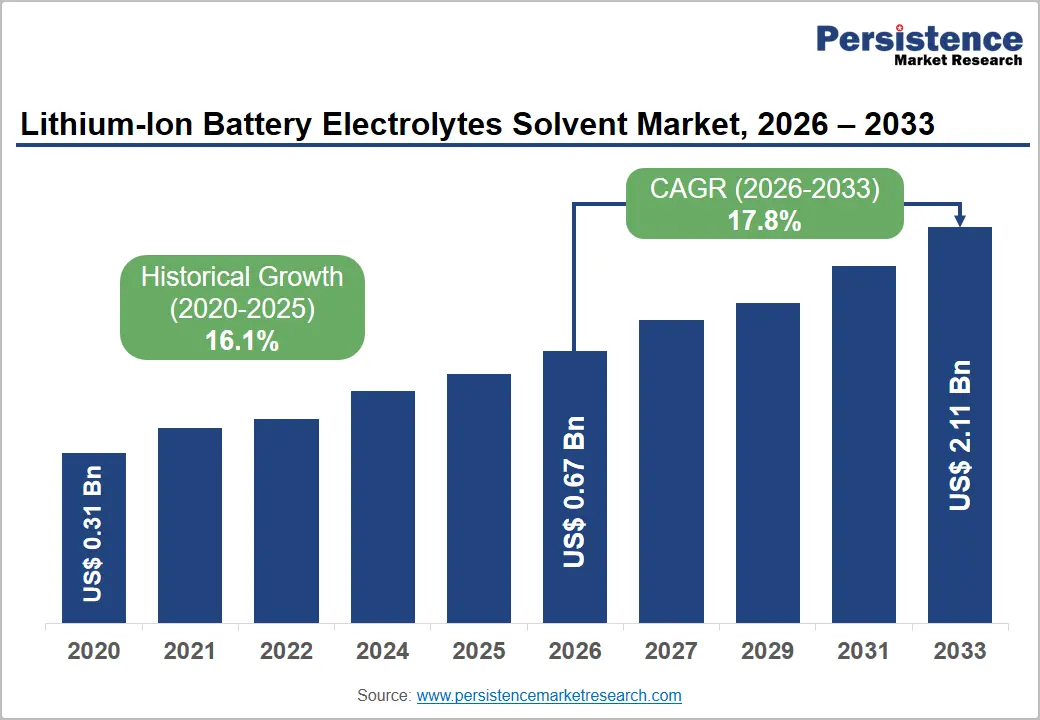
The global lithium-ion battery electrolytes solvent market size is likely to be valued at US$0.67 billion in 2026 and is expected to reach US$2.11 billion by 2033, growing at a CAGR of 17.8% during forecast period from 2026 to 2033, driven by the rapid expansion of electric vehicle (EV) production, increasing deployment of battery energy storage systems (BESS), and continued demand for advanced consumer electronics.
Lithium-ion batteries remain the dominant rechargeable battery technology across transportation, energy storage, and portable electronics, creating sustained demand for high-performance electrolyte solvents. Regulatory initiatives supporting domestic battery manufacturing, supply chain localization, and battery safety standards are further strengthening market growth. As battery manufacturers pursue higher energy density, faster charging capabilities, and improved safety performance, demand for advanced electrolyte solvent formulations continues to increase.
Key Industry Highlights:
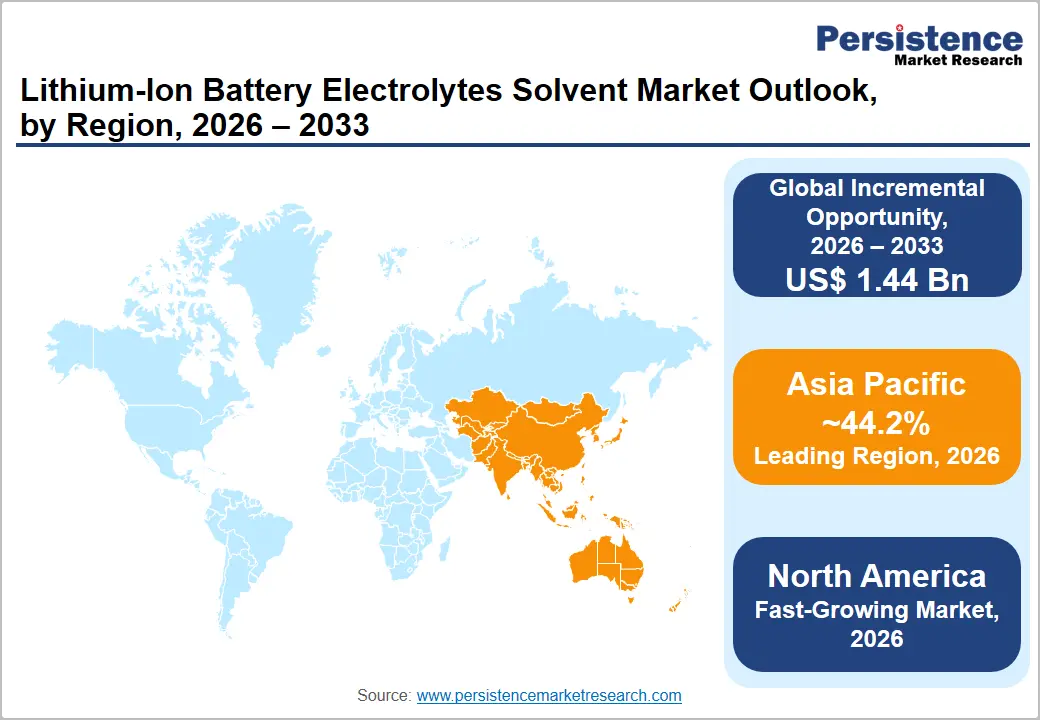
- Leading Region: Asia Pacific is projected to account for 44.2% market share in 2026, supported by China's battery manufacturing leadership, extensive chemical processing infrastructure, and strong EV production ecosystem.
- Fastest-growing Region: North America is projected to record the highest growth rate through 2033, driven by battery gigafactory investments, domestic supply chain localization initiatives, and expanding energy storage deployments.
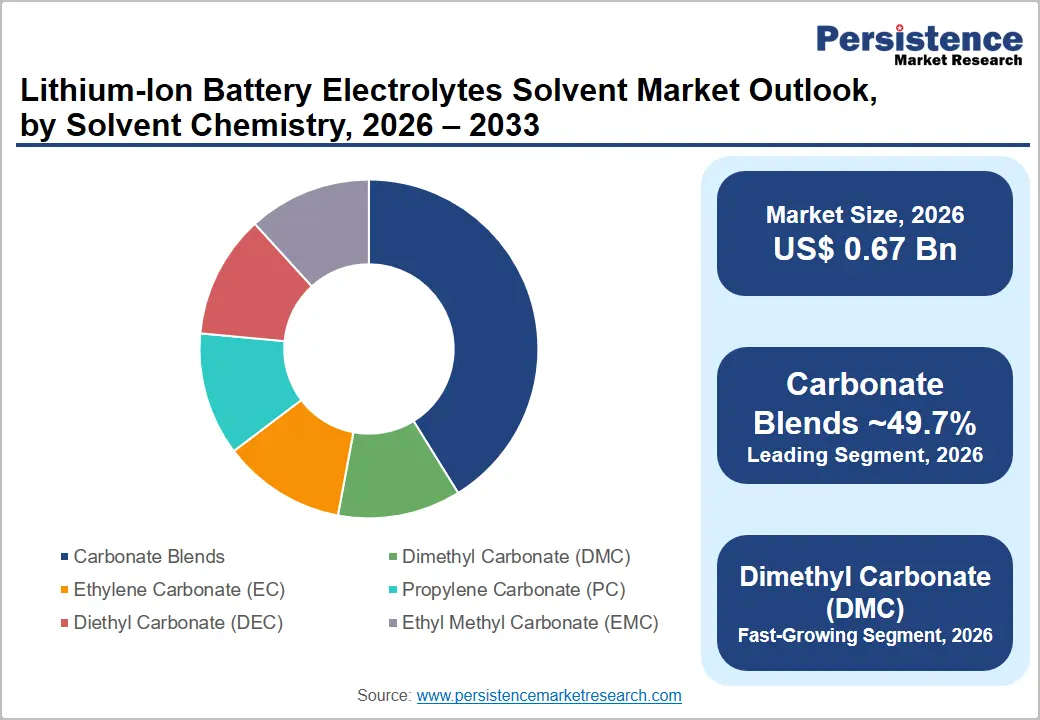
- Dominant Solvent Chemistry: Carbonate blends are estimated to account for approximately 49.7% market share in 2026, owing to their widespread use in lithium-ion batteries for electric vehicles, energy storage systems, and consumer electronics.
- Leading Technology: Liquid carbonate electrolytes are anticipated to hold 83.4% market share in 2026, supported by their commercial maturity, proven electrochemical performance, and compatibility with existing lithium-ion battery manufacturing processes.
DRO Analysis
Drivers - Rising Electric Vehicle Production Accelerates Demand for Electrolyte Solvents
Electric vehicles represent the largest source of demand for lithium-ion battery electrolyte solvents worldwide. Global EV adoption continues to increase as governments implement emissions reduction policies, consumers shift toward sustainable transportation, and automakers invest heavily in battery-powered vehicle platforms. Since lithium-ion batteries rely on electrolyte solvent systems to facilitate ion transport between electrodes, rising battery production directly increases demand for high-purity solvents such as Ethylene Carbonate (EC), Dimethyl Carbonate (DMC), Ethyl Methyl Carbonate (EMC), and Diethyl Carbonate (DEC).
Battery manufacturers require stringent quality specifications to achieve consistent battery performance, safety, and cycle life. As global battery manufacturing capacity expands through new gigafactory investments, demand for battery-grade solvents is expected to rise proportionally. This trend positions solvent suppliers as critical participants in the broader EV value chain while creating long-term growth opportunities for companies capable of meeting increasingly stringent purity requirements.
Expansion of Energy Storage Systems Creates New Demand Opportunities
Large-scale battery energy storage systems are emerging as a significant growth engine for electrolyte solvent consumption. Utility-scale storage projects, renewable energy integration initiatives, data center backup systems, and grid stabilization programs are driving substantial investments in lithium-ion battery installations worldwide.
Energy storage applications require batteries with extended operational life, enhanced thermal stability, and reliable performance under varying environmental conditions. These requirements encourage the adoption of advanced electrolyte formulations incorporating specialized solvent blends and performance-enhancing additives. The increasing deployment of renewable energy sources, including solar and wind power, further strengthens the need for energy storage infrastructure. As governments and utilities pursue grid modernization objectives, energy storage systems are expected to become a major contributor to electrolyte solvent demand throughout the forecast period.
Restraint - Stringent Purity Requirements and Supply Chain Concentration Increase Operational Costs
Despite strong growth prospects, the market faces challenges related to production complexity and supply chain concentration. Battery-grade electrolyte solvents require extremely low moisture content, minimal metallic impurities, and highly controlled chemical compositions. Achieving these specifications necessitates advanced manufacturing processes, sophisticated purification technologies, and extensive quality assurance procedures.
Furthermore, a significant portion of global lithium-ion battery manufacturing remains concentrated in Asia, particularly China. This concentration creates potential supply chain vulnerabilities, including raw material price fluctuations, geopolitical uncertainties, transportation disruptions, and trade-related risks. The flammable nature of conventional carbonate-based solvents also necessitates strict safety protocols throughout manufacturing, storage, and transportation operations. These factors collectively increase production costs and present barriers to market entry for new participants.
Opportunities - Regional Supply Chain Localization Creates Significant Investment Potential
Governments across North America and Europe are actively promoting domestic battery supply chains to reduce reliance on imported battery materials. These initiatives are encouraging investments in local production facilities for electrolyte salts, solvents, and battery components.
The establishment of regional manufacturing capacity presents substantial opportunities for solvent producers, chemical processors, and electrolyte formulators. Localized production can reduce transportation costs, improve supply chain resilience, and support compliance with regional sourcing requirements. Companies capable of establishing production facilities near battery manufacturing clusters are expected to benefit from long-term supply agreements and stronger customer relationships.
Advanced Electrolyte Formulations Increase Product Value and Differentiation
The market is evolving from commodity solvent sales toward advanced electrolyte solutions designed for specific battery chemistries and performance requirements. Battery manufacturers increasingly seek customized formulations that support fast charging, high-voltage operation, low-temperature performance, and improved safety characteristics.
This shift creates opportunities for suppliers offering formulation expertise, proprietary additive technologies, and application-specific solutions. Emerging technologies such as solid-state batteries, sodium-ion batteries, and next-generation lithium-ion chemistries are also driving innovation in electrolyte development. Suppliers capable of supporting these advanced battery platforms are likely to achieve higher margins and stronger competitive positioning.
Category-wise Analysis
Solvent Chemistry Insights
Carbonate blends are expected to remain the dominant solvent chemistry segment, accounting for nearly 49.7% of the market share in 2026. These formulations combine cyclic carbonates such as Ethylene Carbonate (EC) with linear carbonates including Dimethyl Carbonate (DMC), Ethyl Methyl Carbonate (EMC), and Diethyl Carbonate (DEC) to deliver balanced conductivity, stability, and performance. Their widespread use in EV batteries from manufacturers such as Tesla, BYD, and CATL, as well as in energy storage systems and consumer electronics, continues to support market leadership.
Dimethyl Carbonate (DMC) is projected to be the fastest-growing solvent segment during the forecast period due to its low viscosity and ability to enhance ion transport. The solvent is increasingly incorporated into high-performance electrolyte formulations used in fast-charging EV batteries and advanced energy storage applications. Growing adoption by battery manufacturers developing next-generation lithium-ion cells is expected to accelerate DMC demand, particularly for batteries requiring improved low-temperature performance and reduced internal resistance.
Technology Insights
Liquid carbonate electrolytes are expected to account for 83.4% of the market share in 2026, making them the dominant technology segment. Their commercial maturity, proven electrochemical performance, and compatibility with existing lithium-ion battery manufacturing infrastructure have secured widespread adoption. These electrolyte systems are extensively used in electric vehicles, energy storage systems, smartphones, laptops, and power tools, supporting their continued market leadership.
Gel polymer electrolytes are anticipated to witness the fastest growth rate through 2033 as battery manufacturers increasingly prioritize safety and design flexibility. By combining the conductivity benefits of liquid electrolytes with improved thermal stability, these materials are gaining attention for use in wearable electronics, flexible devices, and next-generation battery technologies. Ongoing research into semi-solid and solid-state battery architectures is expected to further expand the commercial potential of gel polymer electrolyte systems.
Regional Insights
North America Lithium-Ion Battery Electrolytes Solvent Market Trends
North America is anticipated to be the fastest-growing regional market for lithium-ion battery electrolyte solvents during the forecast period. Growth is primarily driven by increasing investments in battery manufacturing facilities, expanding electric vehicle production, and rapid deployment of grid-scale energy storage systems. Government initiatives supporting domestic battery supply chains and critical material localization are encouraging new investments in electrolyte solvent production and battery materials processing.
U.S. Lithium-Ion Battery Electrolytes Solvent Market Trends
The U.S. dominates the North America market owing to its expanding network of battery gigafactories, strong electric vehicle adoption, and supportive clean-energy policies. Significant investments in utility-scale battery energy storage projects and grid modernization programs are driving demand for lithium-ion batteries and associated electrolyte materials. The country's focus on supply chain resilience and domestic sourcing is creating favorable opportunities for regional solvent manufacturers.
Canada Lithium-Ion Battery Electrolytes Solvent Market Trends
Canada is strengthening its position within the battery materials value chain through investments in battery manufacturing, critical mineral processing, and clean transportation initiatives. The country's abundant mineral resources and government support for electric mobility are attracting battery-related investments and supporting long-term demand for electrolyte solvents.
Europe Lithium-Ion Battery Electrolytes Solvent Market Trends
Europe remains a strategically important market driven by sustainability regulations, battery traceability requirements, and growing electrification initiatives. The region's regulatory framework emphasizes responsible sourcing, battery recycling, and lifecycle management, encouraging the adoption of high-quality battery materials and electrolyte solutions.
Germany Lithium-Ion Battery Electrolytes Solvent Market Trends
Germany represents the largest market in Europe due to its strong automotive manufacturing industry and rapidly expanding battery production capacity. Major automotive manufacturers and battery producers continue to invest in localized battery supply chains, creating sustained demand for battery-grade electrolyte solvents.
U.K. Lithium-Ion Battery Electrolytes Solvent Market Trends
The U.K. is increasing investments in battery manufacturing and energy storage infrastructure to support its net-zero emissions objectives. Growing adoption of electric vehicles and government-backed battery projects are contributing to market growth.
France Lithium-Ion Battery Electrolytes Solvent Market Trends
France is strengthening its battery ecosystem through investments in battery gigafactories, clean energy projects, and electric mobility programs. The country's focus on industrial decarbonization is supporting demand for advanced lithium-ion battery materials.
Spain Lithium-Ion Battery Electrolytes Solvent Market Trends
Spain is emerging as an important battery manufacturing destination within Europe, supported by automotive industry investments and government initiatives aimed at accelerating EV adoption and renewable energy integration.
European demand for electrolyte solvents is further supported by growing renewable energy installations and increasing deployment of battery energy storage systems. Suppliers capable of meeting strict quality, sustainability, and traceability requirements are expected to gain a competitive advantage across the region.
Asia Pacific Lithium-Ion Battery Electrolytes Solvent Market Trends
Asia Pacific is anticipated to account for approximately 44.2% of the market share in 2026, making it the largest regional market for lithium-ion battery electrolyte solvents. The region benefits from extensive battery manufacturing capacity, established chemical processing infrastructure, strong electric vehicle demand, and a highly integrated battery supply chain.
China Lithium-Ion Battery Electrolytes Solvent Market Trends
China remains the dominant market and primary growth engine for the region. The country leads global battery production, electric vehicle manufacturing, and battery material processing, generating substantial demand for battery-grade electrolyte solvents such as EC, DMC, EMC, and DEC. Continued expansion of EV production and energy storage installations is expected to reinforce China's leadership position.
Japan Lithium-Ion Battery Electrolytes Solvent Market Trends
Japan maintains a strong presence in the electrolyte solvent market through its advanced chemical industry and leadership in battery technology innovation. The country is home to several major electrolyte solvent and specialty chemical manufacturers serving global battery producers.
South Korea Lithium-Ion Battery Electrolytes Solvent Market Trends
South Korea is a major hub for lithium-ion battery production and advanced battery materials development. Strong investments by leading battery manufacturers and chemical companies continue to support demand for high-purity electrolyte solvents and next-generation electrolyte formulations.
India Lithium-Ion Battery Electrolytes Solvent Market Trends
India is emerging as one of the fastest-growing battery markets in Asia Pacific. Government initiatives promoting domestic battery manufacturing, electric vehicle adoption, and energy storage deployment are creating new opportunities for electrolyte solvent suppliers and battery material producers.
Competitive Landscape
The global lithium-ion battery electrolytes solvent market exhibits a moderately concentrated structure characterized by the presence of several global chemical manufacturers and specialized battery material suppliers. Competitive intensity is driven by product purity, manufacturing scale, formulation expertise, and customer qualification capabilities.
Leading companies are prioritizing advanced formulation development, battery-grade purity enhancement, and regional production expansion. Strategic focus areas include supply chain localization, customer-specific electrolyte solutions, and investments in next-generation battery technologies. Integration across production, formulation, and technical support services is becoming an increasingly important competitive differentiator.
Key Industry Developments:
- In February 2025, UBE Corporation held a groundbreaking ceremony for its new Dimethyl Carbonate (DMC) and Ethyl Methyl Carbonate (EMC) production facility in Louisiana, United States, aiming to strengthen domestic supply of lithium-ion battery electrolyte solvents for electric vehicles, hybrid vehicles, and energy storage systems.
- In November 2025, Guangzhou Tinci Materials Technology Co., Ltd. broke ground on its first North American electrolyte manufacturing facility in Baytown, Texas, aiming to enhance localized supply capabilities for electric vehicle and energy storage battery manufacturers in the region.
Companies Covered in Lithium-Ion Battery Electrolytes Solvent Market
- Capchem (Shenzhen Capchem Technology Co., Ltd.)
- Guangzhou Tinci Materials Technology Co., Ltd.
- Soulbrain Co., Ltd.
- UBE Corporation
- Mitsubishi Chemical Corporation
- Enchem Co., Ltd.
- Dongwha Electrolyte Co., Ltd.
- Guotai Huarong New Chemical Materials Co., Ltd.
- Shandong Shida Shenghua Chemical Group Co., Ltd.
- Central Glass Co., Ltd.
- Panax Etec Co., Ltd.
- New Japan Chemical Co., Ltd.
- LOTTE Chemical Corporation
- BASF SE
- Kishida Chemical Co., Ltd.
- BroaHony Group Co., Ltd.
Frequently Asked Questions
The global lithium-ion battery electrolytes solvent market is projected to be valued at US$0.67 billion in 2026.
The lithium-ion battery electrolytes solvent market is expected to reach US$2.11 billion by 2033.
Major trends include increasing EV production, rapid growth of battery energy storage systems, supply chain localization, rising demand for battery-grade high-purity solvents, and the development of advanced electrolyte formulations for next-generation batteries.
Carbonate blends are the leading solvent chemistry segment, accounting for approximately 49.7% of the market share, owing to their widespread use in lithium-ion batteries across EVs, consumer electronics, and energy storage applications.
The lithium-ion battery electrolytes solvent market is anticipated to expand at a CAGR of 17.8% from 2026 to 2033.
Some of the leading companies include Capchem, Tinci Materials, Soulbrain, and UBE Corporation.


