




- Beauty & Personal Care
- Liquid Bath Soap Market
Liquid Bath Soap Market Size, Share, and Growth Forecast, 2026 – 2033
Liquid Bath Soap Market by Formulation (Gel Based, Cream Based, Oil Based, Foam Based), Packaging Type (Bottles, Pouches/Refills, Pump Dispensers, Sachets), End-user (Men, Women, Children), and Regional Analysis for 2026 – 2033

Liquid Bath Soap Market Size and Trends Analysis
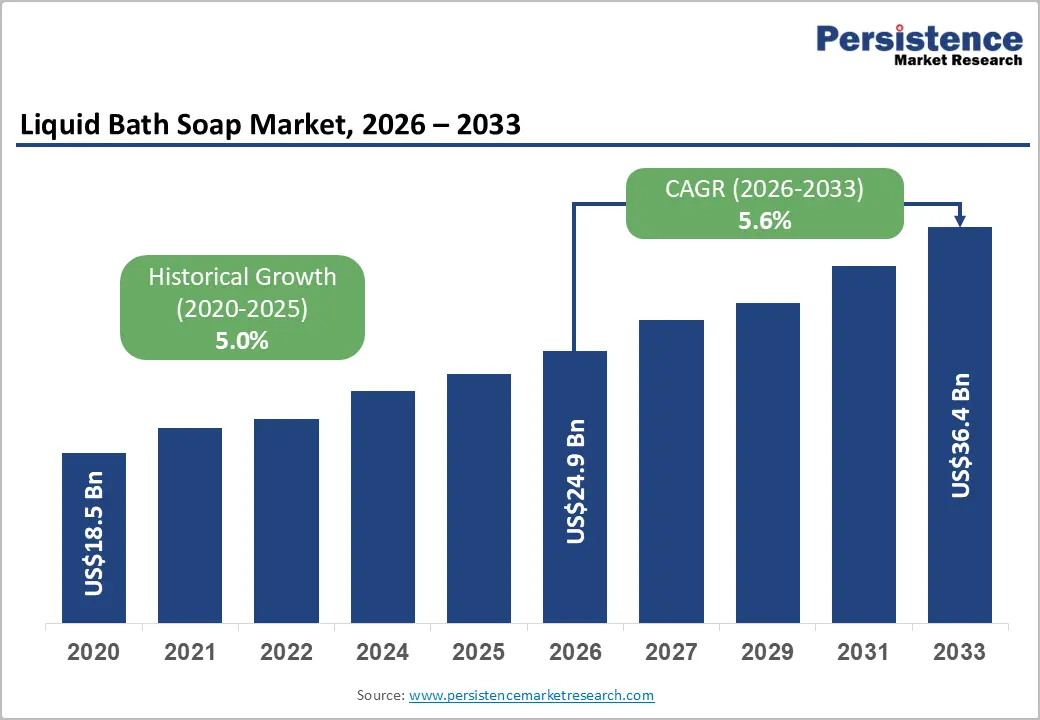
The global liquid bath soap market size is likely to be valued at US$24.9 billion in 2026 and is expected to reach US$36.4 billion by 2033, growing at a CAGR of 5.6% during the forecast period from 2026 to 2033, driven by rising hygiene consciousness, increasing preference for liquid personal care formats, and growing demand for dermatologically tested and natural ingredient-based products.
Consumers are shifting from traditional bar soaps to liquid formulations due to better hygiene, ease of use, and enhanced product innovation. The market is also benefiting from urbanization, higher disposable incomes, and expanding retail and e-commerce channels. Premiumization trends, including herbal, organic, and dermatologically tested variants, are strengthening demand. Sustainability initiatives such as refill packs and eco-friendly packaging are also gaining momentum across developed and emerging regions.
Key Industry Highlights:
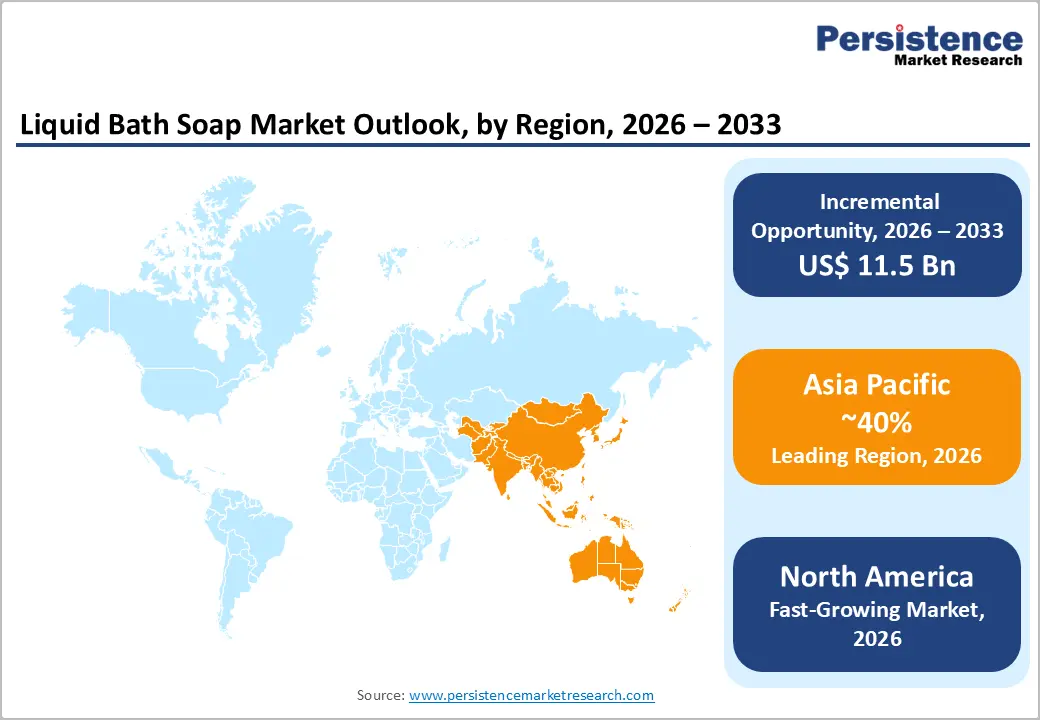
- Leading Region: Asia Pacific is anticipated to be the leading region, accounting for a market share of 40% in 2026, driven by urbanization, rising disposable income, and expanding hygiene awareness.
- Fastest-growing Region: North America is likely to be the fastest-growing region, supported by strong U.S. demand for premium, functional, and sustainable formulations.
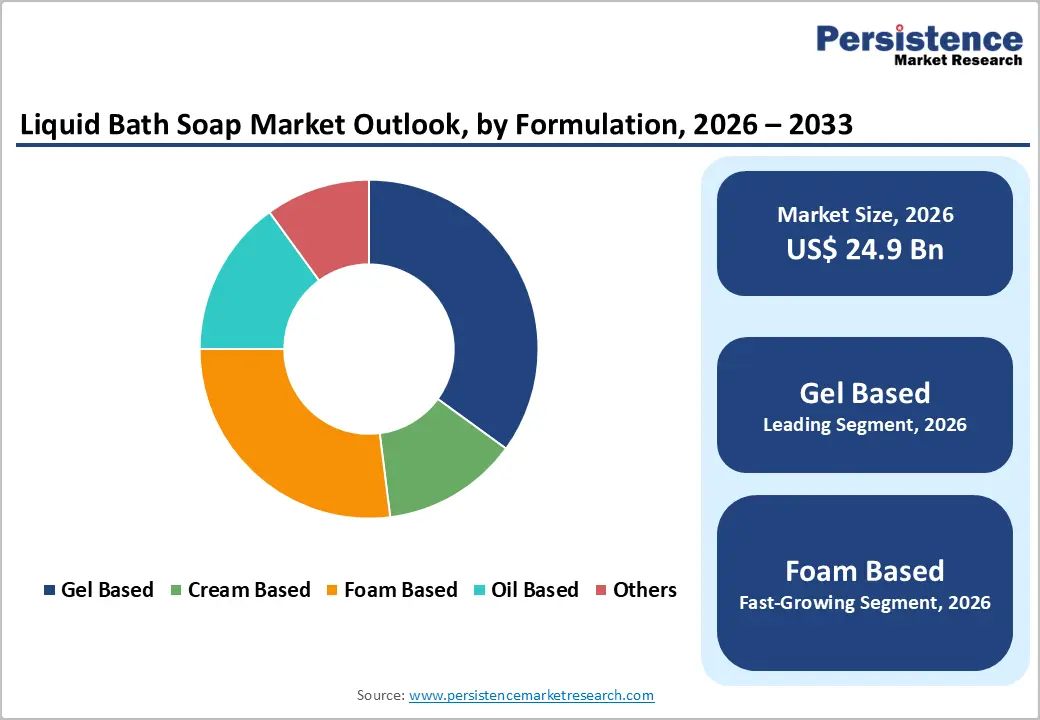
- Leading Formulation: Gel-based is projected to represent the leading formulation in 2026, accounting for 55% of the revenue share, due to its versatility, easy rinsing, and suitability for daily use across all consumer segments.
- Leading Packaging Type: Pump dispensers are anticipated to be the leading packaging type, accounting for over 60% of the revenue share in 2026, supported by convenience, hygiene, and strong retail presence.
- Key Opportunity: The key market opportunity lies in the rapid shift toward sustainable, skin-centric, and personalized formulations supported by eco-friendly packaging innovation and expanding penetration in emerging economies through digital retail and premium product offerings.
DRO Analysis
Driver - Rising Hygiene Awareness and Health Consciousness
Consumers increasingly prefer liquid soap over bar formats due to its perceived superior hygiene, reduced contamination risk, and ease of use. Awareness campaigns by healthcare authorities and wellness organizations have reinforced regular hand and body washing as essential preventive care. This shift is particularly strong in urban populations, where lifestyle changes and exposure to health education have accelerated the adoption of liquid-based personal care products.
The demand is supported by increasing skin health concerns, with consumers seeking products enriched with moisturizing, antibacterial, and dermatologically tested ingredients. Rising disposable incomes allow users to shift toward premium and functional formulations. Workplaces, hospitality sectors, and educational institutions are adopting liquid bath soap systems to maintain higher hygiene standards.
The growing influence of post-pandemic hygiene habits has made frequent cleansing a daily routine rather than an occasional practice. Increasing penetration of liquid soap dispensers in public restrooms and commercial spaces is reinforcing consumer familiarity and trust in liquid formats. Rising awareness about skin infections and dermatological issues is also pushing demand for gentler, pH-balanced formulations.
Restraint - Consumer Preference for Alternatives in Price-Sensitive Markets
The continued consumer preference for low-cost alternatives, particularly bar soaps, in price-sensitive regions. In many developing economies, bar soaps remain dominant due to their affordability, longer shelf life, and lower packaging costs. Consumers with limited disposable income often prioritize basic cleansing over premium formulations, making it difficult for liquid bath soap products to achieve mass penetration. Traditional usage habits and cultural preferences in rural areas slow the transition toward liquid-based personal care products.
Price sensitivity is intensified by economic fluctuations and inflationary pressures on household budgets, which encourage consumers to choose economical hygiene solutions. Liquid bath soaps also face challenges related to packaging costs, transportation expenses, and perceived higher usage cost per wash compared to bar soaps. Even though awareness is increasing, affordability barriers remain significant in rural and lower-income urban segments.
Opportunity - Functional and Personalized Formulations
Increasing demand for skincare-focused hygiene products is driving innovation in variants such as moisturizing, anti-acne, anti-bacterial, vitamin-enriched, and sensitive-skin formulations. Consumers are becoming more ingredient-aware, preferring products free from sulfates, parabens, and harsh chemicals. This shift is encouraging brands to develop clean-label, natural, herbal, and dermatologically tested solutions.
The integration of essential oils, botanical extracts, and aromatherapy benefits is also enhancing product differentiation and premium positioning in competitive markets. Personalization is emerging as a key growth frontier, supported by advancements in data-driven marketing and direct-to-consumer channels. Brands are increasingly offering customized fragrance profiles, skin-type-specific solutions, and subscription-based hygiene products.
Digital platforms and e-commerce channels enable targeted recommendations, strengthening consumer engagement and loyalty. Rising demand for multifunctional products that combine cleansing with skincare benefits is expanding market potential. This trend is particularly strong among younger consumers seeking convenience and personalization, making functional innovation.
Category-wise Analysis
Formulation Insights
Gel-based liquid bath soap is expected to lead, accounting for 55% of revenue in 2026. Its versatile usage, quick-rinsing nature, and suitability for daily cleansing across diverse skin types make it popular. It offers a balanced combination of effective cleansing and skin-friendly properties, making it widely preferred in both household and commercial applications. For example, major brands such as Unilever under their body wash portfolios extensively use gel-based formulations such as Dove body wash variants, which emphasize hydration and mild cleansing for everyday use.
Foam-based formulations are likely to represent the fastest-growing segment, supported by rising demand for premium bathing experiences, controlled product usage, and water-saving benefits. Consumers increasingly prefer foam-based soaps due to their luxurious feel, efficient dispensing, and reduced product wastage per wash. For instance, premium personal care offerings by Procter & Gamble in foaming body wash formats highlight innovation in dispensing technology and sensory experience, accelerating adoption among younger consumers.
Packaging Type Insights
Pump dispensers are projected to lead the market, capturing around 60% of the revenue share in 2026, supported by their convenience, hygiene benefits, and controlled dosage mechanism. They are widely preferred in both household bathrooms and commercial environments such as hotels, hospitals, and offices, where hygiene standards are critical. Pump packaging reduces contamination risk and ensures ease of use for all age groups. A notable example includes Colgate-Palmolive, which utilizes pump-based packaging in several liquid soap offerings, emphasizing cleanliness and user-friendly application.
Pouches and refill packs are likely to be the fastest-growing packaging type due to sustainability benefits, cost efficiency, and reduced plastic consumption. Consumers are increasingly shifting toward refill systems to minimize environmental impact and lower long-term usage costs. This segment is strongly supported by eco-conscious branding strategies and government regulations promoting plastic reduction. For instance, Godrej Consumer Products has expanded its refill-based liquid soap offerings in India.
End-user Insights
Women end-users are expected to lead the liquid bath soap market, accounting for 45% share in 2026. Women consumers tend to prioritize hydration, skin nourishment, and ingredient quality, which increases the adoption of specialized liquid bath soaps. In addition, personal care routines, skincare awareness, and preference for premium and fragrance-rich products supplement the usage. Brands under Kao Corporation focus heavily on women-centric body wash lines in Asia, offering moisturizing and skin-enhancing formulations tailored to daily skincare and wellness needs.
Men are likely to represent the fastest-growing segment, supported by rising personal care and grooming awareness, urban lifestyle changes, and rising demand for multifunctional personal care products. Men are increasingly adopting liquid bath soaps that have antibacterial, refreshing, and skin-friendly properties for daily use. Unilever expanded its male grooming portfolio under brands such as Axe, incorporating body wash products designed specifically for men.
Regional Insights
North America Liquid Bath Soap Market Trends
North America is projected to be the fastest-growing regional market during the forecast period from 2026 to 2033. Consumers are increasingly shifting toward sulfate-free, organic, and fragrance-specific formulations that support sensitive skin and health-focused lifestyles. For instance, Johnson & Johnson has strengthened its personal care portfolio through gentle cleansing and skin-friendly body wash products under brands such as Aveeno, with a strong focus on dermatologist-recommended formulations. As a result, growing consumer preference for premium, wellness-oriented, dermatologically tested, and sustainable personal care products continues to drive demand for liquid soap products.
U.S. Liquid Bath Soap Market Trends
The U.S. dominates the regional market, driven by strong demand for premium body washes, antibacterial products, and wellness-oriented formulations. Rising awareness of skin health and ingredient transparency is pushing brands toward clean-label products. The country is witnessing rapid growth in men’s grooming and functional skincare-infused body washes.
Canada Liquid Bath Soap Market Trends
Canada is a significant market for liquid bath soap, supported by high hygiene awareness and a preference for natural and organic products. Canadian consumers are increasingly adopting eco-friendly liquid soaps and refill systems. The government's focus on reducing plastic waste has encouraged brands to introduce biodegradable packaging. Urban population growth and rising disposable income support demand for premium personal care products in both household and commercial segments.
Europe Liquid Bath Soap Market Trends
Europe is likely to be a significant market for liquid bath soap, due to strong regulatory standards, high sustainability awareness, and increasing demand for natural and organic formulations. Consumers prioritize eco-certified, cruelty-free, and dermatologically safe products, pushing brands toward green chemistry and clean-label innovation. For instance, Henkel has been actively expanding its sustainable personal care portfolio with eco-friendly liquid soap and body wash products under brands such as Fa.
U.K. Liquid Bath Soap Market Trends
The U.K. is a significant market for liquid bath soap, supported by premium skincare trends and rising demand for functional body washes. Consumers are increasingly shifting toward fragrance-rich, moisturizing, and sensitive-skin formulations. The U.K. market is also witnessing rapid growth in e-commerce beauty platforms and subscription-based personal care services. Recent initiatives include the expansion of plastic reduction policies and increased adoption of refill stations in major retail stores.
Germany Liquid Bath Soap Market Trends
Germany dominates the regional market due to high environmental awareness and strong demand for natural and dermatologically tested products. Consumers increasingly prefer organic and vegan-certified formulations. The country is also leading in refillable packaging adoption, supported by sustainability regulations and retail innovation in supermarkets.
Asia Pacific Liquid Bath Soap Market Trends
Asia Pacific is expected to remain the leading region during the forecast period, accounting for a market share of 40% in 2026, driven by rapid urbanization, rising disposable incomes, and increasing hygiene awareness across developing economies. Consumers are shifting from traditional bar soaps to liquid formats due to convenience, perceived hygiene benefits, and product innovation. A notable example includes Unilever, which has expanded its personal care manufacturing and distribution network across Asia Pacific, introducing affordable and premium body wash variants tailored to local consumer preferences and climatic conditions.
China Liquid Bath Soap Market Trends
China dominates the regional market, supported by rapid urban growth, an expanding middle-class population, and strong e-commerce penetration. Consumers increasingly prefer premium, whitening, and herbal liquid bath soaps. Digital platforms such as Tmall and JD.com are driving product accessibility and brand competition. Recent developments include growth in clean beauty trends and rising demand for dermatology-backed formulations.
India Liquid Bath Soap Market Trends
India is a significant market for liquid bath soap, due to increasing hygiene awareness, rural market penetration, and rising adoption of branded personal care products. Consumers are shifting toward affordable liquid soaps with herbal and Ayurvedic ingredients. Recent developments include rising demand for refill packs and antibacterial formulations, especially after increased public health awareness.
Competitive Landscape
The global liquid bath soap market exhibits a moderately fragmented structure, driven by the strong presence of multinational FMCG giants alongside regional and private-label competitors. Competition is shaped by continuous innovation in formulations such as moisturizing, antibacterial, organic, and dermatologically tested variants, along with increasing emphasis on sustainable packaging and eco-friendly production practices.
With key leaders including Procter & Gamble, Unilever, Colgate-Palmolive, Henkel, Kao Corporation, and Godrej Consumer Products, the market remains highly consolidated at the top, with these players leveraging strong distribution networks and brand equity. These players compete through aggressive product innovation, strategic acquisitions, sustainable packaging initiatives, and expansion of premium personal care portfolios.
Key Industry Developments:
- In May 2026, Australian Botanical Soap introduced a new body wash packaged in bottles made with recycled plastic. The product emphasizes eco-friendly innovation, featuring a formulation enriched with natural ingredients such as aloe vera and chamomile while maintaining a focus on gentle cleansing and skin nourishment. According to the company’s sustainability approach, the bottle incorporates around 50% recycled plastic content.
- In May 2026, Native introduced its limited-edition Boba Café Collection exclusively at Walmart, expanding its personal care portfolio with dessert-inspired body washes. The collection draws inspiration from popular boba tea flavors, featuring fragrances such as brown sugar boba, coconut ube, and strawberry matcha, designed to transform everyday bathing routines into a more enjoyable and sensory experience.
Companies Covered in Liquid Bath Soap Market
- Procter & Gamble Co.
- Unilever PLC
- Johnson & Johnson Services, Inc.
- Colgate-Palmolive Company
- Kao Corporation
- The Himalaya Drug Company
- Henkel AG & Co. KGaA
- Godrej Consumer Products Limited
Frequently Asked Questions
The global liquid bath soap market is projected to reach US$24.9 billion in 2026.
The liquid bath soap market is driven by rising hygiene awareness, increasing demand for convenient and skin-friendly cleansing products, and growing preference for premium, functional, and sustainable personal care formulations.
The liquid bath soap market is expected to grow at a CAGR of 5.6% from 2026 to 2033.
Key opportunities in the liquid bath soap market lie in the rising demand for natural and functional formulations, expansion of eco-friendly packaging and refill systems, and growing penetration in emerging markets through premiumization and e-commerce growth.
Procter & Gamble, Unilever, Johnson & Johnson, Colgate-Palmolive, and Kao Corporation are the leading players.


