




- Technology
- LCD Driver Market
LCD Driver Market Size, Share, and Growth Forecast, 2026 - 2033
LCD Driver Market by Display Technology (LCD Driver IC, OLED Driver IC, Others), Application (Smartphones, Automotive Displays, Others), Resolution, Interface, and Regional Analysis for 2026 - 2033

LCD Driver Market Size and Trends Analysis
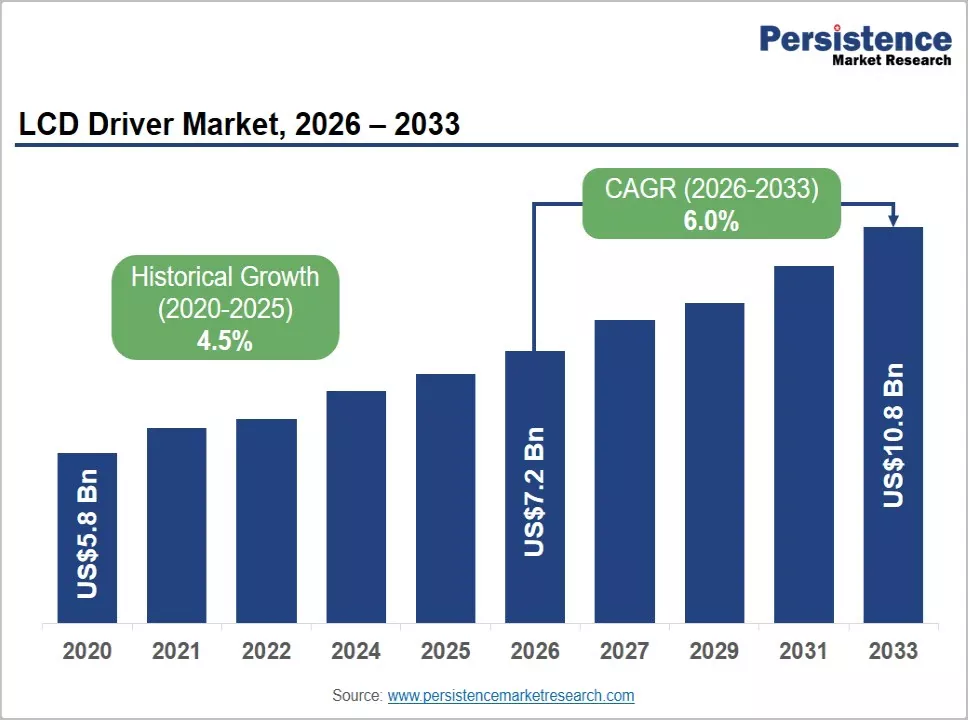
The global LCD driver market size is likely to be valued at US$7.2 billion in 2026 and is expected to reach US$10.8 billion by 2033, growing at a CAGR of 6.0% between 2026 and 2033, driven by continued LCD deployment across televisions, monitors, notebooks, industrial equipment, medical systems, and automotive displays, despite the increasing adoption of OLED in premium smartphones.
Rising display resolutions, higher refresh rates, touch integration, and increasingly sophisticated automotive human-machine interfaces are increasing the semiconductor content associated with individual display modules.
Key Industry Highlights:
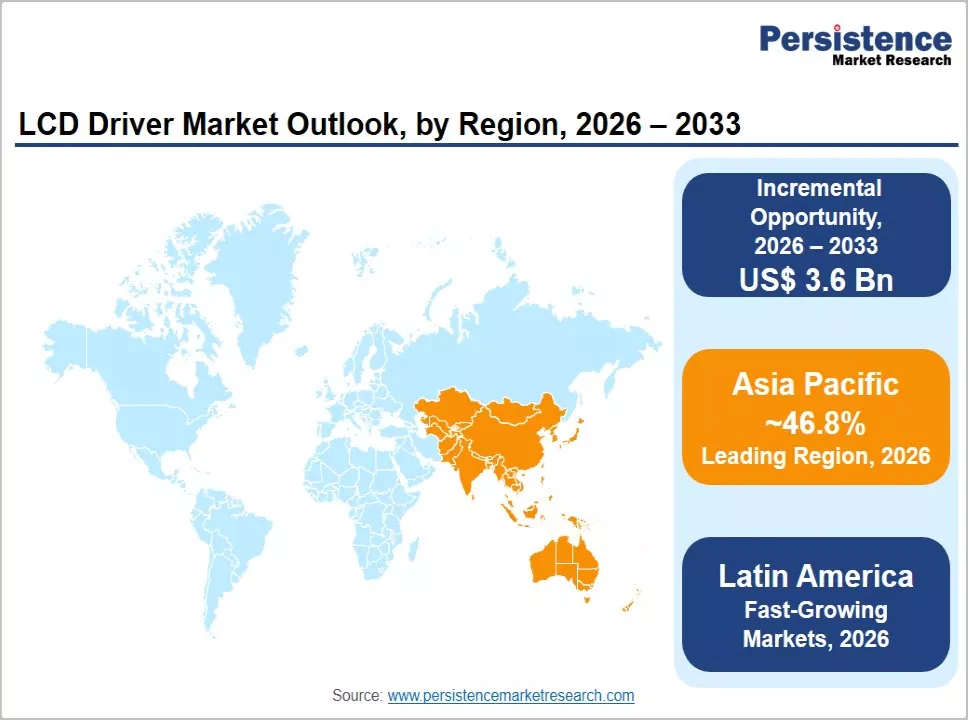
- Leading Region: Asia Pacific is projected to account for 46.8% of market share, supported by concentrated display-panel manufacturing, semiconductor production, electronics assembly, and major smartphone and automotive electronics markets.
- Fastest-growing Region: Latin America, driven by automotive manufacturing, nearshoring, electronics assembly, and semiconductor-policy initiatives in markets such as Mexico and Brazil.
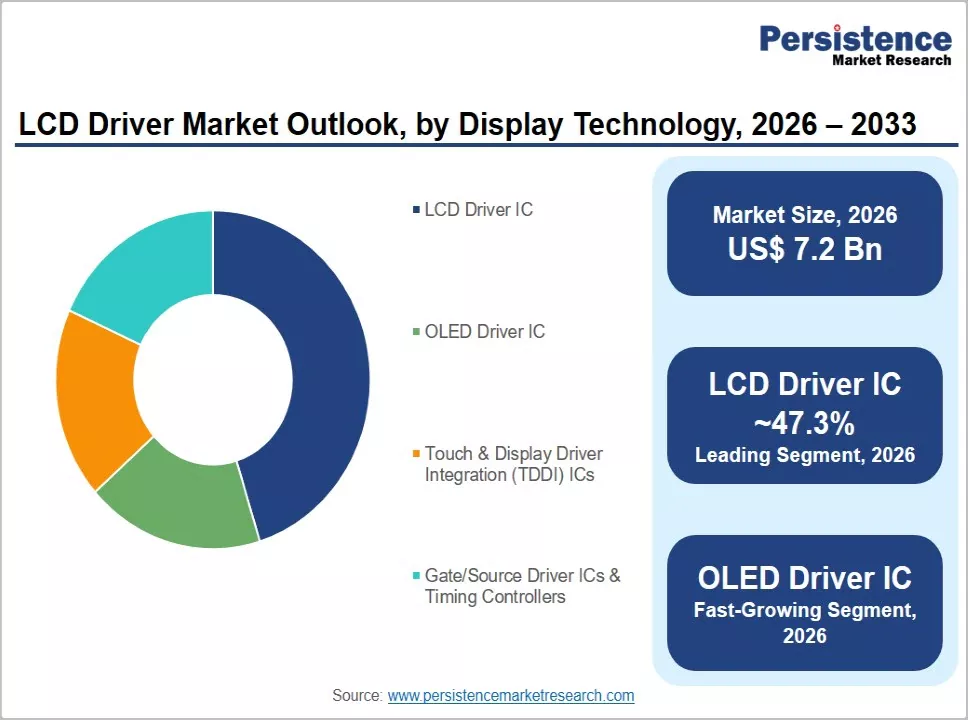
- Dominant Display Technology: LCD Driver ICs, with an anticipated 47.3% of market share, supported by continued demand across televisions, monitors, automotive displays, industrial equipment, and commercial displays.
- Leading Application: Smartphones, with an anticipated 35.9% of market share, although OLED adoption is gradually changing the display-technology mix.
DRO Analysis
Drivers - Expansion of Automotive Displays and Higher Semiconductor Content per Vehicle
Automotive displays are becoming an increasingly important component of vehicle electronic architectures as digital instrument clusters, infotainment screens, head-up displays, rear-seat entertainment systems, and passenger interfaces replace or complement conventional controls. The expansion of electric and software-intensive vehicles is increasing demand for sophisticated display interfaces across passenger vehicles.
The effect on LCD driver demand extends beyond vehicle production volumes. Automotive suppliers increasingly require high-resolution driver ICs, high-temperature and high-reliability components, timing controllers, touch-and-display integration, and solutions for larger display architectures. Automotive display programs also typically involve longer qualification and production cycles than consumer electronics. Himax has reported continued demand for automotive display-driver ICs for dashboards, head-up displays, rear-view applications, and side-view displays. These requirements create opportunities for suppliers to increase value through advanced functionality and integration.
Higher-Resolution Displays and Increasing Integration
Display specifications are progressing toward higher resolution, higher refresh rates, reduced bezels, lower power consumption, and greater system integration. These developments require driver architectures capable of processing larger volumes of image data while maintaining power and thermal efficiency. Samsung Semiconductor has commercialized advanced mobile display-driver ICs using a 22nm process, demonstrating the industry's movement toward greater integration and power efficiency.
The integration trend is particularly visible in touch-and-display driver integration (TDDI), which combines touch sensing and display-driving functions in a single architecture. Automotive applications are also encouraging integration through timing controllers, touch controllers, and display processors. Himax has reported TDDI adoption among automotive customers and continued TCON design activity. For suppliers, this represents a shift from standalone driver components toward multifunction display semiconductor platforms.
Restraint - OLED Substitution and Price Pressure in Mature LCD Applications
The continued migration from LCD toward OLED in premium smartphones, tablets, and selected notebook applications represents a structural restraint for LCD driver demand. Premium device manufacturers are increasing OLED adoption, reducing the addressable market for some mobile LCD driver applications.
The transition is accompanied by persistent pricing pressure in mature LCD applications. Display-driver suppliers must manage customer concentration, qualification costs, inventory cycles, manufacturing expenses, and continuous pricing negotiations. Mature LCD applications also face intense competition because multiple suppliers can support established panel architectures. Supply-chain complexity across wafer fabrication, bumping, packaging, testing, and panel qualification can further increase procurement and production costs.
Opportunities - Automotive Smart-Cockpit Architectures
Automotive displays provide an opportunity for LCD driver suppliers to offset slower growth in selected mobile LCD applications through higher-value vehicle programs. Vehicle architectures are evolving toward larger central information displays, digital instrument clusters, passenger screens, panoramic interfaces, head-up displays, and more sophisticated human-machine interfaces.
The opportunity extends beyond conventional LCD driver ICs. Suppliers can address automotive programs through portfolios covering DDIC, TDDI, TCON, local-dimming controllers, OLED driver ICs, touch controllers, and display processors. Automotive qualification requirements create entry barriers but can also support longer product lifecycles once designs enter production.
Emerging Semiconductor and Electronics Ecosystems
Government-backed semiconductor localization programs are creating opportunities for display-driver manufacturing, packaging, testing, and design outside established Asian production centers. India, Brazil, Mexico, and ASEAN economies are strengthening semiconductor and electronics ecosystems through investment incentives, manufacturing programs, and supply-chain initiatives.
India is developing capabilities relevant to the LCD driver ecosystem, including display-driver IC manufacturing using advanced packaging technologies. These initiatives can support local semiconductor design, assembly, testing, and component manufacturing while creating opportunities for suppliers to establish partnerships closer to emerging electronics markets.
Category-wise Analysis
Display Technology Insights
LCD Driver ICs lead with an anticipated market share of 47.3%. LCD continues to serve televisions, PC monitors, notebooks, automotive instrument clusters, industrial panels, medical displays, and commercial signage. For example, LCD driver solutions remain relevant in automotive digital clusters and center information displays where reliability, brightness, operating life, and cost efficiency are important. Higher refresh rates, wider temperature ranges, local dimming, improved power efficiency, and smaller packages are creating opportunities for suppliers to upgrade mature LCD platforms. Automotive and industrial displays are particularly relevant because their longer product lifecycles and qualification requirements can provide more stable demand than highly cyclical consumer applications.
OLED Driver ICs are the fastest-growing technology segment as OLED adoption expands across smartphones, tablets, notebooks, wearables, televisions, and automotive displays. OLED smartphones from manufacturers such as Samsung, Apple, Xiaomi, and other major brands illustrate the technology's increasing penetration in mobile devices. Chinese and Korean display manufacturers continue to expand OLED production, supporting broader adoption across consumer and automotive applications.
Himax, for example, offers OLED driver ICs alongside timing controllers and touch solutions. For display-driver suppliers, supporting both LCD and OLED architectures allows them to address changing customer requirements while reducing exposure to technology substitution.
Application Insights
Smartphones lead with an anticipated market share of 35.9%. High shipment volumes, frequent product refreshes, high-resolution screens, and integrated touch interfaces sustain demand for display-driver semiconductors. Examples include LCD-based entry and mid-range smartphones and AMOLED-based premium devices from Samsung, Apple, Xiaomi, and other major manufacturers. LCD remains relevant in price-sensitive segments, while OLED continues to gain ground in mid-range and premium smartphones. This transition is encouraging suppliers to develop cost-efficient LCD drivers, TDDI solutions, higher-refresh-rate architectures, and broader LCD/OLED portfolios.
Automotive displays represent the fastest-growing application. Growth is supported by digital instrument clusters, infotainment screens, head-up displays, passenger displays, ADAS interfaces, and larger center screens. Examples include multi-screen digital cockpits, curved instrument panels, and integrated center displays used in newer electric and software-defined vehicles. The opportunity spans LCD driver ICs, TDDI, TCON, local-dimming controllers, OLED drivers, and integrated display processors. Himax's automotive display-driver and TCON programs illustrate the increasing semiconductor content associated with advanced vehicle display architectures.
Regional Insights
North America LCD Driver Market Trends
North America is an important high-value market for LCD driver technologies, supported by semiconductor design, automotive electronics, gaming, medical equipment, and advanced computing. The U.S. remains the region's principal market, while Canada contributes through automotive, industrial, and semiconductor-related applications. Demand is increasingly linked to digital cockpits, infotainment systems, gaming monitors, medical displays, and high-performance computing.
U.S. LCD Driver Market Trends
The U.S. semiconductor ecosystem supports domestic display-driver innovation through chip design, semiconductor equipment, electronic design automation, and advanced packaging. In December 2024, the U.S. Department of Commerce awarded Samsung Electronics up to US$4.745 billion under the CHIPS program for planned semiconductor investments in Texas. Although the program is broader than display drivers, expanded domestic semiconductor capacity strengthens the supplier ecosystem available to display and automotive electronics companies.
Automotive applications are also gaining importance. In March 2025, Synaptics demonstrated its SB7900 SmartBridge automotive display processor, integrating display, touch, sensing, and processing functions. The development illustrates the industry's shift toward integrated automotive display architectures. Synaptics subsequently became the subject of onsemi's announced acquisition in 2026, further highlighting the convergence of sensing, connectivity, processing, and human-machine interfaces.
Canada LCD Driver Market Trends
Canada's contribution is concentrated more strongly in semiconductor design, automotive technology, artificial intelligence, and specialized electronics than in high-volume display-panel manufacturing. Companies such as Celestica support electronics manufacturing and supply-chain services for technology and industrial customers, while Canada's automotive manufacturing base provides demand for digital instrument clusters, infotainment, and vehicle displays. These capabilities complement the broader North American ecosystem by supporting electronics engineering, manufacturing, and automotive technology development.
Latin America LCD Driver Market Trends
Latin America is a smaller display-driver market than Asia Pacific but offers expansion opportunities through automotive manufacturing, electronics assembly, nearshoring, and semiconductor-policy development. Mexico and Brazil are the region's principal markets, with Colombia and Argentina providing additional electronics and automotive demand.
Mexico LCD Driver Market Trends
Mexico provides the strongest automotive pathway for display-driver demand. The country produced approximately 3.95 million light vehicles in 2025, according to national statistics, with light trucks representing most production. Automakers including General Motors, Ford, Stellantis, Volkswagen, and Nissan operate manufacturing facilities in Mexico, creating demand for digital instrument clusters, infotainment systems, cameras, and other vehicle electronics. Nearshoring also encourages Tier-1 suppliers to expand local electronics production, improving opportunities for display-module assembly and component distribution.
Brazil LCD Driver Market Trends
Brazil offers a more policy-driven semiconductor opportunity. Law 14.968, enacted in September 2024, modernized the country's semiconductor and ICT industrial framework and established Brasil Semicon. The program covers semiconductor design and production and supports activities involving displays and panels. This creates opportunities for domestic electronics design, manufacturing, research, and supply-chain development while reducing reliance on imported components over time.
Asia Pacific LCD Driver Market Trends
Asia Pacific remains the leading LCD driver market and manufacturing center because of its concentration of display-panel producers, smartphone OEMs, television manufacturers, semiconductor foundries, packaging companies, and electronics assemblers. The region's anticipated 2025 share is approximately 46.8%, with China representing a substantial portion of regional demand.
China LCD Driver Market Trends
China is central to the regional display ecosystem. Companies such as BOE Technology, TCL CSOT, and Visionox have expanded LCD and OLED panel capabilities, creating a large domestic customer base for display-driver suppliers. China's growing smartphone, television, automotive, and electronics industries further support DDIC and TCON demand. Continued semiconductor localization is also encouraging domestic display-chip development and supply-chain integration.
Japan LCD Driver Market Trends
Japan remains important through automotive and industrial electronics. Companies such as Sony, Panasonic, and Sharp contribute to advanced display and electronics applications, while Japanese automakers create demand for reliable vehicle-display technologies.
India LCD Driver Market Trends
India is emerging as a new semiconductor manufacturing location. Government incentives support qualifying semiconductor and display projects, while Foxconn India and other electronics manufacturers are expanding local production. A planned display-driver IC project involving Vama Sundari Investments and Foxconn represents a move toward domestic DDIC manufacturing and could strengthen India's position within the broader Asian display semiconductor supply chain.
ASEAN economies, particularly Malaysia, Vietnam, Thailand, and Singapore, complement these developments through semiconductor packaging, electronics assembly, and automotive manufacturing. Their growing role in supply-chain diversification gives display-driver companies additional manufacturing and sourcing options beyond established Northeast Asian hubs.
Competitive Landscape
The global LCD and display-driver IC market is concentrated among a limited number of large suppliers while remaining competitive across individual applications and technologies. Competition remains active among specialist suppliers in TDDI, automotive displays, OLED, ePaper, timing controllers, industrial displays, and other application-specific technologies.
Leading suppliers are emphasizing technology integration, automotive qualification, manufacturing efficiency, customer diversification, and geographic expansion. Product portfolios increasingly span DDIC, TDDI, TCON, OLED drivers, touch controllers, and display processors. Competitive differentiation is shifting toward integrated architectures, high-speed interfaces, local dimming, lower power consumption, automotive reliability, and long-term partnerships with panel manufacturers and Tier-1 suppliers.
Key Industry Developments:
- In June 2026, onsemi announced an agreement to acquire Synaptics in an all-stock transaction valued at approximately US$7 billion, combining onsemi's power and sensing capabilities with Synaptics' connected computing, human-machine interface, wireless connectivity, and edge-AI technologies.
- In May 2026, Novatek Microelectronics announced that its automotive TCON/Bridge products had achieved ISO 26262 ASIL B product certification, while its automotive TDDI solutions achieved ASIL B Ready status.
Companies Covered in LCD Driver Market
- Samsung Electronics
- Novatek Microelectronics
- LX Semicon
- Himax Technologies
- Raydium Semiconductor
- ITH Corporation (Ilitek)
- Sitronix Technology
- Fitipower Integrated Technology
- FocalTech Systems
- Chipone Technology
- Magnachip Semiconductor
- Solomon Systech
- Parade Technologies
- Synaptics
- Silicon Works
- MediaTek
Frequently Asked Questions
The global LCD driver market is expected to be valued at US$7.2 billion in 2026.
The LCD driver market is expected to reach US$10.8 billion by 2033.
Key trends include increasing automotive display adoption, higher-resolution and higher-refresh-rate displays, greater use of TDDI and integrated display architectures, continued OLED adoption, and growing semiconductor localization across emerging manufacturing markets.
LCD Driver ICs are the leading technology segment, with an anticipated 47.3% share of total display-driver revenue. Smartphones are the leading application, with an anticipated 35.9% share of display-driver demand.
The LCD driver market is projected to grow at a 6.0% CAGR from 2026 to 2033.
Major players include Samsung Electronics, Novatek Microelectronics, LX Semicon, Himax Technologies, and Raydium Semiconductor.


