




- Aerospace & Defense
- Hypersonic Thermal Protection Systems Market
Hypersonic Thermal Protection Systems Market Size, Share, and Growth Forecast 2026 - 2033
Hypersonic Thermal Protection Systems Market by Material (Ceramic Matrix Composites, Carbon-Carbon Composites, Ultra-High-Temperature Ceramics, Ablative Materials, Thermal Barrier Coatings, Others), Protection Mechanism (Passive Thermal Protection, Ablative Thermal Protection, Active Thermal Protection, Semi-active Thermal Protection), End-User (Defense Agencies, Aerospace OEMs, Missile Manufacturers, Space Agencies, Research Institutions), and Regional Analysis for 2026 - 2033

Hypersonic Thermal Protection Systems Market Size and Trends Analysis
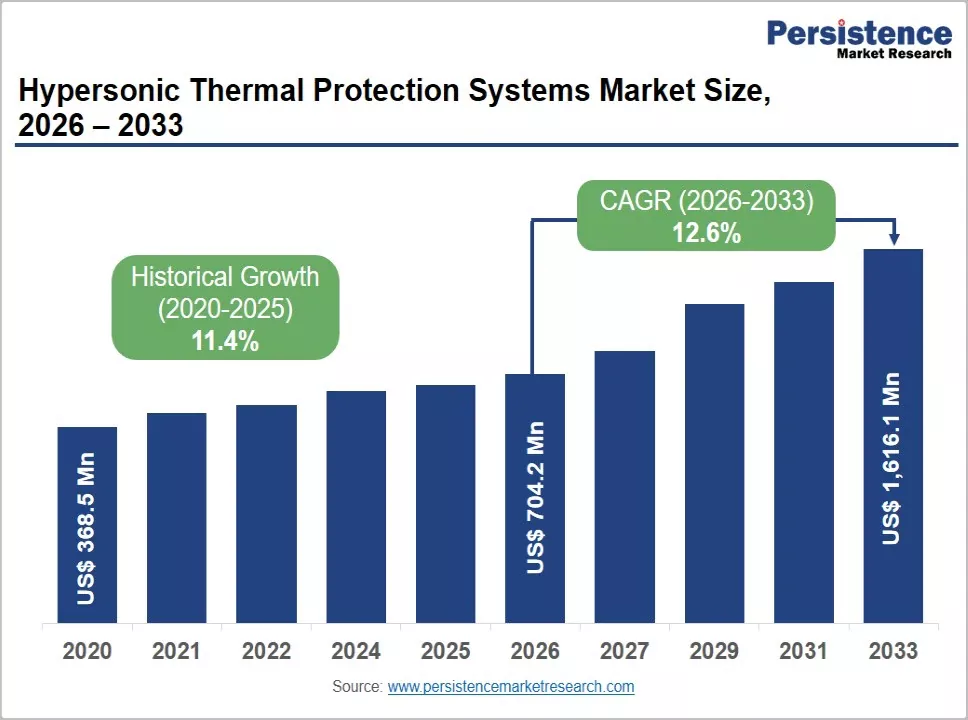
The global hypersonic thermal protection systems market is expected to be valued at US$ 704.2 million in 2026 and is projected to reach US$ 1,616.1 million by 2033, growing at a CAGR of 12.6% between 2026 and 2033. Hypersonic vehicles travel faster than Mach 5, and their surfaces can exceed 1,500°C, creating demand for advanced heat-resistant materials.
Defense programs, reusable space vehicles, and expanding flight-test activity are key market growth factors. Test programs across the U.S., Europe, and Asia are also increasing demand for thermal protection systems.
Key Industry Highlights
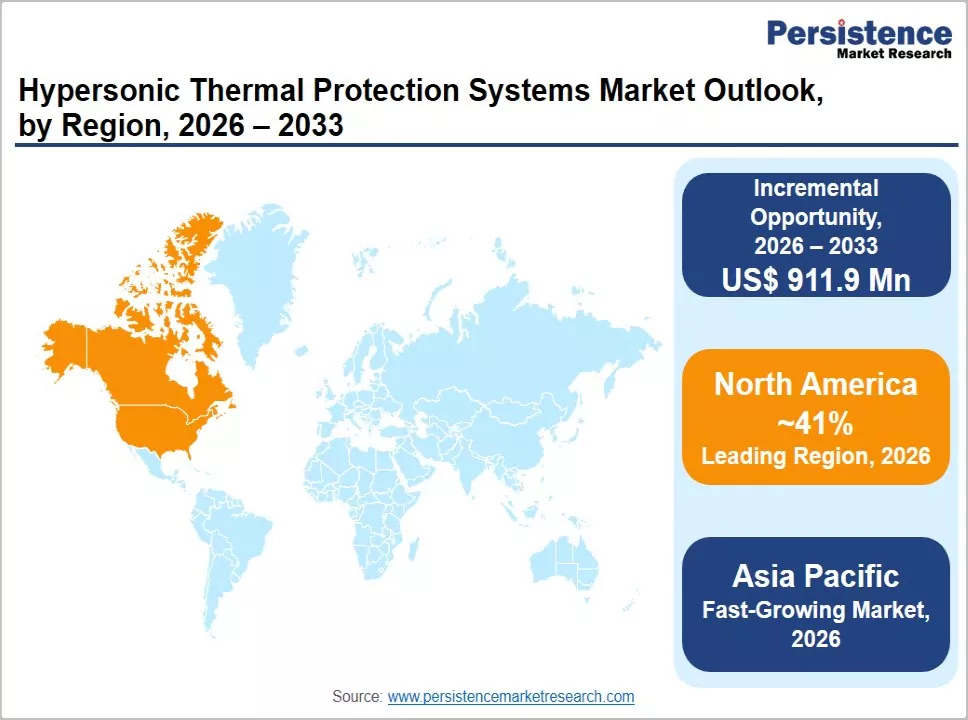
- Leading Region: North America is likely to lead the global market with around 41% share in 2026, supported by major funded hypersonic weapons and space programs, the presence of leading prime contractors, and an established supply base for composites and ceramics.
- Fastest-growing Region: Asia Pacific represents the fastest-growing market, driven by rising defense budgets, regional security concerns, and expanding space programs.
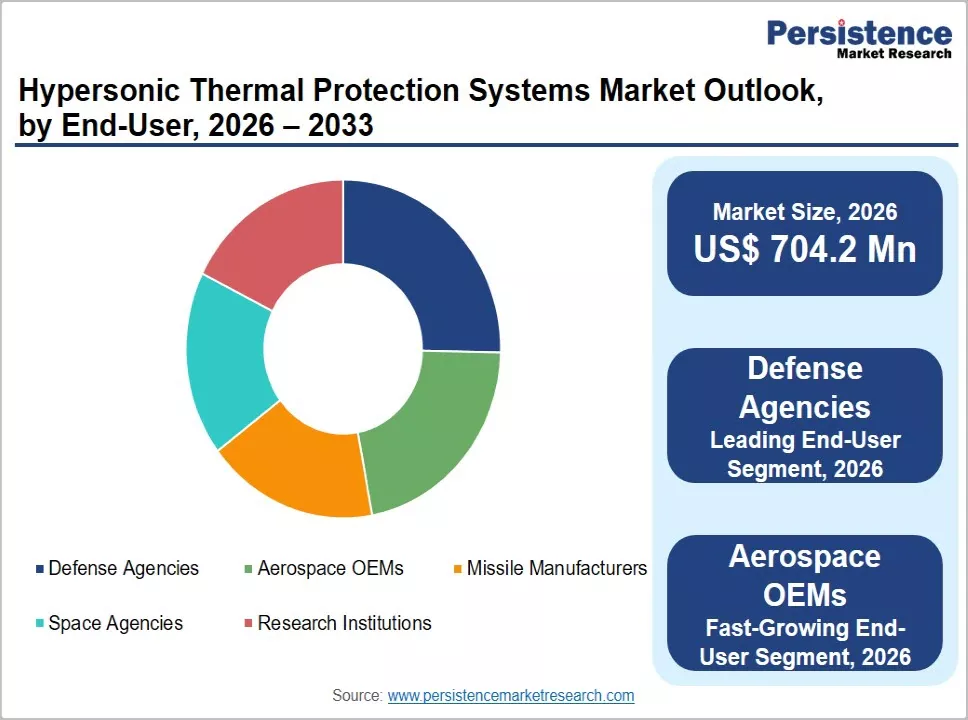
- Dominant Segment: Defense agencies are the leading end-user segment, holding around 36% share in 2026, supported by government funding for hypersonic development, requirements setting, and multi-year contracts with qualified suppliers.
- Fastest-growing Segment: Aerospace OEMs are the fastest-growing end-user segment, driven by the transition of hypersonic programs toward production and the expansion of in-house thermal protection capabilities among prime contractors.
- Key Market Opportunity: Hypersonic defense and interceptor programs present a significant opportunity, supported by growing demand for lightweight, strong, and heat-resistant materials for interceptors, sensors, and related defense systems.
Market Dynamics
Drivers - Rising Hypersonic Weapon Development Programs
Growing investment in hypersonic weapons is a major driver of the hypersonic thermal protection systems market. Glide vehicles and cruise missiles experience extreme heating at nose tips, leading edges, and control surfaces, creating demand for qualified thermal protection materials. Each new test vehicle and production order increases demand for heat-resistant composites, ceramics, and coatings. Government focus on higher production capacity is also encouraging suppliers to expand manufacturing capabilities and improve material processing.
Several countries are funding hypersonic programs. The U.S. Department of Defense requested US$ 6.9 billion for hypersonic programs in its fiscal year 2025 budget. Australia, the United Kingdom, and the United States announced cooperation on hypersonic and counter-hypersonic capabilities under AUKUS in 2022. China displayed its DF-17 hypersonic glide vehicle missile in 2019, increasing the focus on allied hypersonic programs. This spending supports long-term contracts for materials, components, and testing services across the supply chain.
Growth of Reusable Space and High-Speed Flight Programs
Reusable launch and reentry vehicles are creating sustained demand for durable thermal protection systems. Unlike single-use heat shields, reusable vehicles require materials that withstand repeated flights with limited repair. This is increasing demand for ceramic tiles, carbon composites, and coatings that tolerate repeated heating cycles. Space agencies and private launch companies also prioritize lightweight systems, as reducing heat-shield mass increases available payload capacity.
Space programs demonstrate the scale of the thermal challenge. NASA reported that the Orion capsule heat shield experienced temperatures of about 5,000°F during its Artemis I reentry in 2022. SpaceX uses ceramic heat shield tiles on its Starship vehicle, which is designed for rapid reuse. The European Space Agency is developing the Space Rider reusable spaceplane. These programs are encouraging suppliers to improve material durability, inspection methods, and production rates, supporting market growth.
Restraints - High Cost and Complex Manufacturing of Advanced Materials
High costs and complex manufacturing processes limit the pace of market expansion. Advanced composites and ceramics are expensive to produce, while individual components require extensive inspection and quality control. Long processing cycles also limit how quickly production capacity can increase when orders rise. Program managers can face delays when a limited number of qualified suppliers cannot meet delivery schedules, affecting testing and production milestones.
The manufacturing process is demanding. Carbon-carbon parts require repeated densification cycles at high temperatures, which can take weeks or months. Ceramic matrix composites use fiber preforms and infiltration processes that require tight process control. Ultra-high-temperature ceramics are difficult to shape and can crack during processing. Scrap rates, specialized furnaces, and limited skilled labor further increase unit costs. Since production volumes are relatively small and designs vary by program, suppliers have limited opportunities to achieve cost benefits from large-scale production.
Export Controls and Limited Testing Infrastructure
Export controls and limited testing capacity restrict market expansion and narrow the potential customer base. Hypersonic materials and technologies are sensitive, limiting sales to foreign buyers and data sharing with research partners. Companies also face additional compliance requirements, while new entrants can encounter lengthy approval processes. These restrictions keep demand closely tied to domestic programs within individual countries.
Regulation and testing infrastructure both influence market development. Hypersonic-related items are covered by regulations such as the International Traffic in Arms Regulations in the United States and guidelines from the Missile Technology Control Regime. Testing also requires arc-jet facilities, hypersonic wind tunnels, and flight tests, which are costly and limited in number. Limited access to test facilities can delay material qualification, while restricted data sharing limits opportunities for suppliers to accelerate design improvements.
Opportunities – Expanding Hypersonic Defense and Interceptor Programs
Hypersonic defense creates an additional source of demand beyond offensive weapons. Interceptors, sensors, and radar windows need to withstand high speeds and temperatures while maintaining required performance. This creates demand for thermal protection materials that combine low weight and strength, as well as radio-frequency transparency for certain components. Suppliers offering these capabilities can participate in programs separate from glide vehicle and cruise missile production, broadening their potential revenue base.
Governments are funding these programs. The Missile Defense Agency of the United States is developing the Glide Phase Interceptor with Northrop Grumman. In Europe, the European Defence Fund supports projects such as TWISTER and HYDIS², which focus on detecting and intercepting hypersonic threats. These projects involve multiple countries and industrial partners, creating opportunities for specialized material suppliers. As hypersonic threats expand, defense ministries are expected to increase investment in interceptor testing and production.
Demand for Commercial Hypersonic Flight and Reusable Test Vehicles
Commercial and test-flight vehicles offer another growth opportunity for thermal protection suppliers. Companies are developing reusable hypersonic test aircraft to enable more frequent flight-data collection by government and industry. These vehicles require thermal protection systems that can be inspected, repaired, and reused, supporting demand for ceramic composites and advanced coatings. Suppliers offering lower-cost, repeatable components are positioned to secure orders from emerging test-flight companies and research programs.
Several projects demonstrate this trend. Stratolaunch reported a Mach 5 flight of its reusable Talon-A vehicle in 2024 as part of a program focused on more frequent hypersonic testing. Hermeus is developing high-speed aircraft and has tested engine systems on the ground. The European Space Agency plans reuse of its Space Rider vehicle for orbital experiments. As test activity increases, demand for repeatable thermal protection components is expected to grow steadily.
Category-wise Analysis
Which Material Leads the Hypersonic Thermal Protection Systems Market?
Ceramic matrix composites represent the leading material category, holding around 34% share in 2026. This leadership is supported by their ability to retain strength at temperatures above 1,000°C, lower weight than metal alloys, and better crack resistance than conventional ceramics. These properties make them suitable for leading edges, control surfaces, and engine components exposed to high heat and mechanical loads. Suppliers such as Safran and GE Aerospace already produce ceramic composites for aircraft engines, providing relevant manufacturing experience and supporting adoption in hypersonic applications.
Ultra-high-temperature ceramics are expected to be the fastest-growing material segment through 2033, driven by their ability to withstand extreme temperatures and support high-speed vehicle applications. Compounds such as hafnium diboride and zirconium diboride have melting points above 3,000°C, making them suitable for sharp leading edges and nose tips. Research at organizations such as NASA and the Air Force Research Laboratory is improving material toughness and manufacturing methods. As flight tests reach higher speeds and longer durations, demand for materials capable of withstanding extreme thermal loads is increasing.
Protection Mechanism Insights
Passive thermal protection represents the leading segment, accounting for an estimated 44% of the market share in 2026, supported by its simple design, reliability, and use of insulating and heat-resistant materials without coolant or moving parts. These characteristics make passive systems easier to integrate and certify for military applications. Short-duration glide missions also favor passive protection due to limited heat exposure and established material technologies.
Active thermal protection is expected to be the fastest-growing segment from 2026 to 2033, driven by rising demand for thermal management in sustained high-speed flight and reusable vehicles. Air-breathing systems generate prolonged heat loads that passive materials have limited ability to manage. Methods such as regenerative cooling with fuel and transpiration cooling through porous surfaces remove heat during flight. Research programs for cruise missiles and reusable aircraft are evaluating these technologies, supporting adoption as longer missions and reusable platforms gain importance.
Which End-user Leads the Hypersonic Thermal Protection Systems Market?
Defense agencies are likely to lead the market with a 36% share in 2026, supported by government funding for hypersonic development, control of major test programs, and direct procurement of thermal protection systems. Multi-year contracts provide suppliers with stable demand, while security requirements limit the number of qualified vendors. Defense agencies also fund materials research and testing infrastructure, supporting development of the broader supply base. Continued investment in missiles, hypersonic glide vehicles, and related defense systems keeps this end-user segment at the forefront of market demand.
Aerospace OEMs are expected to be the fastest-growing end-user from 2026 to 2033, driven by the transition of hypersonic programs from prototypes toward production. Prime contractors are expanding in-house thermal protection capabilities to gain greater control over quality, production schedules, and costs. Investment in materials processing and long-term supply agreements with specialized suppliers is increasing. Commercial launch vehicles, reusable spacecraft, and high-speed test vehicles are also supporting demand for advanced thermal protection systems.
Regional Analysis
Which Region Leads the Hypersonic Thermal Protection Systems Market?
North America is expected to lead the global hypersonic thermal protection systems market by holding around 41% share in 2026, supported by the region's large funded hypersonic weapons and space programs backed by the Department of Defense, NASA, and major prime contractors. A deep supply base for carbon composites, ceramics, and coatings supports local production. Testing infrastructure, including arc-jet facilities and hypersonic wind tunnels, further strengthens the regional ecosystem. Furthermore, the region is expected to shift from prototype testing toward serial production, creating opportunities for suppliers with qualification capabilities, production capacity, and export control compliance.
U.S. Hypersonic Thermal Protection Systems Market Size
The U.S. accounts for an estimated 93% of the North American market revenue. Programs such as the Army's Long-Range Hypersonic Weapon and the Navy's Conventional Prompt Strike are driving demand for heat shields and leading edges. NASA and commercial launch companies add demand for reusable heat shields, while the Missile Defense Agency funds interceptor programs requiring heat-resistant materials. Major primes and specialized suppliers operate under long-term contracts, supporting investment in production capacity. The country is expected to remain dominant as major programs progress from testing toward production and supplier capacity expands.
Europe Hypersonic Thermal Protection Systems Market Trends and Insights
Europe represents a significant market. The region is developing hypersonic capabilities through national programs and joint funding initiatives. The European Defence Fund supports projects focused on hypersonic threat detection and interception. Strong space agencies and ceramic-composite suppliers provide an additional civil demand base, while the European Space Agency is developing the Space Rider reusable spaceplane.
Export controls and national procurement priorities influence supplier selection, while growing demand for test capacity is increasing pressure on available infrastructure. Moreover, the European market is expected to expand through collaboration between defense primes and materials companies, creating opportunities for suppliers pursuing cross-border partnerships and early program qualification.
France Hypersonic Thermal Protection Systems Market Size
France is projected to hold about 30% share of the European hypersonic thermal protection systems market in 2026. ArianeGroup flew its V-MaX hypersonic glider demonstrator in 2023 for the French defense procurement agency, DGA, while Safran produces ceramic composites. Strong national funding supports missile and space programs, while the country's engineering base supports advanced materials development.
Research centers, defense primes, and materials companies collaborate under national programs, supporting qualification of new components. Large defense contracts also provide suppliers with a stable base for long-term capacity investment. France is expected to remain the largest European market as demonstrator programs progress toward operational systems and larger orders.
Germany Hypersonic Thermal Protection Systems Market Size
Germany is anticipated to hold a substantial share of the European market in 2026. The government announced a EUR 100 billion special fund for the armed forces in 2022, supporting investment in new defense technologies. The German Aerospace Center, known as DLR, operates advanced high-temperature testing facilities. Strong engineering and materials industries also support ceramic and carbon-composite production, while universities contribute research on high-speed flight and material testing. Industrial suppliers can serve both defense and space programs, supporting broader demand. Germany’s market is expected to grow steadily as defense spending increases and research institutions collaborate with industry on heat-resistant materials and testing methods.
U.K. Hypersonic Thermal Protection Systems Market Size
The U.K. is expected to hold a considerable share of the European market in 2026. The country joined AUKUS hypersonic cooperation in 2022, while the Defence Science and Technology Laboratory supports high-speed flight research. Strong aerospace and materials companies provide an established supplier base, while universities contribute research in high-temperature materials and aerodynamics.
Joint programs with international partners provide suppliers with access to larger development programs. Defense primes and specialized companies also collaborate on research and technology development. The country’s market is expected to grow as joint programs with the U.S. and Australia progress from research toward testing and production.
Which Region is Growing Fastest in the Hypersonic Thermal Protection Systems Market?
Asia Pacific is projected to register the fastest CAGR of 15.3% between 2026 and 2033. Rising defense budgets, regional security concerns, and expanding space programs are driving demand. China accounts for the largest share of regional activity, supported by a broad base of carbon and ceramic materials producers. Several countries are also developing test facilities and research programs for high-speed flight. Furthermore, the region is expected to progress from development toward fielding, creating opportunities for companies that establish local partnerships and comply with national security requirements.
China Hypersonic Thermal Protection Systems Market Size
China holds an estimated 46% of the Asia Pacific market share. The country displayed its DF-17 hypersonic glide vehicle missile in 2019 and maintains an active space program. A large domestic base of carbon fiber and ceramic producers supports local material supply. Government funding and military modernization are also supporting demand. Research institutes and manufacturers collaborate on ceramics, carbon composites, and coatings for high-speed vehicles. Space programs also require reusable and ablative heat shields for returning vehicles. China is expected to remain the largest country market as military and space programs expand.
India Hypersonic Thermal Protection Systems Market Size
India is anticipated to hold a significant share of the Asia Pacific hypersonic thermal protection systems market in 2026. The Defence Research and Development Organisation, known as DRDO, tested its Hypersonic Technology Demonstrator Vehicle in 2020, demonstrating progress in scramjet-powered flight. Government support for domestic defense production is increasing demand for local materials and testing facilities. Universities and public laboratories also conduct research on high-temperature ceramics and composites.
The Indian Space Research Organisation requires heat shields for reentry vehicles, while private companies are increasingly participating in public programs as suppliers. India is expected to rank among the faster-growing markets as hypersonic testing programs advance.
Japan Hypersonic Thermal Protection Systems Market Size
Japan is projected to hold a notable share of the Asia Pacific market. The Ministry of Defense is developing a Hyper Velocity Gliding Projectile for island defense, while JAXA researches high-speed flight and reentry technologies. Strong advanced ceramics and carbon fiber industries support the domestic supply base. Precision manufacturing capabilities help suppliers meet demanding quality requirements, while large industrial groups already supply advanced materials to aircraft and space programs. Long-duration testing programs also favor suppliers with proven process control. Japan’s market is expected to grow as defense programs progress toward deployment and increase demand for qualified heat-resistant components from reliable domestic suppliers.
Competitive Landscape
The global hypersonic thermal protection systems market is concentrated around a few defense primes and specialist material suppliers, with differentiation and qualified technology carrying greater importance than scale. Customers are primarily government agencies that demand proven performance, security clearances, and established program records, creating high entry barriers. Leading players differentiate through flight-test data, proprietary processes for carbon and ceramic composites, and control of scarce production capacity.
The dominant strategic themes include vertical integration into materials, long-term supply agreements, and investment in test facilities. Established players are focused on securing capacity and strengthening their positions early, while new entrants are likely to specialize in specific materials or components and partner with defense primes. The market is expected to shift toward serial production contracts.
Key Industry Developments
- In November 2024, DRDO in India conducted the first flight test of its long-range hypersonic anti-ship missile, a milestone that increases demand for domestic heat-resistant materials and thermal protection components across the supply chain.
- In June 2023, ArianeGroup flew its V-MaX hypersonic glider demonstrator for the French defence procurement agency DGA, testing technologies for future maneuvering hypersonic vehicles and their thermal protection, with support from French industry.
Companies Covered in Hypersonic Thermal Protection Systems Market
- Lockheed Martin
- Northrop Grumman
- RTX
- Boeing
- GE Aerospace
- Safran
- Honeywell
- Collins Aerospace
- CeramTec
- CoorsTek
- SGL Carbon
- Hexcel
- Morgan Advanced Materials
- Canopy Aerospace
- Starfire Systems
Frequently Asked Questions
The global hypersonic thermal protection systems market size is estimated at US$ 704.2 million in 2026 and is projected to reach US$ 1,616.1 million by 2033.
Rising hypersonic weapon development is the key demand driver. Governments are funding vehicles that face extreme heat, which raises orders for heat-resistant materials.
North America is likely to lead the market with a 41% share in 2026, supported by large defense and space budgets, strong prime contractors, and advanced testing facilities.
Expanding hypersonic defense and interceptor programs represents a significant opportunity. Interceptors and sensors also face extreme heat and need advanced heat-resistant materials.
Key players include Lockheed Martin, RTX, Northrop Grumman, Boeing, Safran, GE Aerospace, Hexcel, CoorsTek, Ultramet, and ArianeGroup.


