




- Clothing, Footwear, & Accessories
- Hiker Socks and Yoga Socks Market
Hiker Socks and Yoga Socks Market Size, Share, and Growth Forecast 2026 – 2033
Hiker Socks and Yoga Socks Market by Product Type (No-show Socks, Ankle Socks), Material (Cotton, Polyester), Consumer Orientation (Men, Women), Sales Channel (Supermarkets/Hypermarkets), and Regional Analysis, 2026 – 2033

Hiker Socks and Yoga Socks Market Size and Trends Analysis
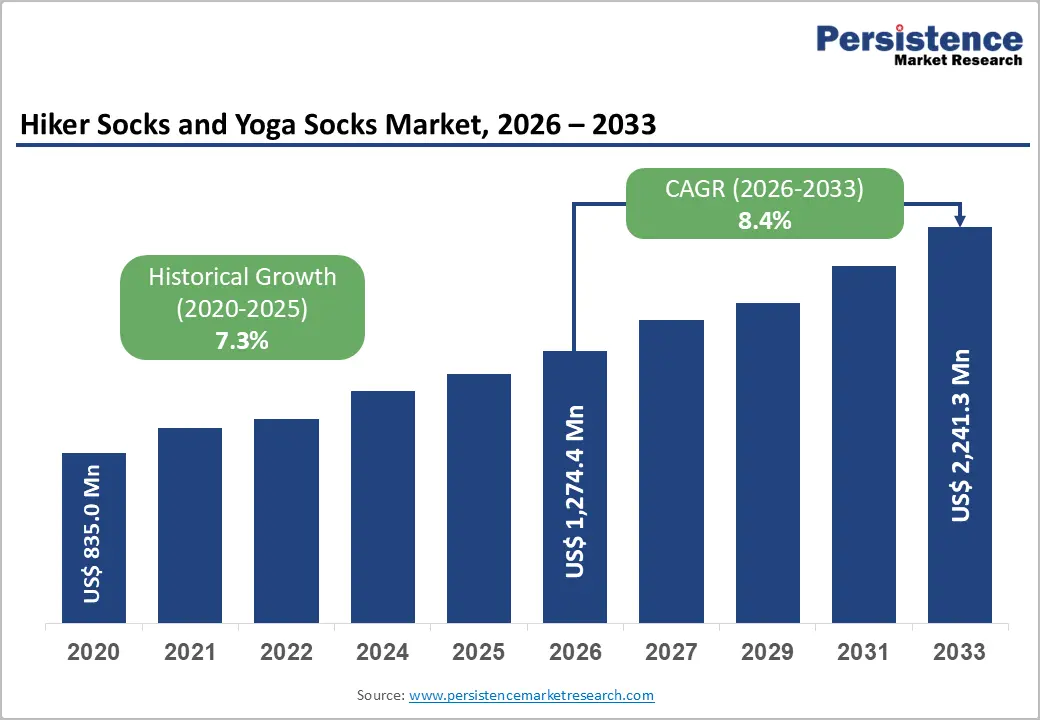
The global hiker socks and yoga socks market size is likely to be valued at US$1,274.4 million in 2026 and is expected to reach US$2,241.3 million by 2033, growing at a CAGR of 8.4% during the forecast period from 2026 to 2033, driven by rising participation in outdoor recreation and fitness activities and increasing demand for performance-oriented and moisture-wicking apparel. Surging adoption of yoga and studio-based workouts is another key factor predicted to foster the market.
Key Industry Highlights:
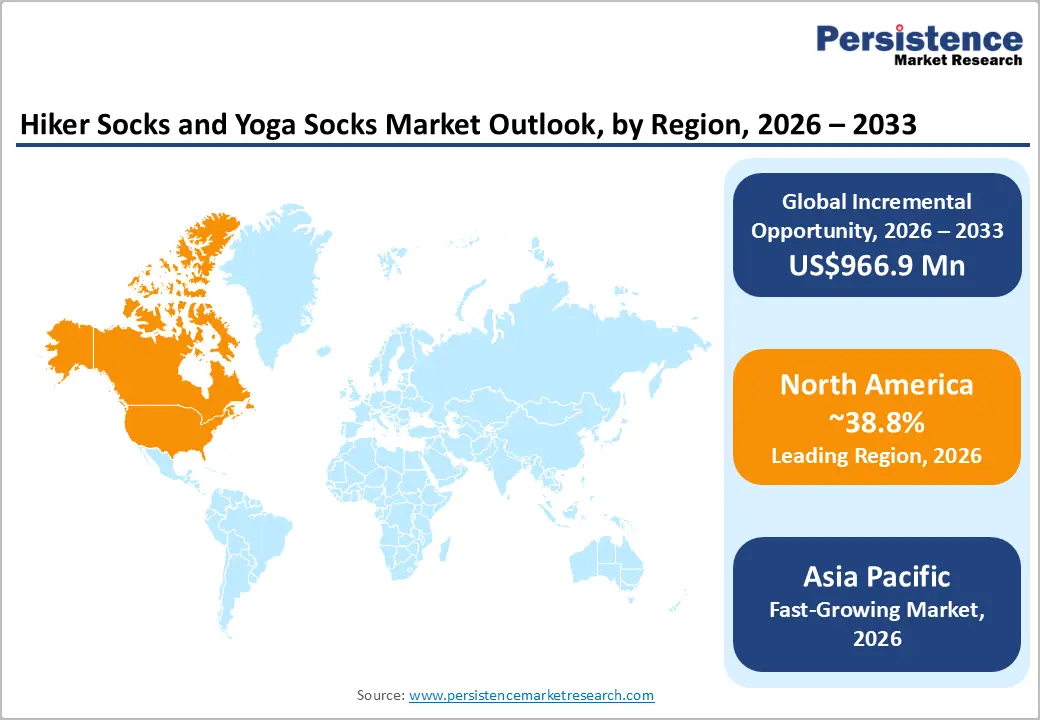
- Leading Region: North America, with about a 38.8% share in 2026, owing to high participation in outdoor recreation and fitness activities.
- Fast-growing Region: Asia Pacific, fueled by ongoing urban fitness adoption and favorable government-led health and wellness initiatives.
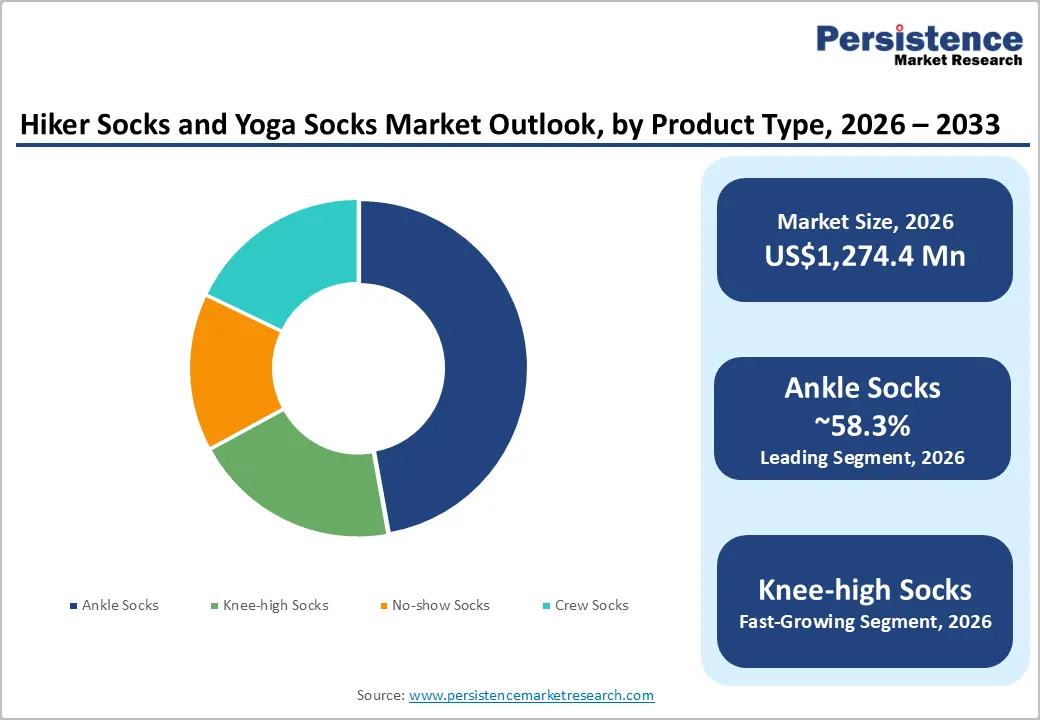
- Leading Product Type: Ankle socks, with approximately 58.3% share in 2026, as they deliver a balance of breathability and protection.
- Dominant Material: Cotton, with a nearly 40.6% share in 2026, owing to its soft texture, high breathability, and wide availability.
- Latest Collaboration: In March 2025, Russell Athletic and For Bare Feet announced a new licensing partnership to bring a premium sock collection to market, blending Russell Athletic's sports heritage with For Bare Feet's expertise in high-quality sock manufacturing. The collection covered a range of styles from performance athletic socks to everyday essentials.
DRO Analysis
Driver- Rising Participation in Hiking, Trekking, and Adventure Sports
Outdoor recreation is no longer a niche hobby. In 2024, the outdoor recreation participant base grew 3% to a record 181.1 million participants in the U.S., representing 58.6% of Americans aged 6 and older. Hiking leads the charge. About 63 million people went hiking in 2024, making it the most popular outdoor activity measured by the Outdoor Industry Association (OIA), a growth of nearly 5 million participants in just four years.
What's notable is who's joining. Participation among seniors surged significantly, with 23.1 million Americans born before 1959 heading outdoors in 2024, which is 11.3 million more than a decade ago. More people on the trail means a high demand for performance-driven gear, especially socks designed to handle rough terrain, prevent friction, and support foot health over long distances.
Ongoing Expansion of Yoga Studios and Indoor Fitness Classes
Yoga has moved well beyond the studio mat. According to the Centers for Disease Control and Prevention (CDC) and National Institutes of Health (NIH)-backed surveys, around 14 to 17% of U.S. adults practice yoga, representing tens of millions of users across age groups. Government-level support is pushing global momentum too. India's Ministry of Ayush organized the 11th International Day of Yoga in June 2025.
The main event at Visakhapatnam set two Guinness World Records, including the largest yoga gathering at a single venue with over 302,000 participants. Industry reports from platforms such as Mindbody and ClassPass indicate that a majority of yoga studios have adopted hybrid digital models, while several established players are broadening into multiple locations to capture rising demand. This expansion creates steady demand for specialized yoga socks with grip-enhancing soles and barefoot-like sensitivity.
Restraint - Heat Build-Up May Hamper Sales in Warm Areas
Heavy hiking socks are built for cold trails and rugged terrain, but they become a liability in warm weather. The core issue is moisture. An observational study of 86 long-distance hikers published in the International Wound Journal found that hikers who developed blisters had significantly higher foot skin hydration levels than those who didn't. Elevated hydration predicted blister formation with 80% sensitivity, and wet socks were flagged as a meaningful contributing factor.
Thick wool or padded synthetic socks trap sweat, soften the skin, and raise friction, the exact conditions that cause blisters. Studies confirm that even a mild increase in moisture around the feet raises skin friction and the chance of blisters. This limits how widely heavy hiking socks can be worn across seasons. Hikers venturing into warm climates or doing short day hikes often find thick socks do more harm than good, shrinking the addressable market for standard padded styles during spring and summer months.
Opportunity - Recycled Materials to Transform Sock Production
Sustainability is shifting from a marketing claim to a measurable manufacturing practice in the outdoor sock segment. Smartwool's Second Cut program is a key proof of concept. Since launching the takeback program, Smartwool has collected more than 725,000 socks and diverted over 54,200 pounds of material from landfills, thereby turning donated socks into new yarn through its partnership with North Carolina-based circularity facility Material Return.
The process re-spins old socks into new yarn, blended with responsibly sourced Merino wool, creating a product that performs like new while reducing the environmental footprint. The urgency is real. The U.S. Environmental Protection Agency (EPA) estimates that only 14% of textiles are recycled, and socks are among the most discarded pieces of apparel. Brands that build circular models early stand to win eco-conscious consumers who want performance without the waste.
Emergence of Smart Fabrics That Keep Feet Dry on Demand
The shift toward technical performance fabrics is opening a transparent product differentiation opportunity in the hiker sock segment. Rather than relying solely on wool or basic synthetics, leading brands are embedding advanced yarns with purpose-built ventilation. Darn Tough integrates Merino wool for thermoregulation, targeting moisture release when feet heat up while retaining warmth in colder conditions, further reducing the sweat-blister cycle that limits thick sock usage in warmer conditions.
Mesh ventilation zones placed across the top of the foot allow targeted airflow without sacrificing cushioning underfoot. This approach addresses the overheating restraint that holds back adoption in spring and summer hiking. For yoga socks, moisture-wicking blends serve a parallel need, keeping grip surfaces stable during hot yoga or high-intensity flow sessions, where sweat on the sole undermines traction and performance.
Category-wise Analysis
Product Type Insights
Ankle-length socks are predicted to lead with a share of approximately 58.3% in 2026, as they balance comfort, hygiene, and versatility. They sit just above the shoe line, which reduces friction compared to no-show socks while still allowing airflow. This makes them suitable for daily wear, gym use, and light outdoor activity. A study published in the Journal of Foot and Ankle Research highlights that moisture buildup and friction are key causes of blisters, and socks that allow ventilation while maintaining a protective layer help reduce this risk. Ankle socks meet this requirement well. They are also widely used in sports training.
Knee-high socks are estimated to be the fastest-growing segment over the forecast period, due to their role in performance support and recovery. Unlike ankle socks, knee-high designs deliver compression benefits that improve blood circulation in the lower legs. This is especially useful for hikers, runners, and people who stand for long hours. Medical research from journals such as BMJ Open Sport & Exercise Medicine shows that compression socks can reduce muscle soreness and improve recovery time after endurance activities. Government-backed health bodies such as the National Health Service (NHS) also recommend compression stockings for preventing conditions, including deep vein thrombosis, during long travel.
Material Insights
Cotton is anticipated to dominate with a share of nearly 40.6% in 2026 due to its comfort, availability, and skin compatibility. Cotton fibers are soft, breathable, and widely accepted for everyday wear. They are also less likely to cause skin irritation compared to synthetic materials. According to the Food and Agriculture Organization (FAO), cotton accounts for a major share of global natural fiber production, which ensures a stable supply and cost efficiency. Medical guidance from dermatology associations often recommends cotton-based fabrics for sensitive skin due to their hypoallergenic nature.
The wool segment is expected to remain in the second position in 2026 due to its performance advantages in extreme conditions. Merino wool, in particular, is gaining traction in premium and outdoor socks. It provides natural temperature regulation, moisture-wicking, and odor resistance. Research published in the Textile Research Journal shows that wool fibers can absorb up to 30% of their weight in moisture without feeling wet, which helps keep feet dry during long hikes. Industry-backed bodies such as The Woolmark Company have also promoted wool’s performance benefits through certified product programs, boosting consumer trust.
Regional Insights
North America Hiker Socks and Yoga Socks Market Trends
North America is predicted to dominate in 2026 with a share of approximately 38.8%, due to strong outdoor culture and premium product adoption. The region has a high participation rate in hiking, fitness, and wellness activities. Data from the Outdoor Industry Association shows that more than half of Americans engage in outdoor recreation each year. This supports demand for technical socks such as moisture-wicking hiking socks and grip-based yoga socks. Consumers in the U.S. and Canada also spend more on premium apparel. Brands such as Smartwool and Darn Tough have built strong loyalty by focusing on durability and performance. Retail distribution is also advanced, with specialty outdoor stores and e-commerce platforms driving consistent product visibility.
U.S. Hiker Socks and Yoga Socks Market Trends
A share of nearly 54.3% is expected to be held by the U.S. in 2026, backed by rising wellness trends and studio culture. Yoga, Pilates, and home fitness have expanded speedily after the pandemic. According to the CDC, physical activity participation has increased as part of preventive health efforts. This has boosted demand for yoga accessories such as grip socks. Boutique fitness studios are also expanding across cities, often requiring or recommending grip socks for hygiene reasons. On the hiking side, the growth of national park visits, reported by the National Park Service, has increased demand for durable hiking gear, including socks designed for long trails.
Asia Pacific Hiker Socks and Yoga Socks Market Trends
Asia Pacific is anticipated to be the fastest-growing region in 2026, with a share of nearly 31.4%, spurred by urban fitness adoption and rising incomes. Countries in this region are seeing a shift toward active lifestyles. Government-led fitness campaigns are playing a key role. For example, China’s national fitness program has encouraged millions to adopt regular exercise. At the same time, rising middle-class income is increasing spending on specialized apparel. Yoga is also broadening beyond India into Southeast Asia, Australia, and China. E-commerce platforms such as Tmall and Flipkart are making global brands more accessible, which is accelerating market penetration.
China Hiker Socks and Yoga Socks Market Trends
China will likely lead Asia Pacific in 2026 with a share of around 40.1%, due to government-backed fitness initiatives and ongoing local manufacturing. The General Administration of Sport of China has actively promoted mass fitness programs, aiming to increase sports participation nationwide. This has led to high demand for affordable and performance-oriented products. China also benefits from a well-established textile manufacturing base, which allows local brands to produce cost-effective socks at scale. Domestic companies are quickly adopting features such as compression and anti-slip grips, which were earlier limited to premium imports.
India Hiker Socks and Yoga Socks Market Trends
In 2026, India is projected to account for a share of approximately 17.5%, driven by yoga culture and digital retail expansion. The country has a natural advantage due to its association with yoga. Government initiatives such as International Day of Yoga, supported by the Ministry of AYUSH, have increased awareness and participation. This has created demand for yoga accessories, including socks with grip features for studio use. Platforms such as Amazon and Myntra are also extending access to both domestic and international brands.
Europe Hiker Socks and Yoga Socks Market Trends
Europe will likely see decent growth over the forecast period, with a share of nearly 15.9% in 2026, fostered by a sustainability focus and established outdoor habits. Modern consumers show high interest in eco-friendly textiles. Policies from bodies such as the European Commission promote sustainable production and circular economy practices. This supports demand for materials such as organic cotton and merino wool. France, Italy, and the Nordic nations already have a strong hiking culture, which ensures consistent demand for performance socks. Growth is stable rather than fast as the market is relatively mature.
Germany Hiker Socks and Yoga Socks Market Trends
Germany will likely register a substantial share of approximately 38.9% in 2026, backed by its strong hiking culture and technical product preference. The German Alpine Club has millions of members, reflecting high participation in outdoor activities. Local consumers also prefer high-quality engineered products. This complies well with premium hiking socks made from merino wool and advanced blends. Local and international brands are focusing on durability, sustainability, and certification, which resonates strongly with buyers.
U.K. Hiker Socks and Yoga Socks Market Trends
A share of around 23.2% is predicted to be held by the U.K. in 2026, as it has seen steady growth in gym memberships and boutique fitness studios. According to Sport England, millions of adults engage in regular physical activity each week. This supports demand for yoga and Pilates socks. Outbound travel and trekking holidays are also popular among consumers, increasing the demand for hiking gear. Sustainability is further influencing buying decisions, with more consumers choosing socks made from recycled or natural fibers.
Competitive Landscape
The global hiker socks and yoga socks market is moderately fragmented with the presence of specialized performance brands, outdoor apparel companies, sportswear giants, and several regional/private-label manufacturers. Brands such as Darn Tough, Smartwool, Injinji, Icebreaker, Farm to Feet, and Bridgedale are among the most recognized players. Merino wool-based products remain the premium category, with manufacturers differentiating through blister prevention, smooth construction, temperature regulation, and lifetime warranty programs.
The yoga socks segment is more fragmented than the hiking socks segment due to lower barriers to entry and the presence of several fitness accessory brands. Specialist grip-sock manufacturers such as ToeSox, Tavi, Gaiam, Shashi, and Great Soles compete alongside large-scale activewear companies, including Nike, Adidas, Lululemon, and Manduka. The top five players collectively account for less than half of market revenue, indicating significant fragmentation and surging participation from local brands and studio-focused suppliers.
Key Industry Developments:
- In March 2026, Lululemon announced the launch of its first-ever sweat-concealing technology for high-sweat activities, under its ShowZero platform. The new yarn technology changes how light interacts with fabric, making sweat virtually invisible while maintaining breathability, moisture management, and a lightweight feel.
- In October 2025, Smartwool and Icebreaker, both leaders in Merino wool performance socks and apparel, announced a four-year partnership with Alterra Mountain Company. Through this deal, guests at Alterra's resort network will have access to premium Merino wool socks and apparel at resort retailers, alongside immersive on-mountain activations across Alterra's 19 destinations in the U.S. and Canada.
- In February 2025, FitLab, a multi-brand performance lifestyle company, acquired Y7, an omnichannel yoga brand with studios in New York, California, and Austin, Texas. FitLab plans to bundle Y7 into a forthcoming all-access membership across its in-real-life fitness brands, which also include Sanctuary Fitness, Yoga Vida, and XPT. As specialized heated yoga formats expand through institutional backing, demand for performance yoga socks with heat-resistant grip and moisture management is set to follow.
Companies Covered in Hiker Socks and Yoga Socks Market
- ADIDAS Group
- Nike, Inc.
- PUMA SE
- Farm to Feet
- Darn Tough
- VF Corporation
- ToeSox, Inc.
- Patagonia, Inc.
- Icebreaker
- Wrightsock
- Others
Frequently Asked Questions
The global hiker socks and yoga socks market is projected to be valued at US$1,274.4 million in 2026.
The hiker socks and yoga socks market is expected to reach US$2,241.3 million by 2033.
Key market trends include high demand for performance-enhancing features and increasing use of sustainable materials.
Ankle socks are expected to be the leading product type with a share of nearly 58.3% in 2026, as they are versatile across multiple use cases, including gym workouts and casual wear.
The hiker socks and yoga socks market is expected to grow at a CAGR of 8.4% from 2026 to 2033.
ADIDAS Group, Nike, Inc., and PUMA SE are a few key market players.


