




- Healthcare Services
- Surgical Apparel Market
Surgical Apparel Market Size, Share, Growth, and Regional Forecast, 2026 to 2033
Surgical Apparel Market by Product Type (Surgical Drapes, Scrubs and Gowns, Caps, Gloves, and Others), by Usage Type (Disposable and Reusable), by Material (Cotton, Polyester, and Blends) by End User (Cotton, Polyester, and Blends), and Regional Analysis from 2026 to 2033

Surgical Apparel Market Share and Trend Analysis
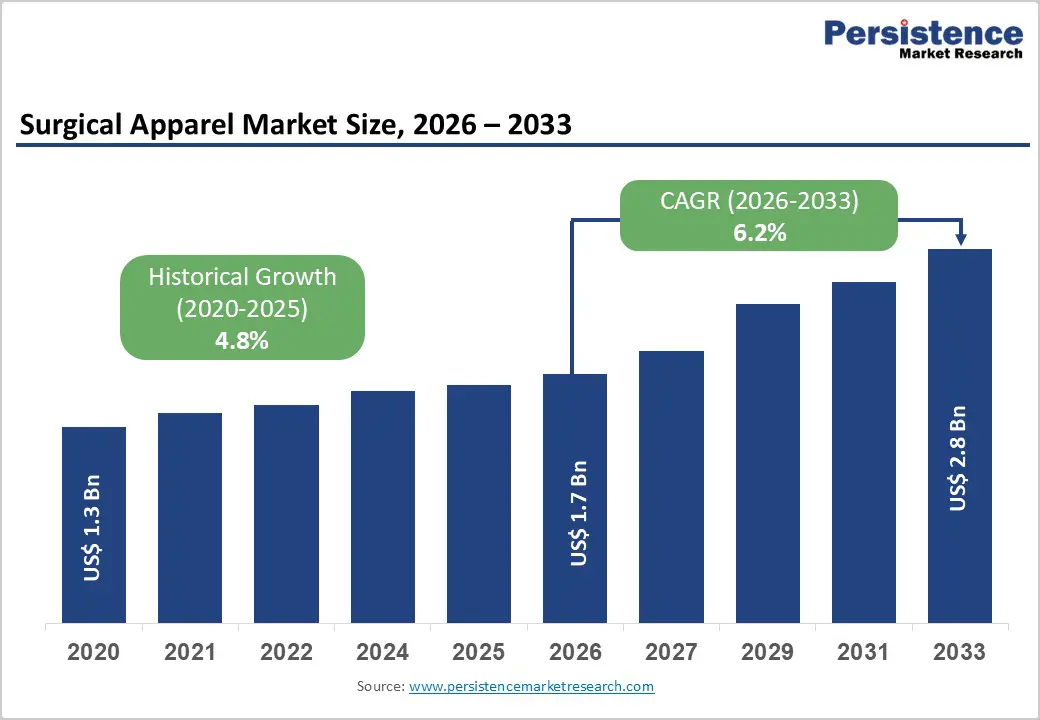
The global surgical apparel market size is estimated to grow from US$ 1.7 billion in 2026 to US$ 2.8 billion by 2033. The market is projected to record a CAGR of 6.2% during the forecast period from 2026 to 2033. Rising surgical volumes and heightened emphasis on infection prevention are significantly influencing the growth trajectory of surgical apparel across global healthcare systems.
These products play a critical role in maintaining sterile environments and protecting both patients and healthcare professionals from contamination risks. Increasing prevalence of chronic diseases, aging populations, and the expansion of surgical interventions are driving consistent demand for gowns, drapes, gloves, and other protective wear.
Healthcare facilities are increasingly prioritizing compliance with stringent safety regulations, which has accelerated the adoption of high-performance, certified apparel. The growing shift toward disposable products, particularly in high-risk procedures, is further supporting demand due to their effectiveness in minimizing cross-contamination. At the same time, advancements in textile engineering-such as fluid-resistant, breathable, and antimicrobial fabrics-are improving product efficiency and user comfort. Additionally, expanding healthcare infrastructure in emerging markets and rising investments in hospital capacity are strengthening procurement volumes. Manufacturers are also focusing on product innovation and ergonomic designs to enhance usability. With continuous improvements in distribution networks and increasing awareness of hospital-acquired infections, the market is expected to witness steady long-term expansion.
Key Industry Highlights:
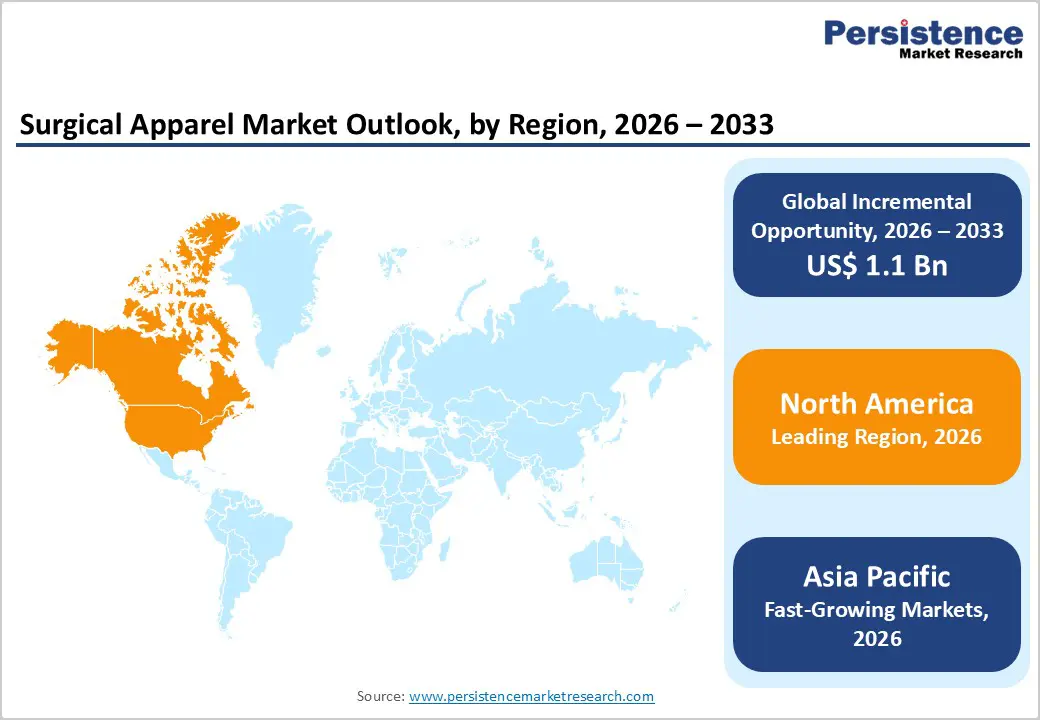
- Leading Region: North America accounts for 48.5% of global revenue, supported by advanced healthcare infrastructure, strict infection control regulations, and high surgical procedure volumes.
- Fastest-Growing Region: Asia Pacific is expanding at the fastest pace, driven by rapid healthcare infrastructure development, rising patient volumes, and improving access to surgical care.
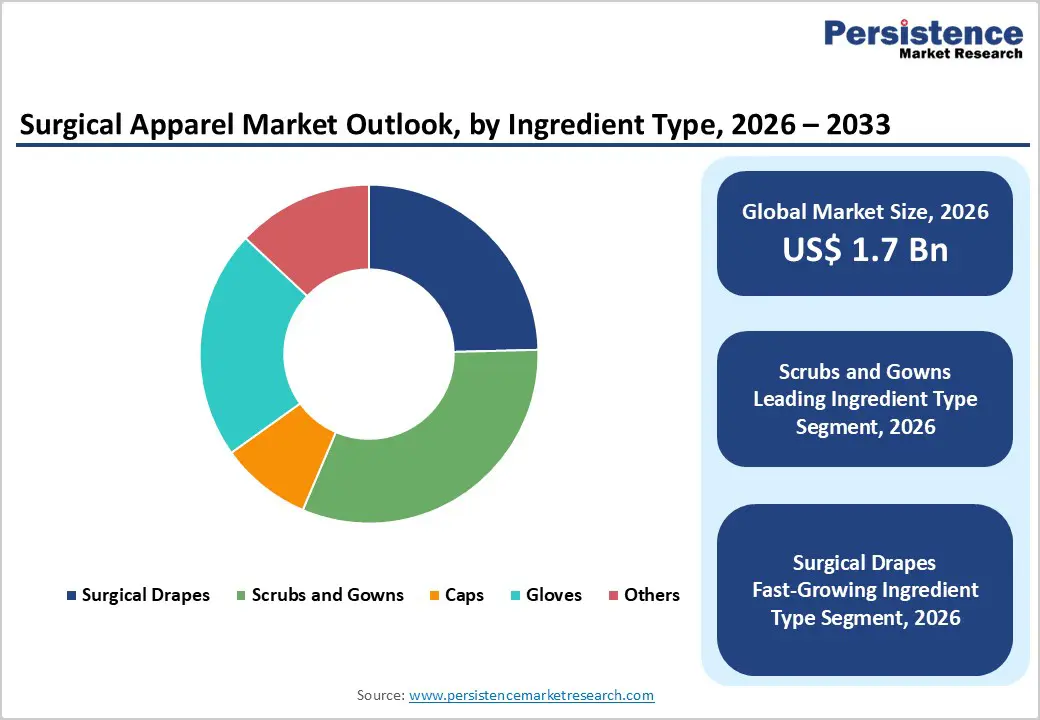
- Leading Product Type Segment: Scrubs & Gowns hold 31.8% share, owing to their essential role in maintaining sterile conditions across all surgical procedures.
- Fastest-Growing Product Type Segment: Gloves are witnessing strong growth due to increased usage frequency, stringent hygiene practices, and rising awareness of infection prevention.
- Leading Material Segment: Blends dominate with 38.3% share, attributed to their balance of durability, comfort, and protective performance.
- Fastest-Growing Material Segment: Polyester is gaining traction as demand rises for lightweight, cost-effective, and fluid-resistant materials in disposable surgical apparel.
| Key Insights | Details |
|---|---|
| Surgical Apparel Market Size (2026E) | US$ 1.7 Bn |
| Market Value Forecast (2033F) | US$ 2.8 Bn |
| Projected Growth (CAGR 2026 to 2033) | 6.2% |
| Historical Market Growth (CAGR 2020 to 2025) | 4.8% |
Market Dynamics
Driver - Increasing Surgical Procedures and Stringent Infection Prevention Protocols
A major factor propelling industry growth is the continuous rise in surgical procedures worldwide, driven by aging populations, increasing prevalence of chronic diseases, and expanding access to healthcare services. As surgical volumes grow, the demand for sterile and high-performance protective apparel rises proportionally. Strict infection control guidelines issued by healthcare authorities and accreditation bodies are compelling hospitals and surgical centers to adopt certified surgical garments that minimize the risk of hospital-acquired infections (HAIs).
Additionally, heightened awareness following global health crises has reinforced the importance of protective medical clothing among healthcare professionals. The shift toward single-use apparel, particularly in high-risk procedures, is further accelerating consumption. Technological advancements in fabric design-such as fluid-resistant, breathable, and antimicrobial materials-are improving both safety and comfort, encouraging broader adoption. Expanding healthcare infrastructure in emerging economies, coupled with rising healthcare expenditure, is also contributing to demand growth. Moreover, increased focus on patient safety, surgical outcomes, and regulatory compliance continues to drive consistent procurement of surgical apparel across hospitals, ambulatory surgical centers, and specialty clinics globally.
Restraint - Cost Pressures and Environmental Concerns Linked to Disposable Apparel
One of the key challenges limiting market expansion is the rising cost burden associated with high-quality surgical apparel, particularly disposable products. Hospitals and healthcare systems, especially in cost-sensitive regions, often face budget constraints that restrict large-scale procurement of premium protective garments. While disposable apparel offers superior infection control benefits, its recurring cost structure creates financial pressure for healthcare providers managing high patient volumes.
Environmental concerns further complicate adoption patterns, as single-use surgical garments contribute significantly to medical waste generation. Disposal of contaminated apparel requires specialized handling and compliance with biomedical waste regulations, increasing operational complexity and costs. Growing scrutiny around sustainability is pushing healthcare institutions to reconsider excessive reliance on disposables. Additionally, fluctuations in raw material prices, particularly synthetic fibers like polypropylene, can impact manufacturing costs and supply stability. Regulatory requirements related to product quality, safety certifications, and performance standards also add to production expenses. These combined factors create barriers for manufacturers and healthcare providers, potentially limiting adoption in developing regions where affordability remains a critical consideration.
Opportunity - Advancements in Sustainable Materials and Expansion of Outpatient Care Facilities
The market presents strong growth opportunities through the development of sustainable and reusable surgical apparel solutions. Increasing environmental awareness among healthcare providers is driving demand for eco-friendly materials that reduce waste without compromising safety standards. Innovations in high-performance reusable textiles, capable of withstanding multiple sterilization cycles while maintaining barrier protection, are gaining traction. This shift enables healthcare facilities to balance cost efficiency with sustainability goals. Another key opportunity lies in the rapid expansion of ambulatory surgical centers and outpatient care facilities, particularly in emerging markets. These settings require a steady supply of cost-effective and efficient surgical apparel, creating new demand channels beyond traditional hospitals. Manufacturers are also focusing on product differentiation through ergonomic designs, enhanced comfort, and improved breathability to meet the evolving needs of healthcare professionals.
Furthermore, advancements in smart textiles and antimicrobial coatings are opening new avenues for product innovation. Integration of infection-resistant technologies can significantly enhance product value. Coupled with increasing investments in healthcare infrastructure and rising surgical demand globally, these innovations are expected to create substantial long-term growth opportunities for the market.
Category-wise Analysis
By Product Type Insights
Scrubs and gowns are projected to account for 31.8% of the global surgical apparel market revenue in 2026, making them the leading product segment. Their dominance is attributed to mandatory usage across all surgical environments, ensuring sterility and minimizing contamination risks. These products are designed with advanced barrier properties, fluid resistance, and comfort, supporting prolonged surgical procedures. Increasing surgical volumes, coupled with strict adherence to infection prevention protocols, continue to drive consistent demand.
Additionally, technological advancements in fabric engineering, including breathable and antimicrobial textiles, have improved usability and clinician preference. Hospitals and surgical centers rely heavily on these garments due to regulatory compliance requirements. The shift toward disposable variants for enhanced safety further strengthens segment growth. Continuous innovation in ergonomic design and material durability is reinforcing the widespread adoption of scrubs and gowns across both developed and emerging healthcare markets.
By Material Insights
Blended materials are expected to hold 38.3% of the global surgical apparel market in 2026, driven by their superior functional performance compared to single-fiber alternatives. These fabrics combine the strength and durability of synthetic fibers such as polyester with the comfort and breathability of natural fibers like cotton. This balance makes them highly suitable for both reusable and semi-disposable surgical apparel. Increasing emphasis on healthcare worker comfort during long procedures has significantly boosted demand for such materials.
Moreover, blended fabrics offer enhanced resistance to fluids and microbial penetration, aligning with stringent safety standards. Their cost-effectiveness and longer lifecycle in reusable applications also make them attractive for healthcare providers aiming to optimize operational expenses. Manufacturers are continuously improving fabric compositions to enhance barrier efficiency while maintaining flexibility. As healthcare systems focus on both performance and sustainability, blended materials are gaining strong traction globally.
By End-user Insights
Hospitals are anticipated to capture 54.8% of the total surgical apparel market revenue in 2026, establishing them as the primary end users. This leadership is driven by the high volume of inpatient and outpatient surgical procedures performed in hospital settings. Stringent regulatory frameworks and infection prevention guidelines necessitate continuous consumption of sterile apparel, including gowns, drapes, and gloves. Hospitals also maintain structured procurement systems, ensuring consistent supply through bulk purchasing and long-term supplier agreements.
The presence of specialized surgical departments further increases product utilization across multiple disciplines. Additionally, rising healthcare expenditure and infrastructure expansion, particularly in emerging economies, are contributing to increased hospital admissions and surgical interventions. Adoption of advanced surgical techniques and growing awareness regarding hospital-acquired infections are further strengthening demand. As hospitals continue to prioritize patient safety and operational efficiency, their reliance on high-quality surgical apparel remains significant.
Region-wise Insights
North America Surgical Apparel Market Trends
North America is expected to account for 48.5% of the global surgical apparel market revenue in 2026, positioning it as the leading regional market. The region’s dominance is supported by a highly developed healthcare infrastructure, significant surgical procedure volume, and strict regulatory frameworks governing infection prevention. The United States plays a pivotal role, with strong adoption of advanced surgical products and consistent demand for high-performance disposable apparel. Healthcare facilities across the region prioritize compliance with standards set by regulatory bodies, driving continuous procurement of certified surgical garments.
Additionally, the presence of major market players and well-established distribution channels ensures product availability across hospitals and ambulatory centers. Technological advancements in material science, including fluid-resistant and antimicrobial fabrics, are further enhancing product performance. The region is also witnessing increased adoption of single-use apparel to reduce cross-contamination risks. Growing healthcare expenditure and ongoing investments in hospital infrastructure continue to sustain market expansion. Overall, North America maintains its leadership through a combination of innovation, regulatory compliance, and high procedural volume.
Europe Surgical Apparel Market Trends
Europe represents a mature yet steadily evolving market for surgical apparel, driven by strong regulatory oversight and increasing emphasis on patient safety. Countries such as Germany, France, the United Kingdom, Italy, and Spain contribute significantly due to well-established healthcare systems and consistent surgical demand. The region places a high priority on quality standards, with stringent guidelines ensuring the use of certified protective apparel in clinical settings. This has encouraged manufacturers to focus on high-performance materials and compliance-driven product development.
Sustainability is emerging as a key trend, with growing interest in reusable surgical garments and environmentally responsible manufacturing processes. Healthcare providers are increasingly evaluating lifecycle costs, leading to a balanced adoption of both disposable and reusable solutions. Additionally, advancements in textile technology are supporting the development of breathable, durable, and protective fabrics. While market growth remains moderate compared to emerging regions, continuous innovation and regulatory-driven demand ensure long-term stability. Europe’s focus on safety, quality, and sustainability continues to shape its surgical apparel market landscape.
Asia Pacific Surgical Apparel Market Trends
Asia Pacific is projected to be the fastest-growing regional market, registering a CAGR of approximately 8.4% from 2026 to 2033. The region’s growth is fueled by expanding healthcare infrastructure, rising population, and increasing access to surgical care. Countries such as China, India, Japan, and South Korea are witnessing a surge in hospital admissions and surgical procedures, directly boosting demand for surgical apparel. Rapid urbanization and improving healthcare awareness are further contributing to increased utilization of protective medical clothing.
Cost-effective manufacturing capabilities and availability of raw materials enable large-scale production within the region, attracting both domestic and international players. Governments are also investing in healthcare modernization and infection control initiatives, which is accelerating product adoption. The expansion of private hospitals and ambulatory surgical centers is further supporting market growth. Additionally, rising focus on hygiene standards post-pandemic has increased demand for disposable apparel. With a combination of strong demand fundamentals and production advantages, Asia Pacific is emerging as a key growth engine in the global surgical apparel market.
Competitive Landscape
The global surgical apparel market is highly competitive, with strong participation from companies such as Cardinal Health, Inc., 3M Company, Mölnlycke Health Care AB, O&M Halyard, Inc., and STERIS plc. These players leverage advanced material technologies, strong manufacturing capabilities, and extensive global distribution networks.
Competitive strategies focus on product innovation, enhanced barrier protection, and compliance with stringent infection control standards. Companies are investing in sustainable materials, ergonomic designs, and capacity expansion to meet the rising demand driven by increasing surgical procedures and healthcare infrastructure development worldwide.
Key Industrial Developments
- In April 2024, Medline announced that it had entered into a definitive agreement to acquire the global surgical solutions business of Ecolab, Inc., including the well-known Microtek product lines. Upon completion, the acquisition will strengthen Medline’s portfolio with advanced sterile drape solutions for surgical teams, patients, and operating room equipment, along with Ecolab’s fluid temperature management system.
- In May 2025, Wadi Surgicals, headquartered in Hyderabad, announced the launch of accelerator-free nitrile gloves under its flagship brand Enliva. Developed through extensive R&D and international collaboration, these gloves mark a significant advancement in India by offering enhanced skin safety and reducing allergy risks associated with conventional nitrile gloves.
Companies Covered in Surgical Apparel Market
- Cardinal Health, Inc.
- 3M Company
- Mölnlycke Health Care AB
- O&M Halyard, Inc.
- STERIS plc
- Thermo Fisher Scientific Inc.
- PAUL HARTMANN AG
- Medtronic
- Medline Inc.
- DuPont de Nemours, Inc.
- Ansell Limited
- Kimberly-Clark Worldwide, Inc.
- B. Braun Melsungen AG
- Lohmann & Rauscher International GmbH & Co. KG
- Winner Medical Co., Ltd.
- Others
Frequently Asked Questions
The global surgical apparel market is projected to be valued at US$ 1.7 Bn in 2026.
Rising surgical volumes, strict infection control protocols, and regulatory compliance requirements are driving demand for surgical apparel globally.
The global surgical apparel market is poised to witness a CAGR of 6.2 % between 2026 and 2033.
Growth opportunities lie in eco-friendly apparel innovation and expanding healthcare infrastructure across emerging markets such as Asia-Pacific.
Cardinal Health, Inc., 3M Company, Mölnlycke Health Care AB, O&M Halyard, Inc. and STERIS plc.are some of the key players in the surgical apparel market.


