




- Semiconductor Materials & Components
- Gaming Console Market
Gaming Console Market Size, Share, and Growth Forecast 2026 - 2033
Gaming Console Market by Product Type (TV gaming console, Handheld gaming console), by Component (Hardware, Software, Services), and Regional Analysis from 2026 to 2033

Gaming Console Market Size and Trend Analysis
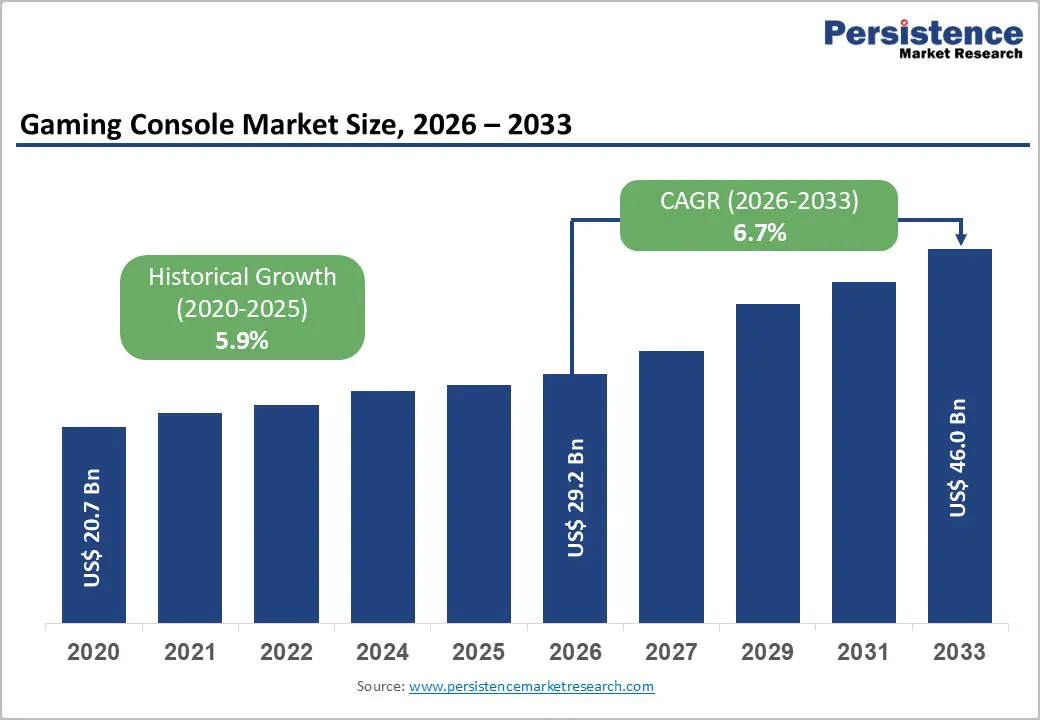
The global gaming console market size is expected to be valued at US$ 29.2 billion in 2026. Growth is driven by advancements in gaming technology and rising consumer demand for immersive entertainment experiences.
Modern consoles equipped with high-performance processors and 4K resolution support deliver superior visual quality, appealing to a wide range of gamers. The surge in online multiplayer gaming enhances community interaction, further boosting software engagement and sales. Leading players, including Sony and Nintendo, continue to see strong adoption, with PlayStation 5 shipments surpassing 50 million units and hybrid consoles gaining traction in the esports and competitive gaming space.
Key Industry Highlights:
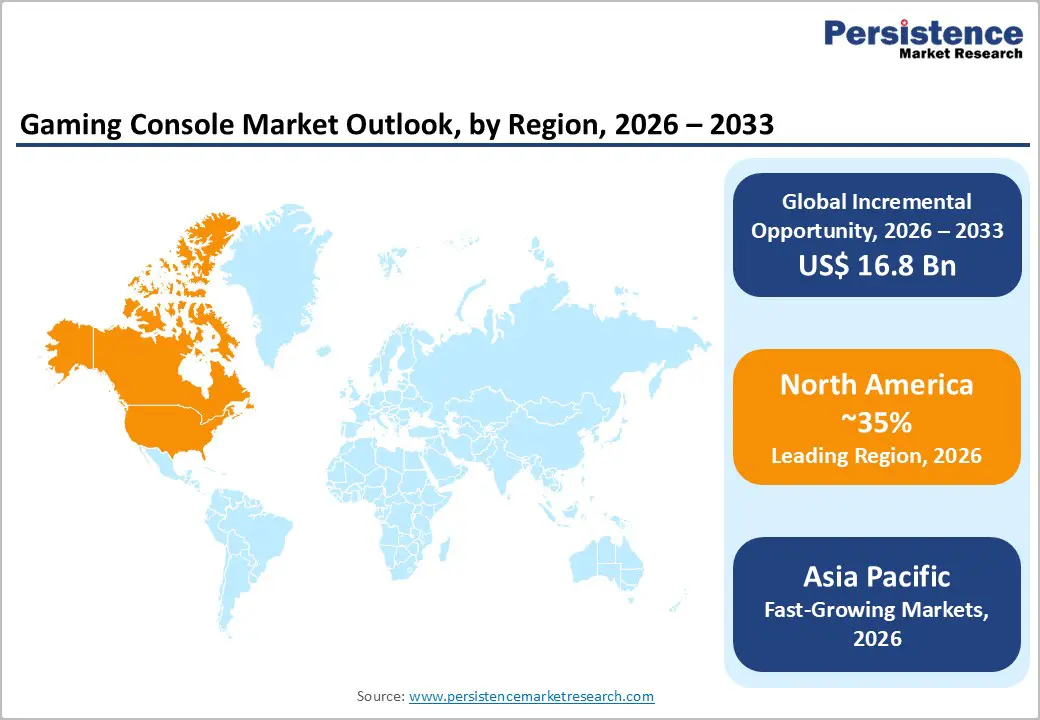
- Leading Region: North America leads with 35% share in 2025, driven by high disposable incomes and mature esports infrastructure.
- Fastest-Growing Region: Asia Pacific is the fastest-growing market with 32% share in 2025, fueled by population growth and expanding gaming adoption in India and China.
- Leading Product Category: TV gaming consoles dominate with 75% share in 2025, powered by home entertainment integration and exclusive titles.
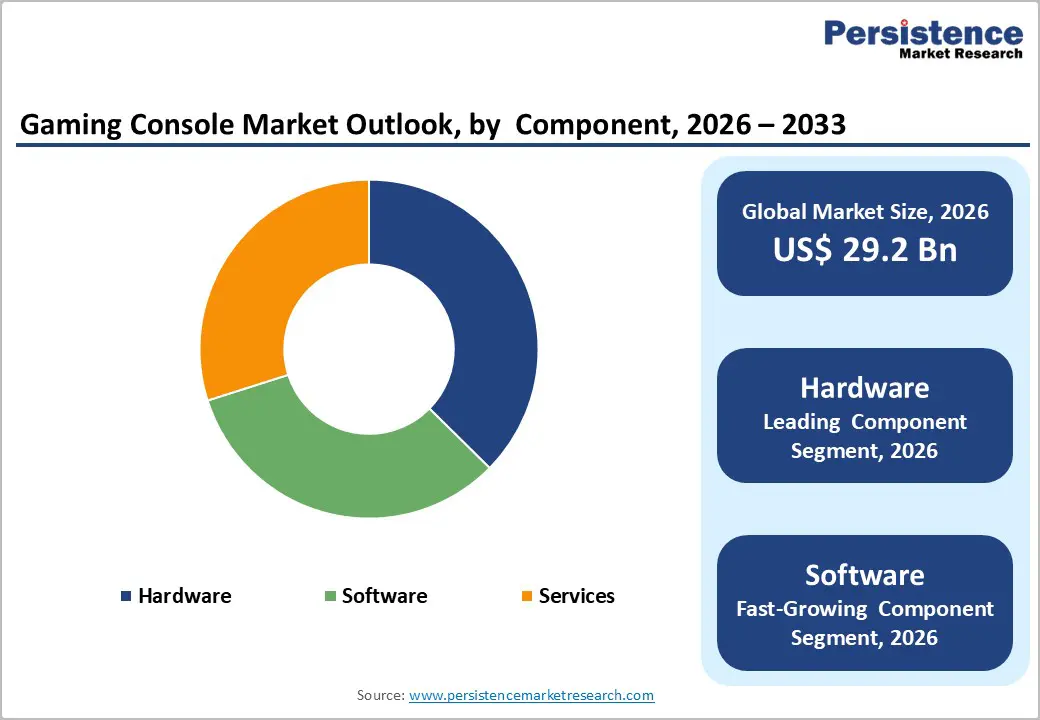
- Leading Component Category: Hardware commands 68% share in 2025, essential for performance upgrades and high-end gaming experiences.
- Key Market Opportunity: Emerging markets present growth potential through affordable hybrid consoles and expanding 5G networks for cloud-enabled gaming.
| Key Insights | Details |
|---|---|
| Gaming Console Size (2026E) | US$ 29.2 billion |
| Market Value Forecast (2033F) | US$ 46.0 billion |
| Projected Growth CAGR (2026 - 2033) | 6.7% |
| Historical Market Growth (2020 - 2025) | 5.9% |
Market Dynamics
Drivers - Rising Demand for Immersive Gaming Experiences Driving Market Growth
Consumers increasingly seek highly immersive gaming experiences, fueled by advanced technologies like ray tracing, 8K resolution, and realistic physics simulations that enhance visual fidelity. AI-powered features such as adaptive difficulty, dynamic storytelling, and personalized content further elevate engagement, creating gameplay that adapts to individual preferences. Gamers are now drawn to consoles offering richer, more responsive environments, intensifying the desire for high-end performance and enhanced sensory experiences.
Modern consoles also integrate cloud gaming, enabling access to high-performance titles on lower-spec devices, expanding the gaming audience. This accessibility encourages frequent upgrades, additional peripheral purchases, and longer gaming sessions. Enhanced graphics and smooth performance heighten user satisfaction, fostering loyalty and retention. As a result, the market benefits from consistent demand, increased software consumption, and recurring revenue streams from subscriptions and accessories.
Expansion of Esports and Competitive Gaming Accelerating Console Adoption
The esports ecosystem is rapidly expanding, with professional tournaments, leagues, and competitions attracting millions of viewers and participants globally. Consoles optimized for low-latency online play, advanced networking, and fast response times cater to this competitive environment. High-performance hardware allows gamers to compete at professional levels while streaming their gameplay, creating aspirational pathways for young players and social engagement opportunities.
Streaming platforms, content creation, and competitive careers inspire youth adoption, boosting console sales and peripheral purchases. The popularity of esports motivates frequent participation, increasing engagement in multiplayer and online titles. This driver enhances subscription revenues, accessory demand, and community-driven engagement, contributing significantly to market growth. Console manufacturers leverage this trend to design products tailored to esports enthusiasts, reinforcing brand loyalty and long-term adoption.
Restraints - Supply Chain Disruptions and Component Shortages Limiting Console Availability
Persistent semiconductor shortages and global supply chain disruptions continue to challenge console manufacturers, impacting production schedules and market availability. Geopolitical tensions, trade restrictions, and manufacturing bottlenecks constrain access to critical components such as high-performance chips and GPUs. Major suppliers face capacity limitations, delaying shipments and forcing staggered console launches.These constraints result in stockouts during peak periods, frustrating consumers and driving secondary market price inflation. Popular consoles experience delayed availability, particularly in emerging regions, reducing adoption rates and slowing overall market expansion. Limited supply amid high demand pressures manufacturers to prioritize certain markets, affecting global reach and creating temporary gaps in consumer satisfaction, which can hinder long-term brand loyalty.
High Initial Costs and Subscription Fatigue Restricting Consumer Adoption
Premium consoles priced above $500, combined with recurring subscription fees for online services and digital content, create a financial barrier for many consumers. Continuous expenditures for cloud gaming, online multiplayer access, and content libraries can lead to subscription fatigue, particularly during periods of economic uncertainty.
This combination of high upfront and ongoing costs limits adoption among price-sensitive demographics, reducing penetration in emerging markets. Budget-conscious consumers may delay purchases or opt for lower-cost alternatives, while others may discontinue subscriptions to manage expenses. As a result, market growth is constrained by affordability challenges, affecting both hardware sales and recurring revenue streams from software and digital services.
Opportunities - Growth in Emerging Markets and Mobile Integration Unlocking New Revenue Streams
Emerging markets, particularly in Asia Pacific, present significant opportunities due to a rapidly expanding middle class and increasing digital adoption. Nations like India are witnessing explosive growth in gaming populations, while lifted restrictions and supportive government policies encourage local console production. Hybrid consoles, such as the Nintendo Switch, integrate seamlessly with mobile ecosystems, bridging portable and home gaming experiences, and expanding access to first-time buyers.
Companies can leverage affordable console bundles and the rollout of 5G networks to provide seamless cloud gaming, appealing to users with limited access to high-end hardware. Investments in esports infrastructure and mobile-linked gameplay further enhance engagement, enabling manufacturers to capture new audiences and build brand loyalty in previously untapped regions.
Advancements in Backward Compatibility and Cross-Platform Play Driving Adoption
Modern consoles increasingly offer backward compatibility, allowing gamers to access legacy game libraries and extend the lifecycle of hardware. Sony’s support for nearly all PS4 titles on PS5 adds significant library value, while cross-platform initiatives, like Fortnite’s unified accounts, connect players across console, PC, and mobile devices, fostering larger communities and sustained engagement. These features encourage loyalty and repeated content consumption, opening avenues for service-based revenue, cloud saves, and enhanced digital experiences. Technologies like upscaling and cloud streaming reduce hardware barriers, making high-quality gaming accessible to broader audiences. Such innovations are especially impactful in regions where mobile gaming dominates, supporting market expansion and driving adoption among cost-conscious or first-time users.
Category-wise Analysis
Product Type Insights
TV gaming consoles lead the market with a 75% share in 2025, driven by superior processing power and immersive home entertainment setups. Consumers prefer stationary systems compatible with 4K/120Hz TVs, with PlayStation 5 and Xbox Series X dominating sales charts. Exclusive titles, multiplayer ecosystems, and integration with smart home devices reinforce their dominance. U.S. TV console shipments reportedly outpace handhelds three to one, reflecting strong household preference for high-performance, living-room-centered gaming experiences.
Handheld and hybrid consoles are the fastest-growing segment, benefiting from portability, convenience, and mobile integration. Devices like the Nintendo Switch allow seamless play at home or on the go, bridging console and mobile gaming. Cloud-enabled multiplayer features and hybrid game ecosystems expand appeal to casual and first-time gamers, particularly in regions where mobility and space constraints drive adoption, fueling overall market growth.
Component Insights
Hardware commands a 68% share in 2025, driven by demand for powerful CPUs, GPUs, and SSDs that deliver fast load times and smooth graphics. AMD supplies chips for both Sony and Microsoft, enabling advanced console performance. Custom controllers, storage expansions, and high-end peripherals further strengthen hardware’s market leadership, as most buyers prioritize processing power and system capabilities over software or services when purchasing a console.
Software and services represent the fastest-growing category, fueled by digital downloads, subscription platforms, and cloud gaming. Cross-platform titles, backward compatibility, and multiplayer functionality increase engagement and content consumption. Subscription models, online services, and cloud saves provide recurring revenue while enhancing user retention, making this segment a key driver for future growth.
Regional Insights
North America Gaming Console Market Trends
North America holds the leading position with a 35% share in 2025, driven by strong gaming culture and technological innovation hubs like Silicon Valley. Consoles dominate household entertainment, supported by widespread adoption, regulatory frameworks ensuring child safety, and streamlined product approvals. Annual gaming expenditure remains high, with major console launches and next-generation prototypes showcased at events like CES capturing significant consumer attention.
Emerging trends include cloud-enabled gaming and multiplayer esports, which expand engagement beyond traditional console play. Subscription services, online marketplaces, and hardware upgrades are fostering sustained growth and higher user retention. The integration of smart home features with consoles further strengthens adoption, particularly in the U.S. and Canada, reinforcing North America’s dominant position in the global market.
Europe Gaming Console Market Trends
Europe accounts for a steady growth trajectory, with the market projected at 25% combined share across major countries and an 8.2% CAGR forecast, led by the UK and Germany. Console adoption is fueled by strong local game development, tax incentives, and harmonized regulations like GDPR, which simplify cross-border digital transactions. Popular titles and esports leagues drive engagement, supporting both hardware and software consumption.
Countries such as France and Spain show growth through government-backed incentives, competitive gaming events, and developer support, further enhancing adoption. The increasing popularity of multiplayer and online games, combined with high-speed internet and smart device integration, positions Europe as a mature yet steadily expanding region, balancing demand for traditional consoles and digital services.
Asia Pacific Gaming Console Market Trends
Asia Pacific emerges as a fast-growing market with a 32% share in 2025, driven by China, Japan, and India. Nintendo’s Switch shipments, cloud gaming trials via 5G networks, and expanding esports infrastructure contribute to rising adoption. Regulatory approvals, manufacturing efficiencies in ASEAN countries, and rising disposable incomes further accelerate console penetration across the region.
The region benefits from hybrid and handheld console demand, mobile integration, and subscription-based gaming models. Growing gaming populations in India and China, combined with localized content and competitive gaming events, create opportunities for first-time buyers and tech-savvy youth. Cloud-enabled multiplayer features and affordable console bundles are also driving adoption in secondary cities, positioning Asia Pacific as a high-growth market for the global gaming console industry.
Competitive Landscape
The gaming console market is highly consolidated, dominated by a few key players with proprietary ecosystems. Leading companies focus on technological innovation, including advanced graphics, cloud gaming, and subscription-based models, while differentiating themselves through exclusive content, multiplayer experiences, and performance optimization. Research and development efforts target immersive features like ray tracing and high-fidelity visual capabilities to attract and retain users.
Expansion strategies emphasize portable and hybrid consoles, regional localization, and ecosystem integration to broaden reach and appeal. Emerging trends include as-a-service offerings and subscription bundles, which reduce upfront costs, while independent developers introduce niche content, creating a dynamic but competitive environment.
Key Developments:
- In June 2025, Microsoft expanded Xbox Cloud Gaming to over 50 countries, collaborating with telecom providers to ensure low-latency streaming. This move broadened global access, allowing users on lower-spec devices to experience high-end gaming without physical consoles.
- In November 2024, Sony launched the PS5 Pro featuring an enhanced GPU, enabling smooth 60FPS 4K gaming. Frame rates improved by 45% through PSSR upscaling, delivering more immersive visuals and higher performance for next-generation titles.
- In March 2024, Nintendo announced the successor to the Switch with full backward compatibility, aiming for a 2025 holiday launch. The new system focuses on hybrid gameplay, portability, and retaining access to legacy game libraries for existing users.
Companies Covered in Gaming Console Market
- Sony Interactive Entertainment
- Microsoft Corporation
- Nintendo Co., Ltd.
- Valve Corporation
- NVIDIA Corporation
- Tencent Holdings Ltd.
- Amazon.com, Inc.
- Google LLC
- Samsung Electronics
- Qualcomm Technologies, Inc.
- Atari SA
- Sega Corporation
- Razer Inc.
- Mad Catz Global Limited
- Hyperkin, Inc.
Frequently Asked Questions
The global Gaming Console Market is expected to reach US$ 29.2 billion in 2026.
Key drivers include immersive technologies, AI-enhanced gameplay, and the growth of esports, boosting engagement and hardware upgrades.
North America leads with 35% share in 2025, driven by high adoption, mature esports infrastructure, and technological innovation.
Emerging markets offer growth through affordable hybrid consoles, cloud gaming, and 5G-enabled streaming access.
Leading players include Sony Interactive Entertainment, Microsoft Corporation, Nintendo Co., Ltd., Valve Corporation, and NVIDIA Corporation.


