




- Processed Food
- Food Technology Market
Food Technology Market Size, Share, and Growth Forecast, 2026 - 2033
Food Technology Market by Component Type (Hardware, Software, Services), Industry Type (Fish, Meat and Seafood, Others), Application (Food Science, Kitchen & Restaurant Tech, Delivery, Supply Chain, Others), and Regional Analysis for 2026 - 2033

Food Technology Market Size and Trends Analysis
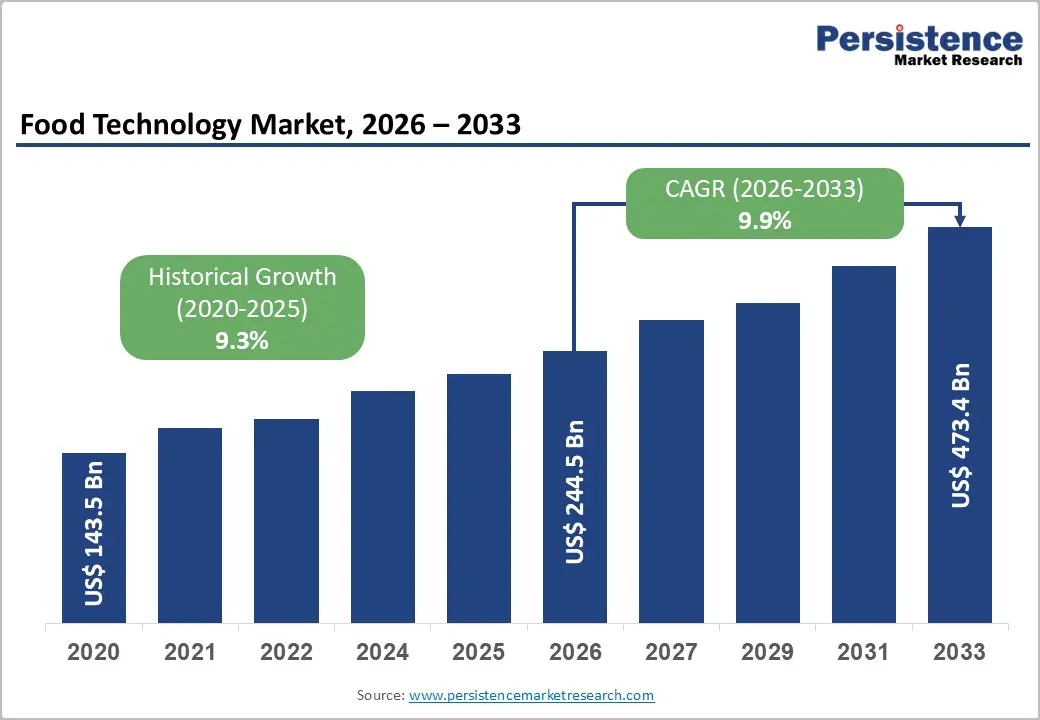
The global food technology market size is likely to be valued at US$244.5 billion in 2026, and is expected to reach US$473.4 billion by 2033, growing at a CAGR of 9.9% during the forecast period from 2026 to 2033, driven by the increasing prevalence of automation in food processing, rising demand for sustainable and personalized nutrition solutions, and advancements in AI, IoT, and robotics.
Growing demand for efficient, scalable food technology solutions, especially in meat alternatives and supply chain optimization, is accelerating adoption across industries. Advances in software and services are further boosting uptake by offering more data-driven, traceable options. Increasing recognition of food technology as critical for food security and innovation in emerging markets remains a major driver of market growth.
Key Industry Highlights:
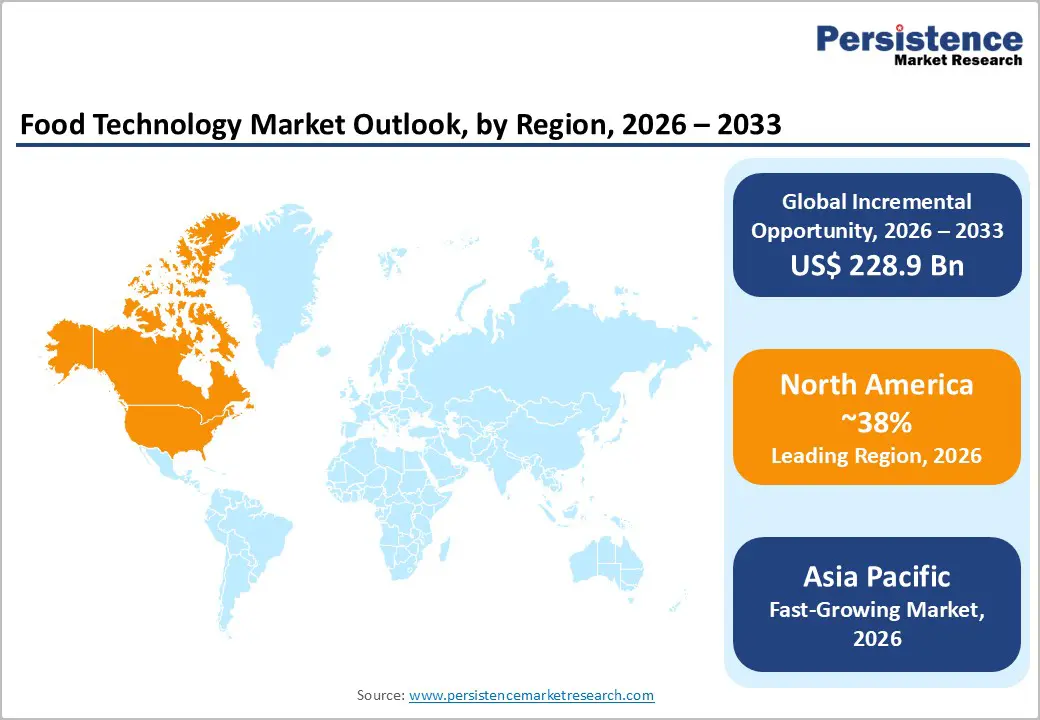
- Leading Region: North America, anticipated to account for a 38% market share in 2026, driven by advanced R&D, high investment in alternative proteins, and strong innovation in the U.S.
- Fastest-growing Region: Asia Pacific, fueled by rapid urbanization, rising middle-class demand, and growing investments in smart food systems in China and India.
- Dominant Component Type: Software, to hold approximately 40% of the market share in 2026, as it enables real-time monitoring and predictive analytics.
- Leading Industry: Meat and seafood, accounting for over 30% of the market revenue, due to high demand for alternative proteins and processing efficiency.
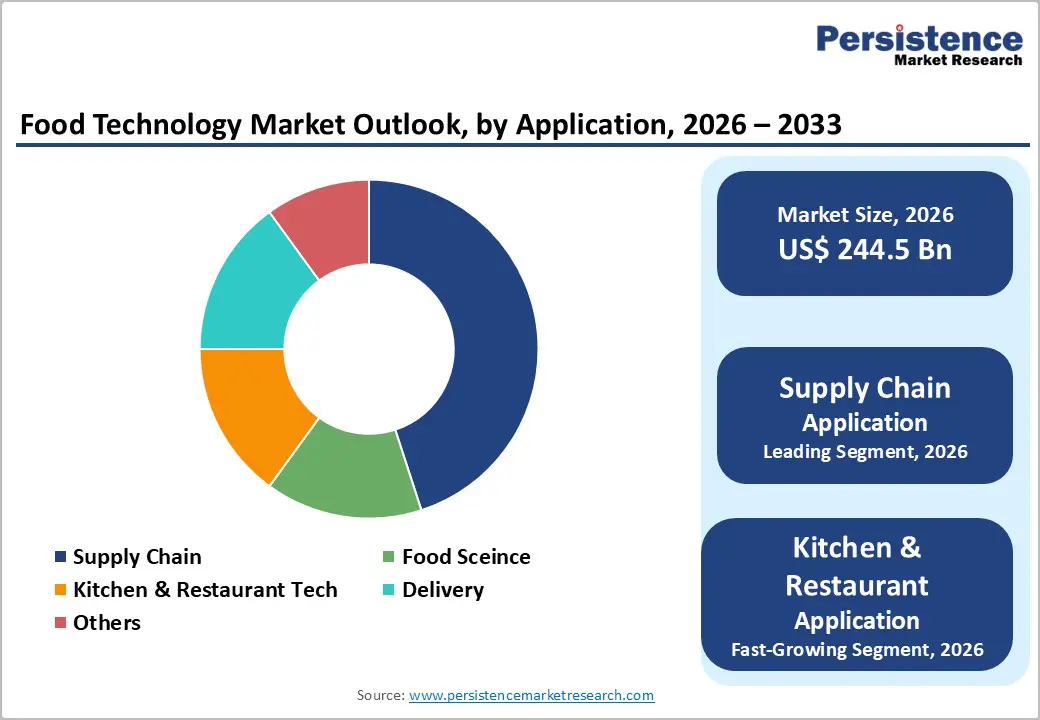
- Leading Application: The supply chain segment, to account for nearly 35% of the market revenue, due to traceability and cold-chain optimization needs.
| Key Insights | Details |
|---|---|
| Food Technology Market Size (2026E) | US$244.5 Bn |
| Market Value Forecast (2033F) | US$473.4 Bn |
| Projected Growth (CAGR 2026 to 2033) | 9.9% |
| Historical Market Growth (CAGR 2020 to 2025) | 9.3% |
Market Factors - Growth, Barriers, and Opportunity Analysis
Rising Demand for Automation in Food Processing and Sustainable Solutions
The rising demand for automation in food processing and sustainable solutions is reshaping the global food industry. Manufacturers are increasingly adopting automated systems to enhance efficiency, consistency, and hygiene across processing lines. Robotics, sensor-based sorting, and advanced control systems reduce manual intervention, minimize human error, and improve product uniformity, making automation a strategic priority for large-scale and mid-sized processors. These technologies also support faster throughput and better traceability, which are essential for meeting stringent food safety regulations and rising consumer expectations.
Sustainability has become a core focus for food processors as environmental concerns and regulatory pressures intensify. Automated equipment enables optimized use of raw materials, water, and energy by precisely controlling processing parameters and reducing waste generation. Smart automation also supports predictive maintenance, lowering downtime and extending equipment life, which further reduces resource consumption. In parallel, food companies are integrating sustainable practices such as energy-efficient machinery, recyclable packaging compatibility, and responsible sourcing into automated production models.
High Development and Integration Costs
High development and integration costs present a significant barrier for companies advancing next-generation food technology and novel processing systems. Developing innovative solutions such as AI-driven robotics, blockchain traceability, or precision fermentation platforms requires extensive research, specialized sensors, and advanced software that are far more expensive than legacy systems. Integration is an even greater challenge: many advanced systems, IoT-enabled lots, and data-driven products are sensitive to legacy equipment, network latency, and data security, requiring rigorous optimization to ensure they remain reliable throughout operations. Achieving long-term performance often involves costly pilot trials, sophisticated interoperability testing, and the use of high-grade hardware, which significantly increases R&D expenditures.
Meeting stringent regulatory expectations for food safety, data privacy, and batch consistency requires multiple validation studies under various conditions and across several production batches. This adds both time and financial burden to development timelines. Scaling up manufacturing requires controlled cleanrooms, specialized software stacks, and quality-assurance systems, further driving up overall costs. For smaller players, these challenges can limit innovation or delay commercialization.
Advancements in AI-Driven and Sustainable Processing Platforms
Advancements in AI-driven and sustainable food technology processing platforms are transforming the global food landscape by addressing two major challenges, labor dependency and waste barriers. AI-driven platforms are engineered to achieve predictive analytics, reducing reliance on manual monitoring and enabling real-time optimization in processing. Innovations, such as machine learning algorithms, IoT sensors, robotic automation, and blockchain traceability, significantly improve efficiency and reduce waste, lowering operational costs for processors and sustainability campaigns.
Progress in sustainable platforms, including precision fermentation, alternative protein extruders, cold-chain IoT, and bio-based packaging, supports more eco-conscious production by minimizing emissions, the industry’s first line of defense against climate impact. These formats eliminate resource waste, enhance yield, and allow scalable production without environmental trade-offs, making them highly suitable for mass food programs. New technologies such as 3D food printing, bio-adhesive coatings, and VLP-based sensors further enhance precision and sustainability response.
Category-wise Analysis
Component Type Insights
Software is anticipated to dominate the market, accounting for approximately 40% of the revenue share in 2026. Its dominance is driven by data analytics, traceability, and scalability, making it preferred for supply chain and quality control. Software provides real-time insights, ensures compliance, and contributes to efficiency, making it suitable for large-scale food campaigns. IBM Food Trust is a blockchain-based supply chain software platform that has been adopted by major food manufacturers, retailers, and suppliers to provide end-to-end traceability and real-time insights across global food networks. The platform uses immutable blockchain records and real-time data exchange to enhance transparency, reduce risk, and enable rapid response to quality issues (such as recalls), making it especially effective for complex supply chains that require consistent quality control and regulatory compliance.
The services segment is expected to be the fastest-growing, driven by its customizable offerings and increasing adoption in consulting and implementation. Its advisory capabilities make it well-suited for targeted digital transformation initiatives, helping organizations reduce reliance on in-house expertise. Ongoing innovations in AI integration are further enhancing its value, accelerating uptake across North America and Europe, where demand for comprehensive, end-to-end solutions is rising. Accenture has notably expanded its AI-driven consulting and implementation services to support enterprise digital transformation across sectors such as supply chain, operations, and quality control. In late 2025, the company announced a multi-year partnership with AI leader Anthropic to accelerate AI adoption and upskill tens of thousands of consultants, enabling the delivery of tailored AI solutions and full-scale transformation services to clients worldwide.
Industry Type Insights
The meat and seafood segment is estimated to lead the market, holding approximately 30% of the revenue share in 2026, driven by alternative protein needs, large processing programs, and strong global demand for sustainable options. Their dominance continues as brands expand plant-based lines. Rising adoption of dairy substitutes and expanded bakery campaigns highlight the growing focus on multi-industry benefits. Eat Just, Inc. launched its plant-based chicken product “Just Meat” nationwide across over 3,000 Walmart stores in the U.S. and Puerto Rico, demonstrating mainstream retailer adoption and growing consumer demand for sustainable alternatives that closely mimic conventional meat in taste and texture.
The dairy segment is expected to be the fastest-growing, driven by strong momentum in plant-based alternatives and the expanding use of precision fermentation. The shift toward sustainable, lactose-free products, combined with improved texture and sensory quality, is accelerating adoption. Advances in fermentation technology and the introduction of vegan blends in consumer trials are further boosting market growth. Perfect Day, Inc. (U.S.) is a leading food-tech company leveraging precision fermentation to produce animal-free dairy proteins, such as whey. These proteins are identical to those found in cow’s milk but are produced sustainably using engineered microbes instead of animals. Perfect Day’s precision-fermented proteins are incorporated into a variety of plant-based dairy alternatives, including yogurts, ice creams, and other dairy-style products, helping manufacturers achieve enhanced texture, nutrition, and flavor that closely resemble traditional dairy.
Application Insights
The supply chain segment is projected to lead the market, accounting for nearly 35% of revenue in 2026, as it serves as the central hub for traceability, large-scale logistics, and management of diverse products requiring real-time monitoring. Its robust integration, skilled operators, and capacity to handle high-volume or cold-chain products drive higher efficiency and consumption. Supply chain sectors are also spearheading software deployments and piloting emerging IoT solutions. Walmart, for example, has strategically implemented blockchain technology to tackle critical supply chain challenges related to food traceability and safety. In collaboration with IBM, Walmart launched the IBM Food Trust platform, which digitizes the entire food supply chain, enabling instant tracking of products from farm to shelf. This innovation enhances transparency, reduces waste, and dramatically improves responsiveness to foodborne illness outbreaks. Traditionally, tracing the source of contaminated food could take several days, or even weeks, requiring extensive paperwork and numerous phone calls across the supply chain.
The kitchen and restaurant technology segment is poised to be the fastest-growing, fueled by its strong automation capabilities and increasing adoption in smart cooking solutions. These technologies provide convenient, efficient, and easily accessible operations, appealing to operators seeking tech-driven, low-labor solutions. Greater focus on sustainability, expanded outreach programs, and wider availability of both standard and premium technologies are accelerating adoption across urban and semi-urban areas. For example, Flippy, an AI-powered robotic kitchen assistant, has been deployed in over 100 White Castle locations and expanded to other chains such as Jack in the Box. It automates repetitive cooking tasks such as frying and grilling, enhancing consistency, speeding up service, and enabling restaurants to manage high order volumes with fewer staff, a significant advantage for urban and semi-urban outlets dealing with labor shortages and cost pressures.
Regional Insights
North America Food Technology Market Trends
North America is expected to lead the market, capturing nearly 38% of the share in 2026, driven by its advanced processing infrastructure, robust research and development capabilities, and high public awareness of sustainable practices. Manufacturing systems in the U.S. and Canada provide strong support for food technology programs, ensuring broad accessibility across meat alternatives, dairy substitutes, and supply chain applications. Rising demand for software-driven, convenient, and easily integrable solutions is further accelerating adoption, as these technologies enhance efficiency and reduce reliance on traditional methods.
Innovations in food technology, including stable AI analytics, advanced IoT integration, and targeted sustainability enhancements, are attracting significant public and private investment. Government initiatives and clean-label campaigns continue to promote solutions that address waste reduction, labor shortages, and emerging sustainability challenges, maintaining strong market momentum.
The increasing focus on dairy-grade technologies and specialty applications is expanding the scope of food tech adoption. For example, European engineering firm GEA opened a 10,000 m² Food Technology Center in Wisconsin, featuring pilot-scale bioreactors and facilities to help startups and producers scale fermentation and cultivated meat processes from lab to industrial levels, supporting the growth of alternative proteins and food biotechnology in North America.
Europe Food Technology Market Trends
Europe is propelled by increasing awareness of sustainability benefits, strong processing systems, and government-led green programs. Countries such as Germany, France, and the U.K. have well-established food frameworks that support routine innovation and encourage the adoption of advanced tech delivery methods, including food technology. These efficient formulations are particularly appealing for meat populations, eco-conscious consumers, and dairy users, improving yield and coverage rates. The IFFA 2025 trade fair in Frankfurt spotlighted cutting-edge AI, robotics, and automation technologies for meat and alternative protein processing, highlighting European industrial leadership in food robotics and smart manufacturing systems.
Technological advancements in food technology development, such as enhanced precision fermentation, application-targeted delivery, and improved clean-label grades, are further boosting market potential. European authorities are increasingly supporting research and trials for tech against both routine and specialized needs, strengthening market confidence. The growing emphasis on convenient, low-waste options is aligned with the region’s focus on preventive nutrition and reducing environmental impact. Public awareness campaigns and transition drives are expanding reach in both urban and rural areas, while suppliers are investing in robotics and novel variants to increase efficacy.
Asia Pacific Food Technology Market Trends
Asia Pacific is likely to be the fastest-growing market for food technology, fueled by rising industrial awareness, increasing government initiatives, and expanding application programs across the region. Countries such as India, China, Japan, and Southeast Asian nations are actively promoting tech campaigns to address food security and emerging alternative needs. Food technology is particularly attractive in these regions due to its scalable administration, ease of integration, and suitability for large-scale processing drives in both urban and rural populations. Mush&, a new South Korean food-tech company launched in 2024, is using precision fermentation of mushroom mycelium for sustainable food and feed ingredient development, reflecting APAC’s focus on next-generation food ingredients and bioprocessing.
Technological advancements are supporting the development of stable, effective, and easy-to-deploy food technology, which can withstand challenging production conditions and minimize waste dependence. These innovations are critical for reaching remote facilities and improving overall efficiency coverage. Growing demand for meat alternatives, dairy substitutes, and supply chain applications is contributing to market expansion. Public-private partnerships, increased food expenditure, and rising investment in tech research and manufacturing capacity are further accelerating growth. The convenience of technology delivery, combined with improved sustainability and reduced risk of inefficiency, positions food technology as a preferred choice.
Competitive Landscape
The global food technology market features competition between established agri-tech leaders and emerging innovators. In North America and Europe, Beyond Meat and Impossible Foods lead through strong R&D, distribution networks, and industry ties, bolstered by innovative proteins and processing programs. In Asia Pacific, Cargill, Incorporated. Advances with localized solutions, enhancing accessibility. AI-enhanced delivery boosts efficiency, cuts waste risks, and enables mass integrations across regions. Strategic partnerships, collaborations, and acquisitions merge expertise, expand portfolios, and speed commercialization. Sustainable formulations solve environmental issues, aiding penetration in green-focused areas.
Key Industry Developments
- In November 2025, Tetra Pak unveiled an automation and digitalization platform aimed at making F&B factories “AI-ready.” The Tetra Pak Factory OS tool provides real-time insights and data integration for manufacturers to boost production efficiency, reduce waste, and support companies’ sustainability goals.
- In July 2025, the IFT introduced CoDeveloper, an AI-driven R&D platform that assists food scientists in rapid recipe development and optimization, accelerating product innovation cycles for food and beverage companies. This platform highlights software and AI tools shaping the future of food innovation.
Companies Covered in Food Technology Market
- Beyond Meat
- Impossible Foods
- Cargill, Incorporated
- Tyson Foods
- Nestlé
- ADM
- Kerry Group
- Givaudan
- The Kellogg Company
- Kraft Heinz
Frequently Asked Questions
The global food technology market is projected to reach US$244.5 billion in 2026.
The rising prevalence of automation in food processing and demand for sustainable solutions are the key drivers.
The food technology market is poised to witness a CAGR of 9.9% from 2026 to 2033.
Advancements in AI-driven and sustainable processing platforms are key opportunities.
Beyond Meat, Impossible Foods, Cargill, Incorporated, Tyson Foods, and Nestlé are the key players.


