




- Pharmaceuticals
- Food Allergen Testing Market
Food Allergen Testing Market Size, Share, Growth, and Regional Forecast, 2026 to 2033
Food Allergen Testing Market by Source (Milk, Egg, Seafood, Tree Nuts, Peanuts, Wheat, Soy, Others), Technology (Polymerase Chain Reaction (PCR)-based, Immunoassay-based, Fluorescent Assays, Mass Spectrometry, Others), Application (Bakery & Confectionery, Processed Food, Infant Formula & Baby Food, Beverages, Meat and Seafood, Dairy Products, Others), and Regional Analysis from 2026 to 2033

Food Allergen Testing Market Share and Trends Analysis
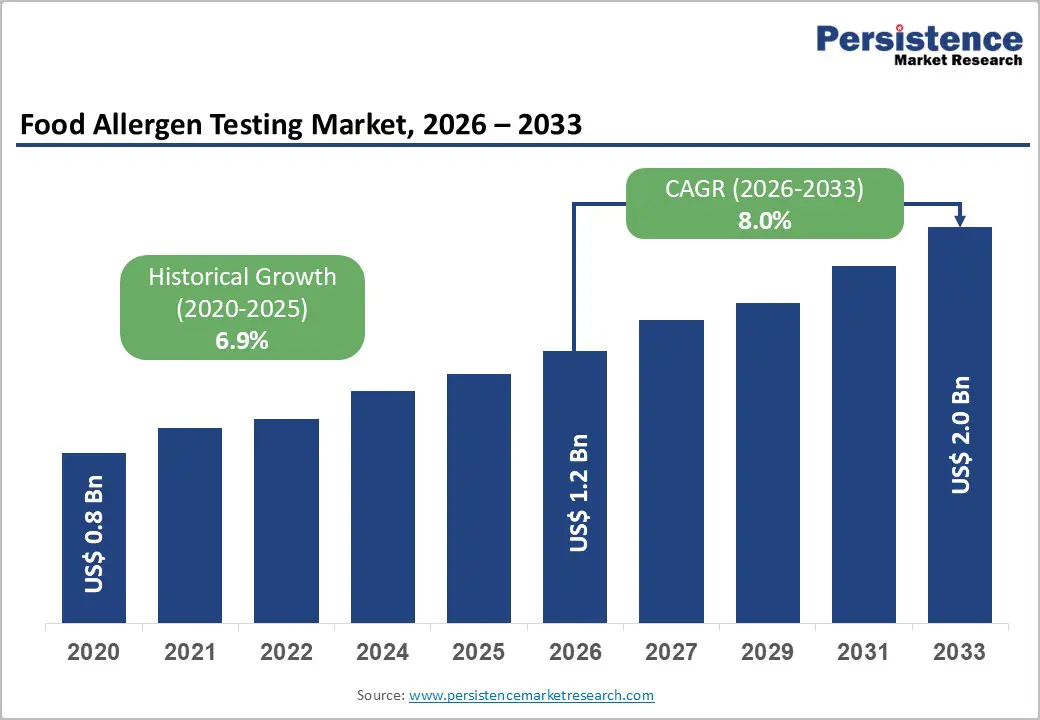
The global food allergen testing market is estimated to grow from US$ 1.2 billion in 2026 to US$ 2.0 billion by 2033. The market is projected to record a CAGR of 8.0% during the forecast period from 2026 to 2033.
The global food allergen testing market is expanding steadily, driven by stringent food safety regulations, rising prevalence of food allergies, and increasing demand for accurate labeling compliance. Growth in processed food consumption and international trade further accelerates testing requirements. North America leads due to strong regulatory enforcement, while the Asia Pacific is poised to focus on improving food safety infrastructure.
Key Industry Highlights
- Dominant Segment: Immunoassay-based technologies (including ELISA) account for 55.6% share of the food allergen testing market in 2025, driven by widespread regulatory acceptance, cost-effectiveness, and high adoption across food manufacturing facilities. Their reliability in routine quality control and labeling compliance supports sustained global dominance.
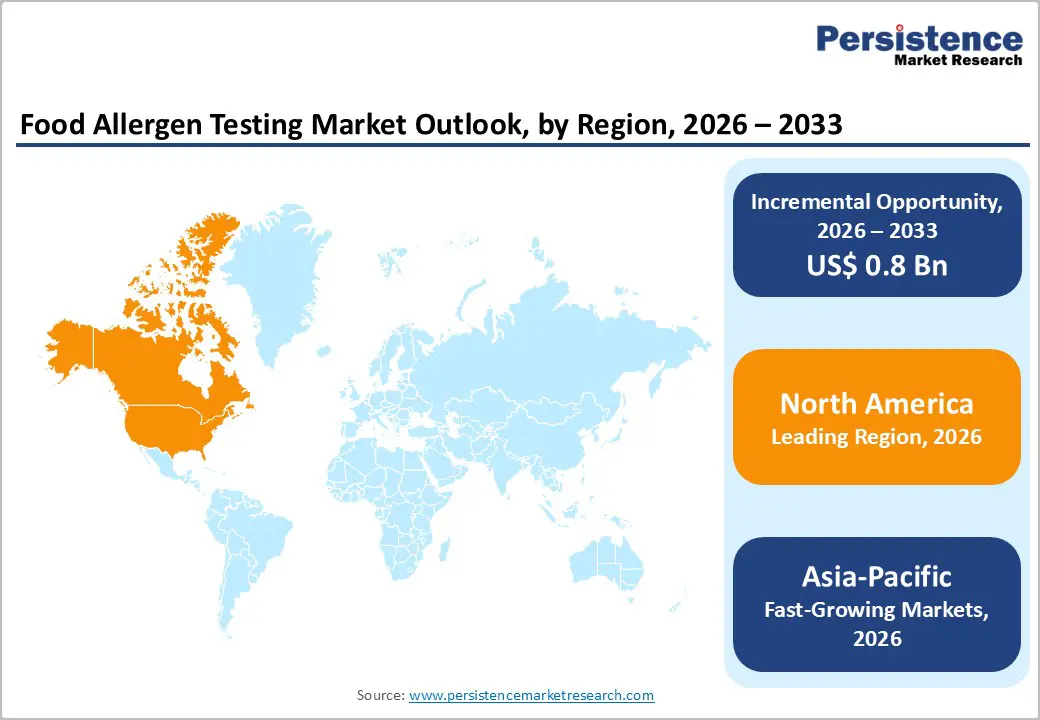
- Dominant Region: North America leads the food allergen testing market in 2025 with 38.1%, supported by stringent food safety regulations, strong enforcement of allergen labeling laws, and advanced laboratory infrastructure. Asia-Pacific is the fastest-growing region, driven by expanding processed food industries, rising consumer awareness, and strengthening regulatory frameworks.
- Market Drivers: Rising prevalence of food allergies, stringent global labeling mandates, increasing processed and packaged food consumption, cross-contamination risks, globalization of food trade, and growing consumer demand for transparency and safety are key factors driving market growth.
- Opportunity: Opportunities include developing rapid on-site detection kits, multiplex PCR platforms, automating testing workflows, expanding into emerging markets, integrating digital traceability systems, and strategic collaborations among test kit manufacturers, food processors, and third-party laboratories to enhance compliance and operational efficiency.
| Key Insights | Details |
|---|---|
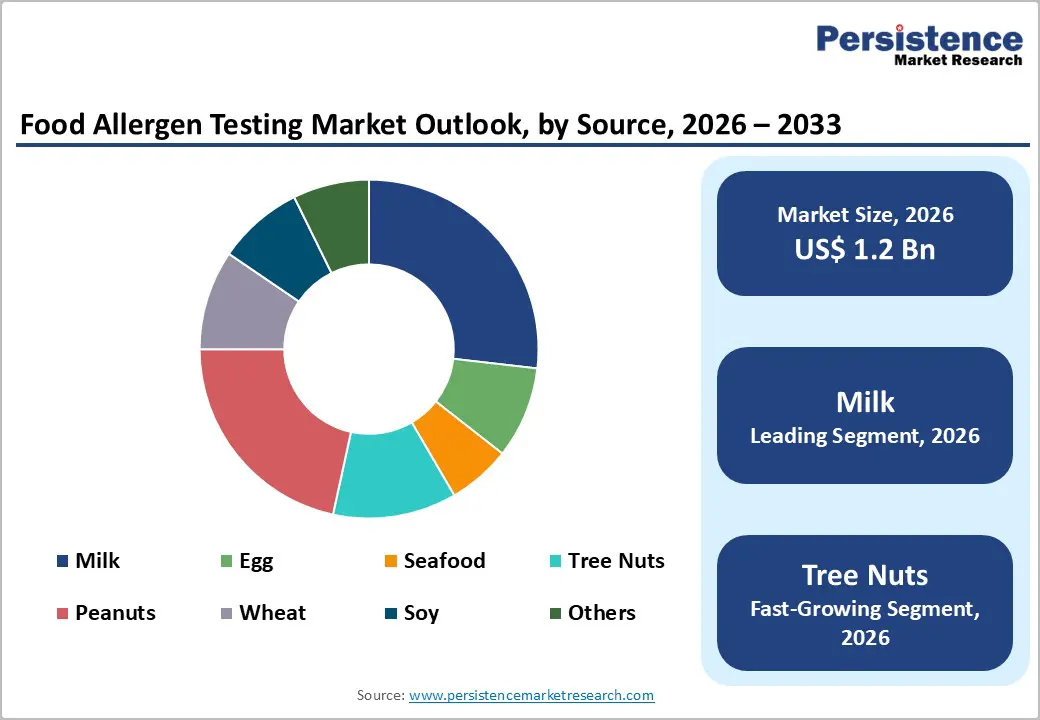
| Food Allergen Testing Market Size (2026E) | US$ 1.2 Bn |
| Market Value Forecast (2033F) | US$ 2.0 Bn |
| Projected Growth (CAGR 2026 to 2033) | 8.0% |
| Historical Market Growth (CAGR 2020 to 2025) | 6.9% |

Market Dynamics
Driver: Growth in Processed and Packaged Food Consumption
The rising consumption of processed and packaged foods significantly drives demand for food allergen testing. According to the U.S. Department of Agriculture (USDA), U.S. consumers spent more than half of their food budget on food prepared away from home, while packaged and ultra-processed products account for a substantial portion of retail grocery sales. Additionally, the U.S. Centers for Disease Control and Prevention (CDC) reports that food manufacturing and processing facilities have expanded significantly to meet convenience-store demand, increasing ingredient complexity and the use of shared production lines. Multi-ingredient formulations containing milk, soy, wheat, peanuts, and tree nuts heighten cross-contact risks, necessitating validated allergen detection protocols throughout manufacturing and packaging.
Public health data further reinforces this need. The CDC estimates that food allergies affect about 32 million Americans, including roughly 1 in 13 children, with reactions often triggered by packaged foods containing undeclared allergens. The U.S. Food and Drug Administration (FDA) identifies undeclared allergens as the leading cause of food recalls, consistently accounting for the majority of recall events each year. Regulatory frameworks such as the Food Allergen Labeling and Consumer Protection Act (FALCPA) mandate a clear declaration of major allergens in packaged foods. As global food trade expands and supply chains become more complex, regulatory enforcement and consumer safety concerns collectively intensify the demand for systematic allergen testing across processed food categories.
Restraints: False Positives and Sensitivity Limitations in Certain Methods
A key restraint in the Food Allergen Testing Market is the risk of false positives and sensitivity limitations inherent in some analytical methods. Immunoassays such as ELISA, widely used for routine screening, can produce cross-reactive signals due to similarities between allergen proteins and unrelated food components. For example, antigens from celery cross-react with proteins in parsley or coriander, yielding false-positive results that do not reflect the true presence of the allergen. This technical limitation increases the risk of unnecessary product recalls, undermines consumer trust, and raises costs for manufacturers who must then perform confirmatory testing with alternative methods.
Additionally, government and industry reviews acknowledge that highly processed food matrices can degrade proteins or alter their structure, making it harder to detect accurately. DNA-based PCR methods may fail to detect allergens when DNA is absent or degraded, as in egg white powder, leading to false-negative results. Both false positives and false negatives complicate interpretation and compliance. For regulators, manufacturers, and testing labs, this translates to additional validation steps, repeat testing, and investment in multiple complementary methods, all of which slow workflows and increase operational costs. These analytical challenges limit the utility of existing testing protocols, especially for complex foods where accurate allergen quantification is critical for safety and regulatory adherence.
Opportunity: Adoption of Multiplex PCR and High-Throughput Platforms
The increasing adoption of multiplex PCR and high-throughput platforms represents a major opportunity for the food allergen testing market, as these platforms enhance efficiency, sensitivity, and scalability. Multiplex PCR allows simultaneous detection of multiple allergen targets from a single sample a crucial advantage given that many food products contain several priority allergens. Market data show that in 2024, approximately 38% of shipped PCR allergen kits supported the detection of five or more allergen targets, up from 24% in 2019, demonstrating rapid adoption of multiplex formats. High-throughput PCR instruments, capable of processing 96-384 samples per run, enable laboratories to manage large testing volumes with improved turnaround times, which is especially valuable for large food manufacturers and accredited labs.
This capability supports regulatory compliance in global supply chains where products must be tested for numerous allergens to meet diverse labeling requirements. Multiplex PCR also reduces total testing costs and labor compared with running separate tests for each allergen, optimizing resource utilization. As PCR technologies continue to become more automated and integrated with analytics software, this expands opportunities for real-time quality control, tiered screening programs, and predictive traceability models in food safety systems. Growth in multiplex adoption already reflected by manufacturers upgrading allergen testing systems suggests that high-throughput PCR platforms will play a central role in addressing complexity, reducing false results, and supporting faster release of safe food products into increasingly competitive markets.
Category-wise Analysis
By Product Insights
Milk occupies 26.8% share of the global market in 2025. Milk proteins (casein and whey) are among the most common food allergens globally, especially affecting children. The U.S. Centers for Disease Control and Prevention (CDC) reports that cow’s milk allergy is one of the most prevalent food allergies in children, affecting approximately 2%-3% of children under age three. Because milk derivatives are ubiquitous in processed foods (baked goods, sauces, confections, dairy substitutes), the risk of undeclared milk traces is high. The U.S. Food and Drug Administration (FDA) lists milk as one of the major food allergens that must be declared on labels under the Food Allergen Labeling and Consumer Protection Act (FALCPA). Regulatory focus on milk, combined with its frequent inclusion in diverse products and high reaction rates, drives extensive testing and compliance efforts.
By Technology Insights
Immunoassay-based methods (such as ELISA) remain the most widely used technology for allergen detection due to their specificity, sensitivity, and practicality for routine screening. The U.S. FDA and many food safety authorities use immunoassays as the first line of testing for allergen proteins because they directly target allergenic proteins rather than DNA fragments or indirect markers. Immunoassays can detect low levels of proteins in complex food matrices and are adaptable for high-throughput laboratory workflows. According to published analytical guidelines from food safety laboratories, immunoassays are preferred for regulatory compliance because they provide quantitative results in parts per million (ppm), enabling verification against labeling thresholds. Their established protocols, widespread commercial availability, and regulatory acceptance solidify their dominant role in allergen testing.
Regional Insights
North America Food Allergen Testing Market Trends
North America leads with 38.1% share in 2025, due to high food allergy prevalence, advanced regulations, and an established food safety infrastructure. Data from the U.S. Centers for Disease Control and Prevention (CDC) show that food allergies affect about 4% of adults and 4%-6% of children in the United States, with emergency visits increasing significantly over the past two decades. Government legislation such as the U.S. Food Allergen Labeling and Consumer Protection Act (FALCPA) mandates clear labeling of priority allergens, which drives rigorous testing across the food industry. The U.S. Food and Drug Administration (FDA) and the United States Department of Agriculture (USDA) enforce comprehensive inspection and compliance protocols to prevent the presence of undeclared allergens. High consumer awareness, well-funded regulatory agencies, and widespread adoption of advanced laboratory methods contribute to North America’s dominant role in allergen testing and management.
Europe Food Allergen Testing Market Trends
Europe’s importance stems from stringent food safety regulations and widespread allergen awareness. The European Food Safety Authority (EFSA) and the EU Food Information for Consumers (FIC) Regulation require mandatory disclosure of 14 allergens on food labels, a broader list than many regions. European countries like Germany, France, and the UK maintain active public health programs that monitor allergy trends and ensure compliance. Clinical studies indicate that self-reported food allergy prevalence in European children ranges from about 6% to 25%, depending on location, reflecting a significant public health concern. EU enforcement agencies routinely audit food producers for allergen labeling and contamination, making systematic testing integral to compliance. Strong healthcare infrastructure and consumer advocacy further solidify Europe’s role in advancing allergen testing practices.
Asia-Pacific Food Allergen Testing Market Trends
Asia-Pacific is the fastest-growing region due to rapid urbanization, evolving diets, and increasing awareness of food safety. Countries such as China, Japan, India, and Southeast Asian nations are experiencing an increase in consumption of processed and packaged foods, which increases exposure to potential allergens. Government efforts in several countries have strengthened food safety oversight, with initiatives to enhance labeling and enforce food standards. Urban populations with rising disposable incomes are more likely to seek allergen-free products, driving the adoption of testing. Additionally, expanding healthcare access and investments in diagnostic laboratories support greater detection and reporting of food allergies. Cultural shifts toward Western eating patterns are associated with rising allergic responses, prompting stronger demand for allergen control and compliance across regional food sectors.
Competitive Landscape
The food allergen testing market is highly competitive, led by major food safety and analytical companies such as Thermo Fisher Scientific, Eurofins Scientific, SGS SA, Neogen Corporation, and Merieux NutriSciences. Competition focuses on advanced detection technologies (ELISA, PCR), rapid testing kits, regulatory compliance capabilities, laboratory network expansion, and strategic partnerships with food manufacturers.
Key Industry Developments:
- In July 2025, InBio and Beckman Coulter Life Sciences announced a strategic partnership aimed at advancing food allergy research and improving analytical capabilities in allergen detection. The collaboration combined InBio’s expertise in purified allergen proteins and diagnostic reagents with Beckman Coulter’s advanced laboratory instrumentation and flow cytometry platforms. The initiative focused on enhancing accuracy, sensitivity, and reproducibility in food allergen analysis and immunological studies.
- In April 2025, Beckman Coulter Life Sciences announced advancements supporting allergy research through enhanced analytical solutions and laboratory technologies. The company expanded its portfolio of flow cytometry and particle characterization systems to improve precision in immune cell analysis and allergen response studies. These developments enabled researchers to better understand immune mechanisms associated with allergic reactions, facilitating more accurate biomarker identification and cellular profiling.
Companies Covered in Food Allergen Testing Market
- Eurofins Scientific SE
- Danaher Corporation
- bioMérieux
- Intertek Group PLC
- Hygiena
- Microbac Laboratories Inc.
- Romer Labs
- SGS SA
- Charm Sciences
- EMSL Analytical
- Neogen Corporation
- 3M Company
- ALS Limited
- Bureau Veritas SA
- Bio-Rad Laboratories
- Quest Diagnostics
- Thermo Fisher Scientific
- R-Biopharm AG
- Others
Frequently Asked Questions
The global food allergen testing market is projected to be valued at US$ 1.2 Bn in 2026.
Rising food allergy prevalence, strict labeling regulations, processed food consumption, and testing technology advancements.
The global food allergen testing market is poised to witness a CAGR of 8.0% between 2026 and 2033.
Multiplex testing adoption, emerging markets expansion, rapid kits innovation, and regulatory harmonization initiatives.
PerkinElmer, Eurofins Scientific SE, Danaher Corporation, bioMérieux, Intertek Group PLC, Hygiena.


