




- Medical Devices
- Electroretinogram Market
Electroretinogram Market Size, Share, Growth, and Regional Forecast, 2026 to 2033
Electroretinogram Market by Product Type (Handheld, Tabletop), Electroretinography Type (Flash ERG (ffERG), Pattern ERG (PERG), Multifocal ERG (mfERG)), Application (Clinical Diagnostic, Research), End-user, and by Regional Analysis, from 2026 to 2033

Electroretinogram Market Share and Trends Analysis
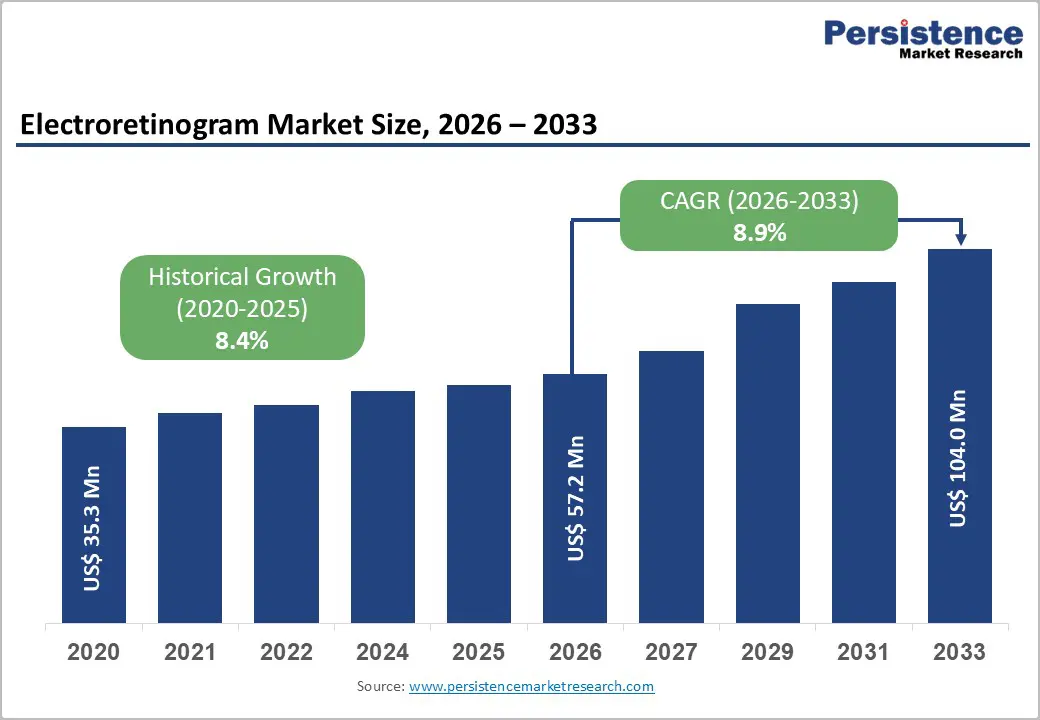
The global electroretinogram market size is expected to be valued at US$ 57.2 million in 2026 and projected to reach US$ 104.0 million by 2033, growing at a CAGR of 8.9% between 2026 and 2033.
The market is further witnessing notable trends such as the development of portable and non-invasive ERG devices, which offer greater patient comfort and accessibility. Additionally, innovations in digital technology are enhancing the precision and efficiency of ERG testing. The growing prevalence of retinal diseases and an aging population are key factors driving market growth. Moreover, healthcare professionals are increasingly incorporating ERG testing into routine eye examinations, thereby further contributing to market expansion. The trend toward integration with other diagnostic tools and AI-powered platforms is also expected to shape the future of the global photopic ERG market.
Key Industry Highlights:
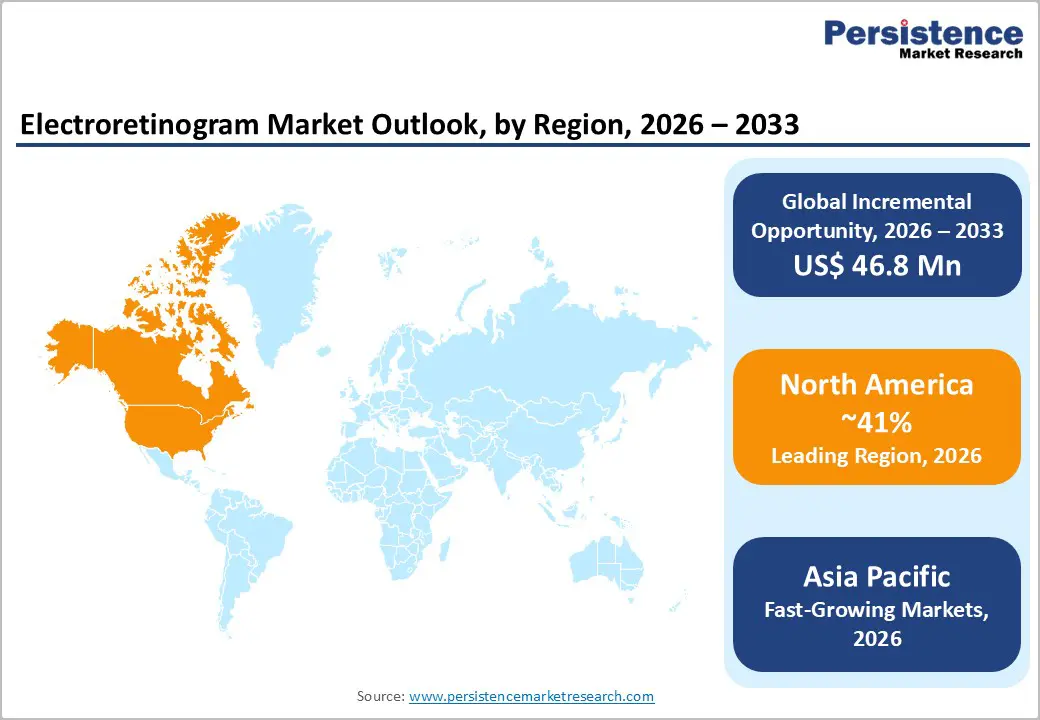
- Leading Region: North America leads the global ERG market due to advanced healthcare infrastructure, high adoption of retinal diagnostics, strong reimbursement policies, and the presence of major ophthalmic device manufacturers.
- Fastest Growing Region: Asia Pacific is the fastest-growing region, driven by rising prevalence of diabetes and retinal disorders, expanding healthcare facilities, increasing patient awareness, and government initiatives supporting eye care.
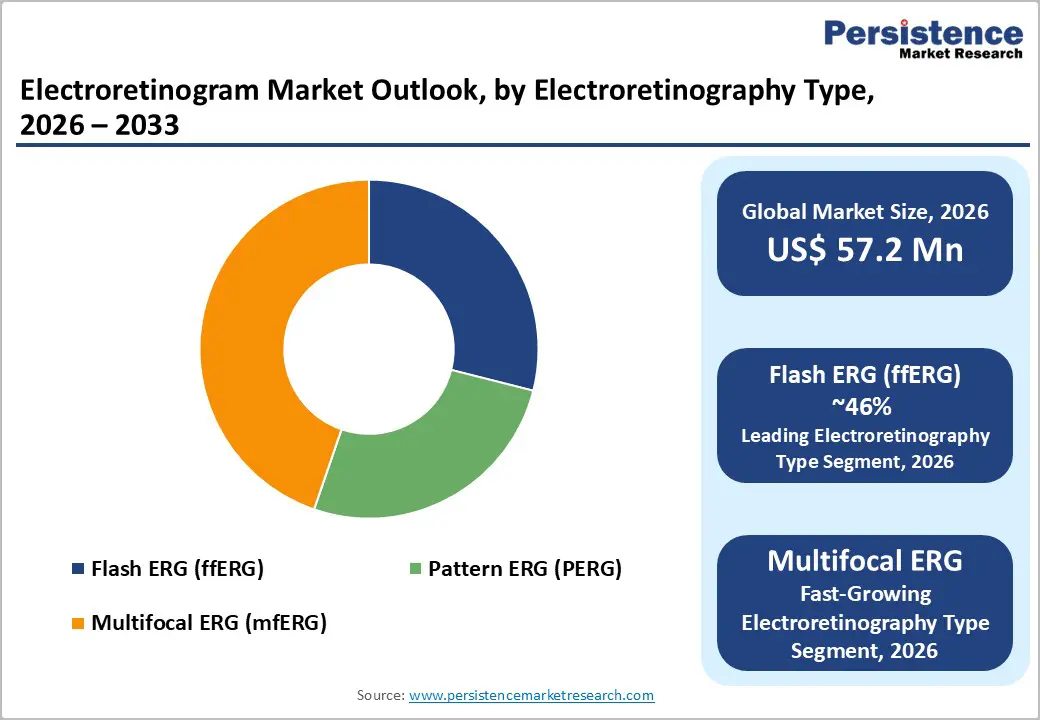
- Dominant Segment: Flash ERG (ffERG) dominates the product type segment, owing to its ability to provide rapid, reliable, and non-invasive retinal assessments, its widespread clinical adoption, and its established use in both diagnostic and research settings.
- Fastest Growing Segment: Multifocal ERG (mfERG) is the fastest-growing segment, driven by early macular disorder detection, localized retinal assessment, diabetes prevalence, and portable ERG adoption.
| Key Insights | Details |
|---|---|
| Electroretinogram Market Size (2026E) | US$ 57.2 Mn |
| Market Value Forecast (2033F) | US$ 104.0 Mn |
| Projected Growth (CAGR 2026 to 2033) | 8.9% |
| Historical Market Growth (CAGR 2020 to 2025) | 8.1% |
Market Dynamics
Driver - Rising Prevalence of Eye Disorders to Fuel Demand for Multifocal Electroretinogram
The increasing prevalence of eye disorders such as retinitis pigmentosa, age-related macular degeneration, and diabetic retinopathy is a key factor driving demand for advanced electroretinogram (ERG) technologies, particularly multifocal ERG. These conditions are becoming more common due to population aging, longer life expectancy, and the growing global burden of diabetes. Early and accurate diagnosis is essential for effective disease management, monitoring progression, and guiding treatment decisions. ERG tests play a critical role in assessing retinal function by providing objective, functional information that cannot be captured through imaging alone. For instance, according to the U.S. Centers for Disease Control and Prevention (CDC), approximately 9.6 million people in the United States were living with diabetic retinopathy in 2021, accounting for nearly 26% of adults with diabetes, with 1.84 million experiencing vision-threatening disease.
Technological advancements in ERG systems are further supporting market growth. Modern ERG devices offer improved diagnostic precision, enhanced patient comfort, portability, and simplified testing protocols, making them more suitable for routine clinical use. Healthcare providers are increasingly adopting these advanced systems to improve diagnostic confidence and clinical outcomes. As demand for reliable and early retinal function assessment rises, innovative multifocal ERG technologies are becoming an essential tool in ophthalmic diagnostics, reinforcing sustained market expansion.
Emergence of Novel Ophthalmology Centers to Boost Demand
The expansion of healthcare infrastructure and the increasing number of ophthalmology centers are significantly boosting demand for electroretinogram (ERG) diagnostic devices. As healthcare systems evolve and more specialized clinics are established, there is a growing need for unique diagnostic tools to address rising eye-related health issues.
ERG devices, essential for diagnosing retinal conditions such as macular degeneration and diabetic retinopathy, are being integrated into ophthalmology centers to enable precise, early diagnosis and improve patient care. The ongoing development of more accessible, user-friendly ERG technologies is also supporting this growth. This further facilitates healthcare providers' adoption of these devices in routine eye examinations, thereby driving market growth.
Restraints - High Cost May Limit Accessibility and Adoption in Developing Countries
The high costs associated with electroretinography (ERG) devices pose a significant restraint for market growth. These are anticipated to limit access to diagnostic services. ERG equipment, especially advanced models, can be expensive, making it challenging for small-scale clinics, hospitals, and healthcare providers in low-resource settings to invest in such technologies.
The financial barrier restricts the widespread adoption of ERG testing, particularly in developing countries, where affordable alternatives are needed. The cost factor also affects insurance coverage, which may limit patient access to necessary retinal assessments. Consequently, while ERG is a significant diagnostic tool, its high cost can hinder accessibility and widespread use in routine eye care.
Opportunity - Launch of Wearable and Portable ERG Devices to Open New Avenues
Technological innovations in wearable and portable electroretinography (ERG) devices present significant opportunities for market expansion, particularly in homecare diagnostics. These innovations enable the development of compact, user-friendly ERG devices that can be easily used outside traditional healthcare settings. With the growing demand for remote healthcare solutions, portable ERG devices enable patients to monitor their retinal health from home, reducing the need for frequent hospital visits.
Ongoing innovations are expected to create new opportunities, particularly in underserved regions, where access to specialized ophthalmology centers may be limited. As these devices become increasingly affordable and accessible, they are poised to revolutionize the diagnosis and management of retinal conditions.
Development of Healthcare Infrastructure to Forge Novel Opportunities
The expansion of healthcare facilities and services is significantly driving demand for advanced access devices, including ERG eye tests. As healthcare infrastructure develops, new hospitals, clinics, and specialized centers are increasingly adopting cutting-edge technologies to improve patient care and procedural efficiency. This expansion not only increases the number of procedures performed but also increases the need for high-performance, minimally invasive access devices.
Enhanced medical facilities seek to offer the latest advancements to attract patients and ensure optimal outcomes, creating a robust market for unique access devices. Consequently, the growth of healthcare infrastructure directly fuels market expansion for these devices.
Category-wise Analysis
By Product Type Insights
Flash ERG (ffERG) is projected to dominate the Electroretinography (ERG) type segment, accounting for approximately 46% of the market share in 2025. Its strong market position is driven by the device’s ability to provide rapid, reliable, and comprehensive assessments of overall retinal function, making it the preferred choice for diagnosing a wide range of retinal disorders. The non-invasive nature of ffERG, combined with its high sensitivity and reproducibility, supports its widespread adoption in both clinical practice and research. The technique is particularly valuable in detecting generalized retinal dysfunction, monitoring disease progression, and evaluating treatment efficacy.
Additionally, ffERG systems have benefited from ongoing technological advances, including portable designs, enhanced signal processing, and integration with electronic medical records, thereby facilitating their widespread adoption. The combination of clinical reliability, ease of use, and broad applicability ensures that ffERG remains the leading product type segment globally, with sustained growth anticipated across North America, Europe, and the Asia-Pacific regions.
By Application Insights
The clinical diagnostic segment continues to dominate the global ERG market, accounting for approximately 70% of the market in 2025. Its leadership is attributed to the rising demand for accurate, timely, and objective retinal functional assessments in routine ophthalmology practice. ERG serves as a critical tool for evaluating patients with retinal disorders, including age-related macular degeneration (AMD), diabetic retinopathy, retinitis pigmentosa, and other inherited or acquired retinal dysfunctions. Clinical adoption is further reinforced by ISCEV guidelines, which standardize ERG protocols, ensuring consistent results across specialty clinics and facilitating early disease detection. Innovations in ERG technology, combined with increasing healthcare expenditures, patient awareness, and high reimbursement rates for relevant CPT codes in mature markets, continue to strengthen this segment. Clinical diagnostics not only support personalized treatment strategies but also complement imaging technologies like OCT, cementing ERG’s indispensable role in modern ophthalmic care and driving sustained market growth globally.
Regional Insights
North America Electroretinogram Market Trends
North America electroretinogram market is expected to maintain a dominant share of 41% in 2025. This growth is driven by the rising prevalence of retinal diseases, increasing awareness of early diagnosis, and innovations in ERG technology. For instance, as per the Centers for Disease Control and Prevention (CDC), there were around 9.6 million cases of diabetic retinopathy and 1.84 million cases of vision-threatening diabetic retinopathy in the U.S. in 2021. Individuals under the age of 25 years had the lowest prevalence of diabetic retinopathy, whereas those between 65 and 79 years had the highest prevalence. This shows that the numbers are anticipated to rise in the future, thereby pushing demand for the electroretinogram. North America’s well-established healthcare infrastructure and early adoption of innovative diagnostic tools also contribute to the continued market expansion.
Asia Pacific Electroretinogram Market Trends
Asia Pacific electroretinogram market is experiencing significant growth due to the rising prevalence of chronic diseases such as diabetes, cardiovascular disorders, and autoimmune conditions, which increase the risk of retinal complications. High adoption of advanced medical technologies, expansion of healthcare infrastructure, and a growing geriatric population further drive market growth. Countries like China, India, and Japan are key contributors, supported by increasing awareness of eye disorders and the availability of FDA, TGA, and EMA-approved ERG facilities.
Japan’s market growth is primarily driven by its aging population, with nearly 30% of residents aged 65 and older in 2023, thereby increasing demand for retinal diagnostics. In China, rapid healthcare development, rising prevalence of chronic diseases, and increasing patient awareness contribute to strong adoption of ERG technologies. According to the International Diabetes Federation (IDF), 206 million people in the Western Pacific Region had diabetes in 2021, projected to reach 260 million by 2045. These factors collectively position Asia Pacific as a fast-growing and increasingly important region in the global ERG market.
Competitive Landscape
The competitive landscape of the electroretinogram (ERG) industry is characterized by the presence of several key players focusing on technological innovation and product development. Leading companies such as Diagnosys LLC, Roland Consult, and Electro-Diagnostic Imaging are actively enhancing the functionality and accessibility of ERG devices.
Key players are investing in portable, user-friendly devices and integrating unique features like AI-driven analysis for improved diagnostic precision. Additionally, partnerships, collaborations, and mergers are common strategies to extend market reach and enhance product offerings. These strategies are helping key players to foster a highly competitive environment in the ERG diagnostic space.
Key Industry Developments:
- In November 2024, Evoq Technologies, headquartered in the U.S., bagged the U.S. Food and Drug Administration (FDA) registration for its first-ever SmartERG platform. Currently, the Biophotomer smartphone product is considered a Class I medical equipment with its ability to test for impairments in dark adaptation. To submit the ophthalmic biosensor and specialty stimulators as Class II medical devices the following year, Evoq plans to carry out clinical research.
- In May 2024, researchers from Waseda University, Japan introduced an innovative soft multi-electrode system for electroretinography (ERG). It is capable of measuring electrical potential from various retinal locations. Built on soft contact lenses, it helps improve comfort and diagnosis.
- In February 2024, LKC Technologies, based in Maryland, acquired RETeval®, bringing new management yet maintaining the same trusted technology. This strategic move positioned LKC to enhance ERG innovations, promising a robust future for vision diagnostics worldwide.
Companies Covered in Electroretinogram Market
- LKC Technologies, Inc.
- Electro-Diagnostic Imaging, Inc
- Roland-consult
- Cadwell Industries Inc
- Diagnosys LLC
- Konan Medical USA, Inc
- CSOITALIA.IT
- Metrovision
- Ocular Instruments
- Haag-Streit Group
- Opto-Medic Co Pte Ltd
- Stereo Optical
- Others
Frequently Asked Questions
The global market is projected to be valued at US$ 57.2 Mn in 2026.
Rising eye disorders and surging healthcare infrastructure are propelling the industry.
The global electroretinogram market is expected to witness a CAGR of 8.9% between 2026 and 2033.
LKC Technologies, Inc., Electro-Diagnostic Imaging, Inc, and Roland-consult are the leading players.
North America is the leading region in the global electroretinogram market.


