




- Biotechnology
- Electroporation Instruments Market
Electroporation Instruments Market Size, Share, and Growth Forecast, 2026 – 2033
Electroporation Instruments Market by Product Type (Instruments, Accessories), Application (Protein Production, Therapeutic Delivery, Biomedical Research), End-user (Hospital Laboratories, Research and Academic Institutes, Pharmaceutical Industries), and Regional Analysis for 2026 - 2033

Electroporation Instruments Market Size and Trends Analysis
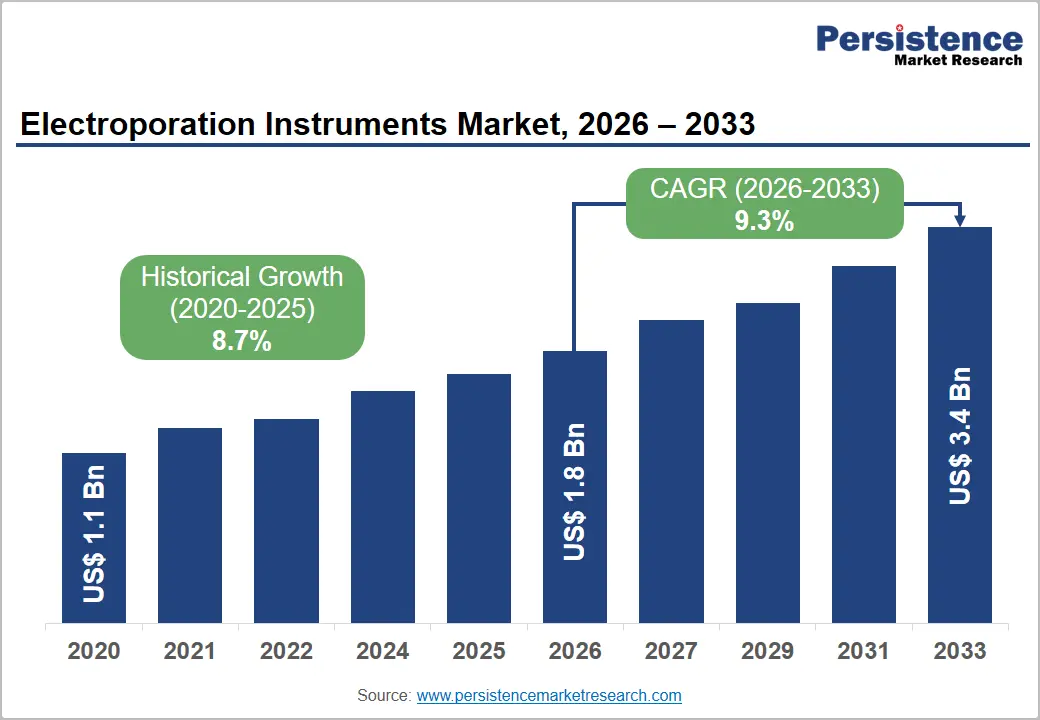
The global electroporation instruments market size is likely to be valued at US$1.8 billion in 2026 and is expected to reach US$3.4 billion by 2033, growing at a CAGR of 9.3% during the forecast period from 2026 to 2033, driven by increasing demand for advanced gene delivery systems and cell modification technologies across biomedical applications. Growth is supported by the rising prevalence of chronic diseases that require advanced therapeutic development platforms. Demographic expansion in aging populations increases demand for regenerative medicine research and cell-based therapies. Regulatory frameworks supporting non-viral gene delivery methods strengthen institutional adoption across clinical and research environments.
Key Industry Highlights:
- Leading Product Type: Instruments are set to hold around 65% of the revenue share in 2026, driven by institutional procurement of capital equipment for cell therapy and gene editing research workflows.
- Fastest-growing Product Type: Accessories are projected as the fastest-growing segment, supported by the expansion of single-use, closed-system consumable adoption in GMP-compliant manufacturing environments.
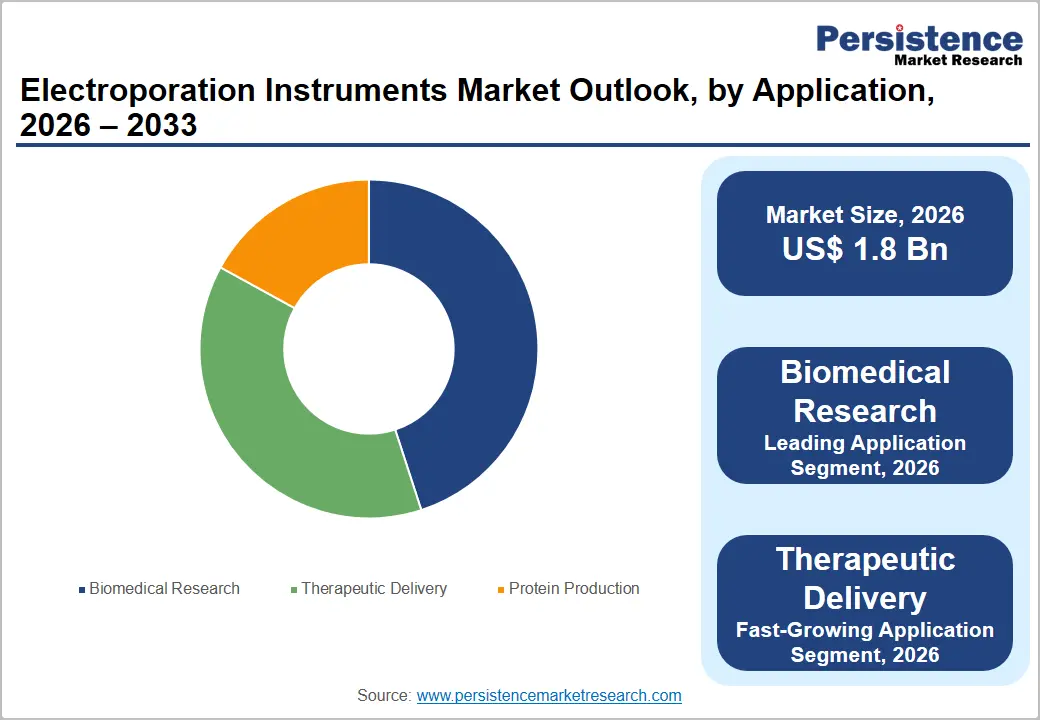
- Leading Application: Biomedical research is estimated to hold roughly 45% of the revenue share in 2026, due to deep electroporation integration within academic and pharmaceutical discovery-stage programs and sustained government research funding.
- Fastest-growing Application: Therapeutic delivery is forecast to record the fastest growth, driven by commercial scale-up of CAR-T and other adoptive cell therapy programs requiring validated non-viral intracellular delivery platforms.
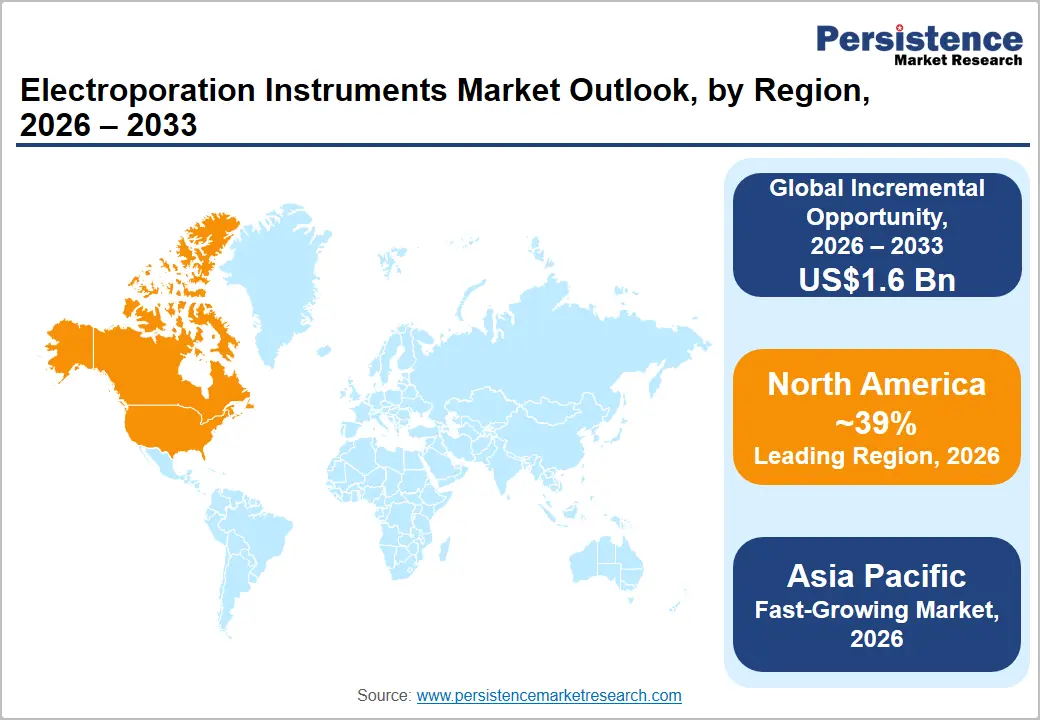
- Regional Leadership: North America is projected to capture approximately 39% of the market share in 2026, driven by advanced biotechnology infrastructure.
- Competitive Environment: The industry is moderately fragmented, with competition focused on technology innovation, workflow efficiency, and therapeutic application capabilities.
DRO Analysis
Driver - Rising Expansion of Cell and Gene Therapy Development
The electroporation instruments market is benefiting from growing research and commercialization activities in gene therapies, cell therapies, and engineered cellular products. Electroporation enables efficient delivery of nucleic acids, proteins, and genome-editing components into cells, making it an essential technology within therapeutic development pipelines. The growing focus on precision medicine and personalized treatment approaches is increasing demand for high-transfection-efficiency systems capable of meeting clinical and commercial manufacturing requirements.
Regulatory progress in advanced therapeutics and expanding investment in biotechnology innovation are supporting wider adoption of cell engineering technologies. Research organizations, pharmaceutical companies, and biotechnology developers are increasingly incorporating electroporation into therapeutic development workflows due to its ability to facilitate efficient intracellular delivery. Growing clinical development activity and rising commercialization efforts are creating favorable conditions for the deployment of advanced electroporation platforms across research, development, and manufacturing environments.
Restraint - Supply Chain Dependence for Critical Components
Production of electroporation systems relies on specialized electronic components, precision engineering materials, and proprietary accessories. Disruptions in semiconductor availability, logistics networks, or manufacturing capacity can affect equipment production schedules and delivery timelines. Extended lead times may delay laboratory expansion projects and technology deployment initiatives.
Supply limitations can increase procurement costs and create pressure on manufacturer margins. Dependence on limited supplier networks may constrain production flexibility during periods of elevated demand. Such challenges can affect commercialization efficiency and reduce the pace of technology penetration across emerging research markets.
Opportunity - Integration with Genome Editing and Synthetic Biology Platforms
The expanding use of CRISPR-based genome engineering and synthetic biology applications presents a significant growth pathway. Electroporation provides efficient delivery of genome-editing materials into difficult-to-transfect cells, creating opportunities for instrument manufacturers to develop specialized systems tailored to advanced therapeutic workflows. Increasing demand for precise cellular engineering solutions is supporting innovation in platform design and software integration.
Product development strategies focused on automation, scalability, and closed-system processing can strengthen adoption across commercial manufacturing environments. Collaboration between biotechnology firms and instrument providers can accelerate technology deployment. Regulatory acceptance of advanced therapies is creating favorable conditions for broader implementation of electroporation-enabled cellular engineering solutions.
Category-wise Analysis
Product Type Insights
Instruments are expected to lead the electroporation instruments market, accounting for approximately 65% of revenue in 2026. Demand is driven by institutional procurement cycles across pharmaceutical and research facilities. Thermo Fisher Scientific's Neon Transfection System exemplifies instrument adoption growth. Capital investment in GMP-grade laboratory infrastructure is the primary cause of sustained instrument revenue dominance over consumables.
Accessories are likely to represent the fastest-growing segment, propelled by increasing adoption of single-use cuvettes and proprietary buffer systems. The shift toward closed-system workflows in cell therapy manufacturing, as implemented by companies such as Lonza in their Nucleofector platform, is elevating consumable attachment rates per instrument. Regulatory requirements for contamination-free GMP processing are reinforcing this transition.
Application Insights
Biomedical research is projected to lead the market, capturing around 45% of the revenue share in 2026. The concentration of use in academic and private research institutions is the primary cause. The Broad Institute's genome editing programs demonstrate the depth of electroporation integration in discovery-stage workflows.
Therapeutic delivery is likely to be the fastest-growing segment, fueled by expanding gene therapy and cell therapy development programs. Increasing demand for efficient intracellular delivery methods is supporting technology adoption across clinical development workflows. Electroporation-assisted delivery techniques are being evaluated in oncology-focused therapeutic research. Growth in advanced therapy pipelines and regulatory support for innovative treatments is strengthening future deployment opportunities.
End-user Insights
The pharmaceutical industry is likely to be the leading segment with a projected 42% of the electroporation instruments market share in 2026 due to the integration of electroporation in both drug discovery and commercial cell therapy manufacturing. Contract development and manufacturing organizations (CDMOs) such as Samsung Biologics are scaling electroporation capacity to meet client demand. GMP compliance requirements drive procurement of validated, high-specification instrument platforms.
Research and academic institutes are anticipated to be the fastest-growing segment, fueled by expanding government investment in life sciences research infrastructure. The European Research Council's Horizon Europe program has directed substantial funding toward gene editing research platforms in 2025–2026. Growing PhD enrollment in biomedical and synthetic biology disciplines at institutions such as the Karolinska Institute is creating sustained new instrument procurement demand.
Regional Insights
North America Electroporation Instruments Market Trends
North America is anticipated to be the leading region, accounting for a market share of 39% in 2026, driven by strong biotechnology research activity, advanced laboratory infrastructure, and increasing commercialization of cell and gene therapies. Expansion of translational medicine programs is accelerating adoption of advanced electroporation platforms.
U.S. Electroporation Instruments Market Insights
The U.S. is projected to account for approximately 81% of the North America revenue share in 2026. Strong biotechnology innovation, advanced clinical research infrastructure, and increasing cell therapy development activities are supporting technology adoption. Expansion of advanced therapy manufacturing facilities is creating sustained demand for scalable electroporation systems.
Canada Electroporation Instruments Market Insights
Canada is expected to represent nearly 19% of the North America revenue share in 2026. Increasing investment in biotechnology research and academic innovation programs is supporting the adoption of advanced laboratory technologies. Expansion of regenerative medicine and molecular biology research initiatives is driving equipment procurement.
Europe Electroporation Instruments Market Trends
Europe is anticipated to account for a market share of 29% in 2026, driven by expanding biotechnology research networks, favorable regulatory frameworks, and increasing investment in advanced therapeutic development. Growth in personalized medicine and genome engineering initiatives is supporting demand for electroporation technologies.
Germany Electroporation Instruments Market Insights
Germany is forecast to contribute approximately 24% of the Europe revenue share in 2026. Strong pharmaceutical manufacturing capabilities and extensive academic research infrastructure are supporting technology adoption. Increasing investment in molecular biology and cell-based therapy development is generating demand for advanced transfection solutions.
U.K. Electroporation Instruments Market Insights
The U.K. is likely to account for around 18% of the Europe revenue share in 2026. Rising focus on genomic medicine and translational healthcare research is encouraging the adoption of advanced cellular engineering technologies. Government-supported life sciences initiatives are expanding biotechnology capabilities.
Asia Pacific Electroporation Instruments Market Trends
Asia Pacific is forecast to be the fastest-growing market for electroporation instruments, supported by the rapid expansion of biotechnology infrastructure, increasing pharmaceutical research activity, and rising investment in advanced therapeutic development. Growth in domestic innovation programs and biopharmaceutical manufacturing capacity is encouraging broader technology adoption.
China Electroporation Instruments Market Insights
China is projected to account for approximately 38% of the Asia Pacific revenue share in 2026. Significant investment in biotechnology innovation, genomic research, and pharmaceutical manufacturing is supporting the adoption of advanced electroporation technologies. Expansion of cell therapy development programs and research infrastructure is creating substantial equipment demand.
Japan Electroporation Instruments Market Insights
Japan is expected to represent nearly 21% of the Asia Pacific revenue share in 2026. A strong focus on regenerative medicine, precision healthcare, and advanced therapeutic research is driving utilization of electroporation systems. Continued investment by pharmaceutical companies and academic institutions is supporting the adoption of cellular engineering technologies.
Competitive Landscape
The global electroporation instruments market is moderately fragmented, with competition shaped by technology innovation, product reliability, application-specific solutions, and integration with cell and gene therapy workflows. Companies are focusing on automated platforms, enhanced transfection efficiency, and scalable systems capable of supporting research and commercial manufacturing requirements. Key participants include Bio-Rad Laboratories, Thermo Fisher Scientific, Lonza Group, Harvard Bioscience, and Eppendorf SE.
Competitive positioning is influenced by research collaborations, product portfolio expansion, and investments in advanced therapeutic applications. Manufacturers are strengthening market presence through the development of high-throughput systems, specialized accessories, and workflow optimization tools. Increasing demand from biotechnology, pharmaceutical, and academic sectors is encouraging continuous innovation and strategic partnerships across the industry.
Key Industry Developments:
- In February 2026, MaxCyte unveiled the ExPERT DTx™ 96-well electroporation platform to accelerate high-throughput transfection and drug discovery workflows, reinforcing innovation in advanced cell engineering applications.
- In July 2025, Lonza launched the next-generation 4D-Nucleofector® LV Unit PRO to enhance scalable electroporation for cell and gene therapy manufacturing, reinforcing innovation in GMP-compliant cellular engineering workflows.
Companies Covered in Electroporation Instruments Market
- Bio-Rad Laboratories
- Thermo Fisher Scientific
- Lonza Group
- Eppendorf SE
- MaxCyte, Inc.
- BTX (Harvard Apparatus)
- Merck KGaA
- BEX Co., Ltd.
- Nepa Gene Co., Ltd.
- Mirus Bio LLC
- Celetrix LLC
Frequently Asked Questions
The global electroporation instruments market is projected to reach US$1.8 billion in 2026.
The electroporation instruments market is driven by increasing adoption of cell and gene therapies, expanding biomedical research activities, and growing demand for efficient intracellular delivery technologies.
The electroporation instruments market is poised to witness a CAGR of 9.3% from 2026 to 2033.
The key opportunities in the electroporation instruments market lie in the expansion of genome editing, synthetic biology, and cell therapy manufacturing applications requiring advanced cellular engineering technologies.
Some of the key market players include Bio-Rad Laboratories, Thermo Fisher Scientific, Lonza Group, Harvard Bioscience, and Eppendorf SE.


