




- Electric Mobility
- Electric Motorcycle and Scooters Market
Electric Motorcycle and Scooters Market Size, Share, and Growth Forecast, 2026 - 2033
Electric Motorcycle and Scooters Market by Vehicle Type (Electric Scooters, Electric Motorcycles), Battery (Lithium-ion, Sodium-ion), Motor Power, End User, and Regional Analysis for 2026 - 2033

Electric Motorcycle and Scooters Market Size and Trends Analysis
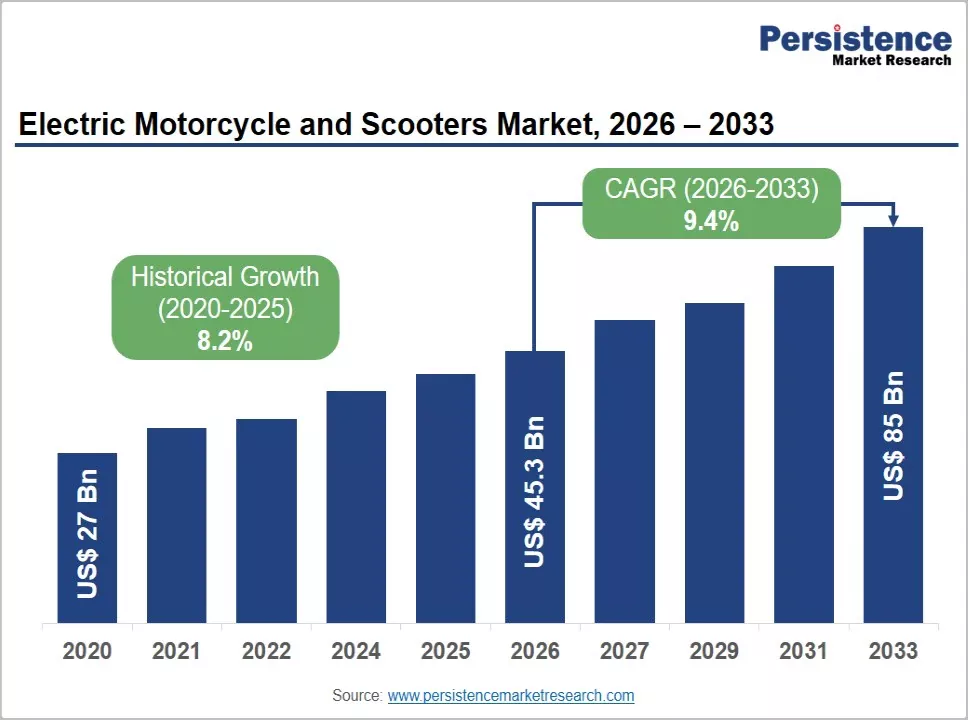
The global electric motorcycle and scooters market size is likely to be valued at US$ 45.3 billion in 2026 and is expected to reach US$ 85 billion by 2033, growing at a CAGR of 9.4% between 2026 and 2033, driven by lower operating costs, expanding purchase incentives, and improving battery technology.
Rising fuel prices across Asia are strengthening the ownership case for electric two-wheelers, while tighter product standards in China and extended subsidies in India are improving product quality and affordability. The market was valued at US$ 27.0 billion in 2020.
Key Industry Highlights
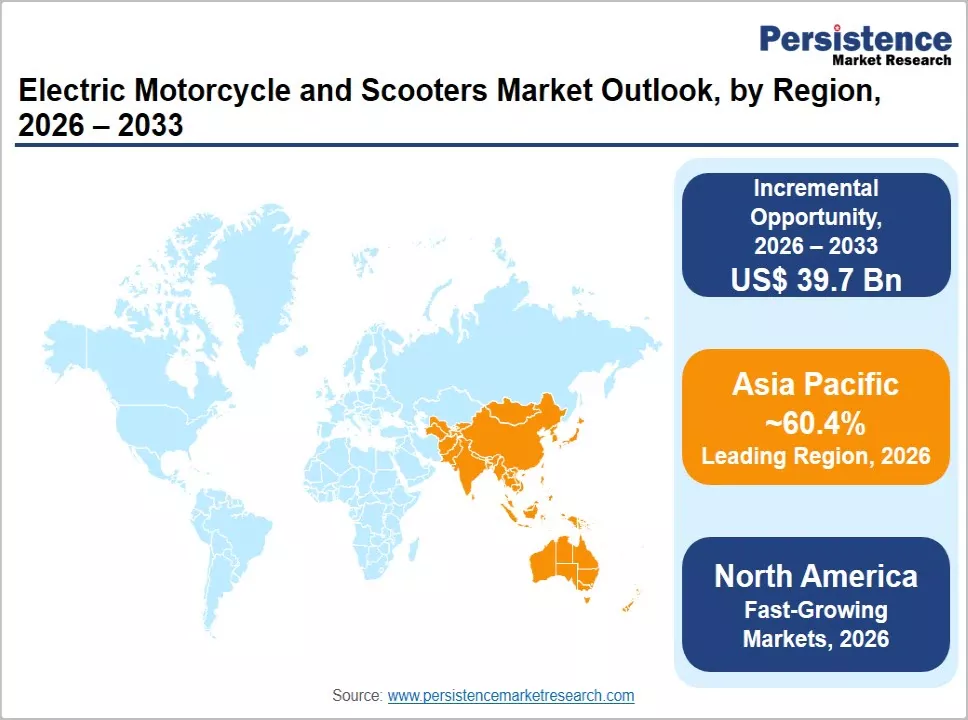
- Leading Region: Asia Pacific, anticipated to account for approximately 60.4% of the market share, supported by large two-wheeler fleets, dense urban populations, and an established battery and component supply base.
- Fastest-growing Region: North America, driven by premium electric motorcycle launches, new entry-level platforms, and rising interest in lightweight urban mobility.
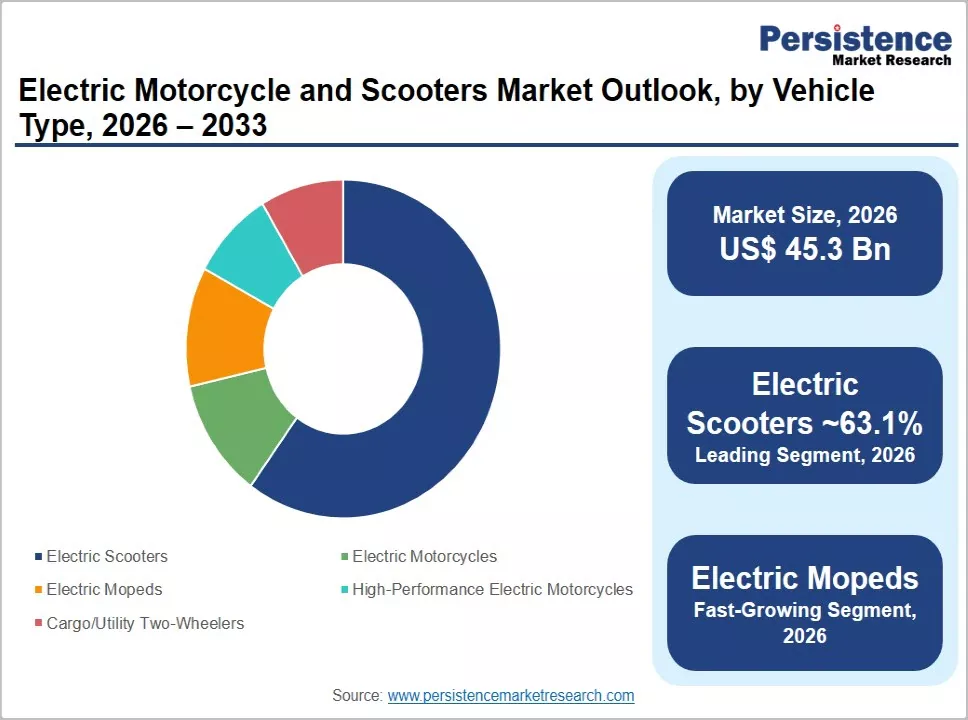
- Dominant Vehicle Type: Electric scooters, anticipated to hold approximately 63.1% of the market, driven by daily commuting demand, low ownership costs, and wide model availability.
- Leading Battery Type: Lithium-ion, anticipated to account for approximately 84.2% of the market share, supported by high energy density, longer cycle life, and compatibility with swappable battery systems.
DRO Analysis
Drivers - Rising Fuel Costs and Lower Ownership Costs Are Accelerating Electric Two-Wheeler Adoption
Operating-cost advantages are moving electric two-wheelers from early adopters to mainstream buyers. The International Energy Agency (IEA) reports that electric two- and three-wheelers are now cheaper on average than combustion alternatives over a typical ownership period in India and Southeast Asia. IEA data also show that sales in Southeast Asia more than doubled year-on-year in the first quarter of 2026, while sales in India grew more than 30%.
India registered 1.40 million electric two-wheelers in fiscal year 2026, a 22% increase, lifting penetration to approximately 6.5% of total two-wheeler sales. Higher petrol prices linked to the 2026 West Asia energy crisis are reinforcing this shift, particularly among daily commuters and delivery riders with high annual mileage.
Government Incentives and Safety Standards Are Expanding Market Participation
Policy frameworks are lowering purchase barriers and raising product quality. India’s PM E-DRIVE scheme provides INR 2,500 per kWh of battery capacity, capped at INR 5,000 per vehicle, and in August 2026 the government extended electric two-wheeler support to March 2028 while raising the scheme outlay to INR 11,900 crore.
In China, the revised GB 17761-2024 safety standard took effect on September 1, 2025, and sales of non-compliant models were banned from December 1, 2025. This pushed manufacturers toward safer, intelligent, and compliant designs. Together, these measures improve affordability in price-sensitive markets and encourage investment in higher-specification products.
Restraint - Subsidy Dependence and Supply Chain Concentration Limit Adoption Momentum
Adoption in several markets remains sensitive to purchase incentives. In the U.K., the Motorcycle Industry Association (MCIA) reports that electric moped and motorcycle registrations fell 38.6% after the 2023 grant reduction and a further 39.2% after support for electric mopeds was withdrawn in 2024. Supply chains add further exposure.
China accounted for more than 80% of global battery cell production in 2025, and a rare-earth magnet shortage disrupted production among Indian manufacturers during 2025. Import tariffs also raise costs in the U.S., where Harley-Davidson projected 2026 tariff costs of US$75 million to US$90 million. These factors increase price volatility and affect delivery timelines.
Opportunities - Sodium-ion Batteries and Battery Swapping Create Lower-Cost, Safer Vehicle Platforms
Sodium-ion chemistry offers a route to lower material costs and improved thermal safety. In January 2025, Yadea launched four sodium-ion scooters in China priced between RMB 3,299 and RMB 4,299, with an energy density of 145 Wh/kg, a cycle life of up to 1,500 cycles, and 80% charging in 15 minutes. CATL introduced its Naxtra sodium-ion line in 2025, and cities such as Shenzhen began piloting swapping stations for sodium-ion packs serving commuters and delivery riders. Sodium-ion batteries are projected to grow at a CAGR of 23.5%, the fastest among battery types, creating openings for cell suppliers, swapping network operators, and manufacturers targeting entry-level scooters.
Category-wise Analysis
Vehicle Type Insights
Electric scooters are anticipated to account for approximately 63.1% of the market share. The segment benefits from accessible prices, step-through designs, and strong use in daily commuting and delivery. For example, Yadea sold 4.82 million electric scooters in 2025, a 22.5% increase, while Indian models such as the TVS iQube, Bajaj Chetak, Ather Rizta, and Hero Vida supported 1.40 million electric two-wheeler registrations in fiscal year 2026. In Europe, compact urban models such as the BMW CE 02 and Niu NQi series serve city riders where access rules and parking constraints favor smaller vehicles. Cargo and utility two-wheelers further extend the segment into last-mile logistics, where fleet operators value low running costs and simple servicing. Shared mobility and rental fleets add volume in dense city centers across Asia and Europe.
Electric motorcycles are anticipated to be the fastest-growing vehicle type, with a CAGR of approximately 9.9%. Growth is supported by longer range, improved performance, and the entry of established brands. LiveWire’s electric motorcycle unit sales rose 176% in the first quarter of 2026, and the company held a 76% share of the U.S. on-road segment above 50 kW through June 2026. LiveWire started production of the S4 Honcho in 2026 to reach lower price points, while Hero MotoCorp and Zero Motorcycles are developing premium electric motorcycles under the VIDA brand. High-performance models are expanding the segment beyond urban commuting into recreational riding, and off-road electric platforms are opening additional buyer groups in North America and Europe. Rising model availability and falling battery costs are supporting wider consumer acceptance.
Battery Insights
Lithium-ion batteries are anticipated to account for approximately 84.2% of the market share. The chemistry provides higher energy density, longer cycle life, and lower weight than sealed lead-acid batteries, which remain in use in price-sensitive models. For example, the Hero Vida VX2 Plus uses a 4.4 kWh lithium-ion pack with a 187 km claimed range, and Ola Electric manufactures its own cells as part of a vertically integrated platform. Swappable lithium packs are also gaining relevance, as Gogoro’s network in Taiwan allows riders to exchange depleted batteries within minutes. Fixed high-voltage systems continue to power long-range motorcycles. China accounted for more than 80% of global battery cell production in 2025, which shapes cost and supply for the entire segment.
Sodium-ion batteries are anticipated to be the fastest-growing battery type, with a CAGR of approximately 23.5%. Growth is driven by lower dependence on lithium, better thermal stability, and suitability for high-frequency urban use. For example, Yadea’s sodium-ion scooters, launched in January 2025, offer 145 Wh/kg energy density and up to 1,500 charge cycles. CATL’s second-generation sodium-ion cells are designed to operate at temperatures down to −40°C. China experienced a wave of battery fires linked to two-wheelers in 2024, which increased interest in safer chemistries across commuter and delivery fleets. Cities such as Shenzhen have started piloting swapping stations for sodium-ion packs, which links the chemistry to shared charging infrastructure. Lower pack costs at scale are anticipated to widen access to entry-level electric scooters in price-sensitive markets.
Regional Insights
North America Electric Motorcycle and Scooters Market Trends
North America is anticipated to be the fastest-growing regional market, supported by premium electric motorcycle launches, new entry-level platforms, and growing interest in lightweight urban mobility. The U.S. accounts for the largest share of regional demand, while Canada adds incremental volume. Growth starts from a small base.
U.S. Electric Motorcycle and Scooters Market Trends
The U.S. remains the leading market in North America due to its established premium motorcycle ecosystem and early commercial electric brands. LiveWire sold 653 electric motorcycles worldwide in 2025, up 7% from 612 units in 2024, and held 70% of the U.S. on-road segment above 50 horsepower. In the first quarter of 2026, its electric motorcycle unit sales rose 176%, and its segment share reached 76% for the year through June. LiveWire started production of the S4 Honcho in 2026 and completed the acquisition of Dust Motorcycles in May 2026, extending its portfolio toward entry-level and off-road electric categories.
Canada Electric Motorcycle and Scooters Market Trends
Canada represents a smaller but expanding market, with electric two-wheeler adoption concentrated in Quebec and British Columbia. Quebec offers a CAD 500 incentive for new electric motorcycles, while electric scooters classified as limited-speed motorcycles lost eligibility in 2025. Canada’s broader zero-emission vehicle sales recovered in 2026, reaching a 12.2% share of new vehicle sales in March as fuel prices rose and federal incentives returned, which is improving consumer familiarity with electric mobility. Harley-Davidson reported an 8% decline in Canadian retail sales in the first quarter of 2026, indicating that discretionary motorcycle demand remains uneven.
Europe Electric Motorcycle and Scooters Market Trends
Europe is a mature two-wheeler market where electric adoption is moderate and influenced by urban access rules, purchase incentives, and Euro 5+ emission standards. The European Association of Motorcycle Manufacturers (ACEM) reported 1,002,848 motorcycle registrations across France, Germany, Italy, Spain, and the U.K. in 2025, a 12.9% decline following the Euro 5+ transition, and registrations in the same five markets rose 21.1% in the first quarter of 2026. Approximately 70,000 electric scooters and motorcycles were registered in Europe in 2025, while internal combustion models continue to account for roughly 85%–90% of registrations.
Germany Electric Motorcycle and Scooters Market Trends
Germany combines high incomes, a strong engineering base, and a growing network of premium electric brands, although electric two-wheeler volumes remain modest. Motorcycle registrations fell 29.2% to 95,190 units in 2025 after the Euro 5+ transition, and electric scooter registrations reached 3,723 units. Early 2026 showed a recovery, with Federal Motor Transport Authority (KBA) data recording a 36.4% rise in motorcycle registrations in January–February. Germany’s 2026 EV purchase premium of up to EUR 6,000 applies to passenger cars and is raising overall awareness of electric mobility, while two-wheeler demand relies on product launches from brands such as BMW Motorrad and Niu. Strong engineering capability and an active battery research base position Germany as a source of premium electric motorcycle and component innovation.
Asia Pacific Electric Motorcycle and Scooters Market Trends
Asia Pacific is the leading region, holding roughly 60.4% of the global electric motorcycle and scooters market, supported by the world’s largest two-wheeler fleets, dense urban populations, and a domestic battery and component supply base. The IEA reports that electric models have accounted for more than half of two-wheeler sales in China since 2020, with about 7 million units sold in 2024. India and Southeast Asia are the primary growth engines, with electric two- and three-wheeler sales more than doubling in Southeast Asia and rising more than 30% in India in the first quarter of 2026.
China Electric Motorcycle and Scooters Market Trends
China remains the world’s largest electric two-wheeler market. Yadea sold approximately 16.3 million electric scooters and bicycles in 2025, up from 13.0 million in 2024, and reported revenue of RMB 37.01 billion, a 31.1% increase. The revised GB 17761-2024 safety standard took effect on September 1, 2025, followed by a ban on non-compliant models from December 1, 2025. Domestic sales fell 37.9% year-on-year to 2.99 million units in February 2026 during the transition, with Aima, Yadea, and Tailg ranking as the top three brands and Ninebot’s share rising to 9.3%. Manufacturers are responding with intelligent features, app connectivity, and sodium-ion models, while Yadea’s production capacity exceeded 20 million electric two-wheeled vehicles annually at the end of 2025, supported by plants in China, Vietnam, and Indonesia.
India Electric Motorcycle and Scooters Market Trends
India is the fastest-expanding major market in Asia Pacific. Electric two-wheeler registrations rose 22% to 1.40 million units in fiscal year 2026, with TVS Motor registering 341,513 units, Bajaj Auto 289,349 units, and Ather Energy 239,178 units. Registrations crossed 1 million in the first half of fiscal year 2027, reaching 203,411 units in September 2026, an 85% increase year-on-year, and electric models accounted for 10.5% of two-wheeler registrations in August 2026. Established manufacturers are gaining share from electric-first start-ups. Ola Electric’s share declined to 6.8% in the first half of calendar year 2026 from 18.6% a year earlier, while TVS Motor registered 251,438 units. PM E-DRIVE support through March 2028 continues to anchor affordability.
Competitive Landscape
The global electric motorcycle and scooters market is moderately fragmented at the global level and concentrated within national markets. In China, Aima, Yadea, and Tailg lead domestic sales, with Aima holding 28.4% and Tailg 12.9% in February 2026. In India, TVS Motor and Bajaj Auto together accounted for nearly 49% of registrations in April–September 2026, compared with about 42% a year earlier. In North America, LiveWire leads the on-road segment above 50 kW. Established combustion-engine manufacturers are gaining share from electric-first brands across Asia.
Leading companies are focusing on battery innovation, vertical integration, and geographic expansion. Established manufacturers use dealer networks and financing to scale quickly, while electric-first brands differentiate through software, charging networks, and in-house cells. Emerging business models include battery swapping, battery-as-a-service, and fleet leasing.
Key Industry Developments
- In May 2026, LiveWire completed the acquisition of Dust Motorcycles, expanding into off-road electric motorcycles and complementing the S4 Honcho entry-level platform that entered production in 2026.
- In July 2026, Hero MotoCorp approved an additional investment of up to INR 1,000 crore in Ather Energy through a preferential allotment, raising its holding from 29.48% to approximately 30.68% and supporting Ather’s manufacturing, product development, and charging network.
- In August 2026, the Government of India extended PM E-DRIVE demand incentives for electric two-wheelers to March 2028 and raised the scheme outlay to INR 11,900 crore, providing a longer planning horizon for manufacturers.
Companies Covered in Electric Motorcycle and Scooters Market
- Yadea Group Holdings Ltd.
- Aima Technology Group Co., Ltd.
- Honda Motor Co., Ltd.
- TVS Motor Company Limited
- Bajaj Auto Ltd.
- Tailg Technology Group
- Ninebot Limited
- Ather Energy Limited
- Hero MotoCorp Ltd.
- Niu Technologies
- Ola Electric Mobility Limited
- Gogoro Inc.
- Zero Motorcycles, Inc.
- LiveWire Group, Inc.
Frequently Asked Questions
The global electric motorcycle and scooters market is projected to be valued at US$ 45.3 billion in 2026.
The market is expected to reach US$ 85 billion by 2033.
Key trends include the adoption of sodium-ion batteries, battery swapping networks, electrification of delivery fleets, premium and entry-level electric motorcycle launches, and tighter safety standards in China.
Electric scooters is anticipated to remain the leading vehicle type, accounting for approximately 63.1% of the market.
The market is projected to expand at a CAGR of 9.4% between 2026 and 2033.
Major companies include Yadea, Aima, TVS Motor, Bajaj Auto, Ather Energy, and Hero MotoCorp.


