




- Pharmaceuticals
- Dupixent Market
Dupixent Market Size, Share, and Growth Forecast 2026 - 2033
Dupixent Market by Product Type (Dupilumab Pre Filled Syringe, Dupilumab Auto Injector Pen), Indication (Atopic Dermatitis, Asthma, Chronic Rhinosinusitis with Nasal Polyps, COPD), Distribution Channel (Hospital Pharmacies), and Regional Analysis, 2026 - 2033

Dupixent Market Size and Trends Analysis
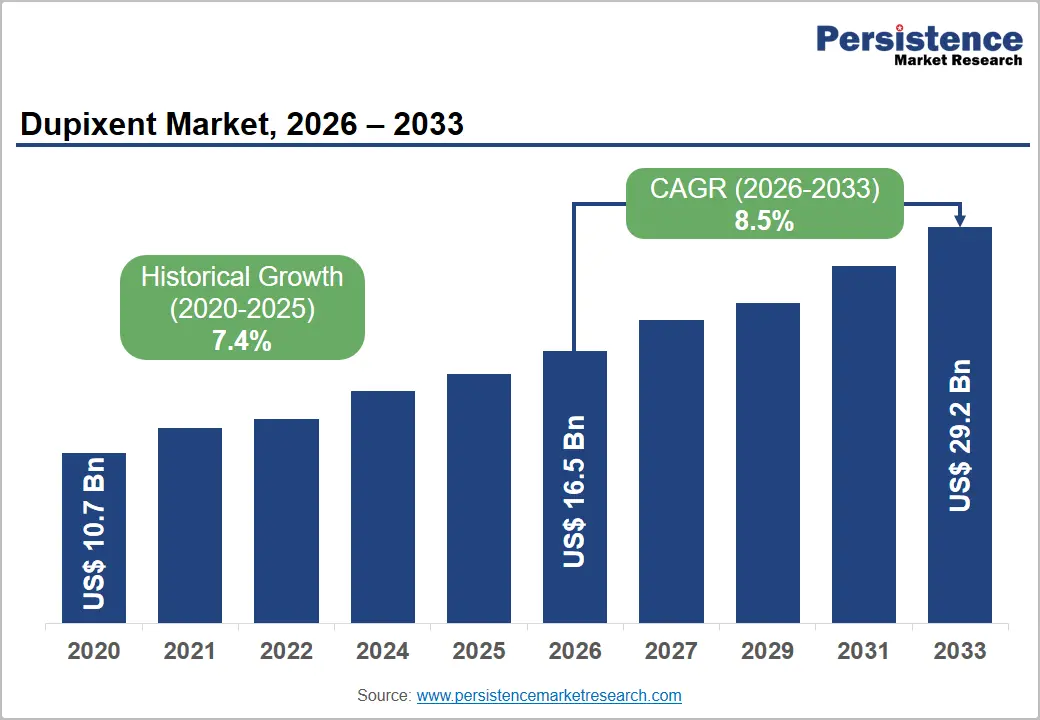
The global dupixent market size is likely to be valued at US$16.5 billion in 2026 and is estimated to reach US$29.2 billion by 2033, growing at a CAGR of 8.5% during the forecast period 2026 to 2033, driven by expanding label approvals across new indications such as COPD and chronic spontaneous urticaria. Growth is further supported by rising diagnosis rates of Type 2 inflammatory diseases, especially atopic dermatitis and severe asthma.
Key Industry Highlights:
- Leading Product Type: Dupilumab pre filled syringe, approximately 75.1% share in 2026, as they allow patients and caregivers to control the injection speed.
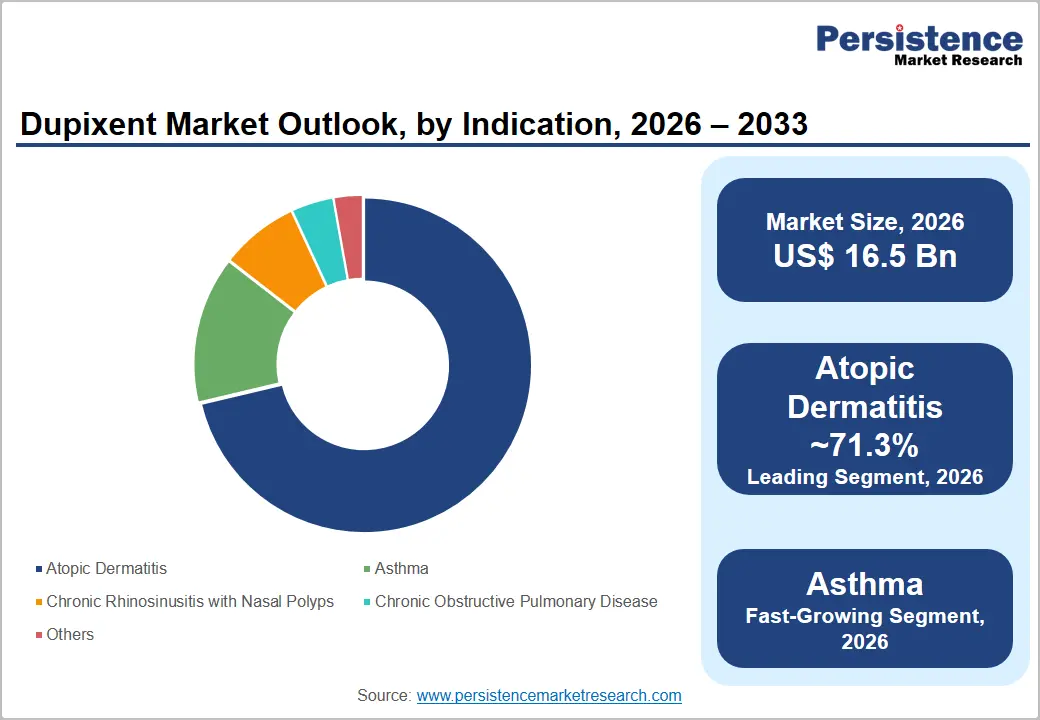
- Dominant Indication: Atopic dermatitis, with a nearly 71.3% share in 2026, as it represents the drug's most established indication.
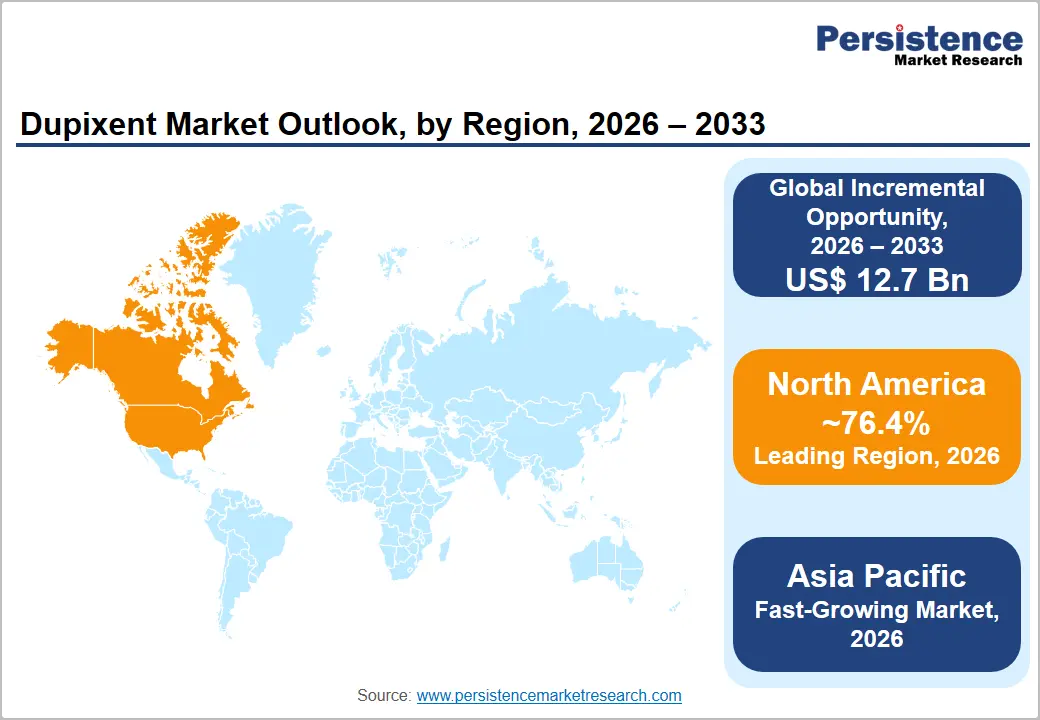
- Leading Region: North America, with about a 76.4% share in 2026, owing to high biologic therapy adoption and broad insurance coverage.
- Fast-growing Region: Asia Pacific, spurred by rising diagnosis rates of atopic dermatitis and improving healthcare infrastructure.
- Recent Approval: In 2025, Dupixent strengthened its respiratory disease franchise following its landmark COPD approval, with ongoing physician adoption and post-approval clinical evidence highlighting reductions in moderate-to-severe exacerbations among patients with Type 2 inflammation. The development further extended Dupixent beyond dermatology and asthma into chronic respiratory care.
DRO Analysis
Driver - Expanding Approved Indications
As its first U.S. Food and Drug Administration (FDA) approval in 2017 for Atopic Dermatitis (AD), Dupixent (dupilumab) has accumulated approvals across nine conditions. The full list now includes AD, asthma, Chronic Rhinosinusitis with Nasal Polyps (CRSwNP), Eosinophilic Esophagitis (EoE), Prurigo Nodularis (PN), Chronic Obstructive Pulmonary Disease (COPD), Chronic Spontaneous Urticaria (CSU), Bullous Pemphigoid (BP), and Allergic Fungal Rhinosinusitis (AFRS).
The COPD approval is particularly significant. Announced on September 27, 2024, Dupixent became the first-ever biologic medicine approved for COPD, a disease area that had seen no new treatment approaches for over a decade. More than 1,400,000 patients are now being treated with Dupixent globally across its approved indications. Each new approval adds a fresh patient population and extends the drug's commercial lifecycle without requiring a new molecule.
High Clinical Efficacy in Diseases with Poor Treatment Histories
Dupixent works by blocking Interleukin-4 (IL-4) and Interleukin-13 (IL-13), two proteins that propel type 2 inflammation across several chronic diseases. The COPD approval illustrates the depth of its clinical impact. Trial results showed patients treated with dupilumab saw a 30% reduction in the BOREAS trial and a 34% reduction in the NOTUS trial in the annualized rate of moderate or severe COPD exacerbations compared with placebo.
These results were published in the New England Journal of Medicine and presented at the American Thoracic Society (ATS) International Conference. In CSU, Dupixent resulted in a nearly 50% reduction in itch and urticaria activity scores compared to placebo in a confirmatory Phase 3 study. These consistent Phase 3 outcomes across unrelated disease types strengthen the clinical case for IL-4 and IL-13 blockade as a broad therapeutic strategy.
Restraint - High List Price May Create Access Barriers without Insurance Coverage
Dupixent carries one of the higher price tags among approved biologics, and uninsured patients face a significant financial burden without assistance. The manufacturer's list price for Dupixent is about US$3,993 per carton of 2 injections as of January 2025. For patients on a standard maintenance regimen, a month's supply of Dupixent without insurance can cost about US$5,377, and uninsured patients can expect to pay up to US$65,000 annually for Dupixent treatment.
Access pathways exist, including the Dupixent MyWay copay card and a patient assistance program. But, they carry income and insurance eligibility requirements. Step therapy rules add further friction. Most insurers require prior authorization or step therapy before covering Dupixent. In markets outside the U.S., reimbursement conditions vary considerably. These cost and coverage barriers may prevent eligible patients from initiating or maintaining treatment. It is mainly because Dupixent is extending into new indications where payer coverage criteria are still being established.
Opportunity - First-Ever Approved Treatment for Allergic Fungal Rhinosinusitis
Dupixent was approved in the U.S. as the first and only medicine for Allergic Fungal Rhinosinusitis (AFRS). It is a condition that affects adult and pediatric patients aged 6 years and older who have a history of sino-nasal surgery. This approval is significant because AFRS had no approved biologic treatment before this decision. The condition is augmented by a specific type 2 inflammatory response to fungal antigens in the sino-nasal tract, involving elevated Immunoglobulin E (IgE), eosinophilia, and mucin production.
It is a mechanistic profile that complies precisely with Dupixent's mode of action. Because Dupixent is now the only targeted biologic approved for this indication, it faces no direct competition in this field. The AFRS approval also strengthens Dupixent's presence in the Ear, Nose and Throat (ENT) specialty, where it is already established for CRSwNP. This potentially simplifies prescribing decisions for physicians treating patients with overlapping conditions.
Pediatric Label Expansions to Open New Patient Populations
Two recent approvals in Chronic Spontaneous Urticaria (CSU) have extended Dupixent's reach into younger age groups. On April 18, 2025, the FDA approved Dupixent for the treatment of adults and adolescents aged 12 years and older with CSU who remain symptomatic despite histamine-1 (H1) antihistamine treatment, the first new targeted therapy for this condition in over a decade. This was followed by a second, more recent approval.
On April 22, 2026, the FDA approved Dupixent for children aged two to 11 years with CSU who remain symptomatic despite H1 antihistamine treatment, making it the first biologic medicine approved for young children with this condition. The European Commission approved Dupixent for CSU in children aged two to 11 years on April 13, 2026, completing a near-simultaneous regulatory alignment across the U.S. and EU. Together, these approvals have broadened Dupixent's CSU label to patients as young as two years old on both sides of the Atlantic.
Category-wise Analysis
Product Type Insights
Dupilumab pre filled syringes are predicted to lead with a share of approximately 75.1% in 2026, as they provide patients with greater control over the injection process. Unlike auto-injector pens, users can inject the drug slowly, which helps reduce discomfort. This is especially important for Dupilumab because the formulation is relatively viscous and can cause injection-site pain when delivered too quickly. Several patients and caregivers report that the ability to control injection speed improves the treatment experience.
Dupilumab auto injector pens are estimated to be the fastest-growing segment over the forecast period. As auto-injector pens simplify self-administration. The device eliminates multiple manual steps associated with traditional syringes. Patients do not need to control needle insertion angles or plunger pressure. Instead, the pen automatically inserts the needle and delivers the medication after activation. This makes treatment easier for first-time users and patients with limited dexterity.
Indication Insights
The Atopic Dermatitis (AD) segment is anticipated to dominate with a share of nearly 71.3% in 2026, as it was the first prominent disease area where Dupilumab demonstrated transformative efficacy. Before biologics became available, patients with moderate-to-severe eczema often relied on topical corticosteroids, immunosuppressants, and other treatments that frequently provided incomplete disease control. Dupilumab delivered a targeted mechanism that addressed the underlying Type 2 inflammation responsible for the disease. This created steady physician acceptance and rising patient demand.
The asthma segment is expected to remain in the second position in 2026 as a significant proportion of patients suffer from Type 2 inflammatory asthma, the specific disease pathway targeted by Dupilumab. These patients often continue to experience exacerbations despite using high-dose inhaled corticosteroids and other maintenance therapies. Dupilumab provides an additional treatment option by blocking IL-4 and IL-13 signaling, two key drivers of airway inflammation.
Regional Insights
North America Dupixent Market Trends
North America is predicted to dominate in 2026 with a share of approximately 76.4%, as it has the highest adoption of biologic therapies for inflammatory diseases. Physicians in the U.S. and Canada are generally early adopters of innovative biologics, especially in dermatology, pulmonology, and allergy care. The region also benefits from broad insurance coverage and patient support programs that improve access to high-cost therapies. North America further benefits from a dense network of allergy clinics, dermatology centers, and specialty hospitals. This enables quicker diagnosis, treatment initiation, and long-term monitoring compared with several developing regions.
U.S. Dupixent Market Trends
A share of nearly 57.8% is expected to be held by the U.S. in 2026, since Dupixent continues to receive new FDA approvals, extending the eligible patient population. In 2025, the FDA approved Dupixent for Chronic Spontaneous Urticaria (CSU), marking the first new targeted therapy for the condition in more than a decade. More than 300,000 patients in the U.S. are estimated to remain symptomatic despite antihistamine treatment, creating a significant treatment opportunity. Growth is also being supported by pediatric label expansions.
Asia Pacific Dupixent Market Trends
Asia Pacific is anticipated to be the fastest-growing region in 2026 with a share of nearly 11.7%, as biologic therapies are becoming more accessible across key countries. Governments and healthcare providers are investing heavily in specialty care, advanced diagnostics, and reimbursement systems. As awareness of severe atopic dermatitis and asthma increases, more patients are being referred for biologic treatment. The region also has a very large population base. Even a small increase in diagnosis rates translates into a substantial increase in eligible patients.
China Dupixent Market Trends
China will likely lead in Asia Pacific in 2026 with a share of around 34.6%, as it has one of the largest patient populations suffering from allergic and inflammatory diseases. Ongoing urbanization, worsening air pollution in several cities, and increasing allergy awareness have contributed to high diagnosis rates of atopic dermatitis and asthma. Another key factor is healthcare modernization. China has extended access to specialty hospitals and biologic therapies over the past decade. More dermatologists and pulmonologists are now incorporating advanced biologics into treatment pathways, especially for patients who do not respond adequately to conventional therapies.
India Dupixent Market Trends
In 2026, India is projected to account for a share of approximately 16.3%, as awareness of severe eczema and asthma is improving among both physicians and patients. Historically, several patients relied on topical therapies, oral steroids, or symptomatic treatment. However, increasing availability of biologics is changing treatment approaches, especially in urban centers. The burden of respiratory diseases is another important factor. India faces high exposure to air pollution, industrial emissions, biomass fuel smoke, and environmental allergens. These factors contribute to severe and uncontrolled asthma cases, creating stable demand for targeted biologic therapies.
Europe Dupixent Market Trends
Europe will likely see decent growth over the forecast period, with a share of nearly 8.1% in 2026, because biologics are already well established in the region's healthcare sector. Unlike emerging markets that are experiencing ongoing adoption, the continent is seeing consistent expansion through new indications and broad patient eligibility. Regulatory approvals have played a key role. Dupixent has extended beyond atopic dermatitis into asthma, COPD, chronic rhinosinusitis with nasal polyps, eosinophilic esophagitis, and other inflammatory conditions. Each new indication adds incremental patient demand.
Germany Dupixent Market Trends
Germany will likely register a substantial share of approximately 33.8% in 2026, as it has a well-developed reimbursement system and a large network of dermatologists, allergists, and respiratory specialists. Patients generally have good access to unique medicines through statutory health insurance programs. Germany also has superior clinical research activity in immunology and inflammatory diseases. This has helped increase physician familiarity with biologics and encouraged adoption in both dermatology and respiratory care.
U.K. Dupixent Market Trends
A share of around 21.5% is predicted to be held by the U.K. in 2026, as biologic use is increasing across the National Health Service (NHS) for severe inflammatory diseases. Dermatologists and respiratory specialists are now using targeted therapies when standard treatments fail to provide adequate disease control. Asthma represents a particularly promising area. The U.K. continues to report a significant burden of severe asthma, and biologics are becoming an important part of specialist treatment pathways. The expansion of Dupixent into additional respiratory indications is anticipated to support future growth.
Competitive Landscape
The global Dupixent market is moderately consolidated, with Sanofi and Regeneron maintaining a dominant position. However, the competitive intensity has increased significantly since 2024 as new biologics and JAK inhibitors entered key indications such as atopic dermatitis, asthma, Chronic Rhinosinusitis with Nasal Polyps (CRSwNP), and COPD. In atopic dermatitis, competition is strongest from Eli Lilly's Ebglyss (lebrikizumab), LEO Pharma's Adbry (tralokinumab), and Pfizer's Cibinqo, along with AbbVie's Rinvoq.
In respiratory diseases, Dupixent faces competition from established biologics such as Xolair, Nucala, and Fasenra. However, these products primarily target narrower patient populations, whereas Dupixent's mechanism addresses both IL-4 and IL-13 signaling pathways. Competitors are gaining traction in selected patient groups, but no single product currently matches Dupixent's combination of commercial scale, indication breadth, and clinical experience.
Key Industry Developments
- In February 2026, the European Medicines Agency's Committee for Medicinal Products for Human Use (CHMP) issued a positive opinion recommending Dupixent for children aged 2 to 11 years with chronic spontaneous urticaria. The recommendation was supported by data from the LIBERTY-CUPID clinical program and represented an important step toward expanding Dupixent's pediatric immunology portfolio in Europe.
- In November 2025, the European Commission approved Dupixent for moderate-to-severe chronic spontaneous urticaria in adults and adolescents aged 12 years and older. The decision was based on Phase III studies showing significant reductions in itch severity and hive activity compared with placebo. The approval made Dupixent the first targeted medicine approved for CSU in the European Union in over ten years.
- In February 2025, Sanofi and Regeneron announced that the U.S. FDA accepted the supplemental Biologics License Application (sBLA) for Dupixent in bullous pemphigoid under Priority Review. The submission was supported by pivotal Phase III data demonstrating significant improvements in sustained disease remission in adults with moderate-to-severe bullous pemphigoid. If approved, Dupixent would become the first targeted therapy specifically indicated for this rare autoimmune blistering disease.
Companies Covered in Dupixent Market
- Sanofi S.A.
- Regeneron Pharmaceuticals, Inc.
- Pfizer Inc.
- Eli Lilly and Company
- AstraZeneca PLC
- GSK plc
- Novartis AG
- F. Hoffmann-La Roche Ltd.
- AbbVie Inc.
- Amgen Inc.
- Others
Frequently Asked Questions
The global Dupixent market is projected to be valued at US$16.5 billion in 2026.
The Dupixent market is expected to reach US$29.2 billion by 2033.
Key market trends include a growing preference for self-administered biologics and rising adoption of targeted therapies over systemic corticosteroids.
Dupilumab pre filled syringes are expected to be the leading product type with a share of nearly 75.1% in 2026, owing to their suitability for pediatric patients and caregivers.
The Dupixent market is expected to grow at a CAGR of 8.5% from 2026 to 2033.
Sanofi S.A., Regeneron Pharmaceuticals, Inc., and Pfizer Inc. are a few key market players.


