




- Automotive Components & Materials
- Drive by Wire Market
Drive by Wire Market Size, Share, and Growth Forecast 2026–2033
Drive by Wire Market by Type (Throttle-By-Wire, Brake-By-Wire, Shift-By-Wire, Steer-By-Wire), Vehicle Type (Passenger Cars, Commercial Vehicles), and Regional Analysis, 2026–2033

Drive by Wire Market Size and Trend Analysis
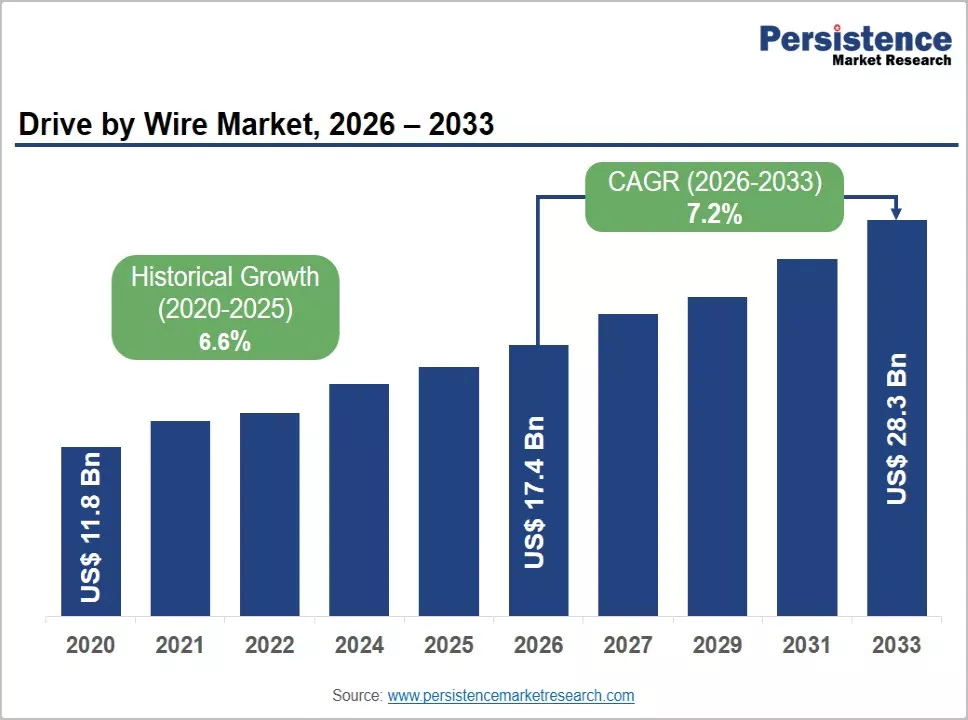
The global drive by wire market size is likely to be valued at US$ 17.4 billion in 2026 and is projected to reach US$ 28.3 billion by 2033, growing at a CAGR of 7.2% during the forecast period between 2026 and 2033.
Drive-by-wire systems replace the mechanical and hydraulic links between the driver and the vehicle with sensors, controllers, and actuators connected by software. The technology began with electronic throttles and gear selectors and is now moving into steering and braking, where it enables variable steering ratios, regenerative braking control, simpler cabins, and direct access for automated driving systems.
The forecast period is defined by the first series-production steer-by-wire and electromechanical brake programmes, functional safety certification, and the rapid launch of by-wire chassis by Chinese electric vehicle makers. Vehicle manufacturers, chassis suppliers, and semiconductor and software providers should read this as a safety-critical, software-led category in which redundancy, certification, and integration expertise determine vendor selection.
Key Industry Highlights
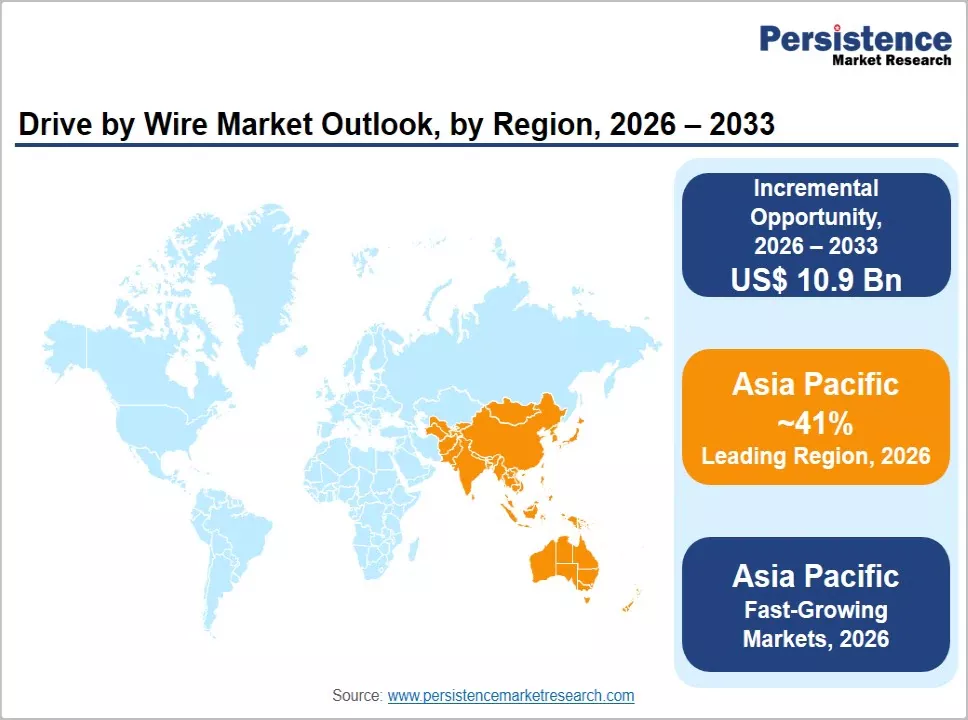
- Dominant and Fastest-growing Region: Asia Pacific holds 41% of the drive by wire market in 2026 and is projected to grow at an estimated 8.4% CAGR through 2033, driven by China, the world's largest electric vehicle producer. Chinese manufacturers are launching software-defined vehicles quickly, and Nexteer began series production of its steer-by-wire system for a Chinese new energy vehicle maker in April 2026.
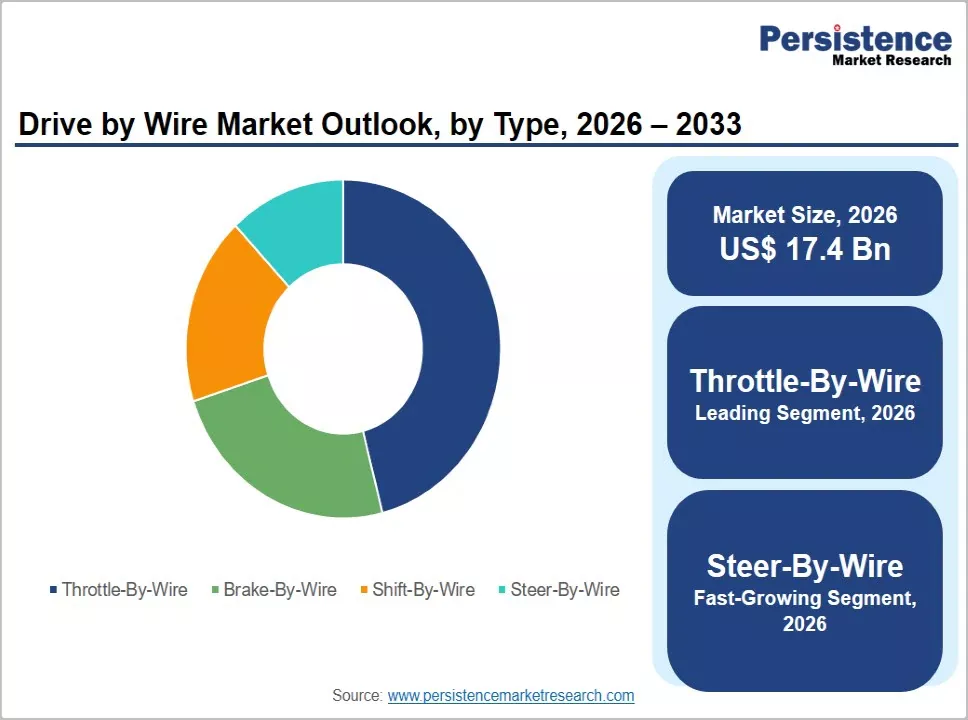
- Leading Type: Throttle-by-wire commands about 46% of 2026 revenue, as electronic accelerator pedals and throttle control have replaced cables on almost every new passenger car and also feed torque control in hybrid and electric vehicles. Robert Bosch GmbH, ZF Friedrichshafen AG, Continental AG, and The Curtiss-Wright Corporation anchor this segment.
- Fastest-growing Type: Steer-by-wire is the fastest-growing type, moving from concept to series production. Nexteer's system received ASIL D functional safety approval in late 2025, and ZF said its latest steer-by-wire system began production in the first quarter of 2025 on the Nio ET9. Brake-by-wire follows closely as electromechanical brakes reach production.
- Leading Vehicle Type and Emerging Opportunity: Passenger cars account for around 78% of revenue, while commercial vehicles are the fastest-growing vehicle type as trucks, buses, and off-highway machinery adopt by-wire steering and braking for automation and driver comfort. Redundant actuation required for autonomous trucking is a major long-term opportunity for suppliers such as Danfoss and ZF Friedrichshafen AG.
DRO Analysis
Driver- Software-Defined Chassis, Vehicle Electrification, and Autonomous-Driving Readiness
Electric and software-defined vehicles need actuators that can be commanded by software, which is moving by-wire systems from niche to core architecture. Removing mechanical linkages saves weight, frees cockpit space, allows variable steering ratios, and gives driver-assistance and autonomous driving systems direct control of steering and braking. Supplier milestones show the shift from validation to production.
Nexteer started series production of its first steer-by-wire system in April 2026 for a Chinese new energy vehicle maker after obtaining ASIL D certification, and ZF stated at Auto Shanghai 2025 that it would supply electromechanical braking for almost five million vehicles for a global manufacturer. Bosch has said that two Asian customers will start series production with its electromechanical brake and steering systems in 2026.
Restraint- Functional Safety Certification, Redundancy Costs, and Cybersecurity Exposure
Without a mechanical fallback, steering and braking must meet the highest safety integrity level, which requires dual controllers, dual power supplies, redundant communication paths, and extensive validation. These features raise system cost and development time and make adoption difficult in price-sensitive vehicle segments.
Software complexity and connectivity expose by-wire systems to cybersecurity and over-the-air update risks that regulators now scrutinize, and some drivers remain cautious about steering feel and trust. Dependence on sensors and semiconductors adds supply risk, as shortages have delayed vehicle production in recent years.
Opportunity- Commercial and Off-Highway Steer-by-Wire, Electromechanical Brakes, and Chinese NEV Demand
Commercial vehicles, buses, and off-highway machinery offer the largest white space, because by-wire steering allows joystick control, tighter turning circles, and automated functions, and autonomous trucking requires redundant actuation. Hybrid braking systems that combine electromechanical rear brakes with hydraulic front calipers, such as the arrangement ZF described for its global manufacturer contract, give automakers a lower-risk path to by-wire braking. Chinese new energy vehicle makers are launching by-wire chassis quickly, as Nexteer's April 2026 program showed, and Chery has said its Exeed EX7 will be the first mass-production vehicle with a fully electromechanical brake system.
Category-wise Analysis
Why Does Throttle-by-Wire Command the Largest Share of the Global Drive by Wire Market?
Throttle-by-wire is projected to lead the segment, holding nearly 46% of market share in 2026. Electronic accelerator pedals and throttle control have replaced mechanical cables in almost every new passenger car, and pedal sensors also feed the software that manages motor torque in hybrid and battery electric vehicles. The technology is mature, low-risk, and cost-competitive, with Robert Bosch GmbH, ZF Friedrichshafen AG, Continental AG, and The Curtiss-Wright Corporation supplying pedals, sensors, and controllers across passenger and commercial vehicles. Shift-by-wire is already common in premium and electric vehicles, where electronic gear selectors save space, supported by suppliers such as Kongsberg Automotive and Ficosa International S.A.
Steer-by-wire is likely to be the fastest-growing segment, as the technology moves from concept to series production. Nexteer's system uses dual controllers, dual power supplies, and dual actuation paths, adjustable steering ratio, and road-feel simulation, with an open interface for autonomous driving. ZF's latest steer-by-wire system began production on the Nio ET9 in the first quarter of 2025, and Nissan Motor Co., Ltd. introduced an early steer-by-wire system with mechanical backup, called Direct Adaptive Steering, on the Infiniti Q50 in 2013. Brake-by-wire is also expanding as electromechanical brakes reach production and support regenerative braking and software-based vehicle dynamics.
Vehicle Type Insights
What Makes Passenger Cars the Leading Vehicle Type in the Drive by Wire Market?
Passenger cars are expected to lead the segment, holding about 78% of market share in 2026. High production volumes, electrification, and the rapid adoption of advanced driver assistance make passenger cars the main customers for by-wire systems, from electronic throttle and shift selectors to brake-by-wire for regenerative braking. Chinese electric vehicle makers and global brands are testing full by-wire chassis, and suppliers including Robert Bosch GmbH, ZF Friedrichshafen AG, Nexteer, Hitachi, Ltd., and Nissan Motor Co., Ltd. are developing or producing systems for them. Software-defined features such as variable steering ratio and adjustable pedal response also let manufacturers differentiate models through updates.
Commercial vehicles are likely to be the fastest-growing segment, as trucks, buses, and off-highway machinery adopt by-wire steering and braking for automation, driver comfort, and cab design flexibility. By-wire steering reduces driver effort, simplifies left-hand and right-hand drive variants, and supports automated functions for logistics, while redundant actuation is a prerequisite for autonomous trucking. Danfoss offers steer-by-wire for off-highway vehicles, The Curtiss-Wright Corporation supplies electronic throttle controls for commercial and off-highway equipment, and safety regulations such as the European requirement for advanced emergency braking on new heavy vehicles are pushing electronically controlled brakes.
Regional Insights
North America Drive by Wire Market Trends and Insights
North America is forecast to account for around 25% of the drive by wire market in 2026. The region has a large light vehicle and pickup market, a growing electric vehicle base, and active development of autonomous trucking and driver-assistance systems. Michigan-based suppliers and global chassis specialists maintain engineering and production capacity close to major vehicle programs.
U.S. Drive by Wire Market Size
The U.S. is estimated to hold around 87% of the North America regional market in 2026. Pickup, SUV, and commercial vehicle programs, strong investment in driver assistance and automated trucking, and the presence of suppliers such as Nexteer, based in Auburn Hills, Michigan, support steady adoption of electronic controls.
Canada Drive by Wire Market Size
Canada is expected to account for over 13% of the North America regional market in 2026. An Ontario automotive manufacturing and engineering cluster, growing electric vehicle assembly investment, and demand from heavy-duty and mining vehicles support gradual adoption of by-wire technologies.
Europe Drive by Wire Market Trends and Insights
Europe is anticipated to command around 14% of the drive by wire market in 2026. Strict safety regulations, strong premium and commercial vehicle production, and the headquarters of leading chassis suppliers drive demand for advanced steering and braking electronics. Manufacturers are shifting towards zonal architectures and software-defined vehicles, which favors by-wire actuation.
Germany Drive by Wire Market Size
Germany is projected to account for around 31% of the Europe regional market in 2026. ZF Friedrichshafen AG, Robert Bosch GmbH, and Continental AG are headquartered in the country, together with major premium vehicle makers, which creates a dense ecosystem for chassis electronics, safety validation, and software development.
U.K. Drive by Wire Market Size
The U.K. is estimated to account for nearly 12% of the Europe regional market in 2026. Premium and performance car makers, strong engineering and motorsport expertise, and the Automated Vehicles Act of 2024, which created a legal framework for self-driving vehicles, encourage development of electronically controlled chassis systems.
Which Region Will Drive the Fastest Drive by Wire Growth Through 2033?
Asia Pacific is forecast to dominate and be the fastest-growing region, capturing around 41% of market share in 2026 and expanding at an estimated 8.4% CAGR through 2033. China's large electric vehicle industry, rapid launches of software-defined models, and supplier localisation are the main drivers, while Japan, South Korea, and India add demand through advanced driver assistance and electrification. By-wire suppliers are partnering with regional manufacturers to secure early series-production programs.
China Drive by Wire Market Size
China is projected to hold 57% of the Asia Pacific regional market in 2026. Chinese new energy vehicle makers are moving quickly to by-wire chassis, as Nexteer's April 2026 steer-by-wire program for a leading local manufacturer and ZF's steer-by-wire supply to the Nio ET9 show, and strong local competition shortens development cycles.
India Drive by Wire Market Size
India is expected to account for around 7% of the Asia Pacific regional market in 2026. Growing passenger car and commercial vehicle production, rising adoption of driver-assistance features, new electric vehicle launches, and government production-linked incentives for advanced automotive technology are creating demand for electronic throttle, shift, and brake systems.
Competitive Landscape
The global drive by wire market is moderately consolidated, with a few global chassis, steering, and braking specialists supplying most series programs. ZF Friedrichshafen AG, Robert Bosch GmbH, Nexteer Automotive, and Continental AG lead on safety-certified architectures, validated redundancy, and integration with vehicle software, while Danfoss, Ficosa International S.A., The Curtiss-Wright Corporation, Nissan Motor Co., Ltd., Kongsberg Automotive, and Hitachi, Ltd. compete through application-specific systems, components, and vehicle-level integration. Competitive intensity is rising as electromechanical brakes and steer-by-wire enter series production and as Chinese manufacturers demand rapid localization. Winning requires ASIL D certification, redundant hardware and software, cybersecurity credentials, and the ability to supply complete chassis motion control packages.
Key Industry Developments
- In April 2026, Nexteer Automotive began series production of its steer-by-wire (SbW) system, its first SbW program in series production, for a leading Chinese new energy vehicle manufacturer. The system received ASIL D functional safety approval from DAkkS, the German accreditation body, in late 2025, and features dual controllers, dual power supplies, dual actuation paths, adjustable steering ratio, and an open interface for autonomous driving. Nexteer also said its Electro-Mechanical Brake solution has completed development and validation and is ready for mass production.
- In April 2025, ZF Friedrichshafen AG highlighted at Auto Shanghai 2025 that its latest-generation steer-by-wire system had started production in the first quarter on the Nio ET9, and that it would supply electromechanical braking technology to a leading global vehicle manufacturer for almost five million vehicles. The contract combines electromechanical brakes on the rear axle with hydraulic front calipers and ZF's Integrated Brake Control to create a hybrid by-wire and hydraulic braking system.
Companies Covered in Drive by Wire Market
- Continental AG
- Danfoss
- Ficosa International S.A.
- Hitachi, Ltd.
- Kongsberg Automotive
- Nexteer Automotive
- Nissan Motor Co., Ltd.
- Robert Bosch GmbH
- The Curtiss-Wright Corporation
- ZF Friedrichshafen AG
Frequently Asked Questions
The global drive by wire market is valued at US$ 17.4 billion in 2026.
Vehicle electrification, software-defined chassis architectures, demand for driver assistance and autonomous driving, and the start of series production of steer-by-wire and electromechanical brakes, partly offset by certification costs, redundancy requirements, and cybersecurity risk.
Throttle-by-wire holds around 46% of the market. Electronic accelerator pedals and throttle control are mature, low-cost, and fitted to almost every new passenger car, and they also feed torque control in hybrid and electric vehicles.
Asia Pacific leads with a 41% share in 2026, driven by China's large electric vehicle industry, rapid launches of software-defined models, and early series production of by-wire chassis systems.
The largest opportunities are steer-by-wire and electromechanical brakes for new vehicle platforms, by-wire steering for commercial and off-highway vehicles, autonomous trucking, and supplier localization in China.
Leading companies include ZF Friedrichshafen AG, Robert Bosch GmbH, Nexteer Automotive, and Continental AG. The market is moderately consolidated, with a few chassis specialists competing on safety certification, redundancy, and system integration.


