




- Automotive Components & Materials
- Convertible Roof System Market
Convertible Roof System Market Size, Share, and Growth Forecast 2026–2033
Convertible Roof System Market by Roof Type (Hardtop, Soft-Top Convertibles), Vehicle Type (Hatchbacks, Sedans, Sports Utility Vehicles, Roadsters, Multi-Purpose Vehicles), Actuation Mechanism (Hydraulic, Electric), Material (Steel, Aluminum), and Regional Analysis, 2026–2033

Convertible Roof System Market Size and Trend Analysis
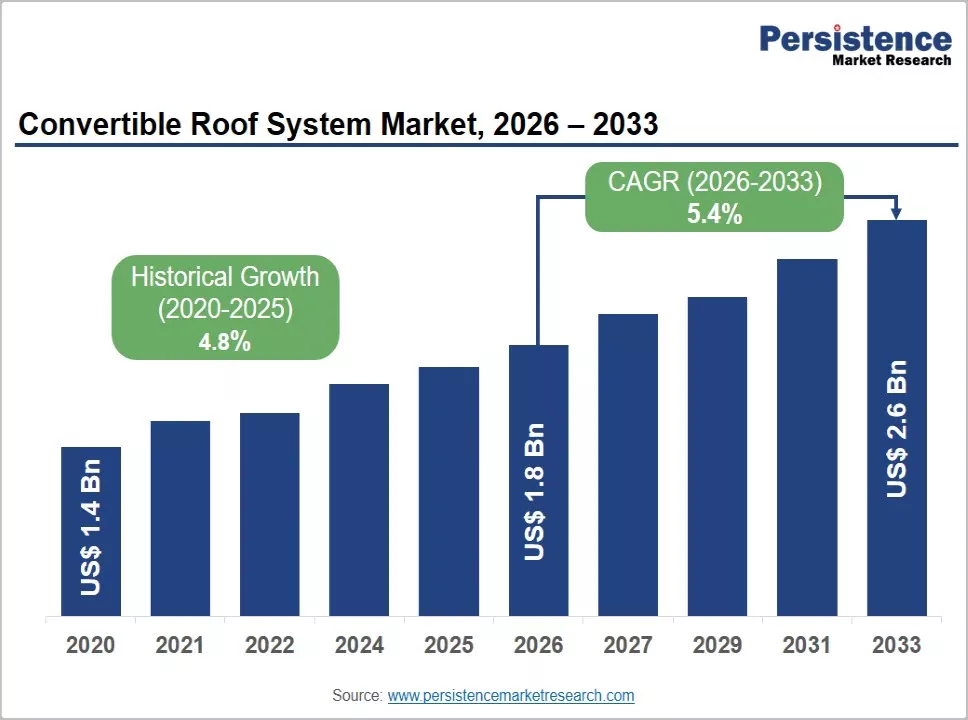
The global convertible roof system market size is likely to be valued at US$ 1.8 billion in 2026 and is projected to reach US$ 2.6 billion by 2033, growing at a CAGR of 5.4% during the forecast period between 2026 and 2033.
Convertible roof systems are a small but engineering-intensive niche, in which complex folding kinematics, sealing, acoustics, and weight management must deliver coupe-like refinement at the touch of a button. The forecast period is defined by electrification of roof actuation, lighter materials, premium and limited-run models, and the extension of open-air design to SUVs and off-road vehicles. Roof suppliers, vehicle manufacturers, and material producers should read this as a premium, platform-led category in which a few large specialists secure long programs and small-volume niche builds reward flexible production.
Key Industry Highlights
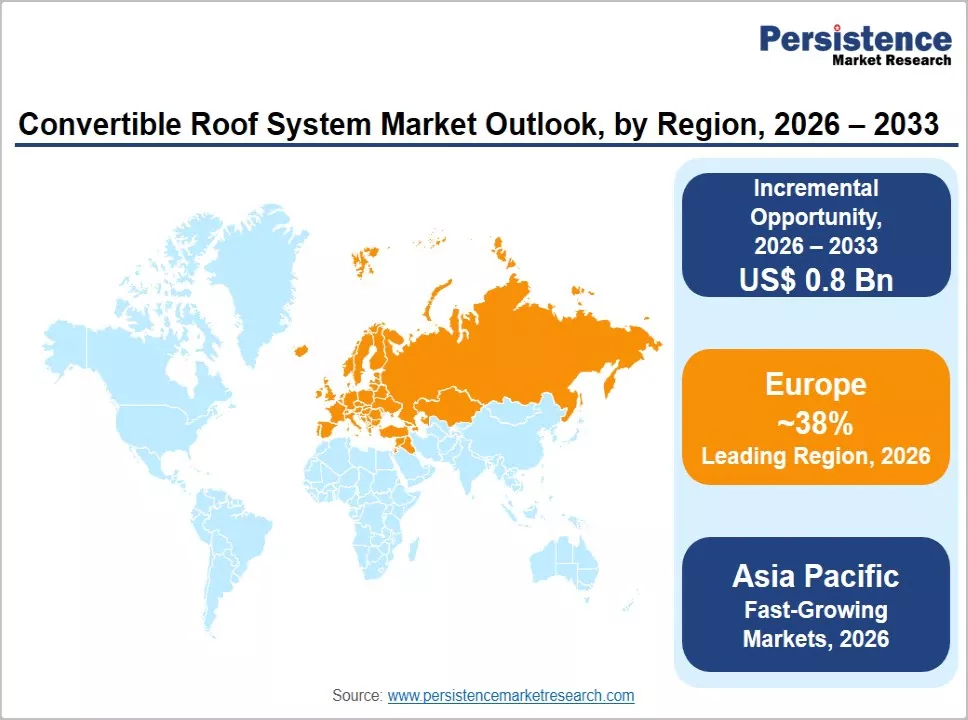
- Dominant Region: Europe holds 38% of the convertible roof system market in 2026, reflecting the presence of premium manufacturers such as BMW, Mercedes-Benz, Audi, and Porsche, and of the world's most experienced roof-system specialists. A strong open-top driving tradition and a large base of premium buyers keep program volumes stable.
- Fastest-growing Region: Asia Pacific is projected to grow at an estimated 6.6% CAGR through 2033, as premium vehicle ownership rises in China, India, and Southeast Asia and manufacturers add open-air variants for affluent buyers. Local roof-system manufacturing is also expanding alongside vehicle production.
- Leading Roof Type: Soft-top convertibles command about 62% of 2026 revenue, supported by lower weight, simpler packaging, and lower cost than retractable hardtops. Webasto Group, Magna International Inc., and Valmet Automotive anchor this segment.
- Fastest-growing Actuation Mechanism and Emerging Opportunity: Electric actuation is the fastest-growing mechanism as manufacturers replace hydraulic lines and fluid with compact motors and software control. Webasto developed a retractable hardtop with six electric motors in place of a hydraulic system for the mid-engine Chevrolet Corvette, showing how quickly electric drives are moving into premium programs.
DRO Analysis
Driver- Premium Vehicle Demand, Limited-Run Special Editions, and the Spread of Open-Air Designs
Premium and performance cars remain the backbone of demand, and manufacturers use convertibles as halo and special-edition models that command high margins. In June 2026, Webasto was commissioned to develop and produce the roof system for the BRABUS 800 Convertible, a strictly limited small series based on the Mercedes-AMG G 63, which shows how open-top variants are reaching SUVs and off-road vehicles. Removable and folding roofs on vehicles such as the Jeep Wrangler and Ford Bronco widen the customer base, while advances in acoustics, sealing, and insulation allow modern soft tops to be driven all year round with near-coupe refinement.
Restraint- Small Production Volumes, High Cost per Vehicle, and Competition from Panoramic Roofs
Convertible roofs are expensive to engineer, validate, and manufacture, with tooling and testing costs spread over small volumes. Complex mechanisms add weight and cost, reduce boot space, and require extra body reinforcement for stiffness and rollover protection. Some manufacturers have trimmed convertible variants as they cut model ranges and invest in electric platforms, and large panoramic glass roofs offer an open-air feel at lower cost and complexity. Suppliers also face raw material and energy cost inflation, while customers expect ever-higher quality for water tightness and noise.
Opportunity- Electric Actuation, Lightweight Materials, and Sustainable Roof Concepts
Electric roof drives remove hydraulic lines and fluid, simplify packaging, and suit electric platforms, as seen in the six-motor retractable hardtop that Webasto developed for the Corvette. Lightweight composites and carbon fiber frames help offset battery weight, while recycled and bio-based fabrics respond to sustainability targets. At Auto Shanghai in April 2025, Webasto presented a folding roof with a large opening made from lightweight materials as an alternative to conventional sunroofs, together with a sustainable panoramic roof concept that cuts CO2e by 30%. Open-air solutions for electric vehicles, premium SUVs, and the Chinese market offer long-term opportunities.
Category-wise Analysis
Why Do Soft-Top Convertibles Lead the Global Convertible Roof System Market?
Soft-top convertibles are projected to lead the segment, hold nearly 62% of market share in 2026. Fabric roofs with folding frames are lighter, cheaper, and take less space when stowed than retractable hardtops, which makes them the default choice for roadsters, small sports cars, and many premium open-top models. Modern multi-layer fabrics, insulation, and tension-bow designs give near-coupe acoustics. Webasto Group, Magna International Inc., and Valmet Automotive supply soft-top systems, while Haartz Corporation is known for convertible top fabrics and Hoerbiger Holding AG for hydraulic components that operate roofs.
Hardtop convertibles are likely to be the fastest-growing segment, driven by demand for coupe-like security, lower cabin noise, and stronger styling when the roof is closed. Retractable hardtops fold rigid panels into the rear of the vehicle and need precise kinematics, sealing, and boot packaging. Webasto's roof for the Chevrolet Corvette and its retractable fastback roof for the Mazda MX-5 show the technology moving into sports cars of different price points, and further electric drive adoption is expected to ease packaging.
Vehicle Type Insights
What Makes Roadsters the Leading Vehicle Type in the Convertible Roof System Market?
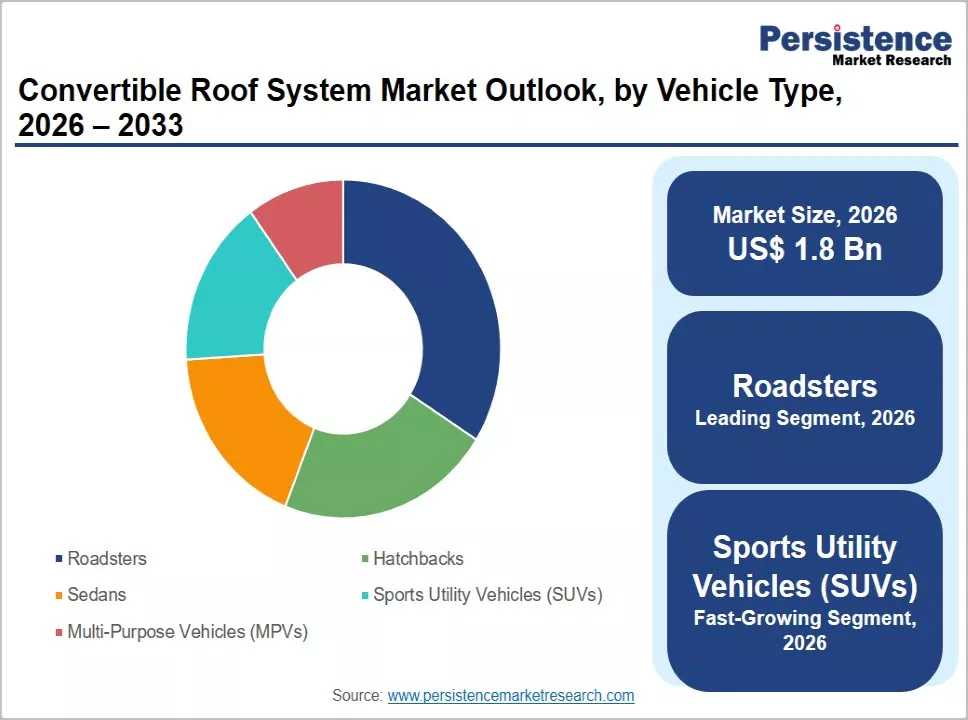
Roadsters are projected to lead the segment, account for around 34% of market share in 2026. Two-seat sports cars such as the Mazda MX-5, Porsche 718 Boxster, and BMW Z4 are built around open-air driving, so buyers accept the cost and weight of a sophisticated folding roof and are less price-sensitive. Sedans, including coupe-cabriolets, and hatchbacks form a mid-sized base for premium brands and compact open-top models, while multi-purpose vehicles remain a minor niche.
SUVs are likely to be the fastest-growing vehicle type, as manufacturers extend open-air design to higher-riding, off-road capable models. Removable and folding roofs on the Jeep Wrangler and Ford Bronco, and the BRABUS 800 Convertible built on the Mercedes-AMG G 63, show demand for open-top SUVs at both mass and ultra-premium levels. Roof systems for SUVs must cope with higher body mass, taller structures, dust, and water, which creates premium engineering content for suppliers such as Webasto Group and Magna International Inc.
Actuation Mechanism Insights
What Is Driving Hydraulic Dominance Across the Convertible Roof System Industry?
Hydraulic actuation is expected to lead the segment, hold about 54% of market share in 2026. Hydraulic cylinders deliver high force and smooth, controlled movement on heavy multi-part roofs and are backed by decades of proven reliability. Hoerbiger Holding AG supplies hydraulic units and Webasto Group and Magna International Inc. integrate them into complete roof modules for premium sedans, coupes, and sports cars, which keeps the installed base large and replacement parts widely available.
Electric actuation is likely to be the fastest-growing mechanism, driven by simpler packaging, no risk of fluid leaks, and finer software control of opening speed and anti-pinch functions. The six-motor Corvette roof is the clearest example, and Aisin Seiki Co., Ltd. and Continental AG supply motors, electronics, and control units for roof and closure systems. Manual roofs remain in lightweight, low-cost roadsters such as the Mazda MX-5, where weight savings and mechanical simplicity are valued.
Material Insights
Why Does Steel Remain the Leading Material in the Convertible Roof System Market?
Steel is projected to lead the segment, accounting for around 44% of market share in 2026. Frames, bows, linkages, and hardtop panels need stiffness, crash performance, and cost efficiency, and steel provides all three at scale. Webasto's roof for the BMW 4 Series convertible, for example, uses a light sheet steel design for its three-piece structure. Steel also benefits from established forming, welding, and corrosion protection processes across supplier plants.
Composite materials are likely to be the fastest-growing segment, as glass-fiber and thermoplastic panels reduce weight and lower the center of gravity, while carbon fiber appears on high-end and limited-run builds. Aluminum is used for frames in premium cars where weight matters, and polyvinyl chloride remains common for rear windows and lower-cost soft tops. Suppliers are investing in recyclable and bio-based materials, as shown by Webasto's roof concept that removes aluminum and uses recyclable components.
Regional Insights
North America Convertible Roof System Market Trends and Insights
North America is forecast to account for around 19% of the convertible roof system market in 2026. The region has a long convertible tradition with models such as the Ford Mustang convertible, the Chevrolet Corvette, and the Mazda MX-5, and strong demand for open-top SUVs. Warm-weather states, a large premium buyer base, and an active aftermarket and conversion sector sustain demand.
U.S. Convertible Roof System Market Size
The U.S. is estimated to hold around 88% of the North America regional market in 2026. Sports cars, pony cars, and open-top SUVs underpin demand, and Webasto assembles its Corvette roof system in Plymouth, Michigan, which keeps engineering and production close to Detroit-based programs.
Canada Convertible Roof System Market Size
Canada is expected to account for over 12% of the North America regional market in 2026. Magna International Inc., headquartered in Ontario, provides roof-system and vehicle-integration capability, and a market for open-top vehicles in summer months supports steady demand.
Europe Convertible Roof System Market Trends and Insights
Europe is forecast to dominate the regional market, capture for around 38% of the convertible roof system market share in 2026. The region is home to BMW, Mercedes-Benz, Audi, Porsche, and a large group of low-volume sports and luxury brands, as well as the leading roof-system specialists. Experience with complex kinematics, acoustics, and small-series production strengthens local supply.
Germany Convertible Roof System Market Size
Germany is projected to account for around 36% of the Europe regional market in 2026. Premium makers and Webasto, headquartered in Stockdorf near Munich, create a tight link between design and production, and customized builds such as the BRABUS 800 Convertible show the depth of the specialist ecosystem.
U.K. Convertible Roof System Market Size
The U.K. is estimated to account for nearly 14% of the Europe regional market in 2026. Luxury and sports car makers including Bentley, Aston Martin, and McLaren, together with convertible variants of the Mini, sustain demand for roof systems built to premium standards.
Which Region Will Drive the Fastest Convertible Roof System Growth Through 2033?
Asia Pacific is forecast to be the fastest-growing region, capturing around 24% of market share in 2026 and expanding at an estimated 6.6% CAGR through 2033. Rising premium vehicle sales, a growing base of affluent buyers, and local production by international manufacturers are lifting demand. Japanese sports cars such as the Mazda MX-5 add steady volumes, and roof-system makers are expanding regional production capacity.
China Convertible Roof System Market Size
China is projected to hold 38% of the Asia Pacific regional market in 2026. Strong premium car sales, rising interest in open-air styling on electric vehicles, and expanding local roof-system production support growth, although the market remains small compared with sunroof and panoramic roof demand.
India Convertible Roof System Market Size
India is expected to account for around 8% of the Asia Pacific regional market in 2026. Luxury car imports and a small but growing premium base support demand, and supplier investment, such as Webasto's third production site in India, points to rising roof-system manufacturing activity in the country.
Competitive Landscape
The global convertible roof system market is highly concentrated at the top, with a few specialists holding long-term programs with premium manufacturers. Webasto Group, Magna International Inc., Valmet Automotive, and Aisin Seiki Co., Ltd. lead on engineering depth, validated mechanisms, and integrated production, while Inalfa Roof Systems Group, Inteva Products LLC, Continental AG, Hoerbiger Holding AG, Haartz Corporation, Pininfarina S.p.A., Standex International Corp., GAHH LLC, Toyo Seat Co., Ltd., ASC Inc., and BOS GmbH and Co. KG supply roof systems, fabrics, actuators, electronics, conversions, and components. Competitive intensity is rising as electric actuation, lightweight materials, and sustainability targets reshape product requirements and as manufacturers consolidate model ranges. Winning requires acoustic and sealing performance, weight reduction, flexibility for low-volume builds, and the ability to deliver complete roof modules on global platforms.
Key Industry Developments
- In June 2026, Webasto Group was commissioned to develop and produce the roof system for the BRABUS 800 Convertible, a strictly limited small-series model based on the Mercedes-AMG G 63. The convertible roof is produced at Webasto's plant in Velký Meder, Slovakia, within its "Masterpiece Manufacture" unit, which focuses on exclusive, highly complex convertible roof systems in small production volumes.
- In April 2025, Webasto Group presented its roof innovations at Auto Shanghai 2025, including a folding roof with a large opening developed using lightweight materials as an alternative to conventional sunroofs, and a sustainable panoramic roof concept that reduces CO2e by 30% and avoids production waste of key components by 60% through intelligent design and low-CO2 materials. The concept uses recyclable and bio-based materials and eliminates the use of aluminum.
Companies Covered in Convertible Roof System Market
- Aisin Seiki Co., Ltd.
- ASC Inc.
- BOS GmbH and Co. KG
- Continental AG
- GAHH LLC
- Haartz Corporation
- Hoerbiger Holding AG
- Inalfa Roof Systems Group
- Inteva Products LLC
- Magna International Inc.
- Pininfarina S.p.A.
- Standex International Corp.
- Toyo Seat Co., Ltd.
- Valmet Automotive
- Webasto Group
Frequently Asked Questions
The global convertible roof system market is valued at US$ 1.8 billion in 2026.
Premium and limited-edition vehicle demand, the spread of open-air designs to SUVs, electric actuation, and lighter materials, partly offset by small production volumes, high cost per vehicle, and competition from panoramic roofs.
Soft-top convertibles hold around 62% of the market. Fabric roofs are lighter, cheaper, and easier to package than retractable hardtops, which makes them the default choice for roadsters and many premium open-top models.
Europe leads with a 38% share in 2026, driven by premium manufacturers, the world's most experienced roof-system specialists, and a strong open-top driving tradition.
The largest opportunities are electric roof actuation, lightweight composite and carbon fiber materials, open-top SUVs, sustainable roof concepts, and rising premium demand in Asia Pacific.
Leading companies include Webasto Group, Magna International Inc., Valmet Automotive, and Aisin Seiki Co., Ltd. The market is highly concentrated at the top, with specialists competing on engineering depth, acoustics, weight, and flexibility for low-volume builds.


