




- Automotive Components & Materials
- CNG Powertrain Market
CNG Powertrain Market Size, Share, and Growth Forecast 2026–2033
CNG Powertrain Market by Drive (Front Wheel Drive, Rear Wheel Drive, All Wheel Drive), Fuel Type (Mono Fuel Engine, Bi-Fuel Engine), Application (Passenger Vehicles, Commercial Vehicles), and Regional Analysis, 2026–2033

CNG Powertrain Market Size and Trend Analysis
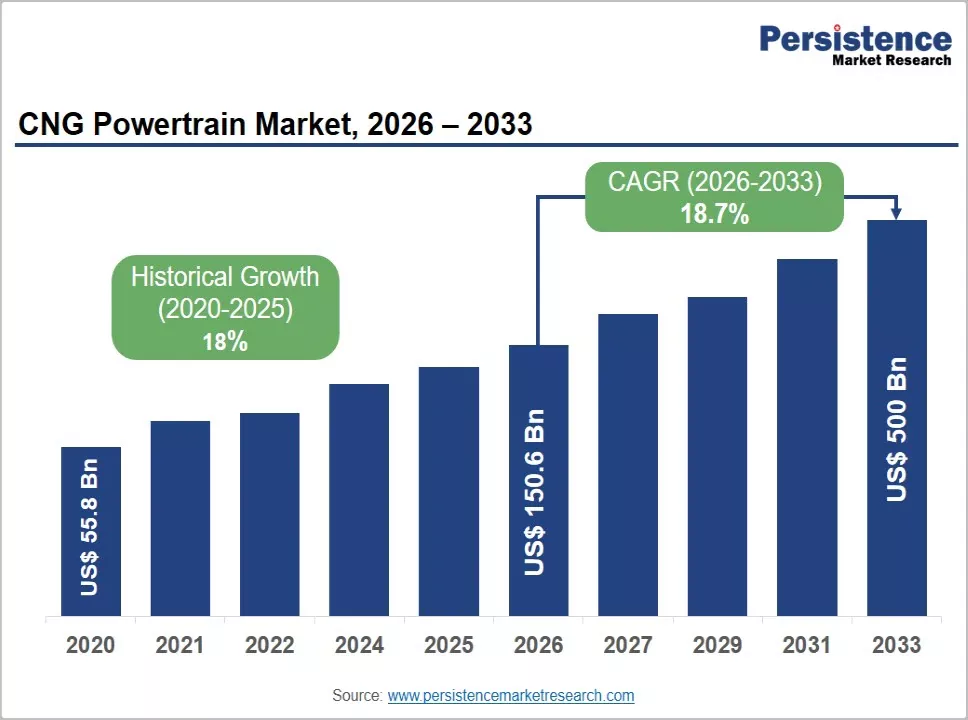
The global CNG powertrain market size is likely to be valued at US$ 150.6 billion in 2026 and is projected to reach US$ 500 billion by 2033, growing at a CAGR of 18.7% during the forecast period between 2026 and 2033. The CNG powertrain market is one of the fastest-scaling segments of the alternative-fuel automotive industry, and growth is now being driven by running-cost economics rather than by subsidy alone.
The forecast period moves the story from small cars to the full vehicle spectrum: factory-fitted underbody tanks, automatic transmissions, and 15-litre heavy-duty natural gas engines are removing the boot-space, convenience, and range compromises that once limited adoption. Powertrain suppliers and vehicle manufacturers should read this as a durable, volume-led category in which tank packaging, engine calibration, and access to fuel infrastructure decide who captures value while electric adoption stays uneven across price segments and duty cycles.
Key Industry Highlights
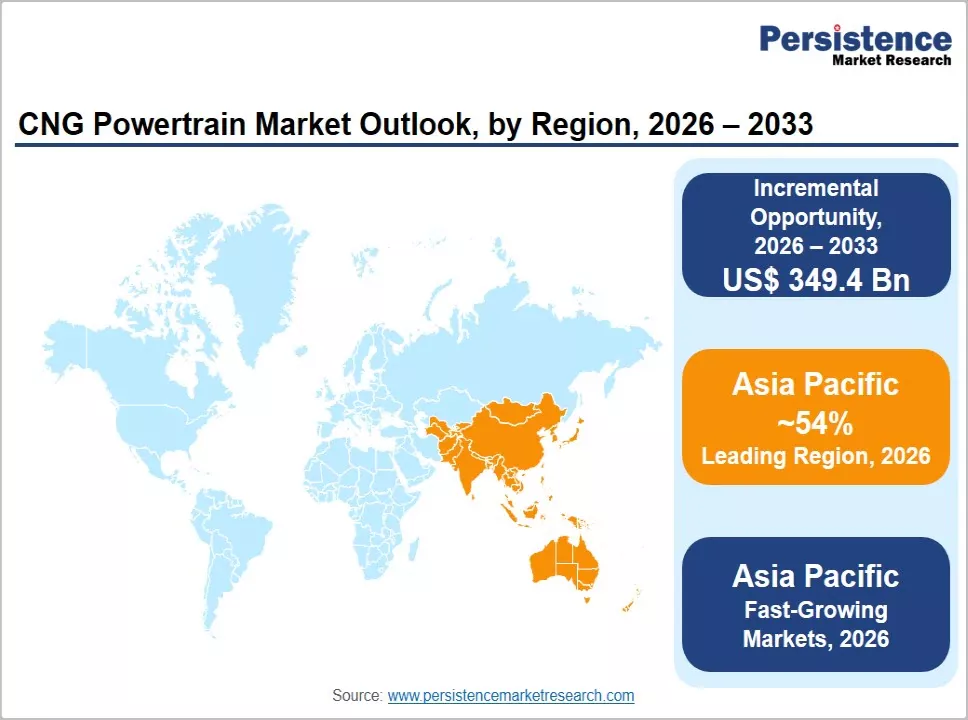
- Dominant Region: Asia Pacific holds 54% of the global market in 2026, supported by the large CNG fleets of India and China, strong policy backing for natural gas as a transport fuel, and the shift of mass-market car buyers towards CNG variants. Regional manufacturers set the pace on cost, which in turn shapes global product design.
- Fastest-growing Region: Asia Pacific is also projected to expand at an estimated 20.6% CAGR through 2033, led by India, where CNG's share of passenger vehicle sales rose from 26% in August 2025 to 32% in August 2026. City gas distribution expansion and rising fuel costs underpin the momentum.
- Leading Fuel Type: Bi-fuel engines command about 61% of 2026 revenue, as the ability to switch to petrol removes range anxiety where CNG stations remain sparse. Maruti Suzuki India Ltd and Hyundai Motor Company anchor this segment through factory-fitted CNG variants.
- Fastest-growing Application and Emerging Opportunity: Commercial vehicles are the fastest-growing application as fleets adopt dedicated natural gas engines such as the Cummins X15N for long-haul work. Renewable natural gas (RNG) compatibility gives operators a credible low-carbon pathway without waiting for charging infrastructure.
DRO Analysis
Driver- Fuel-Cost Savings, Emission Rules, and Factory-Fitted CNG Convenience
Running costs remain the strongest purchase argument for CNG. Maruti Suzuki India Ltd reports that CNG now makes up about 43% of its portfolio sales and expects it to remain the largest contributor to its green-vehicle volumes, with S-CNG sales up 58% year on year in the first quarter of FY2026-27 and a record 83,000 units in July 2026. Product convenience is improving in parallel, with underbody tanks that preserve boot space and automatic transmissions that widen the buyer pool. In heavy-duty trucking, tighter NOx limits favor modern natural gas engines that reach near-zero emission levels with simple aftertreatment.
Restraint- Limited Fueling Infrastructure and Competition from Battery-Electric Vehicles
CNG adoption is uneven because station density outside a few countries remains low, and fleets in many regions cannot guarantee fuel availability along long routes. Compressed natural gas tanks also add weight and cost, and heavy-duty buyers face a higher upfront price than for diesel. Battery-electric vehicles continue to attract policy support and manufacturer investment, particularly in Europe and China, which narrows the long-term policy runway for gas. Natural gas price volatility, as seen during recent supply disruptions, can erode the running-cost advantage that underpins demand.
Opportunity- Heavy-Duty Natural Gas, Renewable Natural Gas, and Hydrogen-Ready Systems
Heavy-duty applications offer the largest white space. Cummins Clean Fuel Technologies introduced a Type 4 CNG tank to cut weight and improve efficiency for Class 6 to 8 trucks, while Westport Fuel Systems and Cespira, its joint venture with the Volvo Group, are pairing high-pressure CNG storage with the HPDI fuel system to approach diesel-like efficiency. Because these systems can run on renewable natural gas and are designed with future hydrogen use in mind, they offer fleets a staged decarbonization path. Clean Energy Fuels is meanwhile extending its CNG network across Western Canada for long-haul fleets using the Cummins X15N.
Category-wise Analysis
Why Does Front Wheel Drive Hold the Largest Share of the Global CNG Powertrain Market?
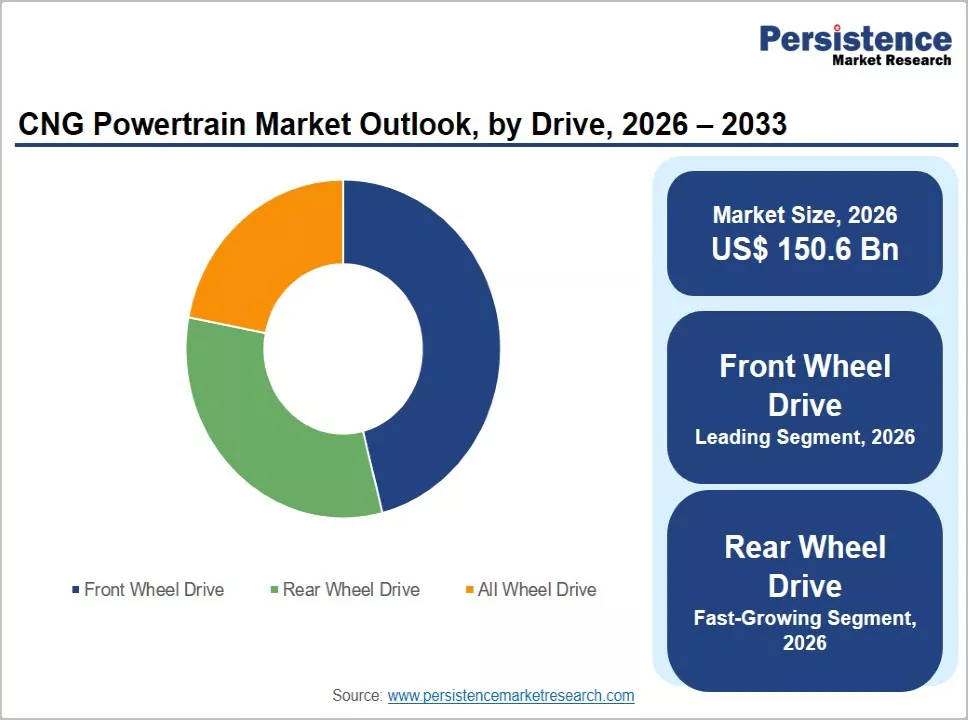
Front wheel drive is projected to lead the segment, accounting for nearly 46% of market share in 2026. The architecture dominates compact hatchbacks, sedans, and entry-level SUVs, the vehicle types in which CNG conversion economics are most compelling. Maruti Suzuki India Ltd has built its CNG range around such models, including the Swift, Dzire, Baleno, and Brezza, and it reports that more than half of Victoris sales come from the underbody CNG variant. Manufacturers also favor front-drive platforms because tank placement and packaging are well understood and can be standardized across high-volume lines.
Rear wheel drive is likely to be the fastest-growing segment, propelled by the adoption of natural gas in medium and heavy commercial vehicles that use rear-drive layouts. Engines such as the Cummins X15N and the Volvo-Westport HPDI system target trucks and tractors hauling heavy loads over long distances. Growth in refuse, regional-haul, and vocational fleets is expected to lift rear-drive volumes faster than the overall market, while all-wheel drive remains a smaller segment tied to SUVs and light trucks.
Fuel Type Insights
What Is Driving Bi-Fuel Engine Dominance Across the CNG Powertrain Industry?
Bi-fuel engines are expected to lead the segment, holding about 61% of market share in 2026. Vehicles that carry both a CNG tank and a petrol tank can fall back on petrol when gas stations are scarce, which makes them the practical choice for private buyers and mixed-route fleets. Maruti Suzuki India Ltd and Hyundai Motor Company rely on this approach for passenger models, and Hyundai Motor India reported that CNG accounted for 13.2% of its domestic sales in FY2025, up from 11.4% a year earlier.
Mono fuel engines are likely to be the fastest-growing segment, driven by dedicated heavy-duty platforms that are optimized purely for gas. Without the compromise of a dual-fuel compression ratio, dedicated engines achieve better efficiency and meet near-zero NOx targets, and manufacturers such as Cummins Inc., AB Volvo, and FPT Industrial are investing in them for long-haul, refuse, and bus applications.
Application Insights
Why Do Passenger Vehicles Command a Majority of the Global CNG Powertrain Market?
Passenger vehicles are projected to lead the segment, holding nearly 68% of market share in 2026. Taxi and ride-hailing fleets, cost-conscious urban households, and entry-level buyers drive volumes, and automakers have responded with broader model coverage. In India, CNG-powered passenger vehicles crossed the 10 lakh annual sales milestone in FY2026, accounting for nearly 22% of domestic passenger vehicle sales and making CNG the country's second-largest fuel choice.
Commercial vehicles are likely to be the fastest-growing segment as operators seek lower fuel cost per kilometer and lower local emissions without changing duty cycles. The launch of the Cummins X15N, a 15-litre natural gas engine, has closed much of the performance gap for heavy loads, and truck makers such as AB Volvo now offer natural gas options, including the VNL 300 with the Cummins ISX12N engine. Availability of RNG supports fleets with corporate emissions targets.
Regional Insights
Asia Pacific CNG Powertrain Market Trends and Insights
Asia Pacific is forecast to dominate the regional market, accounting for around 54% of the CNG powertrain market share in 2026 and expanding at an estimated 20.6% CAGR through 2033. Large city gas networks, government support for cleaner fuels, and the price sensitivity of mass-market buyers all favor CNG. Local manufacturers are scaling factory-fitted systems, while multinational firms are adding gas variants to protect volume in cost-driven segments.
China CNG Powertrain Market Size
China is projected to hold 38% of the Asia Pacific regional market in 2026. The country has a large installed base of natural gas buses, taxis, and trucks, and local engine makers supply dedicated gas engines at competitive prices. Competition from electric vehicles in urban fleets is capping passenger growth, but heavy-duty gas adoption remains active.
India CNG Powertrain Market Size
India is expected to account for around 27% of the Asia Pacific regional market in 2026. Passenger CNG sales are growing quickly as city gas networks expand, with CNG's share of passenger vehicle sales reaching 32% in August 2026. Maruti Suzuki India Ltd targets about 9 lakh CNG vehicle sales in FY2026-27, and its September 2026 launch of automatic S-CNG models is extending the technology to buyers who prefer automatic transmissions.
North America CNG Powertrain Market Trends and Insights
North America is anticipated to command around 17% of the CNG powertrain market in 2026. Demand is concentrated in heavy-duty trucks, refuse vehicles, and transit fleets, supported by abundant domestic natural gas and low-carbon fuel credits for renewable natural gas. Product activity is strong, with new engines, lightweight tanks, and fueling expansion all arriving at the same time.
U.S. CNG Powertrain Market Size
The U.S. is estimated to hold around 88% of the North America regional market in 2026. Fleets in refuse, regional haul, and drayage run the bulk of CNG vehicles, and the Cummins X15N and ISX12N engines are offered across leading truck brands. RNG credits and tightening heavy-duty NOx rules shape purchasing decisions.
Canada CNG Powertrain Market Size
Canada is expected to account for over 12% of the North America regional market in 2026. Clean Energy Fuels is expanding its CNG network in Western Canada as trucking, refuse, and oilfield fleets add natural gas trucks, and federal clean fuel regulations create value for renewable gas used in transport.
Europe CNG Powertrain Market Trends and Insights
Europe is projected to account for about 15% of the CNG powertrain market in 2026. Biomethane availability, fuel-tax treatment, and stringent CO2 targets support gas in heavy-duty and municipal fleets, but passenger car adoption is limited by the strategic focus on electrification. The region's emphasis on bio-CNG gives natural gas a credible carbon story.
Germany CNG Powertrain Market Size
Germany is projected to account for around 24% of the Europe regional market in 2026. A well-developed station network and strong engineering base support CNG in commercial vans, buses, and trucks, while demand for passenger CNG models has softened as electric offerings expand. Biomethane supply remains important for fleet economics.
U.K. CNG Powertrain Market Size
The U.K. is estimated to account for nearly 12% of the Europe regional market in 2026. Logistics and retail fleets running biomethane trucks, supported by renewable fuel obligation credits, form the core of demand, while passenger CNG use remains minimal.
Competitive Landscape
The global CNG powertrain market is moderately consolidated, with engine specialists and automotive groups competing across passenger and commercial applications. Cummins Inc., AB Volvo, Robert Bosch GmbH, and FPT Industrial lead in engines, fuel systems, and components for commercial vehicles, while Maruti Suzuki India Ltd, Hyundai Motor Company, Honda Motor Company, Volkswagen AG, Ford Motor Company, Nissan Motor Co. Ltd, and Fiat Chrysler Automobiles (now part of Stellantis) compete in factory-fitted passenger and light commercial models. Competitive intensity is rising as automatic transmissions, underbody tanks, and high-pressure storage lift product appeal, and as heavy-duty gas engines come closer to diesel efficiency. Winning requires fuel-system integration, strong access to refueling infrastructure partners, and credible RNG and hydrogen-ready roadmaps.
Key Industry Developments
- In November 2026, Kia India announced that the Kia Carens Clavis CNG and Kia Carens CNG had collectively crossed 6,200 wholesale units since their launch in September 2026, reflecting growing customer acceptance of factory-fitted CNG vehicles. Both three-row MPVs feature a 1.5-litre naturally aspirated petrol engine, a 60-litre CNG tank, and a six-speed manual transmission. The company also offered an assured residual value of up to 75% after three years under its Assured Buyback Program, subject to applicable terms and conditions.
- In October 2026, Mahindra & Mahindra announced the upcoming debut of the XUV 3XO CNG compact SUV on October 15, expanding its powertrain portfolio beyond petrol, diesel, and electric variants. The CNG model was expected to feature a factory-fitted CNG kit paired with a 1.2-litre MPFI turbo-petrol engine producing 111 hp. The launch marked Mahindra entry into the factory-fitted CNG passenger vehicle segment and strengthened its presence in the growing compact SUV market.
Companies Covered in CNG Powertrain Market
- AB Volvo
- Cummins Inc.
- Fiat Chrysler Automobiles
- FPT Industrial
- Ford Motor Company
- Honda Motor Company
- Hyundai Motor Company
- Maruti Suzuki India Ltd
- Nissan Motor Co. Ltd
- Robert Bosch GmbH
- Volkswagen AG
Frequently Asked Questions
The global CNG powertrain market is valued at US$ 150.6 billion in 2026.
Lower running costs than petrol and diesel, tighter emission rules, factory-fitted underbody tanks and automatic transmissions, and heavy-duty natural gas engines with renewable natural gas compatibility, partly offset by limited fueling infrastructure and competition from electric vehicles.
Bi-fuel engines hold around 61% of the market. The ability to run on petrol when CNG stations are unavailable removes range anxiety and makes these vehicles the default choice for private buyers and mixed-route fleets.
Asia Pacific leads with a 54% share in 2026, driven by large city gas networks in India and China, supportive fuel policy, and price-sensitive buyers who favor low running costs.
The largest opportunities lie in heavy-duty natural gas engines and lightweight high-pressure tanks, renewable natural gas supply, hydrogen-ready fuel systems, and automatic CNG models that widen passenger appeal.


