




- Specialty & Fine Chemicals
- Drinking Water and Wastewater Treatment Systems Market
Drinking Water and Wastewater Treatment Systems Market Size, Share, and Growth Forecast 2026 - 2033
Drinking Water and Wastewater Treatment Systems Market by Installation (Point-of-Use, Point-of-Entry), Technology (Reverse Osmosis Systems, Distillation Systems, Disinfection Methods), Application (Residential, Commercial), and Regional Analysis, 2026 - 2033

Drinking Water and Wastewater Treatment Systems Market Size and Trends Analysis
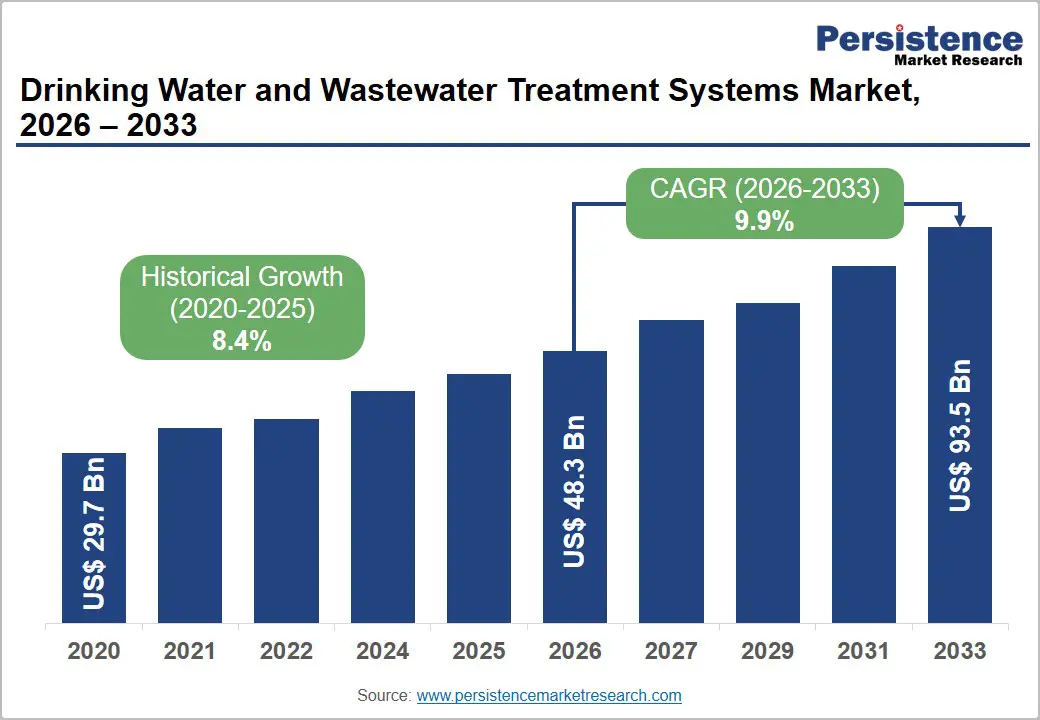
The global drinking water and wastewater treatment systems market size is likely to be valued at US$48.3 billion in 2026 and is estimated to reach US$93.5 billion by 2033, growing at a CAGR of 9.9% during the forecast period from 2026 to 2033, driven by rising water scarcity and increasing pressure on freshwater resources across urban and industrial regions. Growth is further supported by stringent government regulations on wastewater discharge and surging adoption of water reuse as well as recycling practices.
Key Industry Highlights:
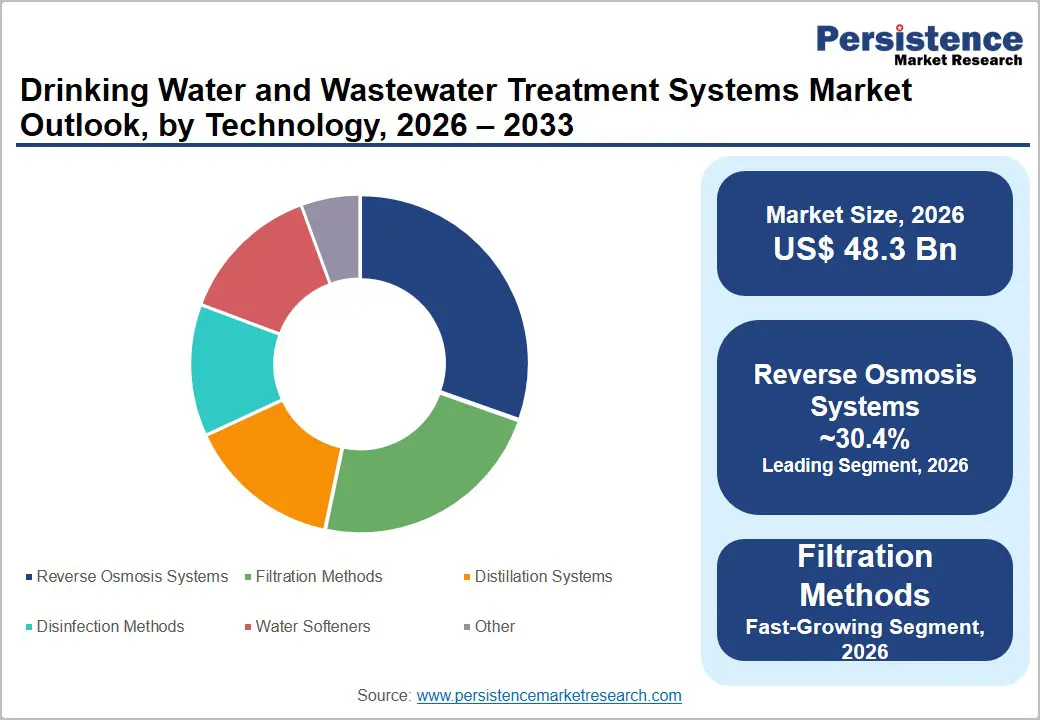
- Leading Technology: Reverse osmosis systems, approximately 30.4% share in 2026, as they can remove dissolved salts, heavy metals, and emerging contaminants in a single-step process.
- Dominant Application: Industrial, with a nearly 45.8% share in 2026, as semiconductors, power, and chemicals sectors require high-purity water and large-scale recycling.
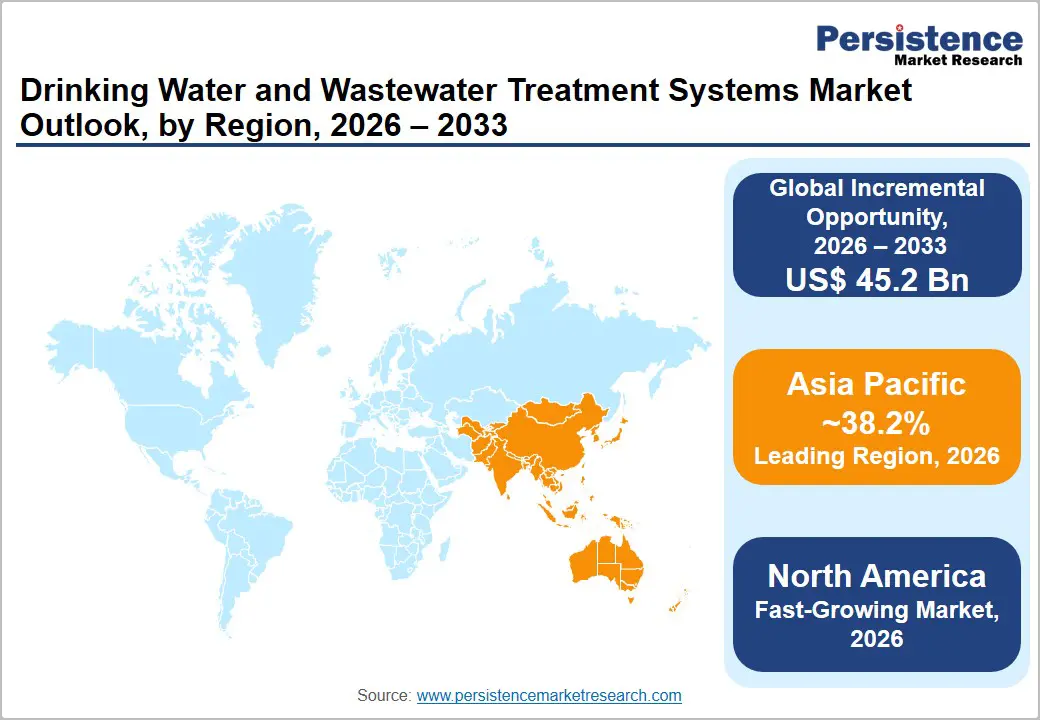
- Leading Region: Asia Pacific, with about a 38.2% share in 2026, backed by large untreated water volumes and government-led infrastructure expansion programs.
- Fast-growing Region: North America, owing to aging infrastructure upgrades and strict regulations on contaminants such as PFAS.
- Recent Acquisition: In August 2025, Ecolab entered into a definitive agreement to acquire Ovivo's Electronics business for approximately US$1.8 billion in cash. The acquisition combined Ovivo's ultrapure water technologies for semiconductor manufacturing with Ecolab's water management and digital monitoring capabilities.
DRO Analysis
Driver - Shrinking Freshwater Availability Globally
Freshwater is becoming very difficult to access, and faster than most projections anticipated. According to the Food and Agriculture Organization's (FAO) 2025 AQUASTAT Water Data Snapshot, renewable water availability per person has declined by a further 7% over the past decade, with pressure on freshwater resources surging as demand increases in regions already facing scarcity.
A November 2025 Global Water Monitoring Report released by the World Bank found that the world is losing 324 billion cubic meters of freshwater every year. It is enough to meet the annual needs of 280 million people. This is propelled by worsening droughts and unsustainable land and water practices. As natural freshwater reserves diminish, the need for treatment technologies that can convert impaired or alternative water sources into usable supply is becoming urgent across governments and industries.
Rising Public Funding for Water Security Infrastructure
Governments are constantly financing water treatment expansion as a matter of national security. In April 2024, the U.S. Department of Energy (DOE) announced US$75 million in renewed funding for the National Alliance for Water Innovation (NAWI) over five years, specifically to reduce the cost and energy use of desalination and water purification technologies.
At the project level, the U.S. Bureau of Reclamation awarded US$223 million to 18 water recycling and desalination projects. It targets the production of over 305,000 acre-feet of recycled water annually, including a new Advanced Water Purification (AWP) facility in Phoenix, Arizona. These dedicated funding streams are swiftly commissioning new treatment infrastructure at scale.
Restraint - Hazardous Byproducts from the Treatment Process
Water treatment plants generate residual waste that is difficult and costly to manage. Desalination facilities relying on Reverse Osmosis (RO) produce reject brine, which is a concentrated and chemical-laden byproduct. Reject brine contains high levels of salts and other potentially harmful compounds, which, when discharged into oceans or on land, can disrupt habitats, degrade soil quality, and harm biodiversity. Wastewater plants face a parallel challenge with sludge carrying heavy metals and organic contaminants.
Several disposal methods are in use today, but they are widely considered unsustainable. Brine treatment and valorization through minimal and zero liquid discharge (MLD and ZLD) desalination systems are being explored as a more viable strategy, though commercial extensibility remains limited. Until cost-effective disposal solutions are standardized, byproduct management will likely remain a key operational barrier for treatment facilities worldwide.
Opportunity - High-Efficiency Membrane Technologies for Ultra-Pure Water Production
Membrane-based systems have become the go-to technology for producing water that meets the strictest quality standards. Membrane Bioreactor (MBR) technology, in particular, has shown high performance across contaminant classes. A 2022 study published in the Journal of Environmental Management found that MBRs achieved removal rates of over 99% for total suspended solids and over 91% for chemical oxygen demand, with microcontaminant removal efficiencies reaching up to 99.7%.
When MBR is paired with Reverse Osmosis (RO) as a post-treatment step, performance improves further. An integrated MBR-RO system achieved below-detection-limit results for 20 out of 27 measured pharmaceutical and personal care product compounds in municipal wastewater. This combination is increasingly being adopted in advanced water reuse projects.
Elimination of Persistent Pollutants through Oxidation-Based Treatment
Conventional treatment plants are not designed to remove pharmaceutical residues, microplastics, or other persistent micropollutants. Advanced Oxidation Processes (AOPs) address this gap by generating highly reactive free radicals that chemically break these compounds down. AOP methods such as photocatalysis, electrochemical oxidation, and ozonation have shown promising results in removing pharmaceuticals, personal care products, pesticides, and microplastics from water.
Unlike conventional methods that simply transfer microplastics from one phase to another, AOPs can mineralize them entirely into harmless carbon dioxide (CO2) and water. A 2024 review in Environmental Science and Pollution Research noted that combining ozonation with ultraviolet (UV) irradiation, hydrogen peroxide (H2O2), and biological treatments further improves pollutant breakdown and refines the treatability of complex wastewater streams.
Category-wise Analysis
Technology Insights
Reverse Osmosis (RO) systems are predicted to lead with a share of approximately 30.4% in 2026 as they can remove dissolved salts, heavy metals, bacteria, and even emerging contaminants such as polyfluoroalkyl substances (PFAS) in a single process. Most other technologies cannot achieve this level of purity without multiple steps. This makes RO suitable for drinking water, desalination, and high-end industrial use. Another factor is cost improvement. Over the last decade, membrane efficiency has improved significantly. Energy use in modern RO plants has dropped to around 3 to 4 kWh per cubic meter, compared to much higher levels earlier. This makes RO economically viable for both cities and industries.
Filtration methods are estimated to be the fastest-growing segment over the forecast period, as they are simple, modular, and cost-effective. Unlike RO, filtration does not always require high pressure or complex systems. This makes it suitable for both small-scale and large-scale use. One key growth driver is the rise of point-of-use and decentralized treatment systems. For example, ultrafiltration units are now widely used in rural water programs in India under the Jal Jeevan Mission. These systems are easier to install and maintain than RO.
Application Insights
The industrial segment is anticipated to dominate with a share of nearly 45.8% in 2026, as industries require large volumes of treated water and strict quality control. Various sectors cannot operate without high-purity water. For instance, semiconductor manufacturing is extremely water-intensive. According to the Taiwan Semiconductor Manufacturing Company sustainability reports, a single advanced fab can consume over 150,000 tons of water per day. This water must be ultra-pure, which requires advanced treatment systems such as RO and ion exchange.
The commercial segment is expected to remain in the second position in 2026, owing to rising health awareness, urbanization, and service-sector expansion. Hotels, hospitals, malls, and offices now require consistent water quality for both safety and customer experience. Hospitals are a prominent driver. The World Health Organization (WHO) states that safe water is critical in healthcare to prevent infections. This has led to increased adoption of advanced filtration and RO systems in healthcare facilities. The hospitality sector is also investing heavily. Multiple global hotel chains now install on-site water treatment systems to reduce dependence on bottled water.
Regional Insights
Asia Pacific Drinking Water and Wastewater Treatment Systems Market Trends
Asia Pacific is anticipated to lead in 2026 with a share of nearly 38.2%, as it combines high population pressure, water scarcity, and rising government spending. Several countries in the region are building new water infrastructure instead of upgrading old systems, which increases demand. China and India alone account for a large share of global water stress. According to the World Bank, over 80% of wastewater in developing Asia Pacific is discharged untreated. This gap is pushing large investments in treatment systems.
China Drinking Water and Wastewater Treatment Systems Market Trends
China will likely lead in Asia Pacific in 2026 with a share of around 43.7%, owing to strict environmental enforcement and industrial upgrades. Under its Water Ten Plan, the country has mandated wastewater treatment and reuse across industries. The Ministry of Ecology and Environment has pushed cities to achieve near-complete wastewater treatment coverage. Various key cities now treat over 95% of municipal wastewater. Industrial reuse is a prominent trend. In northern China, water reuse rates have crossed 25 to 30% in some regions, especially in water-scarce provinces such as Hebei. This is pushing demand for unique membrane and recycling systems.
India Drinking Water and Wastewater Treatment Systems Market Trends
In 2026, India is projected to account for a share of approximately 29.3%, fueled by infrastructure gaps and a strong policy push. A large part of the population still depends on untreated or partially treated water, which creates immediate demand. Government programs are the most prominent driver. The Namami Gange Program has led to the construction of dozens of sewage treatment plants along the Ganga. Many of these projects use hybrid technologies such as RO and biological treatment. Water reuse is further rising in cities. Chennai and Bengaluru now require large buildings to install sewage treatment plants. In some industrial clusters, companies recycle 80 to 90% of water, mainly due to scarcity.
North America Drinking Water and Wastewater Treatment Systems Market Trends
North America is predicted to be the fastest-growing market in 2026 with a share of approximately 27.4%, due to the aging infrastructure and new contamination concerns. Much of the water infrastructure in the U.S. was built decades ago and now requires replacement. The U.S. Environmental Protection Agency (EPA) estimates that the country needs hundreds of billions of dollars in water infrastructure upgrades over the coming decades. This includes pipes, treatment plants, and advanced filtration systems.
U.S. Drinking Water and Wastewater Treatment Systems Market Trends
A share of nearly 60.4% is expected to be held by the U.S. in 2026, as the country is witnessing technology-driven growth rather than basic infrastructure expansion. One key trend is digital water management. Companies are deploying sensors and AI to monitor water quality and reduce leaks. According to the American Water Works Association, utilities are now investing in smart systems to improve efficiency. Another prominent area is water reuse. States such as California are extending potable reuse projects. In 2023, California approved new rules to allow direct potable reuse, which is a leading step forward.
Europe Drinking Water and Wastewater Treatment Systems Market Trends
Europe will likely see decent growth over the forecast period, with a share of nearly 18.6% in 2026, as it already has high treatment coverage but continues to upgrade systems to meet strict standards. The European Commission has introduced tight wastewater regulations under the revised Urban Wastewater Treatment Directive. These rules focus on removing micropollutants such as pharmaceuticals and microplastics. Sustainability goals are also augmenting upgrades. Several countries are investing in energy-efficient treatment and sludge recovery systems. Circular water use is becoming a priority.
Germany Drinking Water and Wastewater Treatment Systems Market Trends
Germany will likely register a substantial share of approximately 36.6% in 2026, owing to its advanced infrastructure and focus on innovation. It already treats almost all municipal wastewater, but is now investing in next-generation treatment. The Federal Environment Agency reports that the country is focusing on removing trace pollutants such as pharmaceuticals. Pilot projects using advanced oxidation and activated carbon are being expanded. Germany is also strong in industrial water reuse. Multiple chemical and manufacturing companies recycle water internally to reduce costs and meet sustainability targets.
U.K. Drinking Water and Wastewater Treatment Systems Market Trends
A share of around 28.3% is predicted to be held by the U.K. in 2026, spurred by regulatory pressure and environmental concerns, especially around river pollution. The Environment Agency has tightened rules on sewage discharge into rivers. Water companies are now required to upgrade treatment plants and reduce overflow events. A key issue is combined sewer overflows (CSOs). Public pressure has increased after reports of untreated sewage being released into rivers. This has pushed utilities to invest in new treatment and monitoring systems.
Competitive Landscape
The global drinking water and wastewater treatment systems market is moderately consolidated with a handful of multinational companies controlling large portions of municipal and industrial projects. Leading players such as Veolia, Xylem, Ecolab, Pentair, Kurita Water Industries, and Solenis compete on technology portfolios, digital monitoring capabilities, water reuse expertise, and long-term service contracts rather than on equipment pricing alone.
Competition is now shifting toward advanced treatment technologies such as PFAS removal, membrane filtration, desalination, ultrapure water production, and industrial water recycling. Companies that can help industries reduce freshwater consumption and meet strict environmental regulations are gaining a competitive edge. Demand from semiconductor manufacturing, data centers, pharmaceuticals, and power generation is creating new growth opportunities for technology-focused suppliers.
Key Industry Developments:
- In May 2026, BioLargo and Aquatech signed a memorandum of understanding to collaborate on the commercialization of PFAS treatment technologies. The partnership aims to combine BioLargo's Aqueous Electrostatic Concentrator (AEC) technology with Aquatech's global water treatment expertise to address high demand for PFAS removal solutions in municipal, industrial, and government water treatment projects.
- In April 2026, Veolia announced plans to increase annual revenue from data center and semiconductor customers to approximately €1 billion (US$1.1 billion) by 2030. The company highlighted that rising demand for water management, cooling water treatment, wastewater recycling, and hazardous waste services is being driven by AI infrastructure and advanced chip manufacturing facilities worldwide.
- In December 2025, Ovivo announced the successful divestiture of its Electronics division to Ecolab and launched a new growth strategy focused on municipal water, industrial wastewater, energy, PFAS treatment, and membrane technologies. The company stated that the transaction would allow increased investments in emerging water treatment applications and environmental remediation technologies.
Companies Covered in Drinking Water and Wastewater Treatment Systems Market
- Veolia
- SUEZ
- Xylem Inc.
- Ecolab (Nalco Water)
- Honeywell International Inc.
- Pentair plc
- Kurita Water Industries
- Danaher Corporation (Trojan Technologies/ChemTreat)
- DuPont Water Solutions
- Aquatech International
- Kemira Oyj
- VA Tech WABAG
- Solenis
- Thermax Limited
- Acciona Agua
- IDE Technologies
Frequently Asked Questions
The global drinking water and wastewater treatment systems market is projected to be valued at US$48.3 billion in 2026.
The drinking water and wastewater treatment systems market is expected to reach US$93.5 billion by 2033.
Key market trends include rising water reuse and adoption of digital monitoring systems.
Reverse osmosis systems are expected to be the leading technology with a share of nearly 30.4% in 2026, owing to improved membrane efficiency.
The drinking water and wastewater treatment systems market is expected to grow at a CAGR of 9.9% from 2026 to 2033.
Veolia, SUEZ, and Xylem Inc. are a few key market players.


