




- Animal Feed & Additives
- Crop Oil Concentrate Market
Crop Oil Concentrate Market Size, Share, and Growth Forecast, 2026 - 2033
Crop Oil Concentrate Market by Application (Herbicides, Fungicides, Insecticides, Others), Surfactant Concentration (Less than 15%, Between 15% to 25%, Greater than 25%), Crop Type (Cereals & Grains, Fruits & Vegetables, Oilseeds & Pulses, Others), and Regional Analysis for 2026 - 2033

Crop Oil Concentrate Market Share and Trends Analysis
The global crop oil concentrate market size is likely to be valued at US$242.1 million in 2026, and is estimated to reach US$301.8 million by 2033, growing at a CAGR of 3.2% during the forecast period 2026 - 2033, driven by the need to enhance the effectiveness of herbicides, fungicides, and insecticides, increasing emphasis on reducing chemical application rates, and the expansion of high-value crop cultivation.
The market recorded modest growth during the historical period amid weather-related uncertainties, fluctuations in commodity prices, and cautious farm spending. Over the forecast period, growth is expected to become more consistent as growers increasingly adopt precision application practices and seek cost-effective solutions to improve crop protection efficiency.
Key Industry Highlights:
- Dominant Application: Herbicides are set to command around 58% of the revenue share in 2026, while fungicides are likely to grow the fastest at about 3.9% CAGR through 2033, as disease pressure and demand for high-value crop protection increase.
- Leading Surfactant Concentration: The 15% to 25% concentration category is expected to lead with 49% in 2026, while concentrations greater than 25% are likely to be the fastest-growing at about 4.2% CAGR during 2026 - 2033, reflecting demand for higher-performance adjuvants.
- Dominant Crop Type: Cereals and grains are anticipated to lead with an estimated 46% share in 2026, while fruits and vegetables are slated to represent the fastest-growing crop segment at about 4.0% CAGR from 2026 to 2033.
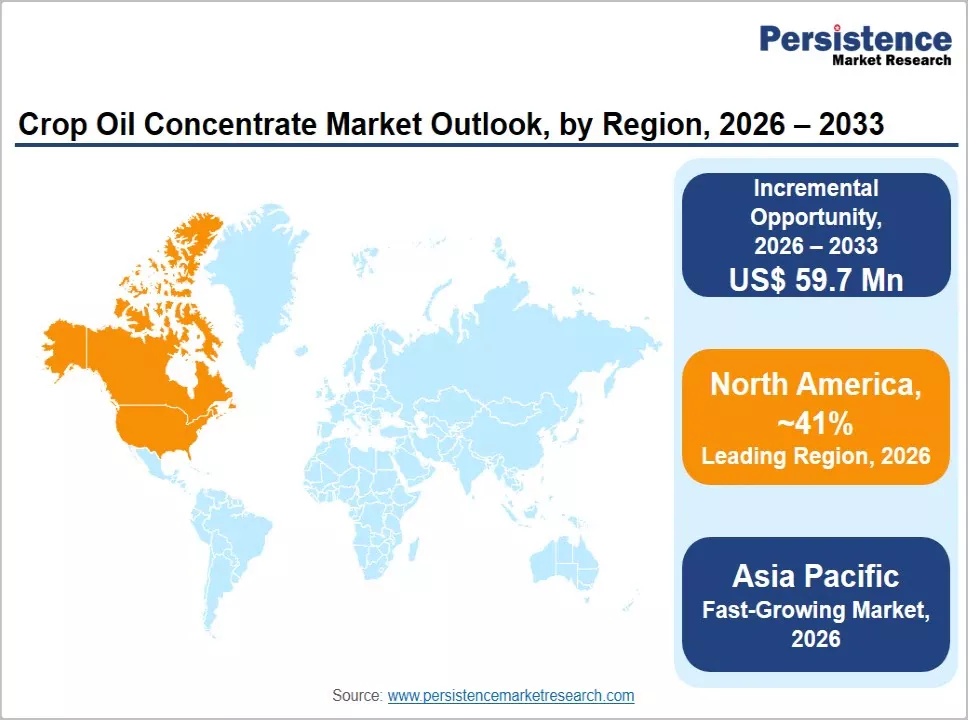
- Regional Leadership: North America is poised to dominate with an estimated 41% share in 2026, while Asia Pacific is expected to register the fastest growth at a 4.3% CAGR through 2033, led by modernization of farming practices in India, China, and Southeast Asian nations.
- Competitive Environment: Competitive dynamics include formulation innovation, bundling of adjuvants with crop protection products, and strategic distribution partnerships with agricultural retailers and cooperatives.
DRO Analysis
Driver: Need for Improved Pesticide Efficacy and Cost-effective Crop Protection as Primary Growth Catalyst
The need to improve pesticide efficacy is the leading force driving the crop oil concentrate market growth, as growers seek to maximize the performance of expensive herbicides, fungicides, and insecticides. Crop oil concentrates, which are typically blends of petroleum or vegetable oil with surfactants, enhance spray coverage, wetting, and penetration of the leaf cuticle, helping active ingredients enter the plant more effectively. This is particularly valuable under hot, dry, or windy conditions, or on weeds with waxy leaf surfaces, where uptake of active ingredients is otherwise limited.
Rising pressure on input costs and increasing herbicide resistance further support adjuvant use. By improving the performance of a given dose, crop oil concentrates can help maintain control levels without raising chemical rates, offering a cost-effective management tool. Extension services and agronomists often recommend specific adjuvants for particular products and crops, and label requirements for many herbicides explicitly call for a crop oil concentrate or similar adjuvant. These factors ensure steady use across major cropping systems and support gradual market growth.
Restraints: Regulatory Restrictions and Competition from Alternative Adjuvants
Regulatory restrictions have become a major challenge for the crop oil concentrate market. Authorities are increasing scrutiny of pesticide adjuvants, with requirements on ingredient disclosure, environmental fate, and potential effects on non-target organisms. In some regions, restrictions on petroleum-based components, drift, and runoff risk are tightening, and varying rules across countries complicate product registration and marketing. Compliance costs for testing and documentation can be high, particularly for smaller formulators.
Competition from alternative adjuvants adds pressure. Methylated seed oils, nonionic surfactants, organosilicones, and ammonium-based water conditioners often compete with or are combined alongside crop oil concentrate, depending on the herbicide, crop, and weather conditions. Variability in crop oil quality, concerns about crop injury under certain temperatures, and limited awareness among growers in some developing regions restrict adoption. Fluctuations in crude oil and vegetable oil prices can also affect production costs and margins.
Opportunities: Precision Agriculture, Bio-based Formulations, and Emerging Market Adoption
The adoption of precision agriculture offers a significant opportunity, as growers use drones, variable-rate sprayers, and sensors to apply inputs more efficiently. Adjuvants that improve droplet spreading, retention, and absorption complement these technologies by ensuring that reduced application volumes deliver consistent efficacy. Suppliers that develop low-drift, high-performance formulations tailored for aerial and ultra-low-volume spraying are well positioned to benefit as digital farming practices expand across large farms and contract-spraying services.
Bio-based and renewable oil formulations are creating additional opportunities, supported by sustainability goals and regulatory interest in reducing reliance on petroleum-based inputs. Emerging markets in Asia Pacific, Latin America, and Africa, where mechanization and modern crop protection practices are expanding, represent underpenetrated demand. Education programs by distributors and manufacturers, together with bundled offerings combining crop protection chemicals and adjuvants, are expected to increase awareness and encourage broader use through 2033.
Category-wise Analysis
Application Insights
Herbicides are expected to lead, holding about 58% of the crop oil concentrate market revenue share in 2026. Many post-emergence herbicides, particularly those targeting grassy weeds in cereals, corn, soybeans, and other field crops, require an oil-based adjuvant to enhance penetration through waxy leaf surfaces. Growing weed resistance problems make it increasingly important to optimize herbicide uptake, and label recommendations frequently specify crop oil concentrates, supporting consistent use across large-acreage crops.
Fungicides are likely to grow the fastest through 2033, at a CAGR of approximately 3.9%. Rising disease pressure from changing weather patterns, higher-value crop protection programs for fruits, vegetables, and oilseeds, and greater use of systemic fungicides support the use of adjuvants that improve coverage and absorption. Insecticides and other applications, including plant growth regulators and foliar nutrients, contribute smaller but growing volumes, as growers use oil-based adjuvants to improve retention and rainfastness under challenging field conditions.
Surfactant Concentration Insights
The 15% to 25% surfactant concentration category is likely to dominate, capturing about 49% of the revenue share in 2026. These products strike a balance between oil content and surfactant action, offering reliable spreading and penetration across a range of herbicides and crops while limiting the risk of phytotoxicity. Widely recommended on pesticide labels, they are available through most agricultural retailers and are well known to growers and applicators, supporting strong, repeat demand.
Concentrations above 25% are expected to be the fastest-growing category, registering a CAGR of about 4.2% from 2026 to 2033. Higher surfactant concentrations enhance wetting, emulsification, and penetration, making these formulations suitable for difficult-to-control weeds, cooler conditions, and tank mixes involving challenging products. Formulators are developing premium, high-performance blends that balance improved efficacy with crop safety. Products containing less than 15% surfactant continue to serve cost-sensitive customers and applications requiring lower surfactant levels but face increasing competition from higher-performance formulations.
Crop Type Insights
Cereals and grains are poised to lead the crop type segment with an estimated 46% share in 2026, driven by the large planted area of wheat, corn, rice, barley, and sorghum. Post-emergence weed control programs in these crops commonly use herbicides that benefit from oil-based adjuvants, creating substantial and consistent volume demand. Large farms and professional applicators in major producing countries tend to adopt standardized spray programs that include adjuvants as a routine component.
Fruits and vegetables are expected to be the fastest-growing crop type segment, expanding at around 4.0% CAGR through 2033. High-value horticultural production relies on intensive crop protection programs to maintain yield and quality, and adjuvants help achieve uniform coverage on complex canopies and waxy surfaces. Oilseeds and pulses, including soybeans, canola, sunflower, and lentils, also represent important demand, supported by expanding acreage and the need for effective weed management in resistant-weed-prone systems.
Regional Insights
North America Crop Oil Concentrate Market Trends
North America is predicted to command an estimated 41% of the crop oil concentrate market share in 2026. The U.S. provides the regional growth anchor, supported by large-scale corn, soybean, wheat, and cotton production and widespread use of post-emergence herbicide programs. Agricultural retailers, cooperatives, and custom applicators are well established, and adjuvants are routinely bundled with herbicide recommendations. Growing weed resistance issues are encouraging producers to use adjuvants to maximize product performance and reduce the risk of control failures.
Canada shows steady demand, particularly in canola, wheat, and pulse production across the Prairie Provinces, where short growing seasons and variable weather increase the importance of reliable herbicide performance. The North America market is characterized by strong distribution networks, active agronomic support, and growing interest in low-drift and renewable oil-based adjuvants.
Europe Crop Oil Concentrate Market Trends
Europe is likely to hold 22% of the global market share in 2026. The region's use of adjuvants is shaped by strict pesticide regulations, including rules on active ingredient approvals and reductions in overall pesticide use under the European Union's Farm to Fork strategy. Adjuvant use is supported by the goal of maintaining efficacy at lower application rates, and oil-based adjuvants are used in cereals, oilseed rape, and sugar beet. France, Germany, the United Kingdom, and Poland are leading agricultural producers and consumers.
The Europe market is characterized by a growing preference for vegetable oil-based and biodegradable adjuvants, careful regulatory documentation, and attention to environmental impact. Regional rules on drift reduction and buffer zones encourage products that improve deposition and reduce losses. Eastern European countries, including Ukraine, Romania, and Hungary, are important cereal and oilseed producers, offering opportunities as farm modernization and professional spraying services expand.
Asia Pacific Crop Oil Concentrate Market Trends
Asia Pacific is anticipated to be the fastest-growing region in the crop oil concentrate market, commanding an estimated 20% in 2026 and projected to achieve a 4.3% CAGR through 2033. China is a large agrochemical producer and consumer, with growing use of adjuvants as farm sizes consolidate and professional spraying services expand. Australia is a well-established market for adjuvants, with extensive broadacre cropping and a strong tradition of using oil-based adjuvants to maximize herbicide efficacy in dry conditions.
India is expected to offer dynamic growth opportunities, as government support for modern farming practices, rising use of herbicides due to labor shortages, and expanding drone-based spraying increase demand for adjuvants. Southeast Asian nations, including Vietnam, Thailand, and Indonesia, are also experiencing growth in rice, palm, and horticulture production, supported by improving farmer education. The region attracts competition from multinational firms and local formulators focused on affordable products.
Competitive Landscape
The global crop oil concentrate market structure is moderately fragmented, with leading suppliers, including Wilbur-Ellis, Helena Agri-Enterprises, Corteva Agriscience, and Nufarm, holding a significant share of the revenue. These established players leverage extensive agricultural retail networks, strong relationships with growers, broad crop protection portfolios, and technical support. They invest in field trials, formulation research, and agronomic education to promote the proper use of adjuvants.
Meanwhile, regional and specialized competitors such as UPL, Loveland Products, Winfield United, Brandt, Precision Laboratories, and Croda International are focusing on specific crop systems, proprietary formulations, and local distribution strengths. Barriers such as product registration, regional regulatory compliance, and the importance of retailer relationships moderate new entry. Market consolidation is expected to continue gradually, as larger agricultural input companies acquire specialized adjuvant firms to broaden portfolios and strengthen geographic reach.
Key Industry Developments:
- In April 2026, Bharat Petroleum Corporation Limited launched MAK ADJOL AGRI UNIVERSAL, an agricultural adjuvant spray oil designed to improve crop-protection spray performance and pesticide efficiency. The launch expands the use of oil-based adjuvant technology in crop protection applications.
- In September 2026, Dhanuka Agritech launched Wetcit Neo, a spray adjuvant formulated with avocado oil, blackcurrant oil, and surfactants. The formulation is designed to reduce water surface tension and improve spray spreading, coverage, and penetration, supporting demand for multifunctional oil-based adjuvant formulations.
Companies Covered in Crop Oil Concentrate Market
- Wilbur-Ellis Company LLC
- Helena Agri-Enterprises, LLC
- Corteva Agriscience
- Nufarm Limited
- UPL Limited
- Loveland Products, Inc.
- Winfield United
- Brandt Consolidated, Inc.
- Precision Laboratories, LLC
- Croda International Plc
- Syngenta Group
Frequently Asked Questions
The global crop oil concentrate market is projected to reach US$242.1 million in 2026.
The need to improve the efficacy of herbicides, fungicides, and insecticides, rising herbicide resistance, and demand for cost-effective crop protection are driving the market.
The crop oil concentrate market is poised to witness a CAGR of 3.2% from 2026 to 2033.
Adoption of precision and drone-based spraying, development of bio-based oil formulations, and rising modernization of farming in emerging markets are key market opportunities.
Wilbur-Ellis Company LLC, Helena Agri-Enterprises, LLC, Corteva Agriscience, Nufarm Limited, and UPL Limited are some of the key players in the market.


